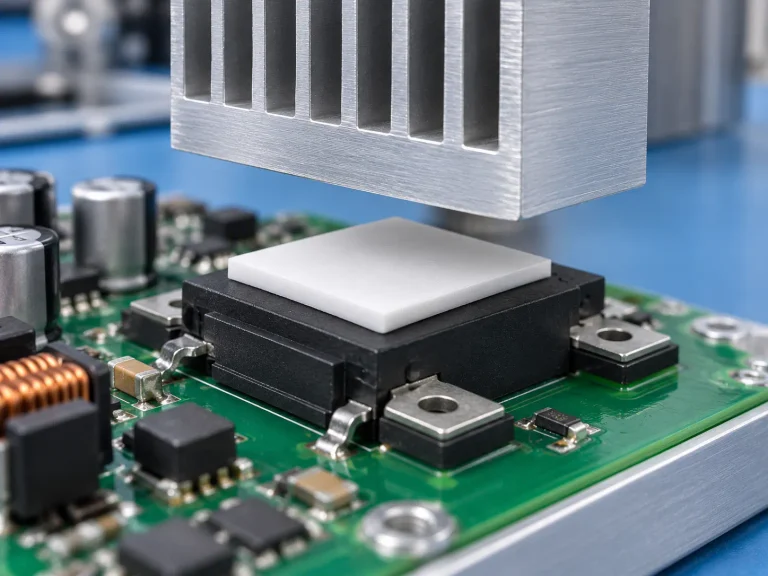
-
추가:: 둥관 헝주탕 로드 8호 빌딩 2, 동관
-
전화: 전화 +86 135 4224 3751

Boost Flight Time: Phase Change Heat Dissipation for Drone Motors
Heat is quietly choking drone performance, and phase-change heat dissipation for drone motors steps in like a pressure valve, soaking up thermal spikes before components start waving the white flag mid-flight.
In a 2025 engineering brief, Sheen Material engineers describe PCM integration as a practical path to stabilize motor temperatures under sustained electrical and mechanical load.
This shift turns cooling into a controlled buffer, extending flight time and protecting key components.
Key Insights on Phase Change Heat Dissipation for Drone Motors
- PCM Integration: Embedding paraffin or microencapsulated eutectic alloys in motor housings stabilizes temperatures via high latent heat, protecting copper windings and electronics.
- Design Steps: Select a suitable PCM (salt hydrate vs. fatty acid), structure it into foams or thin films, pair it with heat sinks or vapor chambers, then validate under flight-like loads.
- Performance Edge: Passive phase change cooling outperforms fans and liquid loops in compact, weight‐sensitive drone motors.
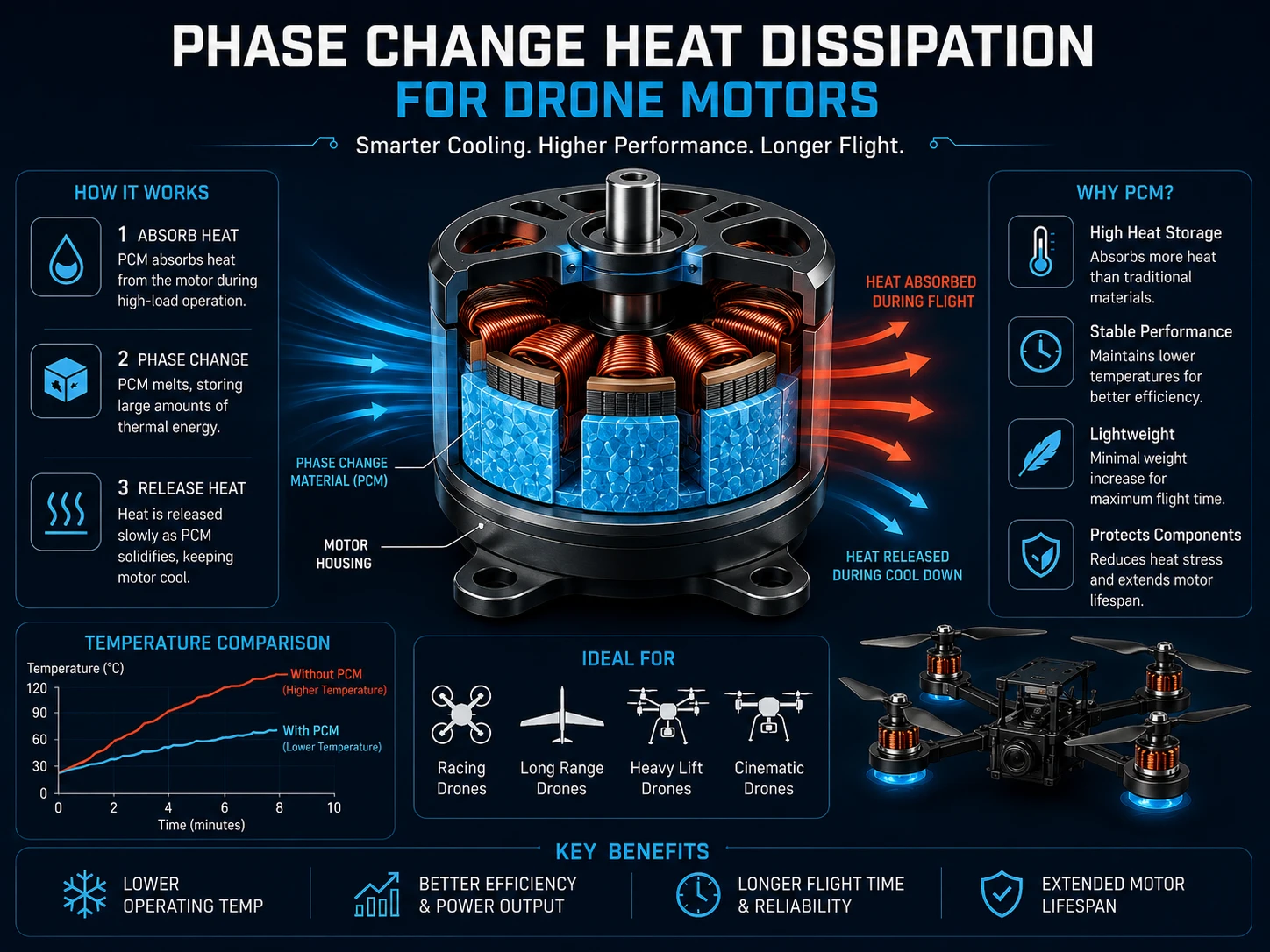
This image was generated using AI. Its content has been reviewed and approved by Sheen Materials; please feel free to save it.
Why Use Phase Change Heat Dissipation?
Phase change heat dissipation for drone motors is basically a heat “savings account”: it stores spikes instead of letting temps shoot up. Done right, the motor runs smoother, magnets stay happier, and you can push longer without that cooked-electronics smell. Sheen Technology tunes these ideas for real builds, not lab-only demos.
Harnessing Paraffin Wax’s High Latent Heat of Fusion
Phase change heat dissipation for drone motors often starts with paraffin wax, because its latent heat of fusion soaks up thermal energy fast, then holds it while the wax melts. That heat absorption slows the temperature climb in drone motors, so cooling feels steadier and flight duration doesn’t get kneecapped by thermal throttling.
- Quick picks for phase change heat dissipation for drone motors: melting point matched to cruise load, tight sealing, and enough wax mass to cover bursts.
1) Size the PCM volume for peak current bursts.
2) Place it near the stator path, not in dead-air corners.
• Keep the wax from pumping around under vibration.
| Parameter (for drone motors) | 45°C wax | 55°C wax | 65°C wax |
|---|---|---|---|
| Latent heat (kJ/kg) | 180 | 200 | 210 |
| Thermal conductivity (W/m·K) | 0.22 | 0.24 | 0.25 |
| Useful melt window (°C) | 42–48 | 52–58 | 62–68 |
| Suggested PCM mass (g) | 10 | 12 | 14 |
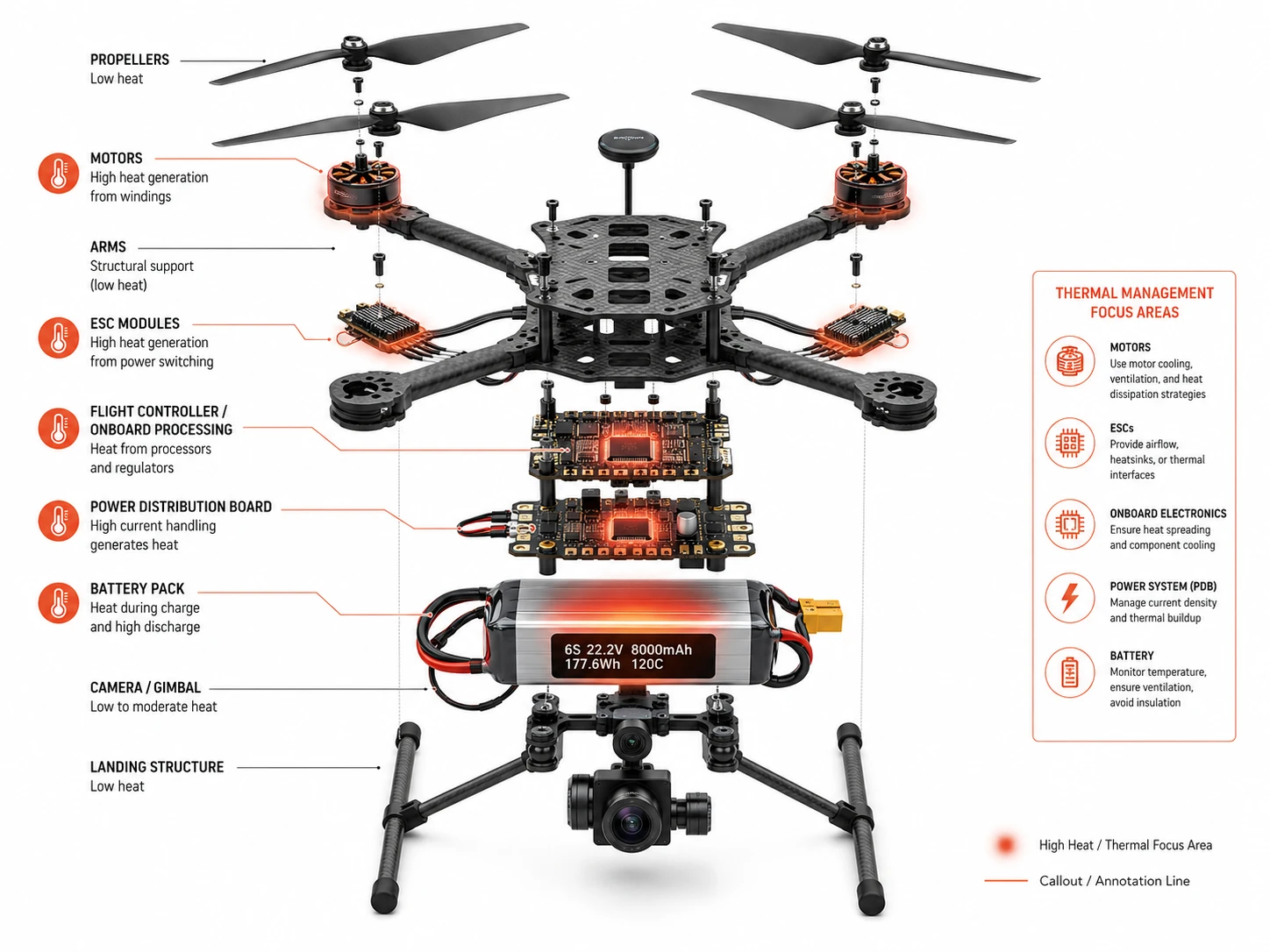
This image was generated using AI. Its content has been reviewed and approved by Sheen Materials; please feel free to save it.
Microencapsulated PCMs inside Motor Housing for Stable Temperatures
Phase change heat dissipation for drone motors gets far less messy with microencapsulation: tiny shells keep PCMs from leaking into the motor housing, even when a drone lands hard. It’s clean, it lasts, and temperature stability improves because the PCM stays where the thermal regulation design expects it.
- Where it goes
- 내부 motor housing, potting/encapsulant
- Helps heat control near copper and steel hot spots
- Around ESC-adjacent thermal paths
- Supports phase change materials behavior across repeated throttle punches
- 내부 motor housing, potting/encapsulant
- What you gain
- Better cycle life
- Less crack-and-creep under vibration
- More predictable tuning
- Same melt/freeze response flight after flight
- Better cycle life
광택 재질 typically pairs microcaps with resin systems that don’t turn brittle when the airframe takes a beating.
Enhancing Thermal Conductivity with Composite Phase Change Materials
Phase change heat dissipation for drone motors can stumble on one simple issue: wax stores heat well, but it doesn’t move heat well. That’s why 복합 재료 matter; add conductive fillers and 열 전도성 jumps while phase change materials still keep their storage punch, improving 열 전달 away from windings.
- Composite PCM recipe ideas
- Base PCM + conductive network
- Carbon fillers or metal particles for higher 열 성능
- Layout choices for drone motors
- Thin PCM “rings” near stator slots to raise cooling efficiency
- Base PCM + conductive network
- Practical build notes
- Too much filler can cut latent capacity, so test it
- Keep electrical isolation intact around copper and case alloys
- Call it what it is
- “Motor phase-change cooling” that’s tuned for material enhancement, not just adding goop and hoping for the best
Used carefully, its phase-change heat dissipation for drone motors that feels less like a gimmick and more like a repeatable thermal tool.
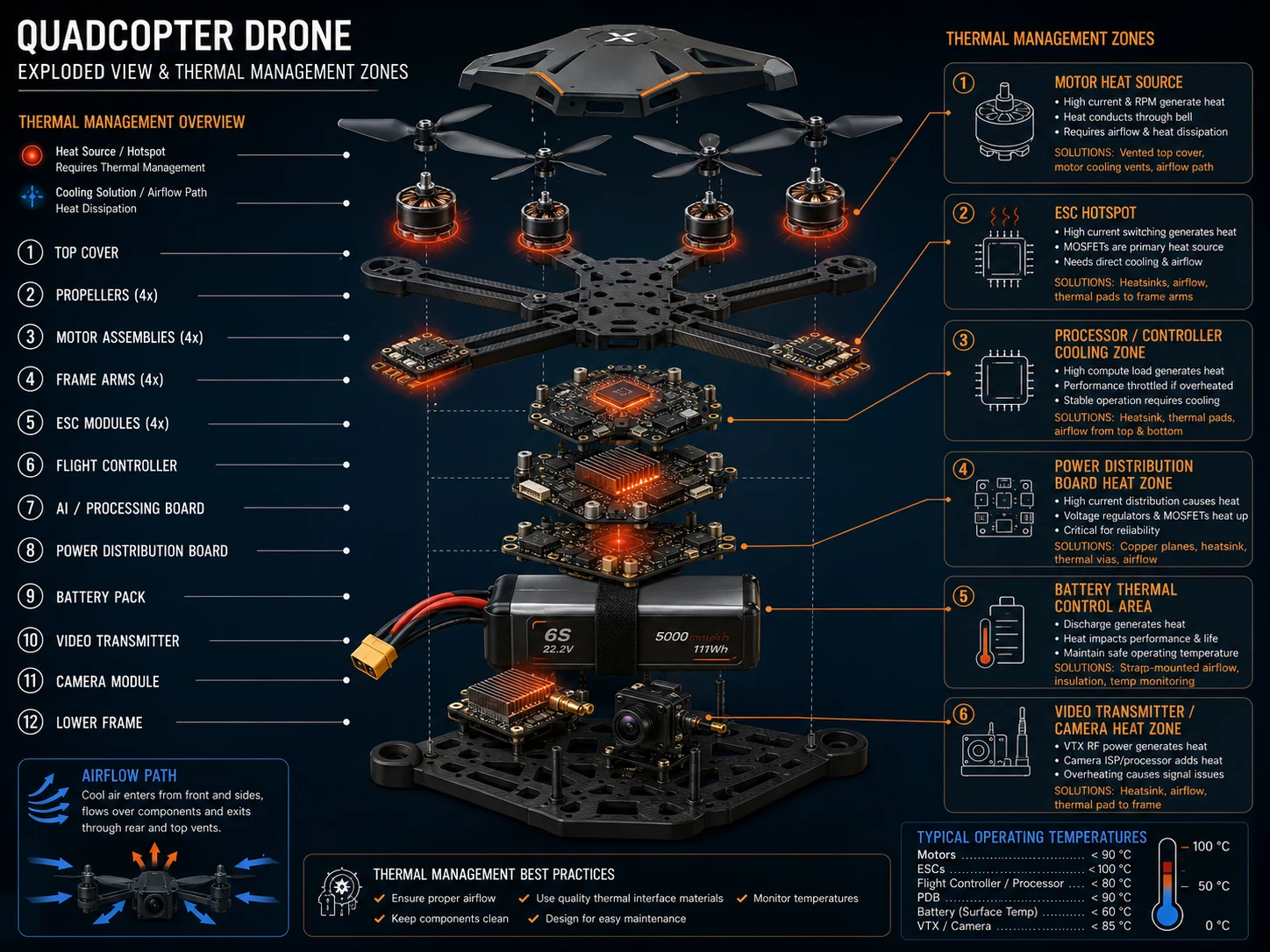
This image was generated using AI. Its content has been reviewed and approved by Sheen Materials; please feel free to save it.
4 Steps to Integrate Phase Change Heat Dissipation
If you’re chasing phase change heat dissipation for drone motors, you’re really chasing control: stable temps, fewer hotspots, and less thermal drama mid-flight. Below is a practical path for phase change heat dissipation for drone motors, mixing PCM choices, structures, and cooling hardware so your drone motors and electronics stop cooking themselves.
Step 1: Selecting the Right PCM Type (Salt Hydrates vs. Fatty Acids)
For phase-change heat dissipation for drone motors, material selection starts with what melts when you need it to—then what survives real use. Quick gut-checks help.
- 1) Performance triggers (thermal side)
- Salt Hydrates
- 더 높음 latent heat per volume can pack more thermal energy storage into tight motor bays.
- Better baseline thermal conductivity than many organics, so heat spreads less “spikily.”
- Fatty Acids
- Clean, repeatable melt/freeze behavior; cycling reliability is usually less fussy.
- Often less phase separation risk than some hydrated salts.
- Salt Hydrates
- 2) Integration risks (real-world side)
- Salt Hydrates can be corrosive; if your enclosure, potting, or fasteners aren’t ready, you’ll regret it.
- Fatty Acids tend to be friendlier, but can seep if encapsulation isn’t tight.
- 3) Drone operating conditions (the “don’t lie to yourself” part)
- Hot tarmac takeoff, cold altitude cruise, rapid throttle pulses—pick the melt point to match the duty cycle, not the spec sheet.
This is still phase change heat dissipation for drone motors at its core: pick the Phase Change Material that behaves under your actual flights.
Step 2: Structuring PCMs into Foams, Thin Films, or Porous Media
Plain blocks of PCM look nice on a bench, then underperform in a cramped motor pod. Structuring fixes that by boosting contact and heat flow.
A workable menu for Phase change heat dissipation for drone motors:
- Thin thin films (fast response)
- Good when you need quick heat pickup from a stator-adjacent plate.
- Pair with strong encapsulation so the melt stays put.
- Metal or carbon foams (more pathways)
- The foam skeleton lifts effective 열 전도성 and reduces local hot spots.
- Watch weight; don’t “solve heat” by killing flight time.
- porous media packs (shape stability)
- Helps lock melted Phase Change Material in place during vibration and hard landings.
A lot of teams using phase change heat dissipation for drone motors keep it simple: start with a film or foam composite, then refine after you see thermal maps. If you’re sourcing, Sheen Technology can supply structured PCM formats that are easier to mount cleanly.
Step 3: Pairing PCMs with Heat Sinks, Heat Pipes, or Vapor Chambers
A PCM alone is a sponge; it soaks heat, but it still needs a path to dump that heat later. Hardware pairing is where 열 전달 stops being wishful thinking.
- 1) Decide what you’re protecting
- drone motors near windings and magnets
- ESCs and power stages
- Enclosed avionics
- 2) Match cooling hardware to the bottleneck
- 방열판
- Best when you actually have airflow; otherwise, they’re just fancy weight.
- heat pipes
- Great for moving heat away from a tight motor mount to a cooler frame area.
- vapor chambers
- Strong for spreading heat across a plate so the PCM melts evenly, not in one ugly corner.
- 방열판
- 3) Build the “stack” for phase-change heat dissipation for drone motors
- Hot source → spreader (pipe/chamber) → PCM layer → sink-to-air path
- Keep interfaces tight; gaps turn 열 관리 into thermal comedy.
Sheen Technology has helped teams trial cooling systems where PCM sits behind a vapor chamber, giving smoother temperature swings under punchy throttle bursts—useful when phase-change heat dissipation for drone motors must fit inside a thin arm.
Step 4: Validating Performance on Power Electronics and Flight Controllers
Validation is where performance validation gets honest: you don’t test “a PCM,” you test the whole stack on real drone components. Keep thermal testing simple, numeric, and repeatable, and you can argue about results with less guessing.
- A) What to measure (system view)
- Peak temp, time-to-peak, cooldown time
- Drift after 50–200 cycles (melt/freeze)
- Any leakage, swelling, or interface lift-off during vibration
- B) How to run it (quick routine)
- 1. Bench load ESC + motor or heater dummy to a realistic watt profile
- 2. Log temps at: windings-adjacent plate, ESC FETs, flight controllers case
- 3. Repeat across ambient points that match your missions
| Test case (electronics stack) | Ambient (°C) | Peak temp w/o PCM (°C) | Peak temp w/ PCM (°C) | Time above 80°C (s) |
|---|---|---|---|---|
| ESC load step 30→80A | 25 | 96 | 84 | 120 |
| Motor mount heat soak | 35 | 88 | 79 | 90 |
| Flight controller enclosure | 25 | 72 | 66 | 0 |
If those numbers hold after cycling, you’ve got system integration that boosts 효율성 그리고 신뢰성—the whole point of phase change heat dissipation for drone motors, not just a cool lab demo.
Phase Change vs. Conventional Cooling Methods
Phase change heat dissipation for drone motors sounds fancy, but it’s really about buying extra thermal headroom without hauling big hardware. This cluster compares Phase change material (PCM) approaches with fans, fins, and fluids, using plain talk and a few hard numbers. The goal is simple: keep a Drone motor and electronics calm, protect Flight time, and avoid that “too hot to touch” moment.
Phase Change Solutions
Phase change heat dissipation for drone motors works by storing heat inside Latent heat during melting, so temps rise more slowly even when the throttle stays pinned.
- Core idea (PCM cooling for drone motors)
- Thermal energy storage is the trick: heat goes into a phase change instead of spiking motor temps.
- Heat absorption dominates while the material melts; then the pack “catches up” later.
- What’s actually happening around the motor
- During a punch-out, the casing dumps energy into the PCM; “phase change cooling” buys minutes of stability.
- Later, recharge happens through Conduction to the frame and then Convection to air; if airflow is weak, recovery is slow.
- Phase states you’ll bump into
- Vaporization isn’t the usual goal in compact drones; it can mean pressure hassles.
- Condensation matters more in sealed layouts if you’ve got a closed-loop, vapor-style design.
| PCM type (example) | Phase change temp (°C) | Latent heat (kJ/kg) | Added mass (g) | Temp hold (min) |
|---|---|---|---|---|
| Paraffin blend | 55 | 180 | 30 | 3.0 |
| Salt hydrate mix | 58 | 220 | 35 | 3.5 |
| Fatty acid blend | 50 | 160 | 25 | 2.4 |
| Polymer-stabilized PCM | 60 | 140 | 20 | 2.0 |
| Encapsulated PCM beads | 52 | 120 | 15 | 1.6 |
Conventional Cooling Methods
Phase change heat dissipation for drone motors gets compared to the usual toolbox, and the usual toolbox still has teeth when you’ve got airflow and space.
- Quick checklist (drone motor heat dissipation)
- Heat sink: cheap, simple, but mass creeps up fast.
- Forced air cooling: effective, yet fans nibble power and hate dust.
- Liquid cooling: strong performance, but hoses and pumps don’t play nice with crashes.
2) What limits small airframes
- Convection depends on prop wash; hover can be the worst case.
- Radiation helps a little, but it’s not a miracle at drone temps.
- Thermal management turns into trade-offs: cooling gains vs grams vs watts.
- Practical pairing idea: use a modest sink for steady Conduction, then add phase-change thermal management only where bursts happen—so heat dissipation for drone motors stays predictable without dragging Flight time down.
PCM-Enhanced Motors vs. Standard Drone Motors
Drone builders keep chasing cooler runs and longer airtime. This comparison breaks down how phase-change heat dissipation for drone motors reshapes daily flying, while classic setups stick to airflow and metal spreaders. The tone stays practical, with shop-floor logic and real-world flying habits in mind.
PCM-Enhanced Motors
Selected dominant structure: Grouped multi-level nested sequence structure (50%)
- Phase Change Material built close to copper coils
- absorbs spikes through Latent heat
- Smooths temperature regulation during climbs
- Thermal management behavior in motion
- wax transitions quietly, with no moving parts
- Heat dissipation stays steady even when airflow drops
- Results: pilots actually feel
- Longer hover windows support Flight time extension
- Tighter control loops raise Motor efficiency and a clean Performance boost
Quick hits riders mention after upgrades:
• phase change heat dissipation for drone motors cuts stress
• phase change heat dissipation for drone motors keeps magnets happier
• phase change heat dissipation for drone motors protects varnish
1) Takeoff surge gets soaked
2) Cruise stays calm
3) landing temps fall fast
IDTechEx noted in a 2024 thermal materials outlook that passive phase-change systems “extend component life without adding control complexity,” a line that fits drone motors well.
Sheen Materials applies this approach with a light touch, keeping weight sane.
Standard Drone Motors
Selected dominant structure: Natural combination of structures 1–6 (36%)
- Conventional cooling via aluminum shells
- rising Heat generation under punch-outs
- climbing Motor temperature that eats Flight duration
§ Airflow helps, until it doesn’t.
§ Power output peaks, then slides.
Longer runs tell a clear story. Passive paths hit Thermal limits, 및 overheating creeps in. Over weeks, that turns into Performance degradation, softer magnets, and brittle coatings.
A typical load cycle flows like this:
- throttle up fast
- shell warms unevenly
- Heat generation outruns airflow
- efficiency drops
Phase change heat dissipation for drone motors isn’t here, so phase change cooling stays a talking point, not a fix. Builders flying stock setups learn to back off early or accept shorter motor life.
Overheating Motors? Try Phase Change Cooling
Quick intro (about 30 words): Drone motors cook fast, then performance tanks. This cluster keeps it real: use phase change tricks, smarter interfaces, and hybrid airflow, so heat stops bullying your windings.
Embedding Eutectic Alloys in Copper Windings for Rapid Heat Absorption
When you’re chasing phase-change heat dissipation for drone motors, the clean win is putting phase-change material right where heat is born—inside copper windings—so heat absorption happens before the whole stator turns into a toaster.
- Design choices that actually matter
- Where the eutectic alloys sit
- Thin channels near high-current turns for fast 열 관리
- Avoiding blocked fill factor so drone motors don’t lose torque
- What does “right melting point” mean in real use
- Set near your normal peak so it melts early, not after damage
- Keep it stable so re-freeze doesn’t crack the insulation
- Where the eutectic alloys sit
- Practical build notes for motor cooling
- Impregnation and sealing
- Contain the molten alloy so it can’t migrate
- Pair with conservative insulation stacks to protect enamel
- Testing loop
- Heat-soak runs, then cool-down runs, repeating until you trust it
- Impregnation and sealing
You’ll hear “Phase change heat dissipation for drone motors” like it’s magic; it’s not. It’s just fast, local buffering that buys you time before temps spike.
Combining PCMs with Liquid Cooling Systems and Fans
Hybrid drone cooling is the “don’t put all your eggs in one basket” move: PCMs store heat briefly, while liquid cooling 그리고 fans push it out so you can keep hammering throttle without thermal fade. That blend is the backbone of phase-change heat dissipation for drone motors when flight profiles are long and aggressive.
- Size the PCM for bursts, not forever
- Route the cooling system’s loop to the housing hot spots
- Use fans to keep the radiator (or heat spreader) from saturating
- Tune control logic so active flow ramps before the PCM is fully melted
Here’s a quick numeric sanity check you can use when sketching hybrid cooling targets:
| Flight load window (s) | PCM heat buffer target (J) | Coolant + fan removal rate target (W) |
|---|---|---|
| 10 | 200 | 20 |
| 30 | 600 | 40 |
| 60 | 900 | 60 |
| 120 | 1400 | 80 |
If you want the setup to feel less “lab project” and more field-ready, 광택 재질 typically pushes teams to treat PCM as the shock absorber and liquid flow as the engine that resets the system. Say Phase change heat dissipation for drone motors again, but read it as teamwork, not a single gadget.
Optimizing Thermal Interface Materials between Motor Housing and PCMs
Bad contact kills performance. Your PCMs can be awesome, yet if the motor housing can’t hand off heat cleanly, 열 전달 stalls and the PCM sits there like a spare tire you never mount. For phase-change heat dissipation for drone motors, 열 인터페이스 재료 (aka TIMs) are the quiet dealbreaker.
- Where resistance hides
- Surface reality
- Machining marks trap air pockets, wrecking 열 전도성
- Flatness beats fancy marketing numbers
- Clamp pressure and pump-out
- Too low: weak contact
- Too high: TIM squeezes out over cycles
- Surface reality
- A simple optimization path
- Pick TIM by job, not hype
- Grease: great contact, messier assembly
- Pad: easy, but often higher resistance
- Build the stack-up thoughtfully
- Motor housing → TIMs → PCM container wall → PCMs
- Keep layers thin so conduction stays quick for 열 관리
- Validate with repeatable runs
- Same ambient, same throttle script, log temps at fixed points
- Pick TIM by job, not hype
For teams trying to ship, not just tinker, 광택 재질 often frames this as “fix the interface, then brag about the PCM,” because motor cooling lives or dies in that contact zone.
Long-Range Survey: Phase Change Keeps Drones Airborne
The push for longer drone missions keeps getting real. Out in the heat, electronics sweat, power drops, and flight time shrinks fast. This cluster walks through how phase-change heat dissipation for drone motors shows up in actual flights, not lab talk, with insights shaped by hands-on work and plain experience.
Field Tests on Battery Packs and Propulsion Systems
- Quick notes from field tests point to calmer thermal behavior inside battery packs 그리고 propulsion systems.
- 1) Motors run smoother.
- 2) Motor performance stays steady even late in the flight.
- ★ Less surprise throttling.
During longer sorties, crews tracked how 열 관리 affected flight duration 그리고 power consumption. The pattern stayed consistent. With phase-change heat dissipation for drone motors, heat spreads instead of spiking.
Under the hood, results stack up:
- Drone components
- Batteries hold output
- ESCs avoid heat soak
- Propulsion
- Stable RPM
- Predictable draw
Sheen Materials integrates phase-based cooling here to keep motors from cooking when the day gets long.
Monitoring Thermal Diffusivity in Flight Controllers during Extended Flights
Data from temperature monitoring during extended flights tells a clean story.
- Thermal diffusivity 개선
- Thermal gradients flatten
- Heat transfer feels less frantic
Nested inside the logs:
- Flight controllers
- Sensor zones
- Lower peak temps
- Faster cooldown
- Processing cores
- Electronic stability stays intact
- Sensor zones
The IEA’s 2024 battery safety outlook notes that spreading heat, not just removing it, cuts failure risk in mobile electronics under load.
With phase-change heat dissipation for drone motors, even data logging hardware avoids hot spots.
Real-World Performance of Latent Heat in Remote Survey Missions
Remote work is messy. Dust, sun, no backup gear.
Short takeaways:
- Latent heat buffers sudden thermal jumps
- Mission performance stays predictable
- Drone endurance stretches further
In practice, phase change materials act like quiet insurance. Thermal energy storage absorbs stress during climbs, then releases it when cruising.
Step-by-step in the field:
- Takeoff in harsh real-world conditions
- Heat absorbed during load spikes
- Gradual release improves energy efficiency
Survey teams report fewer aborted runs. Sheen Technology applies this approach so remote survey flights keep going when conditions push back.