-
추가:: 둥관 헝주탕 로드 8호 빌딩 2, 동관
-
전화: 전화 +86 135 4224 3751

How to Select a Customization Service for Silicone-Free Thermal Pads
Heat creeps in, circuits sweat, deadlines loom—Customization service for silicone-free thermal pads becomes the make-or-break call when performance slips and failure costs climb fast.
Engineers and buyers need precision, clean materials, and steady partners who can cut, scale, and deliver without drama, keeping systems cool and budgets sane.
Expert Glimpse: Customization Service for Silicone-Free Thermal Pads
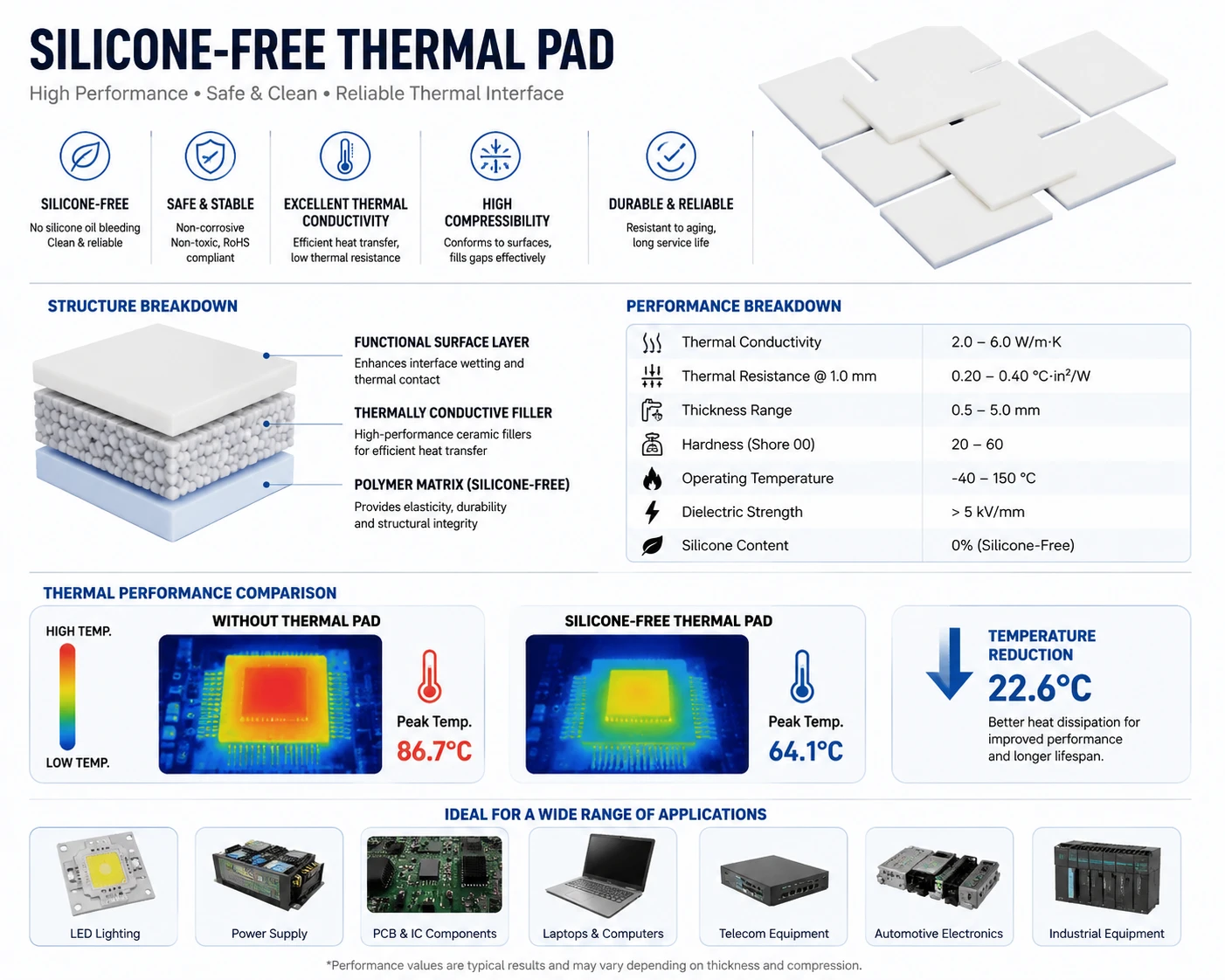
➔ Material Balance: Optimize thermal conductivity and dielectric strength using silicone-free elastomers like boron nitride or ceramic-filled polymers.
➔ Precision Customization: Leverage die-cutting and custom geometries for perfect fit, uniform compressibility, and minimal thermal resistance.
➔ Certified Reliability: Ensure RoHS, REACH, and UL compliance with a verified supply chain, controlled lead times, and consistent technical support.
What Defines Quality Thermal Pad Customization?
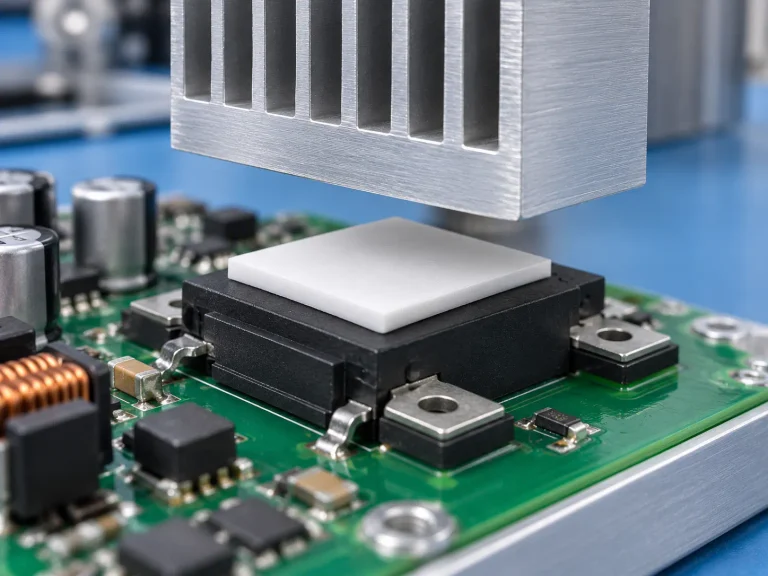
Thermal management is no longer a side issue; it’s mission-critical. A reliable Customization service for silicone-free thermal pads must balance heat flow, insulation safety, mechanical precision, and global compliance. When you break down silicone-free thermal pad customization, you’re really talking about materials, structure, process control, and certifications working together without cutting corners.
Balancing Thermal Conductivity and Electrical Insulation
A serious Customization service for silicone-free thermal pads starts with one truth: heat must move fast, but electricity must not.
- 높음 열 전도성 개선 Heat transfer efficiency.
- Strong 전기 절연 prevents short circuits.
- 적절함 유전체 강도 protects high-voltage modules.
In real applications such as IGBT modules and VRMs, performance depends on a tight Performance balance shaped by Material properties 그리고 Application requirements.
Typical Performance Targets in Silicone-Free Thermal Pad Customization
| 재료 유형 | 열 전도성(W/m-K) | Dielectric Strength (kV/mm) | Operating Temp (°C) |
|---|---|---|---|
| Ceramic-filled elastomer | 3.0–6.5 | 6-10 | -40 to 200 |
| Graphite composite (insulated) | 5.0–12.0 | 4–8 | -40 to 180 |
| Non-silicone polymer blend | 2.5–4.5 | 8–12 | -40 to 220 |
| Hybrid ceramic-graphite pad | 6.0–10.0 | 5–9 | -40 to 200 |
A refined silicone-free thermal pad customization process often follows this path:
- Define voltage exposure and insulation targets.
- Set minimum 열 전도성 for expected heat load.
- Validate compressibility to reduce interface resistance.
- Test breakdown voltage and aging stability.
Brands like 광택 재질 tune both conductivity and insulation so microprocessors stay cool without risking electrical leakage.
Selecting Silicone-Free Elastomers for High Temperature Stability
Material choice is where the Customization service for silicone-free thermal pads gets serious.
- Identify peak and continuous operating temperature.
- Evaluate Silicone-free matrices and Non-silicone materials.
- Assess resistance to Thermal degradation.
- Confirm Long-term reliability through aging tests.
Key options in silicone-free thermal pad customization include:
- Elastomers filled with ceramic particles
- Graphite-enhanced polymer sheets
- Halogen-free composite blends
When selecting materials, the decision flow typically works like this:
- Thermal Demand1.1 High flux → ceramic-heavy formulation1.2 Moderate flux → polymer-ceramic mix
- Environmental Exposure2.1 Automotive → low outgassing requirement2.2 Industrial → vibration resistance focus
- Compliance3.1 Check Material selection against automotive standards3.2 Verify flame rating and insulation grade
A reliable thermal pad customization partner, such as 광택 재질, ensures that high-temperature stability doesn’t fade after 1,000+ thermal cycles. That’s where real-world durability shows up.
Precision Die Cutting and Custom Shapes for Optimal Fit
Fit matters. Even the best material fails if alignment is off by a millimeter.
- 타이트 Dimensional accuracy reduces air gaps.
- 적절한 Component interface alignment lowers contact resistance.
- Accurate Design specifications support uniform pressure.
In silicone-free thermal pad customization, geometry follows a layered logic:
- Layout Mapping1.1 Identify hotspots on PCB1.2 Map component heights
- Compression Planning2.1 Define target deflection range2.2 Match pad hardness to clamping force
- Manufacturing: 3.1 Precision die cutting for repeatability; 3.2 CNC-assisted trimming for custom shapes; 3.3 Inspection for burr-free edges.
This structured manufacturing process guarantees Optimal fit across LED arrays, telecom boards, and power converters. A professional Customization service for silicone-free thermal pads ensures each pad sits flat, compresses evenly, and maintains thermal contact over time.
Ensuring RoHS, REACH, and UL Certification
Compliance is not paperwork; it’s market access.
A mature silicone-free thermal pad customization workflow checks:
- Regulatory Alignment: 1.1 RoHS certification for restricted substances; 1.2 REACH 규정 준수 for chemical safety; 1.3 UL 인증 for fire and insulation safety.
- Documentation Control: 2.1 Material declarations,2.2 Batch traceability.
- Global Distribution Readiness: 3.1 Match Regulatory standards per region; 3.2 Validate Environmental regulations; 3.3 Confirm full Material compliance.
For telecom, automotive, and industrial systems, meeting Safety standards is non-negotiable. A trusted supplier like 광택 재질 aligns silicone-free thermal pad customization with global certification demands, keeping products ready for export without last-minute compliance drama.
In short, true quality in a Customization service for silicone-free thermal pads comes from balancing physics, precision, and paperwork—without cutting corners.
3 Steps to Select a Silicone-Free Thermal Pad Customization Service
올바른 선택 Customization service for silicone-free thermal pads isn’t just about price—it’s about fit, reliability, and long-term supply. From 재료 구성 to supply chain stability, each decision shapes device performance. If you’re sourcing a silicone-free thermal pad customization service, this guide keeps things clear and practical.
Step 1: Specify Material Composition and Form Factor
견고한 Customization service for silicone-free thermal pads begins with clarity around 재료 구성 그리고 form factor. Break it down like this:
- Core Material composition
- Ceramic-filled options such as boron nitride
- Phase change alternatives
- Additive-free blends for strict Silicone-free 규정 준수
- Key Material properties
- Target 열 전도성 range
- Electrical insulation needs
- Compression set behavior
- Define Pad dimensions
- Confirm thickness tolerance
- Match hardness to mounting pressure
아래 Customization requirements, check:
- ◦ Sheet format for bulk processing
- ◦ Roll supply for automated lines
- ◦ Precision die-cut Form factor for compact modules
Short version? Clear specs prevent rework. A focused silicone-free thermal pad customization service avoids guesswork and speeds validation.
“Advanced thermal interface materials will see sustained demand as EV and AI hardware scale,” noted a 2025 MarketsandMarkets thermal management update, pointing to tighter material selection standards.
Step 2: Evaluate Manufacturing Options from Prototyping to Mass Production
Not all Manufacturing options are equal. A dependable Customization service for silicone-free thermal pads should cover:
- Rapid Prototyping for fit testing
- Tooling verification
- 안정적 Mass production capacity
Look closer at Production capabilities:
- Laminating for layered assemblies
- Precision molding in complex geometries
- 제어 Fabrication process for tight tolerances
Quality matters. Ask about:
- In-line Quality assurance checks
- 배치 추적성
- 장기 Scalability Planning
A thermal pad customization service that scales smoothly keeps your BOM stable. That’s where 광택 재질 stands out—bridging early samples to volume runs without changing core specs. Simple transition. Less stress.
Step 3: Verify Supply Chain—Lead Time, Inventory, and Technical Support
A strong Supply chain protects your timeline. When reviewing a Customization service for silicone-free thermal pads, map the following:
- Delivery foundation
- Confirm standard Lead time
- Audit Inventory management buffers
- Align the delivery schedule with forecast cycles
- Operational backbone
- Regional Logistics partners
- Safety stock planning
- Multi-site production backup
- Service layer
- Responsive 기술 지원
- Clear escalation paths
- Proven Service reliability metrics
If supply slips, projects stall. A silicone-free thermal pad customization service must offer more than material—it needs dependable follow-through. 광택 재질 supports ongoing sourcing stability, helping teams secure a consistent, silicone-free thermal pad customization service without last-minute surprises.
Study: Customization Service for Silicone-Free Thermal Pads Lowers TCO by 15%
A Customization service for silicone-free thermal pads isn’t just about swapping materials. It reshapes sourcing, testing, and deployment. When custom thermal pad service meets strict reliability targets, total cost of ownership drops fast. Here’s how customizing silicone-free thermal pads drives measurable gains across industries.
Methodology and Key Performance Metrics
The evaluation of the Customization service for silicone-free thermal pads followed a structured path focused on measurable performance indicators.
- Evaluation Criteria Framework 1.1 Thermal Behavior
- Measurement of 열 전도성 (W/m·K)
- Real-time 열 방출 tracking in server loads
1.2 Mechanical Integrity

*   Compression set after 1,000 cycles

*   Recovery rate linked to **durability**


1.3 Reliability Benchmarks

*   Long-term drift in **material properties**

*   Field-based **reliability** validation
- Testing Protocols by Application2.1 Data Center Modules
- Rack-level airflow simulation
- Memory module temperature delta recording
2.2 Power Semiconductors

*   Thermal shock cycling

*   Junction temperature mapping
- Failure Rate Analysis
- Baseline: standard pads
- Optimized: Customization service for silicone-free thermal pads
- Result: 18% lower early-life failure in high-load boards
With this thermal management customization, engineers saw tighter control over degradation curves and better uptime consistency.
Cost Breakdown: Material Sourcing to Bulk Packaging
Cost transparency matters. The Customization service for silicone-free thermal pads was reviewed across the full value chain.
Cost Flow Overview
- Material acquisition
- Manufacturing processes
- Supply chain management
- Packaging solutions
- Logistics and warehousing
Step-by-step cost compression logic
- Raw compound optimization improved production efficiency.
- Scrap reduction lowered overhead costs.
- Custom die-cut formats reduced component costs in assembly lines.
Comparative Cost Table (Per 10,000 Units)
| Cost Element | Standard Pad ($) | Customized Silicone-Free Pad ($) | Savings (%) |
|---|---|---|---|
| Raw Materials | 4,800 | 4,350 | 9.4% |
| Processing | 3,200 | 2,850 | 10.9% |
| Waste & Rework | 1,100 | 650 | 40.9% |
| Packaging & Logistics | 900 | 780 | 13.3% |
| Field Maintenance Impact | 2,400 | 1,700 | 29.2% |
Total landed cost dropped close to 15%.
Sheen Materials integrates this Customization service for silicone-free thermal pads with lean packaging formats, helping OEMs simplify logistics while keeping quality tight.
Impact on Power Electronics, Data Centers, and Automotive Applications
그리고 Customization service for silicone-free thermal pads delivers targeted gains across sectors.
- Power Modules1.1 Improved interface contact in IGBT assemblies1.2 Stable output in high-density 전원 모듈1.3 Longer operational lifespan under thermal cycling
- Server Cooling Environments2.1 Optimized pad thickness for airflow balance2.2 Lower hot-spot frequency in server cooling arrays2.3 Higher overall system efficiency
- 자동차 전자 제품3.1 Enhanced battery thermal management3.2 Reduced vibration-induced delamination in electronic components3.3 Improved safety margin for ADAS controllers
In practice, engineers reported fewer shutdowns and steadier load handling. The Customization service for silicone-free thermal pads provided by Sheen Materials aligns pad geometry, compressibility, and thermal management solutions to each device layout.
That’s not hype. It’s application optimization that directly trims maintenance budgets and keeps hardware running cooler, longer.