-
추가:: 둥관 헝주탕 로드 8호 빌딩 2, 동관
-
전화: 전화 +86 135 4224 3751

코로나에 강한 열 전도성 단열재로 미래 지향적인 디자인 구현
Corona-resistant thermally conductive insulating material isn’t just a spec-sheet flex—it’s the quiet bodyguard inside your high-voltage design. When heat stacks up and partial discharge starts nibbling at insulation, failures creep in like termites in a beach house. One weak layer, and your million-dollar system taps out early.
Global EV sales jumped 35% in 2023, topping 14 million units, reports the International Energy Agency. Higher voltage, tighter packaging, hotter cores.
Designers feel that squeeze daily. You need insulation that dumps heat fast and shrugs off corona like it’s no big deal—because downtime, recalls, and warranty claims? Nobody’s got time for that.
Corona-Resistant Thermally Conductive Insulating Material Explained
High-voltage systems run hot and push insulation to its limits. That’s why Corona-resistant thermally conductive insulating material has become a go-to solution for engineers chasing both safety and performance. By blending corona resistance, thermal conductivity, and stable electrical insulation, this insulating material handles heat dissipation while guarding dielectric strength. Let’s break it down in plain terms and see where this thermally conductive insulation really earns its keep.
What corona resistance means for power modules and IGBTs
In high-frequency switching devices like IGBTs, partial discharge is a quiet troublemaker. Over time, it eats away at 전기 절연. That’s where Corona-resistant thermally conductive insulating material steps in.
1) At the device level
- IGBT chips operate under high dv/dt stress.
- Microscopic air gaps can trigger corona discharge.
- Corona resistance slows insulation erosion.a. Material response
- 그리고 insulating material forms a dense barrier.
- Enhanced 유전체 강도 resists breakdown.
- 안정적 재료 속성 maintain structure under heat.
2) At the module level
- Heat builds up fast.
- Poor heat dissipation increases electric stress.a. Thermal pathway
- 높음 열 전도성 pulls heat away from hotspots.
- Lower temperature reduces partial discharge intensity.
- Balanced heat dissipation extends module lifespan.
In simple terms, Corona-resistant thermally conductive insulating material protects power modules from the inside out. Sheen Electronic Technology fine-tunes this balance so corona-resistant insulation and thermally conductive performance work together, not against each other.
Key thermal conductivity metrics for high-voltage transformers
When engineers talk about thermally conductive insulation in transformers, numbers matter.
Core performance indicators include:
- 열 전도성 (W/m·K)
- Volume resistivity (Ω·cm)
- 유전체 강도 (kV/mm)
- Continuous operating temperature (°C)
Below is a typical comparison for insulating materials used in high-voltage systems:
| 재료 유형 | 열 전도성(W/m-K) | Dielectric Strength (kV/mm) | Max Temp (°C) | 체적 저항(Ω-cm) |
|---|---|---|---|---|
| Standard Epoxy | 0.8 | 18 | 130 | 1×10¹⁴ |
| Filled Resin | 1.5 | 20 | 155 | 5×10¹³ |
| Ceramic-Filled Polymer | 2.5 | 22 | 180 | 1×10¹³ |
| Corona-resistant thermally conductive insulating material | 3.0+ | 25 | 200 | 1×10¹³ |
Higher thermal conductivity improves heat dissipation across windings. Strong dielectric strength keeps layers isolated even during voltage spikes. A well-designed Corona-resistant thermally conductive insulating material handles both, which is why advanced transformer builders increasingly shift toward thermally conductive insulating material systems instead of conventional resins.
Why dielectric strength is critical in renewable energy inverters
Solar and wind inverters deal with unstable inputs. Voltage swings. Outdoor humidity. Dust. Heat.
1) Electrical stress factors
- Rapid switching cycles
- High DC bus voltage
- Environmental contaminationa. Risk chain
- Weak 전기 절연 → partial discharge
- 감소됨 유전체 강도 → breakdown
- Breakdown → system downtime
2) Role of Corona-resistant thermally conductive insulating material
- High dielectric margin resists arc formation.
- Strong corona resistance slows surface erosion.
- Elevated thermal conductivity improves heat dissipation from power semiconductors.
3) Long-term reliability
- Stable material properties under UV and humidity.
- Lower maintenance costs.
- Better safety compliance.
A corona-resistant insulating material that also spreads heat evenly keeps renewable inverters running longer. That balance is exactly what Corona-resistant thermally conductive insulating material is built for.
Application spotlight: EVs, data centers, and aerospace electronics
Power density keeps rising. Space keeps shrinking. Cooling gets harder.
1) Electric Vehicles
- a. Motor drives
- High switching frequency
- Need thermally conductive insulation for compact layouts
- b. Battery systems
- Thermal conductivity supports even temperature distribution
- Strong dielectric strength prevents short circuits
2) Data Centers
- a. Power distribution units
- Continuous high load
- Corona-resistant thermally conductive insulating material stabilizes electrical insulation
- b. Cooling interface
- Improved heat dissipation reduces hotspot risk
3) Aerospace Electronics
- a. Weight sensitivity
- Lightweight insulating material required
- b. Extreme conditions
- Wide temperature swings
- Demand for consistent material properties
Across these industries, the winning formula is simple: corona resistance + thermal conductivity + reliable electrical insulation. Sheen Electronic Technology delivers Corona-resistant thermally conductive insulating material tailored for high-voltage, high-heat environments, helping engineers keep systems cool, compact, and safe without overcomplicating the design.
Materials Breakdown: Thermal Conductivity And Corona-Resistance
Power modules run hot, and high voltage pushes insulation to its limits. That’s why Corona-resistant thermally conductive insulating material has become a go-to choice in modern electronics. Let’s break down how ceramic, polymer, nitride, and mica systems handle 열 전달 그리고 electrical discharge without cracking under pressure.
Ceramic composites: maximizing heat dissipation and corona resistance
Ceramic-based Corona-resistant thermally conductive insulating material systems often center on aluminum nitride or boron nitride. The magic lies in how 재료 구성 drives both conductivity measurement results and long-term 재료 성능 저하 control.
1) Thermal pathway design
- Crystal structure → lowers 열 저항
- Dense sintering → smooth temperature gradient
- Filler alignment → boosts 열 방출
2) Electrical endurance under voltage stress
- 높음 유전체 강도 limits partial discharge
- Tight grain boundaries reduce surface erosion
- Stable lattice slows aging effects from repeated voltage stress
Key performance comparison:
| 재료 | 열 전도성(W/m-K) | Dielectric Strength (kV/mm) | Max Temp (°C) |
|---|---|---|---|
| AlN | 170–200 | 15–20 | 1000 |
| BN | 30–60 | 25–35 | 900 |
| Alumina | 20–30 | 12–15 | 1600 |
| Si3N4 | 70–90 | 15–18 | 1200 |
For high-power inverters, ceramic Corona-resistant thermally conductive insulating material keeps insulation properties steady even as heat ramps up. That’s why suppliers like Sheen Electronic Technology focus heavily on ceramic-filled platforms.
Polymer-matrix composites: balancing flexibility with dielectric strength
Flexible pads and sheets built as Corona-resistant thermally conductive insulating material rely on epoxy or silicone matrices packed with ceramic fillers.
A. Matrix role
- Absorbs mechanical stress
- Maintains bonding during thermal cycling
- Protects against moisture-driven 재료 성능 저하
B. Filler network
- Creates continuous 열 전달 channels
- Reduces 열 저항 at interfaces
- 향상 partial discharge resistance
C. Performance outcome
- Lower electrical discharge risk
- 안정적 유전체 강도
- 제어 aging effects
This type of thermally conductive insulation material works great in compact EV chargers where space is tight but flexibility matters.
Boron nitride vs. aluminum nitride: which offers better thermal stability?
비교할 때 Corona-resistant thermally conductive insulating material options:
I. Boron Nitride
- Easier processing
- Excellent insulation against electrical discharge
- 보통 conductivity measurement values
- Smooth surface lowers surface erosion
II. Aluminum Nitride
- Superior 열 방출
- Higher thermal stability under steep temperature gradient
- Strong resistance to voltage stress
- Better fit for rigid substrates
If the design pushes extreme power density, aluminum nitride-based Corona-resistant thermally conductive insulating material usually wins.
Mica-based materials: proven performance in industrial power electronics
Mica has been around for ages, and it still earns respect. As a Corona-resistant thermally conductive insulating material, it handles high 유전체 강도 demands in motors and heavy converters.
Performance stack:
- Layered crystal structure → blocks partial discharge paths
- Natural insulation properties → stable under repeated electrical discharge
- Laminated builds → improved 열 저항 control
- Long-term durability → reduced aging effects
For industrial drives and generators, mica-based thermally conductive insulating material remains a safe bet. Sheen Electronic Technology integrates mica hybrids with ceramic fillers to fine-tune both 열 전달 and corona resistance, keeping systems cool and steady over the long haul.
How To Test Corona-Resistant Thermal Conductors
Corona damage is sneaky. It eats away at insulation while heat keeps rising. That’s why testing a Corona-resistant thermally conductive insulating material isn’t just a lab ritual; it’s how you protect real hardware in the field. From 유전체 강도 checks to partial discharge screening, every method connects to long-term 전기 절연 stability and reliable 재료 속성 under stress.
IEC 60243 breakdown voltage tests for thermal insulators
Testing under IEC 60243 focuses on verifying 유전체 강도 in a Corona-resistant thermally conductive insulating material.
- Test preparation
- Sample conditioning
- Control humidity and temperature to stabilize 재료 속성
- Ensure uniform thickness for accurate testing methods
- Electrode configuration
- Select flat or spherical electrodes depending on application
- Confirm contact pressure to avoid air gaps
- Voltage application
- Gradual ramp-up
- Increase AC voltage steadily
- Monitor leakage current behavior
- Breakdown detection
- Record failure voltage
- Observe carbonization or puncture paths
For a Corona-resistant thermally conductive insulating material, high breakdown voltage signals reliable 전기 절연 even when thermal loads are intense. Manufacturers like Sheen Electronic Technology fine-tune filler dispersion to keep heat flowing while preventing premature dielectric collapse.
ASTM D149 partial discharge resistance measurement methods
ASTM D149 goes deeper into partial discharge endurance of a Corona-resistant thermally conductive insulating material.
- Electrical stress simulation
- Apply high voltage across defined spacing
- Introduce controlled defects to mimic real gaps
- Discharge monitoring
- Track inception voltage
- Measure discharge magnitude over time
- Endurance evaluation
- Compare time-to-failure
- Analyze surface erosion patterns
When a thermally conductive insulating material survives repeated discharge cycles, it proves true corona resistance. A stable corona-resistant insulation layer means fewer surprises in motors, inverters, and transformers. Sheen Electronic Technology designs its Corona-resistant thermally conductive insulating material to balance heat transfer with discharge suppression, keeping performance steady under long-term stress.
IEC 60112 standards for corona resistance classification
IEC 60112 targets surface tracking linked to corona.
- Prepare the specimen surface.
- Apply electrolyte drops under set voltage.
- Observe tracking formation and failure time.
Key evaluation layers include:
- Surface carbon path development
- Comparative tracking index classification
- Environmental sensitivity in humid air
A high tracking index confirms that the Corona-resistant thermally conductive insulating material resists surface degradation while maintaining 전기 절연. That matters in compact systems where heat and voltage crowd together.
ASTM D257 procedures for bulk electrical insulation evaluation
ASTM D257 measures volume and surface resistivity in a Corona-resistant thermally conductive insulating material.
Testing flow:
- Instrument calibration
- Guarded electrode placement
- Resistance measurement under stable voltage
Assessment focus:
- Volume resistivity for bulk insulation
- Surface resistivity against leakage paths
- Stability across temperature shifts
Strong resistivity values indicate dependable 전기 절연 performance, even as the thermally conductive insulating material transfers heat away from power devices. When 재료 속성 stay consistent, long-term corona resistance follows naturally.
Corona-Resistant Thermal Interface Materials Compared
High-voltage electronics run hot, and heat is never just about temperature. It’s about safety, lifespan, and steady output. Choosing a Corona-resistant thermally conductive insulating material means balancing 열 전도성, 전기 절연, 및 long-term reliability without overcomplicating the design.
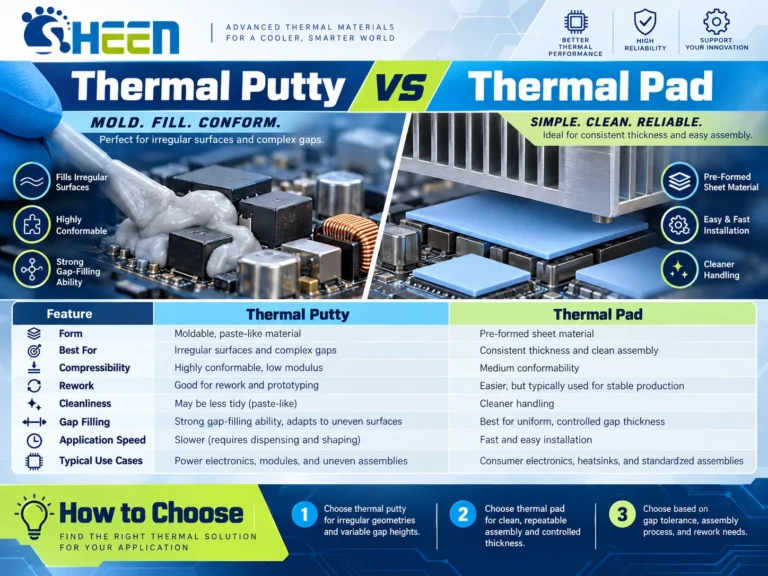
Thermal grease
Thermal grease is often the quick fix when heat builds up between a power module and a heat sink. In many builds, a Corona-resistant thermally conductive insulating material in grease form helps cut 열 임피던스 while still offering decent 유전체 강도.
Core traits include:
- Smooth surface wetting
- 안정적 재료 구성 under rated 작동 온도
- Rework-friendly maintenance
In practical use, engineers evaluate it through layered criteria:
- Interface behavior
- Contact filling capability
- Air gap reduction
- Electrical safety
- Partial discharge tolerance
- Stability of 전기 절연
- 내구성
- Pump-out resistance
- Aging under thermal cycling
A corona resistant thermal interface in grease form works well where flexibility matters more than rigidity.
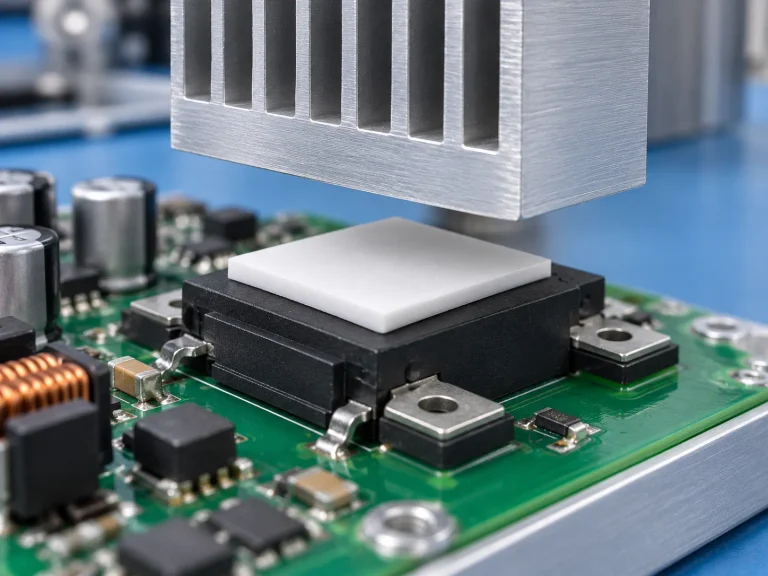
Silicone pad
Silicone pads feel simple, but there’s more going on under the hood. A pad-based Corona-resistant thermally conductive insulating material blends ceramic fillers into elastic silicone to balance 열 전도성 and insulation strength.
When assessing performance, teams often break it down:
- Mechanical layer
- Compression recovery
- Thickness consistency
- Thermal layer
- Heat flow stability
- 제어 열 임피던스
- Electrical layer
- 강화됨 유전체 강도
- 신뢰성 전기 절연 in high-frequency systems
For inverter modules and LED drivers, this thermally conductive insulating material keeps things neat and easy to install. No mess, no drama.
Polymer film
Polymer films shine in tight spaces. As a thin Corona-resistant thermally conductive insulating material, film solutions focus heavily on 유전체 강도 and controlled 재료 구성.
Evaluation usually follows a layered logic:
- Structural integration
- Lamination strength
- Adhesion to copper windings
- 열 경로
- Heat spreading behavior
- Stability across 작동 온도 swings
- Electrical endurance
- Corona aging resistance
- Breakdown voltage margin
In compact motors and consumer electronics, a corona resistant insulating film keeps insulation thin yet dependable.
Ceramic-filled paste
Ceramic-filled paste starts as a spreadable compound and ends as a cured barrier. Once hardened, this Corona-resistant thermally conductive insulating material shows stronger resistance to partial discharge.
Key checkpoints include:
- Filler system
- Boron nitride or aluminum nitride ratio
- Uniform particle dispersion
- Post-cure structure
- Crack resistance
- Bonding to substrates
- Heat-electric balance
- Enhanced 열 전도성
- 지속적 전기 절연
For power electronics facing high stress, this thermally conductive insulating material adds both heat control and corona resistance in one layer.
Epoxy encapsulant
Epoxy encapsulants turn circuits into sealed units. As a rigid Corona-resistant thermally conductive insulating material, epoxy creates a solid shield around components.
Performance is typically reviewed in nested stages:
- Encapsulation integrity
- Void elimination
- Adhesion to metals and PCB surfaces
- Thermal pathway
- Bulk 열 전도성
- Managed 열 임피던스 inside the potting mass
- Electrical safety
- 높음 유전체 강도
- Proven long-term reliability under voltage stress
In aerospace converters and automotive drives, this corona-resistant, thermally conductive insulating material supports safety and device longevity. Brands like Sheen Electronic Technology continue refining these materials to meet tougher voltage and heat demands without making system design a headache.
3 Factors Affecting Corona-Resistant Insulation Performance
High-voltage equipment doesn’t fail overnight. It wears down, little by little, under heat and electrical stress. That’s why Corona-resistant thermally conductive insulating material has become a key player in power modules, transformers, and inverters. When corona discharge, heat buildup, and surface defects collide, performance drops fast. The right corona-resistant, thermally conductive, insulating material keeps systems stable, cool, and electrically safe for the long haul.
Factor 1: Thermal stability during prolonged high-voltage operation
A Corona-resistant thermally conductive insulating material must stay stable when voltage and temperature keep climbing.
- Core material foundation
- Insulation material selection
- 높음 유전체 강도 to prevent breakdown
- 안정적 polymer type under continuous electrical stress
- Functional enhancement
- 균형 잡힌 필러 콘텐츠 to improve heat flow
- Protective additives to slow thermal aging
- Structural endurance under heat
- Preservation of 재료 속성
- Mechanical flexibility at elevated temperature
- Resistance to cracking from thermal cycling
- 지속적 corona resistance
- Reduced surface erosion
- Stable dielectric performance over time
- Performance outcome
- Maintained thermal conductivity
- Reduced hot spots in power modules
- Longer service life in high-frequency systems
When thermally conductive insulating material loses stability, insulation weakens. A stable Corona-resistant thermally conductive insulating material keeps heat moving and breakdown risks low.
Factor 2: Partial discharge resistance to extend service life
Partial discharge is sneaky. It starts small, then eats away at insulation.
- Discharge origin control
- Raw material purity
- Fewer contaminants in insulation material
- 제어 material purity during compounding
- Internal defect prevention
- Limited void formation
- 감소됨 manufacturing defects
- Resistance mechanisms
- Strong 유전체 강도 under repetitive electrical stress
- 최적화 필러 콘텐츠 to block discharge channels
- 안정적 polymer type resisting micro-erosion
- Long-term aging defense
- Slower aging effects under high partial discharge exposure
- Consistent performance in renewable converters and IGBTs
A well-designed Corona-resistant thermally conductive insulating material handles repeated discharge without crumbling. That’s the difference between a quick failure and years of reliable output.
Factor 3: Interface contact quality for optimal heat transfer and insulation
Even the best Corona-resistant thermally conductive insulating material can underperform if interface contact is poor.
- Surface preparation
- Smooth surface finish
- 제어 extrusion quality
- 적절한 processing temperature
- Curing and bonding
- 최적화 curing conditions
- Reduced micro-gaps
- Improved adhesion strength
- Stable interface under atmospheric pressure variations
- Environmental interaction
- Resistance to humidity in the operating environment
- Reliable insulation under fluctuating temperature
- Protection against external electrical stress
When contact is tight and uniform, heat flows efficiently through the thermally conductive insulating material while electrical isolation stays intact. A properly processed Corona-resistant thermally conductive insulating material ensures both cooling performance and insulation reliability work hand in hand, not against each other.
FAQs about Corona-Resistant Thermally Conductive Insulating Material
Why is Corona-resistant thermally conductive insulating material critical for high-voltage power modules?
In high-voltage power modules, tiny electrical discharges can quietly erode insulation and trigger sudden failure. A Corona-resistant thermally conductive insulating material acts as both shield and heat bridge.
- Electrical protection – High dielectric strength and strong corona resistance protect IGBTs and high-voltage transformers from partial discharge damage.
- Heat dissipation – Stable thermal conductivity moves heat away from power modules and inverters before hotspots form.
- Long service life – Thermal stability reduces cracking during temperature cycling in electric vehicles and renewable energy systems.
When partial discharge resistance and heat dissipation work together, industrial power electronics stay reliable under switching stress.
How does thermal conductivity influence electrical insulation performance?
Heat and electricity constantly compete inside power converters, LED lighting, and motor windings. If heat lingers, insulation ages faster.
- High thermal conductivity in ceramic composites or polymer-matrix composites lowers internal temperature rise.
- Lower temperature slows dielectric strength decay.
- Stable electrical insulation maintains safe operation in aerospace electronics, data centers, and medical devices.
The balance is delicate: move heat efficiently, yet preserve electrical insulation across thin films, pads, or encapsulants.
Which materials and forms are commonly used in manufacturing?
Material choice depends on voltage level, flexibility, and assembly method.
Core materials
- Boron nitride and aluminum nitride (often sintered) for high thermal conductivity substrates
- Mica-based materials for natural corona resistance in motor windings
- Silicone elastomers and epoxy resins for flexible or rigid systems
Typical forms & processes
| Material Form | Common Process | Typical Use in Electronics |
|---|---|---|
| Sheets / Films | Lamination, coating | Insulation layers in power modules |
| Pads / Greases | Filling, molding | Interface heat transfer in IGBTs |
| Potting compounds | Curing, casting | Inverters, transformers |
| Ceramic substrates | Sintering | High-power industrial power electronics |
Each form balances thermal conductivity, dielectric strength, and installation demands.
What standards verify dielectric strength and corona resistance before application?
Testing is where confidence is earned.
- IEC 60243 / ASTM D149 – Breakdown voltage and dielectric strength validation
- IEC 60112 – Tracking and corona resistance under humid conditions
- ASTM D257 – Surface and volume resistivity measurement
- UL 94 – Flammability classification for safety compliance
- IEC 60034 / ISO 11357 – Motor insulation and thermal behavior assessment
For engineers selecting materials for electric vehicles or renewable energy systems, these standards are not paperwork—they are the line between endurance and unexpected shutdown.