-
추가:: 둥관 헝주탕 로드 8호 빌딩 2, 동관
-
전화: 전화 +86 135 4224 3751

How to Optimize Your Thermal Design Using Custom-Shaped Phase Change Material
Heat is choking modern electronics, and Custom-shaped phase change material cuts through the chaos by targeting hotspots instead of blanketing everything with one-size sheets.
Engineers and buyers want cooler chips, longer lifespans, and fewer failures; tailored PCM delivers tighter control, faster cooldowns, and fits production without drama.
About Custom-shaped Phase Change Material Magic
Targeted Heat Management: Tailored geometries align PCM forms directly with hotspots, boosting heat dissipation and ensuring uniform temperatures in processors, GPUs, and power modules.
원활한 통합: Microencapsulated or molded shapes fit PCBs and multilayer stacks, leveraging conformal coatings and precision dispensing to prevent leakage and maintain electrical isolation.
Performance Validation: Combine thermal simulations, DSC analysis, and cycle life testing to quantify cooling capacity, confirm peak temperature reduction, and verify long-term reliability.
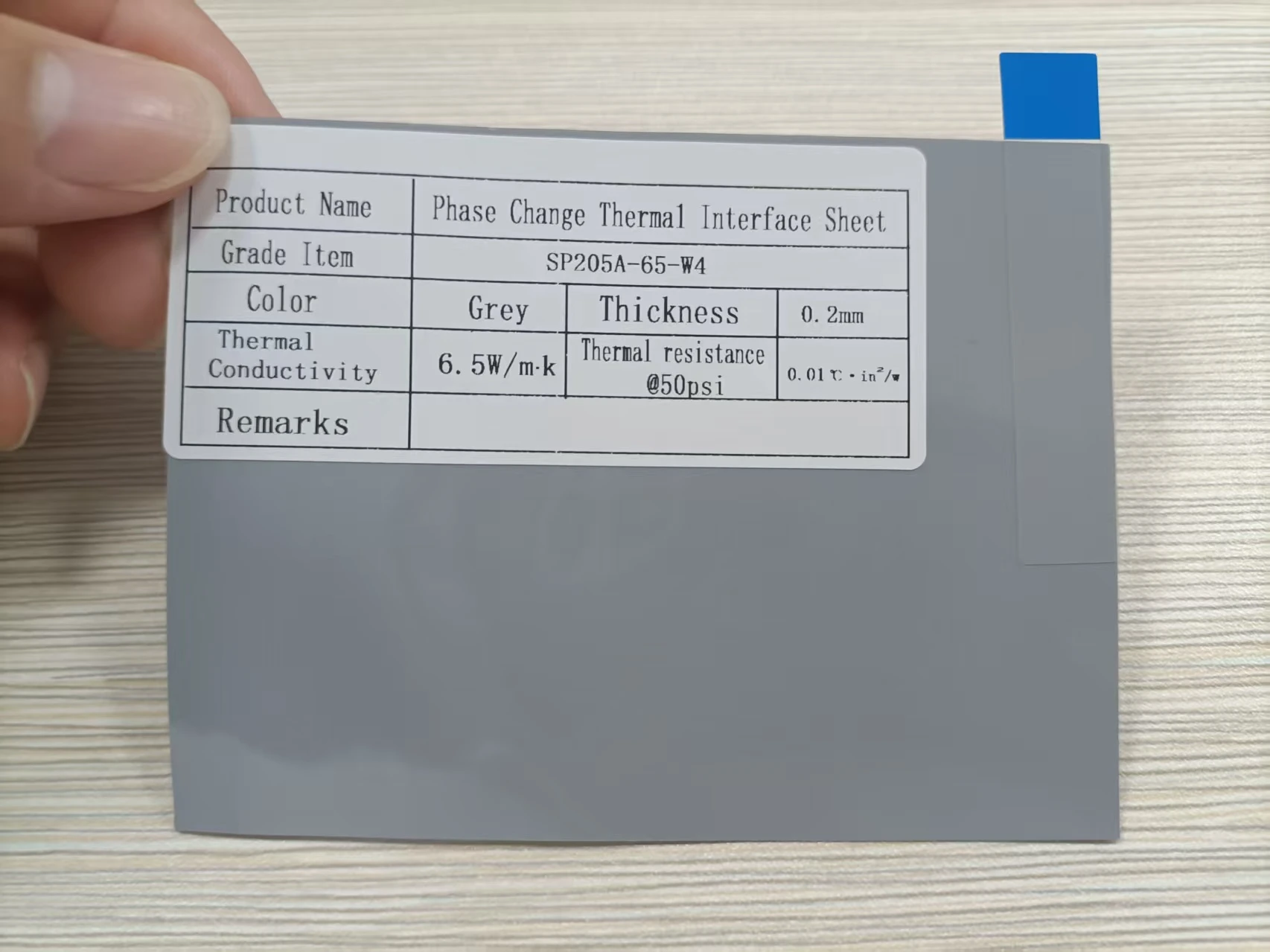
Comparative: Flat PCM Vs. Customized PCM Designs
A quick heads-up before diving in: picking between standard sheets and a custom-shaped phase change material setup can feel like choosing between off-the-rack and tailored gear. Both work, just differently. In thermal management, those differences show up fast—especially when heat loads spike and layouts get messy.
Flat PCM
Flat sheets of phase change material keep things simple, but that simplicity comes with trade-offs when heat paths get uneven.
- Core traits:
- Standard form factor keeps installation quick
- Predictable latent heat storage
- Basic 열 전도성 without directional tuning
- Performance flow:
- Heat hits the surface
- Heat absorption begins as melting starts
- Energy is stored, delaying temperature rise
- Where it struggles:
- Complex boards:
- Uneven hotspots
- Limited spread due to fixed geometry
- Weak 열 관리 in dense zones
- Complex boards:
- Practical note: Flat PCM behaves best in uniform layouts. Once components stack or spacing tightens, temperature uniformity slips, even with decent encapsulation methods.
Customized PCM Designs
A custom-shaped phase change material setup flips the script by adapting to the device instead of forcing the device to adapt. That includes custom phase change material blocks, molded inserts, and fully custom PCM geometries.
- Design hierarchy:
- Geometry tuning:
- Custom geometry aligns with hotspots
- 개선 heat transfer efficiency
- Material structuring:
- Encapsulated or hybrid layers
- 부스트 열 성능
- Geometry tuning:
- Optimization path:
- Map thermal load
- Shape custom-shaped phase change material accordingly
- Integrate into application-specific 레이아웃
- Why it wins in advanced systems:
- Handles complex shapes with ease
- Enables integrated solutions for GPUs and power modules
Short take: a custom-shaped phase change material or even a fully custom PCM build gives tighter control, especially when paired with design expertise from teams like Sheen Materials. It’s not just cooling—it’s precision cooling.
Layered: From Material To Mold: PCM Design Stages
A smooth path from raw stuff to molded performance parts matters more than it sounds. This flow ties material science, shaping, and production into one clean system for real cooling gains.
Material Selection & Composition
- Picking a phase change material starts with core thermal properties
- Target melting temperature aligns with device heat peaks
- Balance latent heat, specific heat capacity, 및 열 전도성
- Paraffin: stable, easy cycling
- Salt hydrates: higher density, sharper transitions
- Eutectics: tuned blends for tight ranges
→ Material compatibility with housings avoids degradation
Custom-shaped phase change material design often begins here, where a custom phase material or shaped phase material is tuned for load behavior. A Custom-shaped phase change material from Sheen Materials keeps repeat cycling predictable without messy drift.
Prototype Fabrication & Additive Manufacturing
Rapid loops matter.
- Prototyping with additive manufacturing speeds validation
- 3D printing supports layer-by-layer fabrication of test units
Short passes:
Small batch.
Test heat spikes.
Refine geometry.
“Thermal interface innovation is increasingly driven by rapid prototyping cycles and digital manufacturing workflows,” notes a 2025 IDC advanced packaging brief.
A custom-shaped PCM prototype lets engineers tweak form before scaling.
Custom Geometry Modeling & 3D Printing
- CAD software defines geometric design precisely
- 3D modeling builds custom shapes
- Handles complex geometries via slicing software
- 3D modeling builds custom shapes
Flow:
- Map hotspot zones
- Build digital design
- Print and validate
Custom-shaped phase change material adapts tightly to chips, not the other way around.
Encapsulation Techniques & Sheets Formation
- Microencapsulation for stability
- Polymer films enable flexible sheets
- Barrier materials improve containment
Steps:
- Select shell chemistry
- Apply coating
- Form sheets via extrusion
A shaped phase material in sheet form integrates cleanly into tight assemblies.
Vacuum Forming of Molded Shapes
- Vacuum forming 그리고 thermoforming shape plastic sheets
- Driven by mold design and precise tooling
Sequence:
- Heat sheet
- Pull over custom molds
- Cool and trim
Sheen Materials supports this stage so each custom phase material holds thickness control and strong contact where it counts.
3 CAD Tips For PCM Shaping
Custom-shaped phase change material design isn’t just lab talk—it’s how real devices stay cool under pressure. When custom-shaped PCM, phase change material shaping, and tailored thermal forms meet smart CAD, performance jumps. This quick read breaks down how geometry, heat flow, and durability all click together in practical builds.
Leverage Parametric Design for Phase Transition Temperature Control
- Parametric inputs tie design geometry to 재료 속성, allowing the phase transition temperature to shift with intent, not guesswork.
- With temperature control, small geometric tweaks reshape the melting range in a custom-shaped phase-change material block.
1) Define constraints
- a) target phase window
- b) allowable transition range
2) Map geometry variables
- a) cavity volume
- b) fin spacing
3) Iterate material blends
Nested flow:
- Core model
- Geometry layer
- Adjusts design 두께
- Material layer
- Tunes 재료 속성
- Impacts phase transition temperature directly
- Geometry layer
Short notes: tighter curves, faster response. Broader mass, slower melt. Sheen Materials often aligns these variables into ready-to-tune libraries for custom-shaped PCM builds.
Simulate Heat Flux to Refine Thin-Film Geometries
- Simulation reveals heat flux paths before fabrication.
- Thin-film layouts sharpen thermal modeling accuracy.
Process chain:
- Model setup
- boundary conditions
- 전력 밀도
- mesh control
- boundary conditions
- Run thermal passes
- Analyze flux gradients
- Geometry refinement
- Adjust thin-film geometry
Table snapshot:
| Case | Heat Flux (W/cm²) | Film Thickness (mm) | Temp Spread (°C) |
|---|---|---|---|
| A | 12 | 0.4 | 6.2 |
| B | 18 | 0.3 | 4.8 |
| C | 22 | 0.25 | 3.9 |
Tighter films, better uniformity. That’s where phase-change material shaping meets simulation-driven gains, often refined using Sheen Materials datasets.
Optimize Wall Thickness to Enhance Thermal Cycling Stability
- Optimization balances wall thickness with 내구성.
- 안정적 thermal cycling keeps custom-shaped phase change material from cracking out early.
Sequence:
- Set load cycles
- define cycling count
- Adjust walls
- thin for response
- thick for stability
- Validate fatigue
Deep structure:
- Mechanical layer
- stress zones
- influenced by wall geometry
- stress zones
- Thermal layer
- expansion rates
- tied to thermal cycling
- expansion rates
- Outcome
- long-term enhancement of reliability
Thinner reacts faster; thicker lasts longer. The sweet spot depends on use. Sheen Materials usually tunes this balance so a custom-shaped PCM stays consistent across thousands of cycles.
How To Integrate Custom PCM Into PCBs?
Getting custom-shaped phase change material into boards isn’t sci-fi anymore—it’s a practical move for tighter 열 관리. With smarter material integration and process control, engineers can slot phase change material right into PCB workflows without wrecking reliability or form factor.
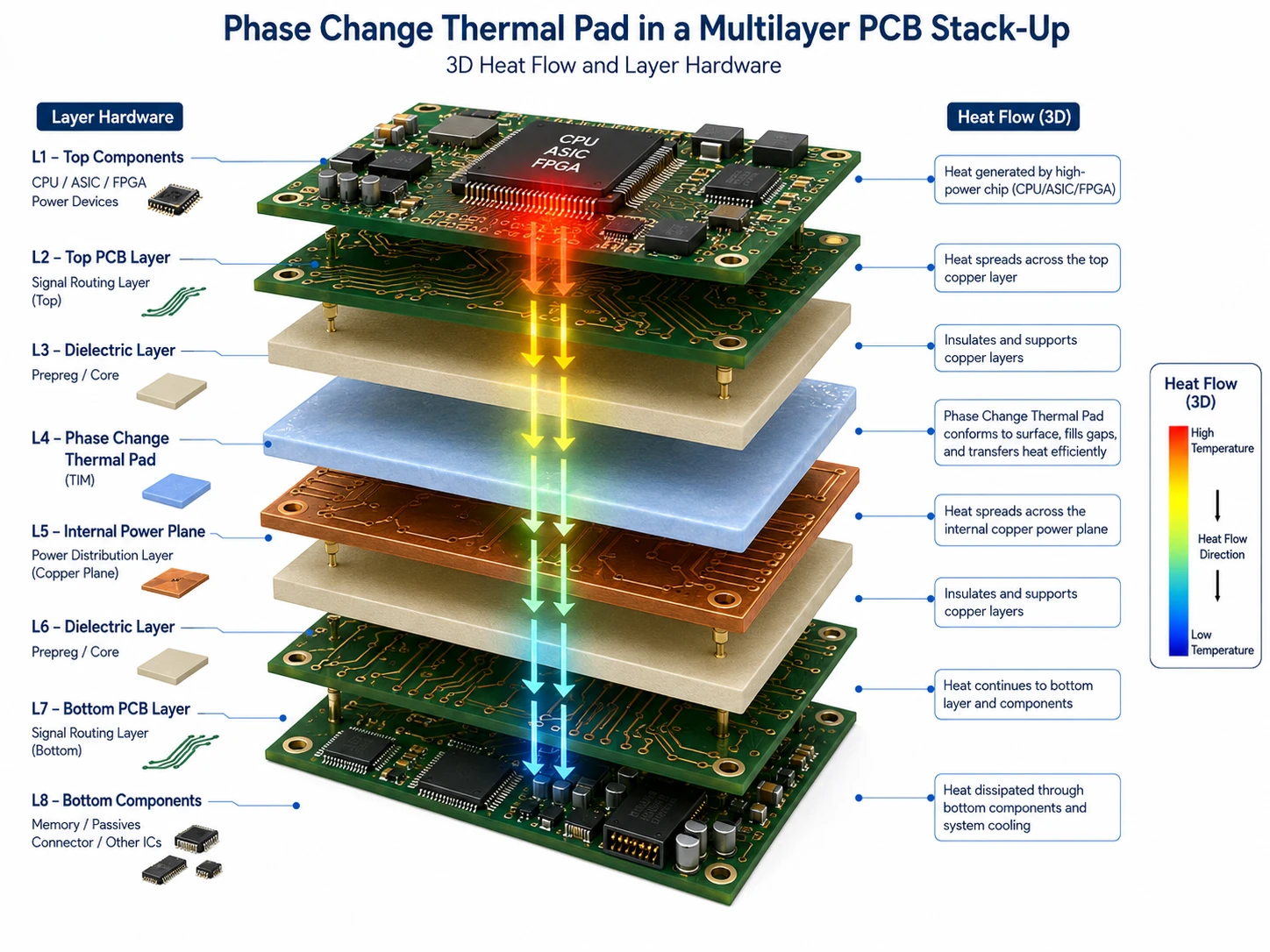
Can Encapsulated PCM Fit Within Multilayer PCB Stacks?
- Integration path:
- Encapsulated PCM placement inside Multilayer PCB:
- Core-adjacent embedding → keeps layer thickness stable
- Cavity-based insertion → preserves form factor
- Stack considerations:
- Resin compatibility
- Lamination pressure tolerance
- Encapsulated PCM placement inside Multilayer PCB:
1) Design → define thermal hotspots
2) Select custom-shaped phase change material format
3) Validate PCB stack compression behavior
A custom-shaped phase material insert must match copper density zones, or warpage creeps in. Teams working with Sheen Materials often tune capsule size to match dielectric spacing, which keeps both heat flow and board integrity in check.
How to Ensure Electrical Isolation With Conformal Coating?
- Key layers:
- Conformal coating over insulation material
- 부스트 유전체 강도
- Shields PCB protection zones
- Conformal coating over insulation material
• Match coating chemistry with 열 전도성 needs
• Avoid voids near electrical isolation boundaries
Steps:
1) Dispense phase change material
2) Cure or stabilize
3) Apply coating evenly
4) Inspect for pinholes
A custom-shaped phase change material blob near fine-pitch components needs tighter coating control, or leakage risk rises.
What Dispensing Process Suits PCB-Level Manufacturing?
- Process stack:
- Automated dispensing systems:
- 제어 material deposition
- Inline process control
- Automated dispensing systems:
1) Tune material viscosity
2) Calibrate jet or needle
3) Lock repeatable precision application
- For volume production:
- Jetting → speed
- Time-pressure → accuracy
A custom-shaped phase material works best when deposition paths mirror pad geometry. Sheen Materials supports this by pre-formulating PCM rheology for stable flow during high-speed PCB runs.
How to Validate Thermal Cycling Performance on Boards?
- Validation flow:
- Lab screening:
- DSC for phase range
- Initial performance validation
- Board-level checks:
- Environmental chamber
- 와이드 temperature range swings
- Monitor thermal stress
- Lab screening:
1) Run 100–1000 thermal cycling loops
2) Inspect for 재료 성능 저하
3) Confirm PCB assembly integrity
Multiple quick checks:
- Warpage after cycling
- Leakage signs
- Thermal response drift
A well-tuned custom-shaped phase change material should hold phase stability across cycles, keeping hotspots calm without cracking the stack.
Power Electronics: Optimize Cooling With PCM
Think tighter thermal control, fewer hotspots, and longer life for components that run hard all day.
IGBT Modules: Reducing Peak Temperature With Custom Geometries
- Custom-shaped phase change material fitted around an IGBT module trims peak temperature during fast switching.
- Custom geometry PCM hugs hotspots, boosting 열 방출 in semiconductor stacks.
- Map heat zones in the module
- Shape PCM blocks to match copper traces
- Seat custom-shaped phase change material near die edges
- Validate 열 관리 with cycling tests
Nested approach:
- Design path
- Geometry tuning
- curved inserts near bond wires
- thin fins over die corners
- Material pick
- paraffin blends for quick melt
- salt hydrates for higher capacity
- Geometry tuning
- Integration
- mechanical fit
- clip-in carriers
- gap fillers
- 성능
- lower peak temperature
- steadier junction temps
- mechanical fit
Short notes: tighter fit, faster absorption, calmer transients.
Power Modules & Heat Dissipation in Automotive Electronics
- Power module cooling in 자동차 전자 제품 benefits from custom-shaped phase change material packs.
- Even temperature means fewer failures across electronic components in a vehicle.
Data snapshot:
| Load (W) | Max Temp w/o PCM (°C) | With Custom-shaped PCM (°C) |
|---|---|---|
| 150 | 98 | 84 |
| 200 | 112 | 93 |
| 250 | 126 | 101 |
| 300 | 139 | 109 |
| 350 | 151 | 118 |
Multi-level flow:
- Thermal design
- hotspot mapping
- enclosure airflow
- PCM placement
- baseplate channels
- sidewall inserts
- Outcome
- improved 열 방출
- smoother gradients
Sheen Materials supplies cut-to-fit PCM blocks that drop into existing housings with minimal redesign.
Thermal Runaway Prevention for GPUs in Telecom Equipment
- GPU racks in telecom equipment risk thermal runaway under nonstop loads; custom-shaped phase change material acts as a buffer.
Sequence:
- Detect spike zones on heatsinks
- Add custom PCM pads near VRMs
- Pair with fans for hybrid cooling system
- Monitor for runaway prevention
Layered setup:
- Heat management
- primary: vapor chamber
- secondary: custom-shaped phase change material
- Control
- sensors
- throttling rules
- Result
- stable temps in data center cabinets
- reduced failure events
Quick hits: less noise, fewer throttles, longer uptime.
Data-Driven: Data Shows 30% Faster Cooldown With Custom PCM
Real lab data, not vibes: custom-shaped phase change material keeps electronics cooler, faster. By tuning shape, melt point, and fit, a custom-shaped phase change layer pulls heat where it spikes. With 광택 재질, the custom-shaped PCM approach translates into tighter temperature control and fewer thermal surprises.
Experimental Setup & Thermal Analysis by DSC
- Core setup:
- Experimental setup aligns heaters, sensors, and sample pans
- Differential Scanning Calorimetry (DSC) tracks heat flow through cycles
- Phase change material (PCM) samples shaped to device geometry
1) Calibrate baseline → 2) run heating/cooling ramps → 3) capture thermal properties → 4) repeat for 재료 특성화.
↳ Deep read:
- Inputs
- geometry: custom-shaped phase change material coupons
- environment: controlled ramp rates
- Outputs
- melt peak, latent heat, hysteresis
- stability across cycles
- Insight
- shape + chemistry tunes transition window
Clean peaks, stable cycles, predictable melt. 광택 재질 refines custom-shaped PCM profiles to match hotspots, not averages.
Quantifying Cooling Capacity & Temperature Uniformity
Multiple snapshots:
- Faster cooldown rate, flatter gradients, tighter 온도 분포
- 더 높음 cooling capacity with targeted placement
- 일관성 열 성능 under burst loads
Sequence:
- Map heat sources → 2. fit custom-shaped phase change material → 3. validate 열 방출 → 4. compare cooldown.
“Advanced PCM integration shows measurable gains in cooldown and uniformity across compact electronics,” notes a 2025 IDC thermal management brief.
Symbols:
- Fewer performance limitations • Less peak fluctuations • Smoother thermal management
Sheen Materials combines custom-shaped phase change material designs with enclosure constraints, so uniformity is not accidental, but the result of careful design.
Scaling Insights for High-Performance Computing Applications
Nested rollout for high-performance computing (HPC) 그리고 data centers:
- System layer
- node: CPUs/GPUs + custom-shaped phase change material inserts
- rack: airflow + thermal management systems coordination
- Load layer
- steady vs burst heat load 처리
- redundancy for peak events
- Integration layer
- cold plates + electronic cooling hybrids
- serviceability without PCM drift
Steps in practice:
1) profile hotspots → 2) deploy custom-shaped PCM modules → 3) monitor → 4) iterate.
Scalable gains in thermal scalability and uptime. With 광택 재질, custom-shaped phase change material moves from lab to aisle, keeping dense compute calm under pressure.