-
추가:: 둥관 헝주탕 로드 8호 빌딩 2, 동관
-
전화: 전화 +86 135 4224 3751

Future-Proof Your Data Center: Silicone-Free Thermal Conduction for AI Servers
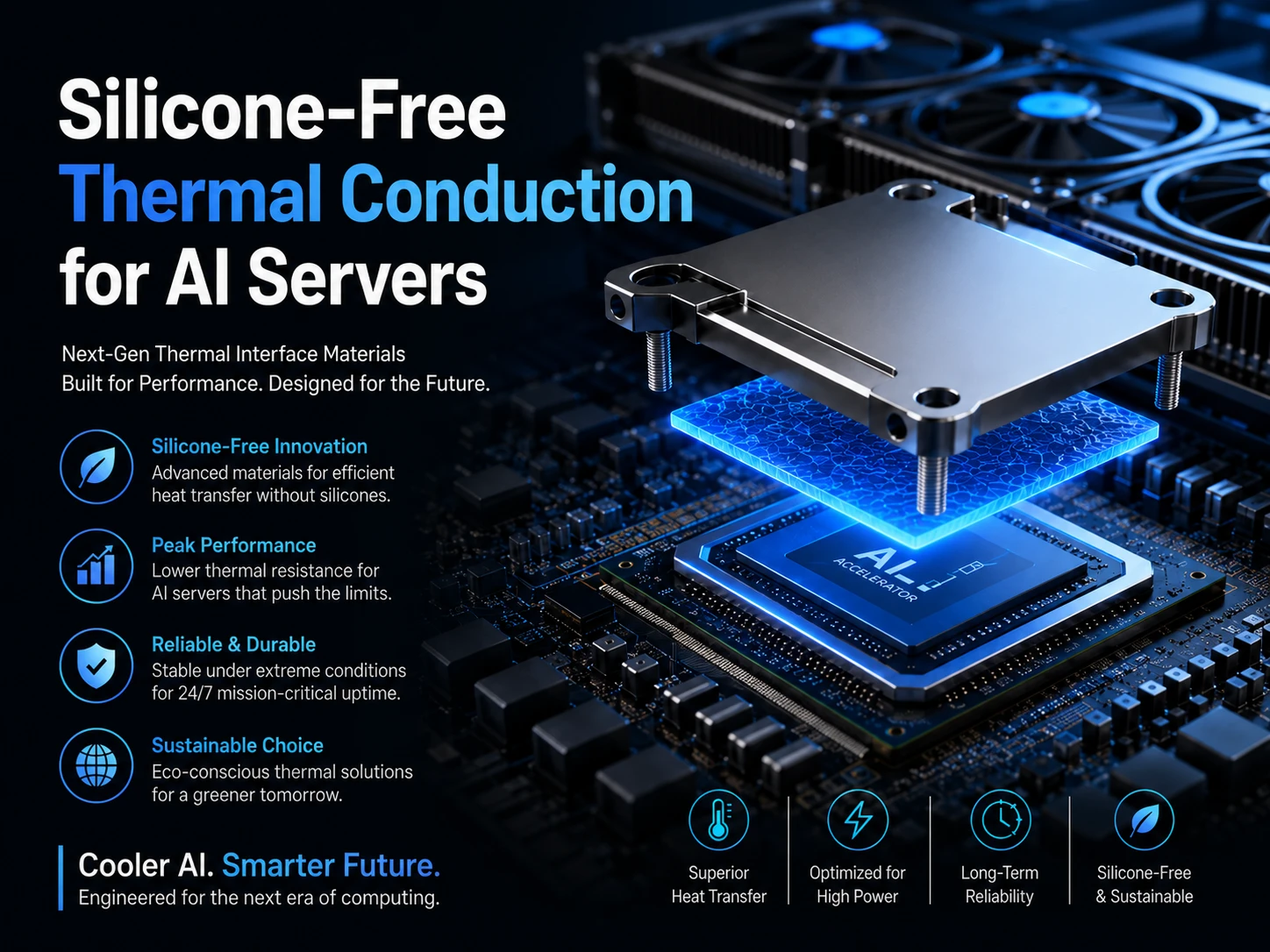
Silicone-free thermal conduction for AI servers is no longer a lab curiosity; it’s the pressure valve for overheated racks, ballooning energy bills, and hardware that quietly throttles when the heat creeps in.
Buyers don’t need magic, materials that stay put, run cooler, and behave on the line, cutting downtime, drift, and messy surprises at scale.
Lyrical Key Points: Silicone-free thermal conduction for AI servers
- Explore diverse material classes—from pastes and pads to liquid metals—optimizing thermal resistance and bond line thickness.
- Leverage graphite and boron nitride for enhanced heat dissipation, electrical insulation, and low outgassing in high-density CPU/GPU cooling.
- Implement precision dispensing, screen printing, and surface preparation to ensure uniform interfaces between silicon dies and copper heatsinks.
- Ensure long-term stability and reliability under extreme operating temperatures, resisting pump-out and maintaining consistent junction temperatures.

What Are Thermal Interface Material Classes?
AI racks run hot—no surprise there. When pushing Silicone-free thermal conduction for AI servers, material choice isn’t just a detail; it’s survival gear. From pastes to liquid metal, each class balances heat transfer, electrical safety, and long-term reliability in high-density compute rooms.
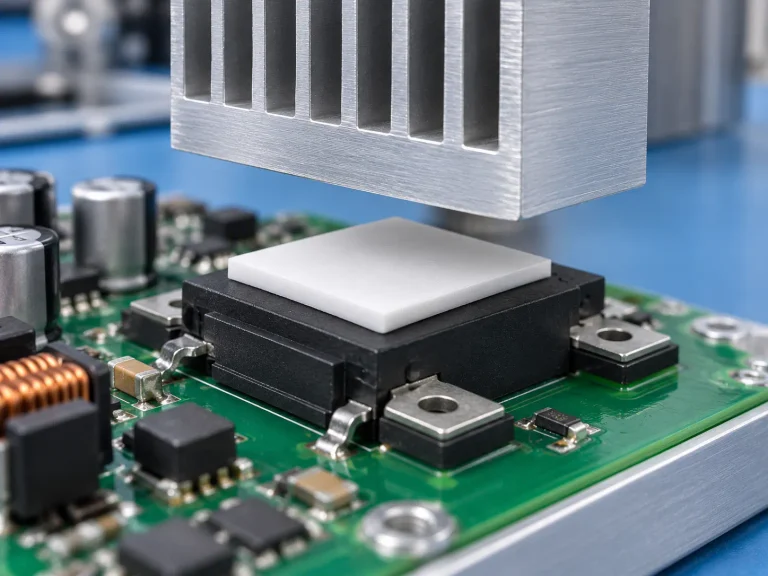
Thermal Pastes and Greases
At the core of Silicone-free thermal conduction for AI servers, thermal paste 그리고 thermal grease sit between chip and heatsink, smoothing microscopic air gaps that choke 열 전달.
Key traits people look at:
- non-curing behavior to avoid cracking
- controlled 점도 for clean spread
- resistance to pump-out under thermal cycling
In AI server boards:
- Die → cold plate contact
- Thin bond line → lower resistance
- Stable interface → consistent GPU boost clocks
For silicone-free thermal conduction, silicone-free blends reduce contamination risk in optical modules and high-speed connectors. That matters in AI clusters where even slight residue can mess with signal integrity.
광택 재질 develops silicone-free pastes tuned for AI accelerators. The application method—screen print, stencil, or syringe—changes flow and final thickness. Pick wrong, and temps creep up. Pick right, and racks stay cool without drama.
Silicone-free thermal conduction for AI servers isn’t hype; it’s how hyperscale teams avoid downtime.
Phase-Change Materials and Polymer Matrix
Phase change materials start as a solid. As the chip heats, they reach a designed melting temperature, softens, and improves surface wetting. That’s gold for Silicone-free thermal conduction for AI servers where flatness isn’t perfect.
Inside the stack:
- Base film
- 폴리머 매트릭스
- conductive fillers
- binder chemistry
- release liner
During thermal cycling, the material adapts. Repeated ramp-up and cool-down won’t easily crack the interface. Re-flow during operation tightens contact, cutting contact resistance and boosting 열 방출.
Performance comparison (typical ranges):
| 재료 유형 | 열 전도성(W/m-K) | Operating Temp (°C) | Bond Line Thickness (µm) | Electrical Property | 재사용 가능성 |
|---|---|---|---|---|---|
| PCM A | 3-5 | 0–120 | 20–40 | Insulating | Limited |
| PCM B | 5-8 | 10–150 | 15–35 | Insulating | 보통 |
| Polymer Matrix Grease | 6-10 | -20–180 | 10–30 | Insulating | Yes |
| Hybrid PCM | 8–12 | 20–160 | 15–25 | Insulating | Limited |
| Silicone-Free PCM | 4–9 | 0–140 | 20–35 | Insulating | 보통 |
For Silicone-free thermal conduction for AI servers, conformability and stable 재료 구성 prevent voids in high-power ASICs. Short story: better contact, fewer hotspots.
Thermal Pads, Gap Fillers, and Ceramic Fillers
When components vary in height, 열 패드 그리고 gap fillers step in. Soft, conformable, and designed with tuned 압축성, they bridge VRMs, memory stacks, and power stages.
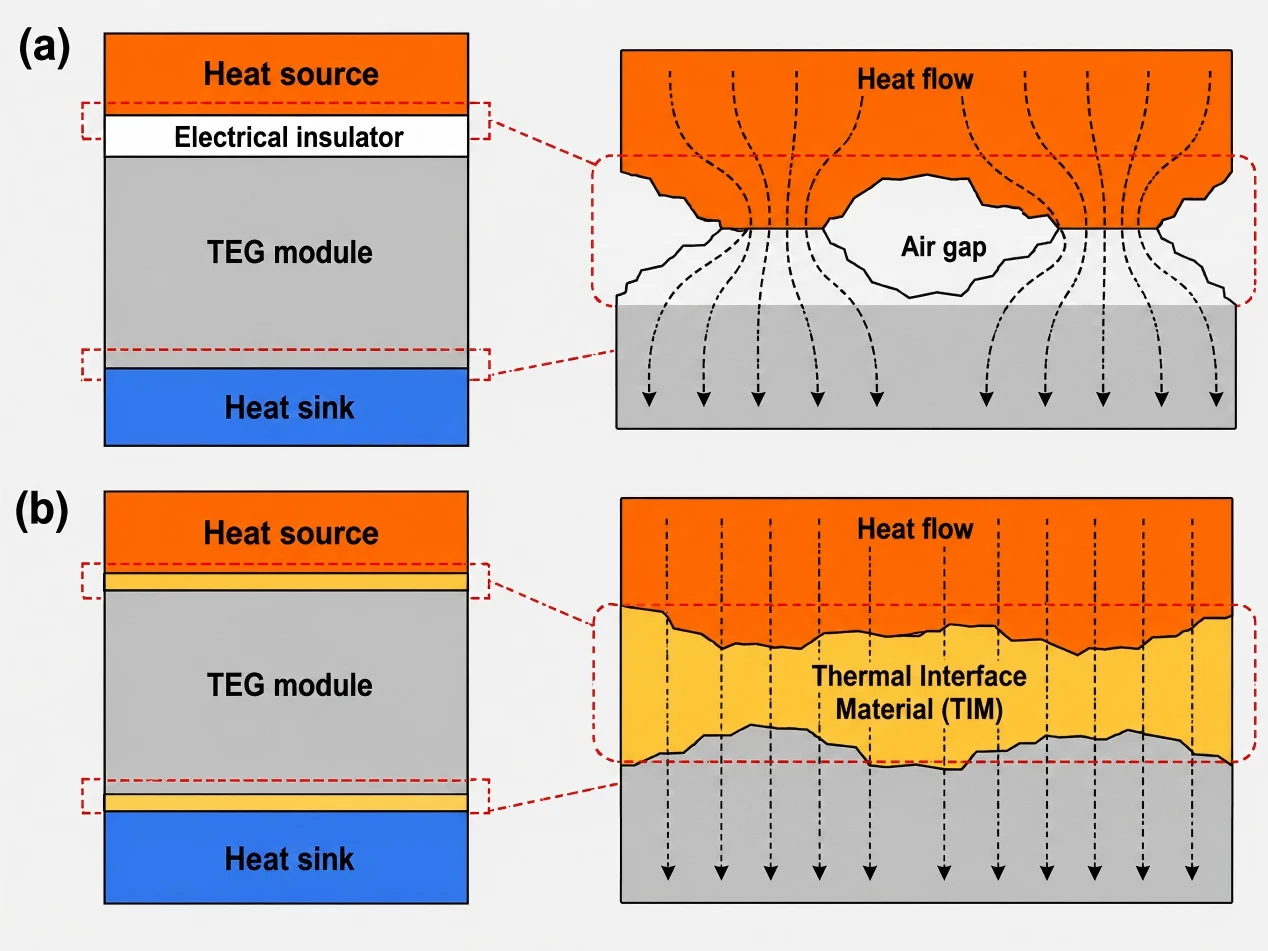
Their inner mix often includes 세라믹 필러 like boron nitride. Why?
- 전기 절연
- stable 열 확산
- predictable material thickness control
For AI server motherboards:
- Measure the gap height
- Select pad thickness
- Apply compression target
- Validate contact pressure
In Silicone-free thermal conduction for AI servers, pads must avoid silicone bleed. That keeps optical modules clean and reduces maintenance headaches.
광택 재질 supplies silicone-free pad solutions that balance softness and structural integrity. Too soft, and they slump. Too hard, and they don’t sit properly. Dialed in correctly, they quietly move heat away from sensitive AI memory modules all day long.
Liquid Metal Alloys and Thermal Adhesives
At the end, liquid metal based on a gallium alloy offers high conductivity—often 30–70 W/m·K. That’s serious muscle for overclocked AI accelerators.
But there’s a catch:
- high electrical conductivity
- risk of corrosion
- strict handling controls
Liquid metal suits controlled environments, not casual installs. Interface containment is critical for long-term stability.
On the other hand, thermal adhesive solutions provide permanent interface bonding. The curing process locks components in place, useful in edge AI modules exposed to vibration.
For Silicone-free thermal conduction for AI servers, adhesives without silicone reduce contamination risk and improve 장기적인 안정성 in dense racks. 광택 재질 aligns these formulations with AI hardware makers aiming for reliable 24/7 inference.
In high-density AI data centers, Silicone-free thermal conduction for AI servers isn’t optional. It’s the difference between peak performance and throttled silicon.
3 Benefits of Silicone-Free Thermal Conduction
Silicone-free thermal conduction for AI servers is getting serious attention in every major data center buildout. As AI servers push higher rack density and brutal junction temperatures, old interface materials just can’t keep up. This is where Silicone-free thermal conduction for AI servers shifts the game—cleaner, cooler, and built for long-haul reliability.
Enhanced Heat Dissipation via Graphite and Boron Nitride
Silicone-free thermal conduction for AI servers depends heavily on advanced fillers like graphite 그리고 boron nitride to boost thermal conduction and real-world 열 방출.
- Material Layer
- 흑연
- High in-plane conductivity
- Rapid lateral heat spreading across CPU lids
- 질화붕소
- Strong through-plane conduction
- Stable under continuous cooling cycles
- 흑연
- System Impact in AI servers
- Lower peak die temperature
- Reduced thermal throttling
- More consistent GPU output
In dense data center racks, Silicone-free thermal conduction for AI servers moves heat away from hotspots fast. The result? Chips stay in their performance window longer. Sheen Materials engineers these composites to match mounting pressure profiles, so thermal contact remains tight without messy silicone bleed.
Improved Electrical Insulation and Reduced Outgassing
Performance is not just about temperature. It’s also about 전기 절연 and contamination control.
- Silicone-free matrices reduce 가스 배출 under sustained load.
- Cleaner interfaces protect micro-solder bumps.
- Stable dielectric strength supports high-frequency AI accelerators.
Recent semiconductor packaging updates reflect this shift:
“Advanced data center processors are increasingly sensitive to material volatility and ionic residues,” noted a 2025 SEMI materials outlook, highlighting tighter contamination thresholds for high-density packaging.
For AI servers, Silicone-free thermal conduction for AI servers protects signal integrity while sustaining thermal conduction efficiency. Sheen Materials aligns formulations with RoHS and low-VOC expectations, keeping reliability and performance in balance.
Longer-Term Stability under High Junction Temperatures
Step 1: Replace silicone pads with silicone-free thermal interface layers engineered for high junction temperatures.
Step 2: Maintain compression consistency to prevent pump-out.
Step 3: Sustain low thermal resistance across repeated high temperatures in 24/7 data center duty cycles.
Silicone-free thermal conduction for AI servers resists dry-out, cracking, and migration. That stability directly supports longevity. In AI server clusters running nonstop training loads, Silicone-free thermal conduction for AI servers keeps thermal pathways predictable—no drift, no surprise spikes, just steady stability over time.
High-Density GPUs: Silicone-Free Heat Paths
Silicone-free thermal conduction for AI servers is no longer a niche idea; it’s becoming the go-to path for dense AI racks that run hot and hard. When uptime matters and GPUs push extreme loads, clean heat paths and stable materials simply make sense.
Copper Heatsink Interfaces for GPU Cooling
In high-density clusters, Silicone-free thermal conduction for AI servers starts at the contact point between the die and copper heatsink. That interface decides how smoothly 열 전달 moves away from a loaded GPU.
- Core interface stack
- Silicon die
- Direct contact with the 열 인터페이스 layer
- Minimized voids for stable cooling
- Copper heatsink base
- High flatness control
- Optimized surface roughness for high-density mounting
- Silicon die
- Performance drivers
- Lower thermal resistance
- Uniform bond line thickness
- Stable pressure distribution
“AI server power density continues to rise, making advanced thermal interface innovation essential for data center efficiency and reliability,” noted Gartner in its 2025 data center infrastructure outlook.
Silicone-free thermal conduction for AI servers avoids pump-out issues often seen in silicone systems. The result? Cleaner contact, tighter 열 인터페이스 behavior, and fewer surprises during long AI training cycles. For operators chasing dependable AI server cooling, silicone-free thermal interface materials are quickly becoming the safe bet.
Automated Dispensing and Surface Preparation Methods
Getting Silicone-free thermal conduction for AI servers right is not just about materials; it’s about automated dispensing and smart 표면 준비 in the manufacturing line.
• Precision dispensing 는 thermal material evenly spread.
• Screen printing controls thickness across large GPU arrays.
• Plasma or micro-abrasion 표면 준비 boosts adhesion.
- Clean substrate.
- Apply controlled volume through automated valves.
- Inspect the bond line with inline metrology.
When the process is dialed in, repeatable application means stable AI server cooling performance rack after rack. Sheen Materials supports this flow with materials tuned for automated production, helping teams move from lab validation to full-scale deployment without drama.
Reliability in Extreme Operating Temperature Ranges
For data centers running 24/7, Silicone-free thermal conduction for AI servers must survive wide operating range swings and heavy thermal cycling.
- Reliability matrix
- Low-temperature startup
- Maintains elasticity under extreme temperatures
- Prevents micro-cracking
- High-load operation
- Sustains 성능 under GPU boost states
- Resists material bleed
- Long-term validation
- Accelerated stress testing
- 확인됨 내구성 in data center racks
- Low-temperature startup
Short bursts of heat are easy. Years of cycling are not. Silicone-free thermal conduction for AI servers reduces mechanical fatigue, keeping contact stable and resistance low. Sheen Materials engineers its compounds for that grind—steady output, fewer maintenance headaches, and performance that doesn’t quietly drift over time.