-
ADD: Building 2, No. 8 Hengzhutang Road, Dongguan
-
Phone: +86 135 4224 3751

Which High-temperature Resistant Insulating Sheet Material is Best for Your Project?
When your circuitry’s cooking hotter than a summer sidewalk in Phoenix, you’d better bet your bottom dollar that the right high-temperature resistant insulating sheet isn’t just “nice to have”—it’s mission-critical. One wrong pick and poof—your project could short out faster than a firecracker on the Fourth of July.
Some folks chase heat ratings like they’re collecting baseball cards, but performance isn’t just about numbers—it’s about how those sheets hold up when reality bites: moisture sneaks in, heat cycles grind down edges, and compliance checks loom like final exams. You want answers that work as hard as your components do? Buckle in—we’re breaking it all down without the fluff.
High-Temperature Resistant Insulating Sheet Basics You Must Understand First
This guide breaks down the essentials of high-temperature resistant insulating sheet materials—how they’re made, what they can handle, and why form matters.
Unpacking Product Forms: Sheets, Rolls & Custom Gaskets
Different jobs call for different shapes. Here’s how to pick your match:
Sheet material is ideal for wide-area insulation across panels or enclosures.
Roll stock works best in automated production lines needing continuous feed.
Custom gaskets come into play when sealing odd-shaped electrical components.
You’ll also find die-cut parts and other fabricated shapes, which are tailored to fit unique designs. These insulating forms keep things snug and safe where standard sizes just won’t cut it.
Temperature Resistance vs. Moisture Absorption: Why It Matters
When heat and humidity hit, poor choices crack under pressure—literally. Here’s what you need to know:
High thermal stability ensures the material won’t degrade at elevated operating temperatures.
Low moisture uptake means better performance in damp environments.
Strong hydrolytic stability prevents breakdown even with long-term exposure to water vapor.
⚠️ If your application faces steam or fluctuating temps, balancing these traits protects both safety and longevity.
Core Material Properties: Thermal Conductivity & Dielectric Strength
Let’s break this down with a quick comparison table of common materials used in high-temp insulation:
| Material Type | Thermal Conductivity (W/m·K) | Dielectric Strength (kV/mm) | Max Operating Temp (°C) |
| Mica-based Sheet | 0.2 | 20 | 500 |
| Ceramic Fiber Board | 0.08 | 12 | 1260 |
| Silicone-Coated Film | 0.25 | 28 | 260 |
| Polyimide Laminate | 0.12 | 30 | 400 |
Low heat transfer, paired with high electrical insulation, makes these materials perfect for demanding setups like transformers, motor windings, or PCB barriers.
Manufacturing Processes Explained: Lamination, Sintering, Coating
The way a sheet is made changes everything—from strength to moisture resistance:
A. Start with lamination:
Multiple layers are pressed together using heat and adhesive.
This boosts mechanical strength and structural integrity through the lamination process.
B. Then comes sintering:
Fine particles are heated until they bond without melting.
This method enhances density using a precise sintering technique, often seen in ceramic insulation boards.
C. Finish with coating:
A surface layer is added for extra protection against water or chemicals.
Common types include silicone or epoxy via specialized coating application methods.
Each step in this chain directly affects how well the final product handles stress, heat cycles, and moisture ingress—key concerns when choosing any kind of high-temp insulator like a polyimide laminate or mica board from Sheen Electronic Technology.
Key Performance Standards For Insulating Sheets Under Extreme Heat
Understanding how a high-temperature resistant insulating sheet performs under pressure isn’t just smart—it’s essential. Here’s what makes or breaks their performance.
UL Certification Requirements at High Temperatures
UL doesn’t mess around when it comes to heat. To earn that safety certification, materials must prove they can handle serious stress:
✅ Must pass thermal aging tests at elevated temperatures
✅ Maintain dielectric strength after prolonged exposure
✅ Withstand predefined temperature index thresholds without degrading
The real kicker? If the material shows signs of excessive material flammability, it’s game over for certification. That’s why every legit electrical insulation product proudly touts its UL badge—because it means it’s been through the wringer and come out solid.
How ASTM Testing Verifies Flame Retardancy
ASTM methods are like a fire drill for materials—but with actual fire:
Measure how fast flames move across the surface (flame spread)
Test how hard it is to ignite (ignition resistance)
Record smoke output using a controlled chamber (smoke density)
Bonus test: The material’s ability to resist combustion in low oxygen environments, aka its oxygen index, can make or break its scorecard.
If a sheet fails one of these, it’s not fit for high-temp service.
ISO Standards for Dimensional Stability
You don’t want your insulation warping halfway through a job, right? That’s where ISO steps in:
• Tests simulate extreme temperature cycling and mechanical loading
• Measures thermal expansion, shrinkage, and overall shape retention
• Evaluates long-term resistance to sagging or deformation (aka good ol’ creep resistance)
These checks ensure your sheet stays tight, snug, and reliable—even when things get wild.
REACH Compliance and Environmental Safety
No one wants toxic surprises baked into their equipment. Enter REACH:
A compliant material must avoid any listed hazardous substances, especially those flagged as an SVHC (Substance of Very High Concern). Manufacturers must also provide detailed info via a valid material safety data sheet, ensuring full transparency on chemical composition and environmental impact.
This isn’t just red tape—it keeps both users and ecosystems safe from nasty stuff that might leach out under heat.
RoHS Compliance in High-Temp Insulation
RoHS is all about keeping things clean—chemically speaking:
1️⃣ No more than trace levels of banned substances like mercury or cadmium
2️⃣ Absolutely no use of certain types of dangerous flame retardants like PBDEs (brominated flame retardants)
3️⃣ All components must be certified as fully lead-free, which is crucial for electronics facing thermal loads
By meeting the latest version of the RoHS directive, manufacturers show they’re serious about reducing toxic electronic waste—even under heat stress.
So when you see a compliant label on your next high-temp insulator? You’ll know it’s cleared some seriously tough hurdles.
High-Temperature Insulating Sheet Materials Ranked By Heat Resistance
A quick guide to the top high-temperature resistant insulating sheet materials, sorted by how much heat they can handle without breaking a sweat.
Ceramic Fiber Composite Sheets (Up to 1400 °C)
These beasts thrive where most materials melt.
Ceramic fibers are woven into a composite material, giving them insane durability.
Works like magic in refractory applications, aerospace, and blast furnaces.
Their ultra-low thermal conductivity makes them an unbeatable thermal barrier.
Step-by-step breakdown:
Operating range: up to 1400 °C.
Core feature: extreme heat resistance with low mass.
Bonus: Shock-resistant and doesn’t degrade easily over time.
You’ll find these in high-stakes environments—where failure isn’t an option.
Mica Laminate Insulation (Up to 800 °C)
When you need something that won’t crack under pressure—or heat—mica sheets are your go-to. They’re pressed into solid laminate insulation, offering both flexibility and strength.
Use-case highlights:
• Ideal for high-voltage gear thanks to its electrical insulation properties.
• Resists arc damage better than most materials at this range.
• Withstands thermal cycling without flaking or delaminating.
It’s not flashy, but it’s reliable—and sometimes that’s all you need when the heat is on.
Polyimide Film Insulators (Up to 400 °C)
Tough, flexible, and ready for action—polyimide film is the multitool of mid-range insulation jobs.
Here’s why it rocks:
1) It bends without breaking—perfect for tight spaces.
2) The high-performance polymer resists chemicals just as well as it resists heat.
3) It’s super thin, so it’s great for layered builds in electronics.
From EVs to satellites, these thin marvels keep things cool where it counts.
Silicone Resin Coated Paper (Up to 250 °C)
This one sits comfortably between old-school paper and modern tech—it’s paper wrapped in armor! The silicone resin coating adds serious muscle against moisture and moderate heat swings.
Let’s break it down:
▪ Used heavily in electric motors and transformers.
▪ Provides consistent dielectric stability even under vibration or humidity stress.
▪ Its flexibility makes installation a breeze—no cracking or curling here!
Think of it as the duct tape of electrical insulation: simple but surprisingly effective.
Fiberglass-Epoxy Laminate (Up to 180 °C)
Here comes the workhorse of moderate-temp environments—the classic combo of fiberglass fabric soaked in toughened epoxy resin, then pressed into rigid boards.
Grouped use-cases & attributes:
A) Electrical Performance
‣ Excellent dielectric properties make it perfect for printed circuit boards.
‣ Commonly seen in switchgear panels and relay bases.
B) Mechanical Strength
‣ Reinforced structure holds shape under load.
‣ Doesn’t warp or deform easily during long-term use.
C) Thermal Behavior
‣ Handles temps up to 180 °C reliably.
‣ Maintains integrity even after repeated heating cycles.
| Property | Value Range | Application Area | Durability Rating |
| Max Temp | Up to 180 °C | Transformers | High |
| Dielectric Strength | >20 kV/mm | PCBs | Very High |
| Flexural Strength | ~400 MPa | Structural insulators | Moderate |
| Moisture Absorption | <0.2% | Outdoor enclosures | Low |
Solid choice when you want toughness without going overboard on cost or complexity—and yes, it’s still holding strong decades later!
EV Batteries And Motors: High-Temperature Insulation Challenges Explained
From battery packs to motor cores, high-temperature resistant insulating sheets play a huge role in keeping EVs safe and efficient when things heat up.
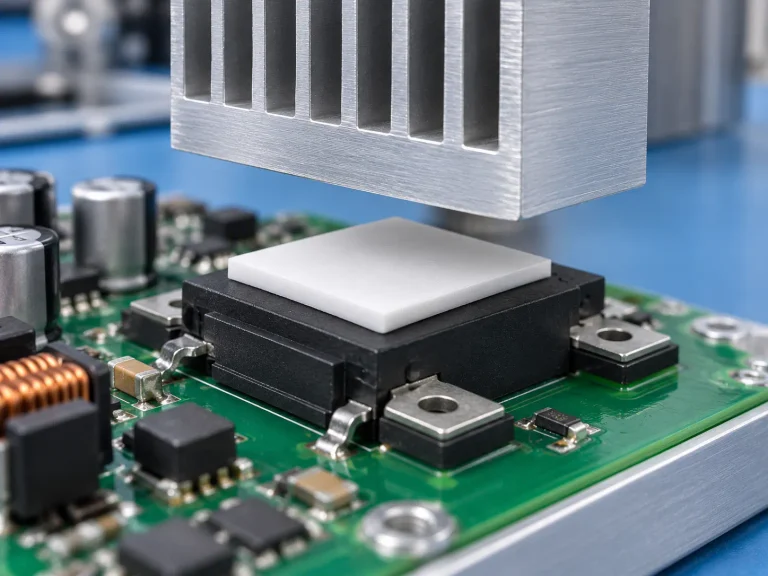
Pack Thermal Management: Balancing Heat & Dielectric Strength
Keeping battery packs cool while also preventing electrical chaos? That’s where thermal conductivity and insulation resistance come into play. A solid thermal interface material bridges the gap between cells and cooling plates, improving heat dissipation without compromising on safety. But here’s the kicker—materials must survive repeated thermal cycling, all while dodging dielectric breakdown that could lead to full-blown thermal runaway. Engineers often rely on layered composite barriers that juggle both thermal control and electric isolation—no easy feat under fluctuating loads and ambient spikes.
Motor Windings: Mechanical Strength Meets Temperature Resistance
Inside the motor, it’s a war zone of movement, heat, and pressure. To stay in shape, insulation must resist crazy levels of mechanical stress, extreme vibration, and long-term thermal aging. The right combination of slot liner, reinforced tapes, and multi-layered interlayer insulation helps prevent issues like partial discharge, which can quietly destroy motors over time. A good chunk of this protection comes from durable forms of electrical insulation, specifically tailored for tight winding geometries where space is tight but reliability is non-negotiable.
According to IDTechEx’s 2024 report on EV motor materials: “The increasing demand for high-efficiency motors is pushing innovation in advanced winding insulation systems that combine chemical endurance with mechanical flexibility.”
On-Board Electronics: UL Certification for Automotive Insulation
You can’t mess around with electronics running at hundreds of volts next to passengers. Every sheet used here needs a proper UL standard rating—not just for show but for actual performance under fire (literally). Meeting the right flammability rating, proving consistent operation under real-world grime through strong environmental resistance, and maintaining long-term function via high-endurance builds are key goals. Only an approved multi-layered insulation system with proven track record in tests like thermal overloads or arc faults meets the bar—and makes it into top-tier automotive-grade EVs like those from Sheen Electronic Technology.
And yep, without strong focus on things like dielectric integrity or solid-state bonding layers, even a great-looking design can fizzle out fast when exposed to prolonged high voltage or harsh climates.
Supplier Evaluation: What Really Matters Beyond Price
Smart buyers know it’s not just about the price tag. Let’s unpack what truly counts when choosing a supplier for your high-temperature resistant insulating sheet needs.
Technical Support & Material Traceability
When dealing with materials like a high-temperature resistant insulating sheet, reliability starts before production even begins.
Engineering support is often the difference between success and scrap. A supplier that offers real-time help during design or troubleshooting can prevent costly mistakes.
Next comes traceability:
Each batch of material should come with proper documentation.
This includes origin details, batch tracking, and full disclosure of material composition.
These records are vital for industries like aerospace or EVs where failure isn’t an option.
If something does go wrong? You’ll want a partner who can perform detailed failure analysis, not just shift blame.
Lastly, clear documentation also helps ensure compliance with safety standards and builds confidence in long-term supply relationships.
Customization Options for Gaskets & Tubes
The gasket or tube doesn’t fit right? That’s a red flag. For applications involving a high-temp insulating sheet, customization is key.
• Suppliers should offer flexibility in:
• Thickness
• Cut shapes
• Tolerance levels
• Want something super-specific?
• Look for providers offering:
• Rapid prototype development
• Multiple iterations before finalizing specs
• Bonus if they allow adjustments based on test runs—because real-world conditions don’t always follow CAD files.
A truly adaptable supplier will work with you to optimize performance without sacrificing durability or thermal resistance.
Lead Time, Bulk Packaging & Delivery Reliability
For manufacturers using bulk rolls or sheets of high-temperature insulation, timing is everything. Delays? They hit your bottom line hard.
Great suppliers manage tight schedules through smart coordination between:
Production planning
Inventory buffers
Streamlined shipping logistics
Packaging isn’t just about looking neat—it must protect material integrity during transit and storage:
Think moisture-resistant wraps
Shock-proof crates for delicate gasket forms
On-time delivery rates matter more than promises. Ask about their historical data on delivery performance and missed shipments.
According to the April 2024 Global Supply Chain Index by IHS Markit, “Consistent lead time fulfillment now ranks as the second most critical factor after raw material cost control in industrial procurement decisions.”
Reliable logistics cut stress—and costs—when working with sensitive materials like a high-temperature resistant insulating sheet.
Quality Standards Adherence: RoHS, REACH & ISO Standards
You don’t want surprises when your product reaches customs—or worse—your client’s QA lab.
Start with certifications: Does the supplier carry up-to-date RoHS and REACH declarations?
Are their facilities audited under an ISO-certified quality management system?
Materials used in your insulation sheets must meet strict thresholds on hazardous substances to align with global regulations.
Even if you’re not selling into Europe today, these rules are becoming baseline everywhere—especially when it comes to environmental safety and product traceability.
Working with compliant partners ensures smoother audits, fewer recalls, and peace of mind that your components won’t be flagged later.
FAQs about High-temperature Resistant Insulating Sheet
What makes these sheets withstand extreme industrial heat?
Ceramic fibers hold firm past 1200 °C, mica steadies near 800 °C—each chosen for its unique blend of low thermal conductivity and steady dielectric strength. Laminated or sintered layers resist warping; silicone resin coatings tighten pores against moisture intrusion, so mechanical strength remains unmoved even inside roaring furnaces or aerospace engines.
Why is certification a silent guardian in global trade?
UL marks tell of tested flame retardancy, ISO standards speak to dimensional stability, RoHS and REACH compliance whisper environmental safety. These seals are shields—assuring buyers their insulation won’t falter under the rules that protect both machines and people across continents.
How do form options shape the way insulation works in the field?
Sheets: broad barriers between live circuits in high voltage panels.
Rolls: wrap induction coils quickly without gaps.
Custom shapes & gaskets: hug irregular housings deep inside automotive electronics or power converters. The right silhouette can mean cooler surfaces and longer service life when every millimeter matters.
What traits set apart a trustworthy bulk supplier?
Clear material traceability ties each sheet to its origin story; technical support turns specifications into workable solutions; customization cuts match design tolerances; dependable lead times keep assembly lines breathing easy while protective packaging guards against damage on long voyages toward industrial floors.