-
ADD: Building 2, No. 8 Hengzhutang Road, Dongguan
-
Telefone: +86 135 4224 3751

Engineering the Best Silicone-Free Thermal Pad for EV Electronics
As EV systems run hotter and tighter, the Silicone-free thermal pad for automotive electronics stops silent contamination before it wrecks performance, cutting risk where silicone bleeds quietly ruins sensitive boards.
Engineers and buyers want clean, stable materials that behave on the line, hold tolerance, and avoid costly failures.
Key Points for Silicone-Free Thermal Pad for Automotive Electronics
- Defining Performance: Thermal conductivity and dielectric strength balance heat transfer with electrical insulation for ECUs, inverters, and BMS.
- Material Breakdown: Silicone-free matrices (acrylic, polyurethane) with boron nitride or graphite eliminate bleed while ensuring stability.
- Engineering Thickness: Optimize compressibility, shore hardness, and bond line control to minimize thermal resistance in automated assembly.
- Compliance & Validation: Meet IATF 16949, AEC-Q100, RoHS/REACH, UL 94; verify thermal cycling, breakdown voltage, and volume resistivity under automotive conditions.
Silicone-Free Thermal Pad for Automotive Electronics Basics
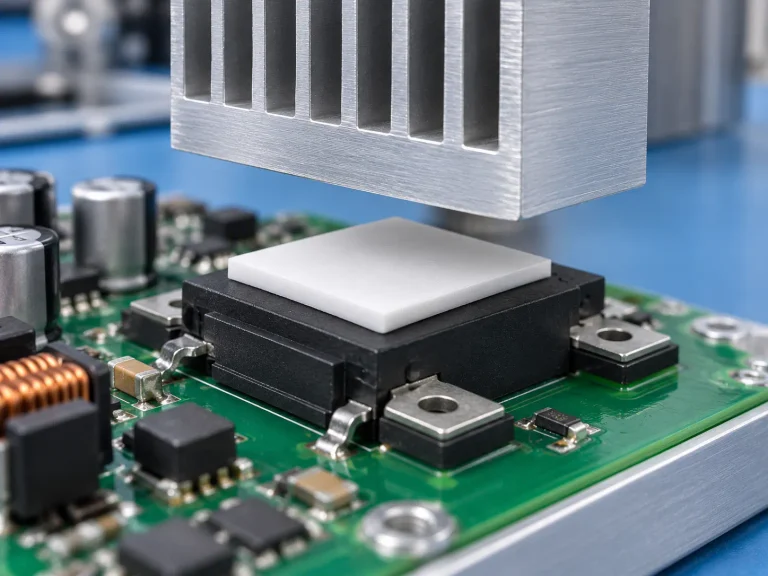
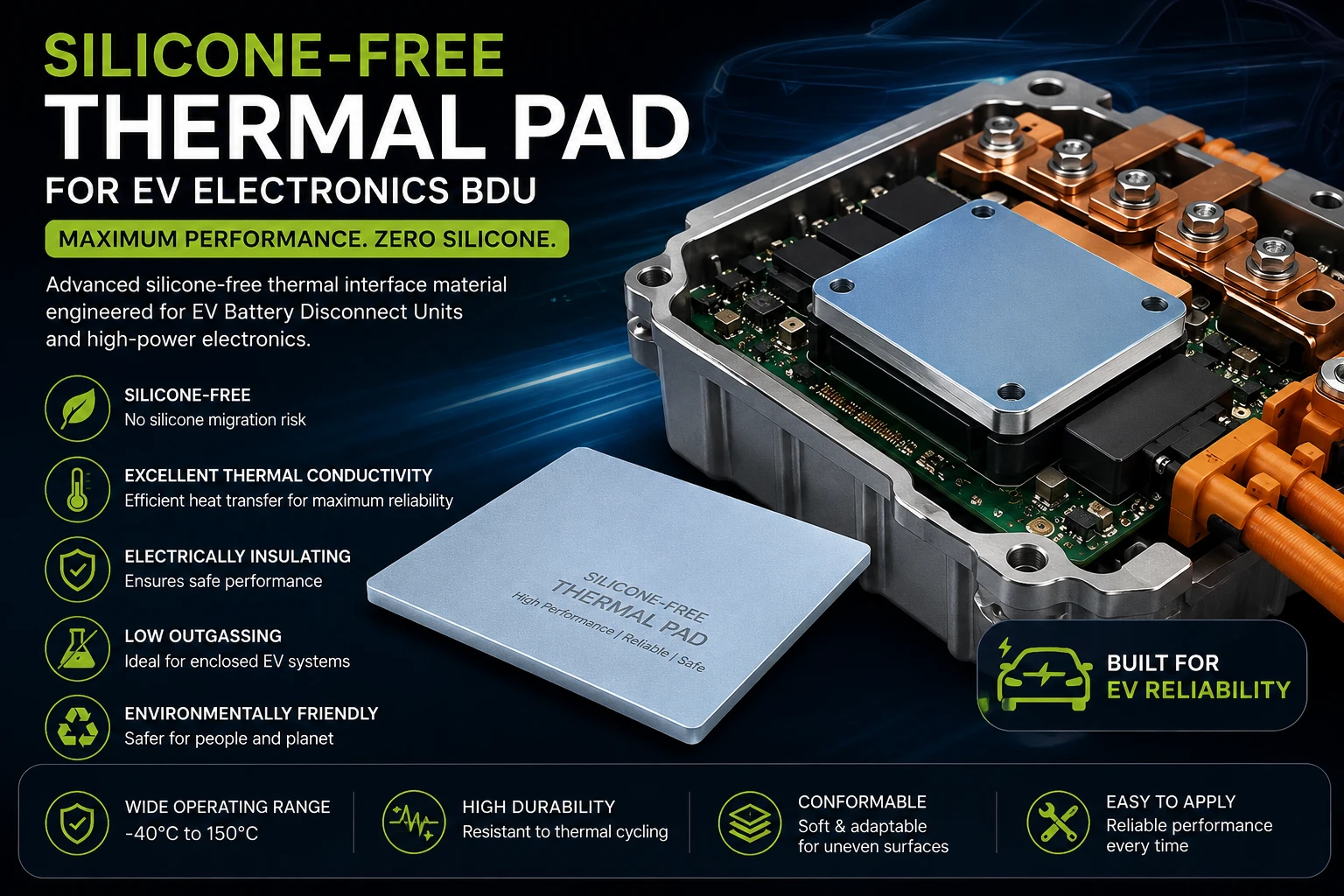
O Silicone-free thermal pad for automotive electronics is gaining traction as EV systems get hotter and tighter. From power control to battery safety, heat and insulation can’t slip up. This silicone-free thermal interface material keeps things cool, clean, and electrically safe—without the bleed and pump-out issues of traditional pads.

Defining Thermal Conductivity and Dielectric Strength in Pads
A Silicone-free thermal pad for automotive electronics lives or dies by two core propriedades dos materiais:
- Condutividade térmica accionamentos transferência de calor longe das batatas fritas.
- Resistência dieléctrica ensures isolamento elétrico sob alta tensão de rutura.
- Stability as a material de interface térmica keeps performance steady over time.
- High conductivity reduces hot spots in inverters.
- Strong dielectric strength protects compact power modules.
- Balanced filler design supports safe transferência de calor without sacrificing insulation.
When engineers spec a silicone-free thermal pad, they often break evaluation into:
- Performance Layer
- ▸ Measured condutividade térmica
- ▸ Thickness tolerance
- Electrical Safety Layer
- ▸ Rated rigidez dieléctrica
- ▸ Tested tensão de rutura
In short, the right pad moves heat fast and blocks current completely. That’s the deal.
Key Operating Temperature and Long-Term Stability Requirements
Automotive electronics face wild swings in temperatura de funcionamento.
- –40°C cold starts
- Rapid load spikes
- Years of ciclo térmico
A Silicone-free thermal pad for automotive electronics must survive:
- Continuous high-temperature range exposição
- Repeated envelhecimento térmico
- Resistência a degradação dos materiais
Testing usually follows a layered path:
- Environmental Stress
- Cycling validation
- Humidity soak
- Reliability Metrics
- Long-term reliability tracking
- Post-aging thermal resistance check
“EV power electronics are entering a reliability-focused phase, where material stability under thermal cycling is now a core supplier benchmark,” noted a 2025 McKinsey mobility update.
Brands like Materiais de brilho align pad formulations with these evolving automotive-grade demands.
Role of Compressibility and Chemical Resistance in EV Modules
In EV modules, gaps are never perfect. That’s where compressibilidade passos em.
• Enables controlled preenchimento de lacunas
• Improves stress distribution
• Protects delicate dies
A silicone-free gap filler pad also needs strong resistência química against:
- Automotive fluids
- Coolants
- Transmission oils
- Battery vapors
Evaluation typically unfolds as:
- Measure baseline thickness.
- Apply compression load.
- Re-test recovery and mechanical stability.
Bom compatibilidade de materiais prevents swelling, cracking, or performance drift. Materiais de brilho designs silicone-free thermal interface pads that balance softness with structural backbone, keeping EV modules tight and reliable.
Application Areas: ECU, Inverter, Battery Management Systems
O Silicone-free thermal pad for automotive electronics fits across key aplicações automóveis:
- ECU – stable gestão térmica in compact housings
- Inverter – insulation for high-voltage eletrónica de potência
- Battery Management System – safe heat spread in EV packs
In practice:
- Mount the pad between the heat source and the cold plate.
- Apply uniform compression.
- Validate temperature drop under load.
Dentro de electric vehicles, every watt counts. A silicone-free thermal pad reduces contamination risk while improving gestão térmica efficiency. That’s why engineers sourcing from Materiais de brilho increasingly choose silicone-free thermal solutions for next-gen automotive electronics.
Materials Breakdown: Silicone vs. Silicone-Free Pads
In automotive electronics, heat is no small thing. Control units, battery systems, and power modules all need steady cooling to stay sharp. Choosing between silicone and non-silicone materials can feel tricky. This breakdown keeps it real, especially for engineers searching for a reliable Silicone-free thermal pad for automotive electronics.
Silicone Thermal Pads
Silicone pads rely on Silicone material blended with ceramic fillers to improve Condutividade térmica and smooth Heat transfer across tight gaps. The material’s natural Compressibilidade helps fill uneven surfaces, which is why many legacy automotive electronics thermal pad designs still use it.
Core material traits include:
- Forte Dielectric properties for insulation
- Stable thermal cycling performance
- Flexible structure for vibration-heavy modules
Yet trade-offs show up over time.
- Emissão de gases may occur in high-temperature zones.
- Volatility can lead to slight oil bleed.
- Longo prazo Contamination risk may affect optical sensors or sensitive ECUs.
For standard control boards, silicone works fine. In high-density EV battery systems, things get stricter. A Silicone-free thermal pad for automotive electronics often becomes the safer bet when contamination control matters most.
Manufacturers like Sheen Materials still offer silicone options, but the push toward cleaner systems is changing preferences fast.
Silicone-Free Thermal Pads
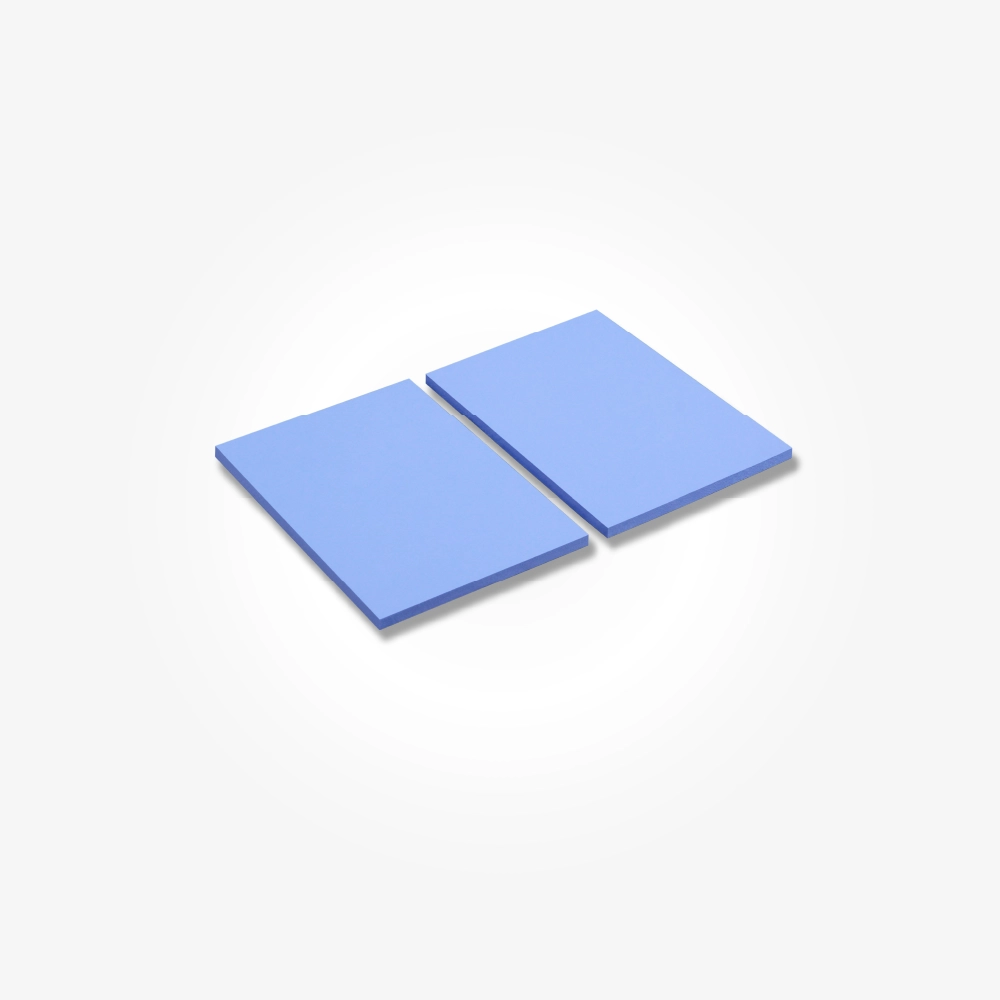
A Silicone-free thermal pad for automotive electronics uses Non-silicone materials such as modified acrylic or polyurethane, paired with boron nitride or graphite for strong Dissipação de calor. The focus here is simple: low bleed, low odor, low risk.
Key performance highlights:
- • Baixa libertação de gases for enclosed modules
- - Melhorado Material stability under EV load cycles
- - Melhor Contamination prevention
In EV applications, reliability is everything.
Performance pathway in automotive systems:
- Pad conforms to micro gaps.
- Heat moves efficiently through the ceramic network.
- Electrical isolation remains intact.
- Longo prazo Thermal performance stays consistent.
This makes the Silicone-free thermal pad for automotive electronics a practical solution for battery management systems, onboard chargers, and ADAS modules. Engineers looking for a silicone-free thermal pad that balances Reliability and insulation often turn to Sheen Materials for validated options.
As vehicle electronics evolve, the Silicone-free thermal pad for automotive electronics is no longer niche. It’s quickly becoming the default choice for cleaner, safer, high-power designs.

5 Steps to Engineer Optimal Pad Thickness
A Silicone-free thermal pad for automotive electronics must hit the sweet spot between compression, heat flow, and production reality. Get thickness wrong, and even premium materials underperform. Let’s break it down in a practical, shop-floor way.
Balancing Compressibility with Shore Hardness
When tuning compressibilidade e shore hardness, it’s not just about softness. It’s about control under tensão mecânica.
- Target durometer range for automotive modules: 30–70 Shore OO
- Compression set after 1,000 hrs @125°C: <15%
- Elastic recovery ≥90%
- Define load conditions from the ECU housing.
- Match propriedades dos materiais to clamp force.
- Validate deformação after thermal cycling.
Key interactions:
- Elasticity
- High elasticity
- + Better gap fill
- − Risk of pump-out
- Low elasticity
- + Dimensional control
- − Incomplete interface contact
- High elasticity
- Tensões mecânicas
- Static compression
- Vibration-induced shear
A Silicone-free thermal pad for automotive electronics must resist oil fog and prevent siloxane migration. That’s why Materiais de brilho focuses on non-silicone matrices engineered for stable propriedades dos materiais across long service intervals.
Short takeaway? Soft isn’t always smart. Balanced hardness keeps thermal impedance steady.
Selecting Ceramic Fillers: Boron Nitride vs. Aluminum Oxide
Choosing cargas cerâmicas shapes thermal and dielectric behavior.
| Filler Type | Condutividade térmica (W/m-K) | Resistência dieléctrica (kV/mm) | Typical Particle Size (µm) | Cost Index |
|---|---|---|---|---|
| Nitreto de boro | 30-60 | 15–25 | 5–30 | Elevado |
| Óxido de alumínio | 20–35 | 10–20 | 1–50 | Médio |
| Hybrid BN/Al₂O₃ | 25–45 | 12–22 | Mixed | Medium-High |
| Spherical Al₂O₃ | 18–28 | 10–18 | 10–40 | Médio |
| Platelet BN | 40–60 | 18–25 | 10–25 | Elevado |
- Nitreto de boro
- ↑ Heat spreading
- Estável rigidez dieléctrica
- Óxido de alumínio
- Cost-friendly
- Isolamento fiável
“Electrified vehicle platforms are pushing higher power density and tighter packaging, increasing the demand for advanced thermal interface materials,” noted a 2025 IDTechEx report on automotive thermal management.
Para um Silicone-free thermal pad for automotive electronics, filler dispersion and tamanho das partículas control are everything. Poor dispersion kills performance fast. Materiais de brilho blends hybrid systems to balance conductivity and cost without sacrificing insulation.
Controlling Bond Line Thickness for Minimal Thermal Resistance
Bond line thickness directly impacts resistência térmica. Thinner usually means better heat flow—but only if surfaces cooperate.
Nested control logic:
- Define surface condition
- Medida surface roughness (Ra)
- Map component warp
- Set compression target
- Clamp pressure range
- Expected squeeze %
- Validate interface
- IR imaging for transferência de calor
- Cross-section analysis
Para material de interface térmica design in automotive electronics:
- 0.3–0.5 mm: tight tolerance modules
- 0.5–1.5 mm: uneven cast housings
- >1.5 mm: high-gap battery systems
A Silicone-free thermal pad for automotive electronics reduces the risk of siloxane contamination on optical sensors and connectors. Thin bond lines only work when preenchimento de lacunas remains uniform under vibration. That’s the real-world test.
Ensuring Dispensing Compatibility and Reworkability
Production lines hate surprises. So does maintenance.
Critical checks for dispensing systems:
- Viscosity window aligned with pump specs
- Estável material flow at 20–30°C
- No stringing during automated pick-and-place
Nested workflow:
- Durante processo de fabrico
- Pump calibration
- Nozzle diameter selection
- Durante montagem
- Compression verification
- Adhesion check
- During rework
- Clean peel
- Minimal residue
Low but controlled adhesion ensures modules can be serviced. A good Silicone-free thermal pad for automotive electronics stays in place yet lifts cleanly. Shops appreciate that. Downtime drops.
Validating Thickness in Automated Assembly and Storage Conditions
Thickness isn’t stable by luck. It’s verified through quality control e environmental testing.
Validation path:
- Storage simulation
- 85°C / 85% RH aging
- Shelf-life compression drift
- Production simulation
- Robotic placement force
- Inline laser thickness scan
- Lifetime durability
- Thermal cycling (−40°C to 150°C)
- Resistência à vibração
Monitor:
- ±0.05 mm estabilidade dimensional tolerance
- <5% thickness loss after cycling
- Consistente long-term performance
A Silicone-free thermal pad for automotive electronics must survive warehouse heat and still behave predictably on the line. That’s why Sheen Materials validates thickness under both storage and automated assembly stress before release.
Bottom line? Thickness engineering isn’t guesswork. It’s controlled, measured, and built for the road.
3 Reasons Silicone-Free Thermal Pads Lower Costs
Automotive designers chasing tighter budgets are rethinking material choices. A Silicone-free thermal pad for automotive electronics is not just about heat control—it’s about cleaner processing, smarter automation, and leaner bills of materials. When engineered right, this silicone-free thermal interface material cuts waste, simplifies tooling, and keeps electrical insulation solid without pricey extras.
Reduced Material Waste through Die-Cut and Custom Shapes
A Silicone-free thermal pad for automotive electronics melhora eficiência de fabrico by aligning geometry with application zones inside ECUs and battery systems.
- Material waste drops through precision die-cut formats.
- Custom shapes match housing contours.
- Cleaner edges mean measurable scrap reduction.
In automotive electronics production, waste often hides in offcuts. With optimized flexibilidade de conceção, converters apply:
- CAD-guided process optimization
- Tight-tolerance die patterns
- Batch nesting layouts
Nested production flow:
- Layout Planning
- Component mapping
- Heat zone marking
- Conversion Stage
- Precision die-cut execution
- Inline inspection
- Assembly Fit
- Placement validation
- Adhesion alignment
The result? A silicone-free thermal pad fits right the first time. Less trimming. Fewer rejects. Lower material overhead.
Lower Volume Resistivity without Expensive Polymer Matrix Additives
Electrical insulation matters as much as thermal transfer. A Silicone-free thermal pad for automotive electronics achieves stable resistividade volumétrica através de composição do material, not costly fillers.
| Imóveis | Silicone-Based Pad | Silicone-Free Thermal Pad |
|---|---|---|
| Resistividade volumétrica (Ω-cm) | 10¹² | 10¹³ |
| Additive Load (%) | 18–25 | 5–10 |
| Material Cost Index | 1.00 | 0.87 |
Instead of relying on a heavy matriz polimérica, additive-free systems enhance electrical conductivity control while maintaining insulation. This material de interface térmica approach lowers raw material expense and supports performance enhancement in high-voltage modules.
For automotive OEM buyers, that translates to predictable compliance without additive creep.
Simplified Tooling Requirements for Automated Assembly
Automation loves consistency. A Silicone-free thermal pad for automotive electronics reduces complex tooling requirements and smooths robotics integration.
Assembly gains appear in layers:
- Equipment Design
- Flat-release liners
- Stable thickness control
- Production Efficiency
- Faster pick-and-place
- Reduced misalignment
- Manufacturing Process
- Cleaner surfaces
- Less residue buildup
Short cycle times. Fewer stoppages. Cleaner tooling.
É aqui que Materiais de brilho steps in, supplying silicone-free thermal interface material solutions tailored for automated EV electronics lines. Their approach trims assembly friction while supporting assembly simplification across power modules and control units.
Lower waste. Lower additive cost. Lower tooling complexity.
That’s how a silicone-free thermal pad keeps budgets grounded in real automotive production.
Measuring Thermal Impedance and Breakdown Voltage
Heat removal and insulation must coexist. A Silicone-free thermal pad for automotive electronics sits between live components and grounded heatsinks, so both impedância térmica e tensão de rutura matter.
Validation includes:
- Laser flash or steady-state plate method for transferência de calor
- ASTM D149 for tensão de rutura
- IEC-based rigidez dieléctrica checks
Standard Lab Data Example
| Sample ID | Condutividade térmica (W/m-K) | Thermal Impedance (°C·cm²/W) | Tensão de rutura (kV/mm) | Power Dissipation @100W (°C rise) |
|---|---|---|---|---|
| A1 | 3.5 | 0.42 | 8.2 | 38 |
| A2 | 4.0 | 0.36 | 7.9 | 34 |
| A3 | 5.0 | 0.30 | 6.8 | 29 |
| A4 | 6.0 | 0.25 | 6.1 | 24 |
| A5 | 7.5 | 0.20 | 5.4 | 19 |
Notice the trade-off. As conductivity improves, insulation margin may narrow. That’s why balance is key.
Validation flow often follows:
- Measure baseline resistência térmica
- Apply 2× rated voltage
- Monitor leakage current
- Increase voltage until dielectric failure
- Record breakdown point
For EV inverter modules, insulation failure is not an option. A silicone-free thermal interface pad must maintain electrical integrity while transferring heat fast.
Materiais de brilho typically targets >6 kV/mm rigidez dieléctrica for traction systems, giving engineers extra safety headroom.
Silicone-Free Thermal Pad for Automotive Electronics Compliance
Modern vehicles pack serious computing power, and heat is the quiet troublemaker. A Silicone-free thermal pad for automotive electronics helps manage temperature without silicone bleed or contamination. When automotive control units must meet global rules, material choice stops being casual and starts being critical.
Automotive Grade Standards: IATF 16949 and AEC-Q100
In automotive production, compliance is layered and strict.
- automotive standards demand traceability from raw material to final module.
- IATF 16949 defines quality management systems across suppliers.
- AEC-Q100 validates component qualification under thermal and electrical stress.
Para um Silicone-free thermal pad for automotive electronics, meeting these rules means:
- Stable thermal impedance during vibration
- No silicone migration onto sensitive chips
- Longo prazo cumprimento documentation
Testing Flow
- Material screening
- Thermal conductivity verification
- Outgassing inspection
- Reliability validation
- 1,000+ hour heat aging
- Thermal cycling (-40°C to 150°C)
- Production control
- Batch trace coding
- PPAP documentation
A silicone-free pad for automotive use must survive engine heat, inverter spikes, and daily road shock. That’s why Materiais de brilho aligns its silicone-free thermal interface pads with both IATF 16949 systems and AEC-Q100 stress expectations, keeping automotive electronics cool without silicone-related risks.
RoHS, REACH, and Halogen-Free Certification Processes
Environmental rules aren’t optional anymore. A Silicone-free thermal pad for automotive electronics must pass chemical screening before it ever touches a PCB.
| Regulation | Restricted Substance Limit | Typical Test Method | Compliance Impact |
|---|---|---|---|
| RoHS | Pb <0.1% | XRF Screening | EU market access |
| REACH | SVHC reporting | Chemical analysis | Supply chain approval |
| Sem halogéneos | Cl/Br <900 ppm | Ion chromatography | Low corrosion risk |
Key checks include:
- environmental compliance audits
- Review of restrições materiais
- Documentation of substâncias perigosas
A silicone-free gap pad reduces contamination risk while simplifying certification processes. For global OEMs, that’s peace of mind.
Ensuring UL Certification and Automotive-Grade Reliability
Safety matters. Period.
A Silicone-free thermal pad for automotive electronics seeking Certificação UL goes through:
- Flammability rating (UL94 V-0 target)
- Electrical insulation validation
- Longo prazo durabilidade and heat exposure trials
In daily language? It must handle heat, resist breakdown, and stay stable for years.
automotive-grade expectations include:
- Consistente desempenho across temperature swings
- Documented testing data
- Comprovado fiabilidade in control units
From EV battery systems to ADAS modules, a silicone-free thermal pad keeps electronics steady. Materiais de brilho supports OEM programs with validated silicone-free thermal interface solutions built for safety standards and real-world abuse.
When compliance, safety, and heat control all matter, the Silicone-free thermal pad for automotive electronics isn’t just an option—it’s the smart move.