-
ADD: Building 2, No. 8 Hengzhutang Road, Dongguan
-
Phone: +86 135 4224 3751

How to Choose Boron Nitride Thermal Interface Materials
Heat is the silent profit killer, and boron nitride thermal interface materials stop it cold. Protect margins, cool chips, and keep production humming at scale today.
When power density climbs, and warranties loom, you need insulation that performs without drama. Choose smart materials, cut risk, sleep better. Your bottom line wins.
Quick Insights: Boron Nitride Thermal Interface Materials
→ High intrinsic thermal conductivity and electrical insulation enable efficient heat transfer in power modules, CPUs, and GPUs.
→ Controlled bond line thickness minimizes thermal resistance for peak performance.
→ Optimized viscosity and wettability ensure void‐free contact in paste, pads, and adhesives.
→ Matching thermal expansion coefficients prevents stress and enhances reliability under cycling.
→ Strong pump-out resistance and chemical stability guarantee long-term, maintenance-free operation.
5 Key Factors For Optimum Thermal Conductivity
Getting real performance from boron nitride thermal interface materials isn’t about hype—it’s about details. From powder quality to long-term stability, every variable shapes heat flow. When designing boron nitride TIM systems, small tweaks can mean cooler chips, longer lifetime, and fewer headaches. Let’s break it down in practical terms.
Thermal Conductivity of Hexagonal Boron Nitride Powder
At the core of boron nitride thermal interface materials sits hexagonal boron nitride—often called hBN. Its thermal conductivity depends on more than just chemistry.
- Material foundation
- Crystal structure
- A layered structure enables in-plane heat transfer
- Orientation affects directional conductivity
- Purity
- High purity reduces phonon scattering
- Impurities lower the effective conductivity
- Crystal structure
- Powder engineering
- Particle size
- Large particles → higher bulk conductivity
- Small particles → better packing density
- Filler loading
- Higher filler ratio increases heat paths
- Excess loading raises viscosity
- Particle size
In advanced boron nitride thermal interface materials, balancing powder morphology with matrix compatibility is key. Sheen Materials optimizes hBN surface treatment to improve filler dispersion, helping boron nitride thermal management materials hit stable thermal targets without killing processability.
Thermal Resistance and Bond Line Thickness Control
Heat flow isn’t just about conductivity. Thermal resistance is heavily shaped by bond line thickness (BLT) and interface quality.
- Interface control
- Contact quality
- Reduced contact resistance
- Improved surface conformity
- Applied pressure
- Compresses gaps
- Enhances heat transfer
- Contact quality
- Gap management
- Surface roughness creates micro gaps
- Uniform BLT reduces hot spots
Performance Snapshot
| BLT (µm) | Interface Pressure (psi) | Thermal Resistance (°C·cm²/W) | Heat Transfer Efficiency (%) |
|---|---|---|---|
| 20 | 50 | 0.08 | 92 |
| 40 | 40 | 0.12 | 88 |
| 60 | 30 | 0.18 | 81 |
| 80 | 20 | 0.25 | 73 |
| 100 | 15 | 0.33 | 66 |
Thinner, consistent BLT keeps boron nitride thermal interface materials performing like they should—especially in CPUs and IGBTs where every degree matters.
Viscosity and Wettability in Thermal Paste Forms
A solid thermal paste based on boron nitride thermal interface materials must flow right and settle right.
- Rheology balance
- Controlled viscosity for dispensing
- Stable suspension to avoid filler settling
- Surface behavior
- Low surface tension improves wettability
- Better spreading reduces voids
When TIM rheology is dialed in, the paste fills microscopic gaps without bleed-out. Too thick? Poor contact. Too thin? Pump-out risk. Boron nitride TIM formulations from Sheen Materials are tuned to maintain flow stability during screen printing and automated dispensing.
Matching Thermal Expansion Coefficient for Reliability
Reliability comes down to matching the thermal expansion coefficient (CTE) of the TIM with the substrate.
- CTE alignment
- Reduce mismatch
- Minimize cyclic stress
- Failure prevention
- Limit strain
- Avoid delamination
During thermal cycling, expansion mismatch builds internal force. Over time, that stress cracks interfaces. Smart filler design in boron nitride thermal management materials helps tune effective CTE, extending system reliability in automotive and telecom hardware.
Pump-Out Resistance and Long-Term Reliability
Short-term performance is easy. Keeping it stable over the years? That’s tougher.
- Material stability
- Polymer matrix resists aging
- Stable filler network prevents separation
- Degradation control
- Reduce bleed-out
- Improve pump-out resistance
- Thermal cycling endurance
- Maintain interface thickness
- Prevent performance drop
Repeated expansion and contraction can push material outward. High-quality boron nitride thermal interface materials rely on strong filler-matrix bonding to resist migration. When material stability is maintained, lifetime performance remains consistent.
In real-world electronics, that consistency makes all the difference.
How To Compare Boron Nitride Thermal Interface Materials
Choosing the right boron nitride thermal interface materials is not just spec-sheet talk. From boron nitride paste to BN pads and thermal interface sheets, performance depends on heat flow, insulation, and long-term stability. Here’s how to size them up without the fluff.
Evaluating Thermal Resistance Across Material Forms
When comparing boron nitride thermal interface materials, focus on total thermal resistance across real material forms.
- By form factor
- Thermal paste (boron nitride paste)
- Check the intrinsic thermal conductivity of the boron nitride filler.
- Control bond line thickness under fixed pressure.
- Measure heat transfer across the device-to-heatsink interface.
- Pads and sheets
- Evaluate compressibility vs. final thickness.
- Track contact resistance at low and high pressure.
- Gap fillers and adhesives
- Review the curing impact on thermal resistance.
- Compare the flow behavior before setting.
- Thermal paste (boron nitride paste)
- By the test setup
- Standardized clamping force
- Identical surface roughness
- Same power load
Sheen Materials designs boron nitride thermal interface materials with controlled filler dispersion, so lab numbers actually match field performance.
Assessing Dielectric Breakdown Voltage Performance
High-voltage systems push dielectric breakdown limits. For boron nitride thermal interface materials, insulation is as critical as cooling.
Key checks include:
- Rated dielectric strength per thickness
- Maximum voltage before failure
- Stability under a continuous electrical field
Then go deeper:
- Material purity
- Higher boron nitride purity improves electrical insulation.
- Fewer ionic residues support stable permittivity.
- Application stress
- MOSFET modules
- EV inverters
- Fast-switching power boards
A quick tip: test at elevated temperature, not just room conditions. Real loads heat up. Sheen Materials validates boron nitride thermal interface materials under combined thermal and electrical stress, which keeps power modules safe when voltage spikes hit hard.
Comparing Operating Temperature Range and Chemical Stability
Long service life depends on operating temperature limits and the chemical stability of boron nitride TIMs.
- Temperature capability
- Minimum start-up temperature range for cold climates
- Continuous high operating temperature under load
- Peak tolerance before thermal degradation
- Chemical resistance
- Resistance to oxidation in air
- Coolant and oil exposure
- General chemical resistance in harsh automotive zones
Boron nitride’s natural inertness helps maintain structure when polymers age. Good boron nitride thermal interface materials resist cracking, drying, and pump-out, even after thousands of heating cycles.
Analyzing Electrical Insulation and Density Variations
Electrical safety and mechanical feel both tie back to density and filler design in boron nitride thermal interface materials.
- Electrical metrics
- Volume resistivity for bulk insulation
- Surface resistivity for contamination control
- Consistent electrical insulation across thin films
- Structural factors
- Material composition of the polymer matrix
- Boron nitride filler content percentage
- Control of porosity to avoid air gaps
Higher density often means greater boron nitride loading, boosting heat flow—but push it too far and flexibility drops. The sweet spot balances thermal conductivity, insulation, and mechanical strength.
In short, smart comparison of boron nitride thermal interface materials means checking heat, voltage, temperature, and structure together—not in isolation.
Comparing Dielectric Strength: BN Vs. Alternatives
Heat control in tight electronics is no joke. When engineers compare boron nitride thermal interface materials with other options, dielectric strength often becomes the deal breaker. Let’s break it down in a clear, no-fluff way.
Boron Nitride Films
When discussing boron nitride thermal interface materials, thin films stand out for balancing thermal conductivity and electrical insulation without bulking up assemblies.
- Electrical Performance 1.1 High dielectric strength 1.2 Stable electrical insulation across varied film thickness 1.3 Low leakage on sensitive substrate material
- Thermal Path Control 2.1 Efficient heat transfer through layered structures 2.2 Consistent thermal conductivity even at reduced thickness 2.3 Compatibility with vapor and sputter deposition methods
- Mechanical Behavior 3.1 Good flexibility for uneven surfaces 3.2 Crack resistance under thermal cycling
| Product Type | Test Standard | BSF1600‑03 (0.3mm) | BSF1600‑05 (0.5mm) | BSF1600‑07 (0.7mm) |
|---|---|---|---|---|
| Color | Visual | White | White | White |
| Thickness (mm) | ASTM D374 | 0.3 | 0.5 | 0.7 |
| Density (g/cm³) | ASTM D792 | 1.6±0.2 | 1.6±0.2 | 1.6±0.2 |
| Hardness (Shore C) | ASTM D2240 | 60~80 | 60~80 | 60~80 |
| Thermal conductivity (W/m·K) | ASTM D5470 | ≥15(linear fitting) | ≥15(linear fitting) | ≥15(linear fitting) |
| Breakdown voltage (KV,@AC) | ASTM D149 | ≥3.5 | ≥6 | ≥8 |
| Flammability | UL94 | V‑0 | V‑0 | V‑0 |
| Volume resistivity (Ω·cm, @ 250V) | ASTM D257 | ≥10¹³ | ≥10¹³ | ≥10¹³ |
| Dielectric constant (F/m, @ 1MHz) | ASTM D150 | ≤4.2 | ≤4.2 | ≤4.2 |
| Application temperature (℃) | / | -40~150 | -40~150 | -40~150 |
| Thermal resistance (℃·cm²/W, @40psi) | ASTM D5470 | ≤0.4 | ≤0.5 | ≤0.65 |
| Thermal resistance (℃·in²/W, @40psi) | ASTM D5470 | ≤0.06 | ≤0.08 | ≤0.1 |
| Thermal weight loss rate | / | ≤1 | ≤1 | ≤1 |
| RoHS | IEC 62321 | PASS | PASS | PASS |
| Halogen | EN 14582 | PASS | PASS | PASS |
| REACH | EN 14372 | PASS | PASS | PASS |
Brands like Sheen Materials tune boron nitride thermal interface materials to hit both insulation and heat targets without forcing extra thickness.
Ceramic Fillers
Ceramic-loaded systems look simple, yet performance depends on how the particle size and filler loading behave inside a polymer matrix.
- Composition Factors 1.1 Smaller particle size improves packing density 1.2 Higher filler loading boosts thermal conductivity 1.3 Excess loading raises viscosity
- Electrical Traits 2.1 Strong electrical resistivity 2.2 Moderate dielectric constant 2.3 Stable insulation in composite materials
- Processing Trade-Offs3.1 Harder mixing at high solid ratios3.2 Increased density3.3 Slower flow during dispensing
Compared with boron nitride TIM fillers, traditional ceramics often need more volume to match the same heat transfer path.
Silicone-Based TIMs
Silicone systems are everywhere—thermal grease, thermal pads, and gap filler products dominate consumer builds.
- Pros:
- High conformability
- Broad temperature tolerance
- Reliable electrical insulation
1) Performance hinges on filler dispersion inside the silicone polymer.
2) Poor curing impacts viscosity stability.
3) Pump-out can reduce long-term contact.
Some upgraded boron nitride thermal interface materials blend BN into silicone bases, combining flexible handling with higher dielectric breakdown strength. Sheen Materials offers tailored thermal interface compounds that address both insulation and long-term stability without messy separation.
Polymer Matrix Pastes
Here’s how advanced polymer binder systems with BN work in real production:
Step 1: Select high-purity filler particles (often hexagonal boron nitride powder).
Step 2: Disperse into a controlled-viscosity thermal paste base.
Step 3: Optimize the curing process for crosslink density.
Step 4: Validate electrical resistivity and heat dissipation under load.
“Thermally conductive but electrically insulating interface materials are seeing accelerated adoption in EV power modules and AI hardware,” notes a 2025 update from MarketsandMarkets, highlighting rising demand for boron nitride thermal interface materials in high-voltage systems.
This is where boron nitride TIM solutions shine. By combining boron nitride thermal interface materials with stable polymer chemistry, Sheen Materials helps designers hit strict dielectric targets while keeping assembly smooth and scalable.
Power Electronics: Boost Efficiency With BN TIMs
Power devices run hot, and heat is the silent killer of efficiency. Boron nitride thermal interface materials help move heat fast, keep insulation tight, and support stable output in demanding electronics—from renewables to data centers and EV platforms.
High Thermal Conductivity for IGBTs and Power Modules
In high-power drives and inverters, heat flow decides performance.
- At the device level
- IGBT chips generate intense heat during switching.
- Rising junction temperature increases thermal resistance and shortens lifespan.
- At the module level
- The power module must pass heat through a thermal interface material into the heat sink.
- Poor thermal management slows heat dissipation and wastes energy.
With boron nitride thermal interface materials, heat spreads quickly while maintaining electrical isolation. For designers chasing lower losses, BN-based TIMs keep junctions cooler and systems steadier. Sheen Materials supplies engineered boron nitride thermal interface materials tuned for demanding inverter stacks and renewable converters.
Dielectric Strength Requirements in MOSFETs
High voltage switching leaves no room for weak insulation.
- Inside a MOSFET, the gate oxide must resist dielectric breakdown.
- The interface layer must deliver strong electrical insulation and stable breakdown voltage.
- Long-term electrical reliability depends on insulation that survives spikes and cycling.
Boron nitride thermal interface materials combine thermal conductivity with voltage withstand capability. That balance is critical in EV traction systems and industrial drives. Using BN thermal interface materials helps prevent leakage paths while still pulling heat away from sensitive silicon.
Optimizing Bond Line Thickness for CPUs and GPUs
Data centers hate wasted watts.
- For a CPU or GPU, thin and uniform bond line thickness reduces thermal impedance.
- Excess paste causes voiding; too little raises thermal resistance.
- Controlled interface pressure improves thermal performance without cracking packages.
Engineers often fine-tune in stages:
- Material selection → pressure calibration → thickness validation → thermal cycling check.
Boron nitride thermal interface materials flow well under pressure and maintain structure after cure. Sheen Materials designs BN TIMs that balance spreadability and stability, keeping chips cool without messy pump-out.
Dispensing and Curing Techniques in Automotive Electronics
Under the hood, heat and vibration never take a day off.
- In automotive electronics assemblies:
- The dispensing method must match the material viscosity.
- Automated lines demand repeatable patterns and clean edges.
- During the curing process:
- Controlled profiles protect adhesion.
- Parts must survive harsh thermal cycling for long-term reliability.
From inverter boards to battery control units, boron nitride thermal interface materials provide stable insulation and heat transfer. When paired with precise automation, BN-based thermal interface materials keep power systems running cool, safe, and ready for the road.
FAQs about Boron Nitride Thermal Interface Materials
What separates boron nitride thermal interface materials from other TIMs in power electronics?
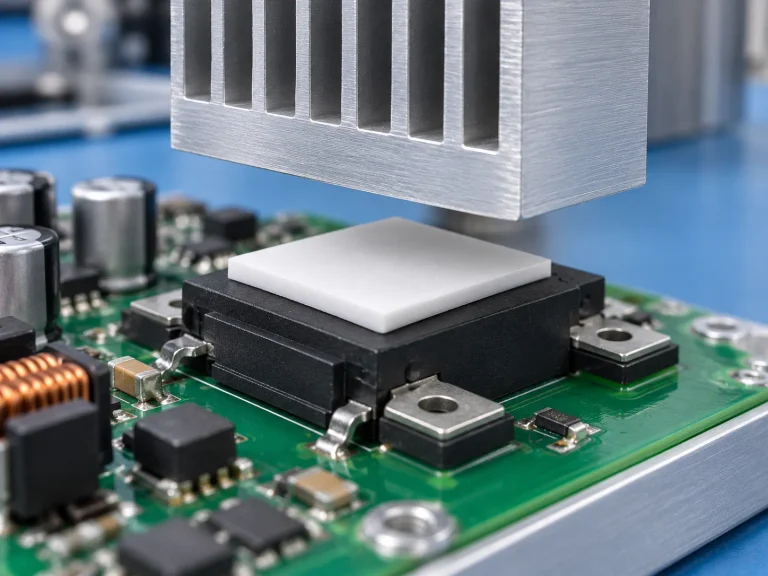
In high-current power electronics and automotive electronics, heat is relentless. Boron nitride thermal interface materials respond with a rare balance:
1. High thermal conductivity that lowers thermal resistance in IGBTs, MOSFETs, and power modules.
2. Strong electrical insulation and stable dielectric strength, critical in dense semiconductor packaging.
3. Wide operating temperature range with steady chemical stability.
From thermal paste and thermal grease to thermal pads and encapsulants, these materials rely on hexagonal boron nitride powder dispersed in a polymer matrix or non-silicone base. The result: controlled heat flow without risking dielectric breakdown voltage.
How do bond line thickness and viscosity influence real-world assembly?
Performance is often decided during dispensing and curing, not just in the datasheet.
1. Bond line thickness. Thinner layers reduce thermal resistance between CPUs, GPUs, or ASICs and heat sinks.
Excess thickness increases the heat path and weakens efficiency.
2. Viscosity & wettability Proper viscosity improves dispensing and screen printing accuracy.
Good wettability limits voids, protecting long-term reliability in data centers and telecommunications equipment.
Behind this balance are carefully controlled filler particles, density, and mixing techniques during compounding.
Too thick, and air hides inside. Too thin, and the pump-out resistance suffers under cycling.
Why is matching the thermal expansion coefficient vital for long-term reliability?
Heat cycles pull materials apart. Cooling contracts them. Stress builds silently.
When the thermal expansion coefficient of a thermal adhesive or thermal gap filler aligns with substrates in LED lighting or consumer electronics:
✓ Stress on memory modules and ASICs is reduced.
✓ Pump-out resistance improves under vibration.
✓ Cracks and delamination decline over time.
Boron nitride films and pastes, built from ceramic fillers within a silicone base or non-silicone base, are tuned for this match. In automotive electronics and semiconductor packaging, that alignment is often the difference between early failure and lasting performance.