-
ADD: Edificio 2, nº 8 de Hengzhutang Road, Dongguan
-
Teléfono: +86 135 4224 3751

15 W/m·K Thermal Silicone Pad with Low Bleed and Low Volatility: SF1500 Case Study
Many suppliers claim they can manufacture high-performance thermal silicone pads. In reality, only a limited number can consistently deliver a genuine thermal conductivity of 10.0 W/(m·K). Reaching 15.0 W/(m·K) is considerably more difficult.
The challenge becomes even greater when the material must combine ultra-high thermal conductivity with low oil bleeding and low siloxane volatility. High conductivity alone is not enough if the pad creates contamination, stability, or long-term reliability problems elsewhere in the system.
This is where Sheen Materials SF1500 was put to the test.
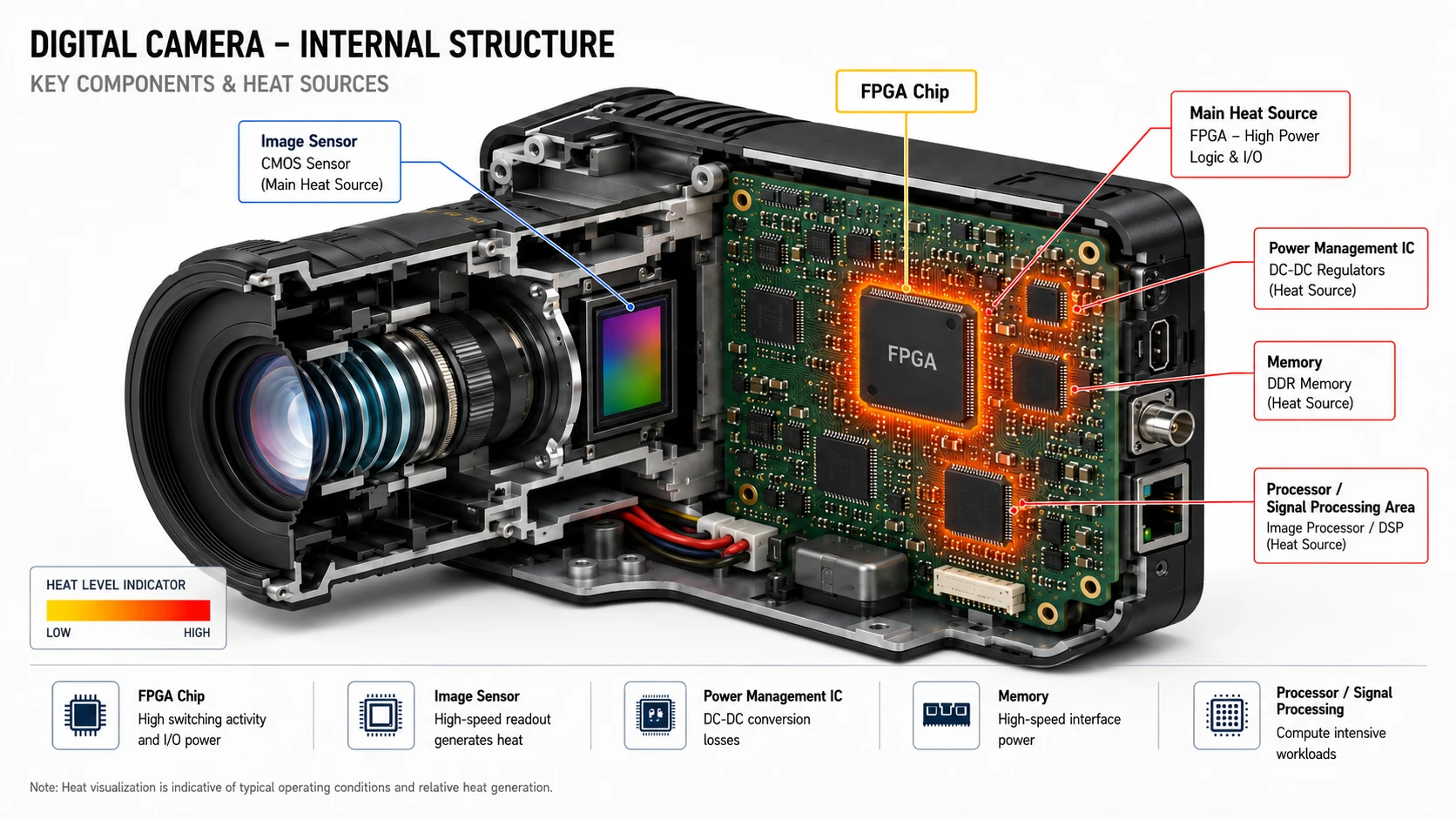
A High-Precision Camera Customer Needed More Than a Datasheet Claim
During the first half of this year, a U.S. company that designs high-precision cameras contacted Sheen Materials. Based on its product design and thermal requirements, our SF1500 thermal silicone pad appeared to be an excellent match. Its key specifications met the customer’s initial engineering targets.
The customer was interested, but understandably cautious.
Before contacting us, its engineering team had already evaluated samples from several suppliers. Each supplier had claimed that its thermal pads could meet the required specifications. Once the samples entered testing, however, the results failed to support those claims.
The customer was concerned that SF1500 might produce the same disappointing outcome.
We understood that concern. We have also evaluated many thermal silicone pads available on the market, and performance problems are not uncommon. One of the most frequent issues is an inflated thermal-conductivity value that cannot be reproduced under actual test conditions.
At Sheen Materials, our response was straightforward:
Our product specifications are based on test data. The required performance values can be written into the supply agreement.
SF1500 was already being used in volume production by a well-known U.S. high-speed camera manufacturer. Even so, we did not ask the new customer to rely on words or marketing claims.
We asked them to test the material.
When a thermal pad is intended for a high-value electronic system, the best proof is not a brochure. It is the customer’s own validation data.
Accelerated Aging Test at 125°C and 150°C
After receiving the SF1500 samples, the customer immediately began a high-temperature aging test.
The original qualification plan required:
- Aging temperature: 125°C
- Test duration: 1,000 hours
- Purpose: Evaluate long-term thermal performance and material stability
To shorten the validation schedule, the customer divided the test into two accelerated-aging groups:
- One group was tested at 125°C
- The second group was tested at 150°C
This reduced the planned test period from approximately 40 days to 20 days.
As soon as the test period ended, the customer sent us the results:
- Measured thermal conductivity: 15.0 W/(m·K)
- Siloxane volatility: Below 0.05%
The customer informed us that the product could move into mass production after the remaining system components completed their qualification.
That result is important because it addresses the three requirements that matter most in this application:
- Ultra-high thermal conductivity
- Low oil bleeding
- Low siloxane volatility
Data does not lie. For demanding thermal-management applications, verified results remain the strongest proof.
How Sheen Materials Maintains SF1500 Production Consistency
High thermal conductivity must be repeatable from sample to sample and from batch to batch. A laboratory result has limited value if it cannot be reproduced in mass production.
Sheen Materials uses automated production processes for its thermal silicone pads to reduce operator-related variation and improve product consistency.
The raw materials also undergo secondary processing with nanoscale grinding equipment. This process reduces filler particle size, supports higher filler loading, and helps optimize the thermal-conduction pathway inside the pad. It is a highly specialized manufacturing approach that remains uncommon among domestic thermal-pad suppliers.
This combination of formulation control, material processing, and automated manufacturing allows SF1500 to balance high thermal conductivity with processability and long-term reliability.
What Is the SF1500 Thermal Silicone Pad?
SF1500 is a soft, electrically insulating thermal gap pad based on a silicone matrix filled with thermally conductive metal oxides and other functional materials.
Thermal silicone pads may also be described as:
- Thermal gap pads
- Silicone thermal pads
- Thermally conductive silicone pads
- Soft thermal interface pads
- Silicone heat-transfer pads
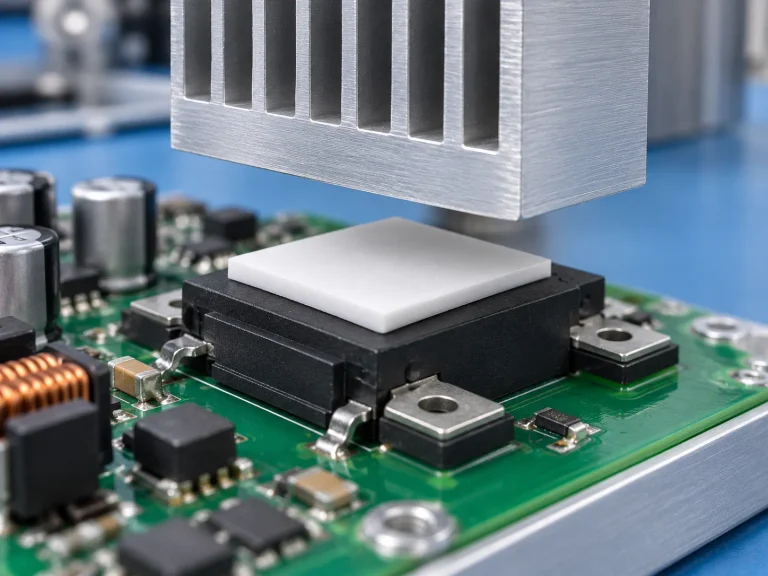
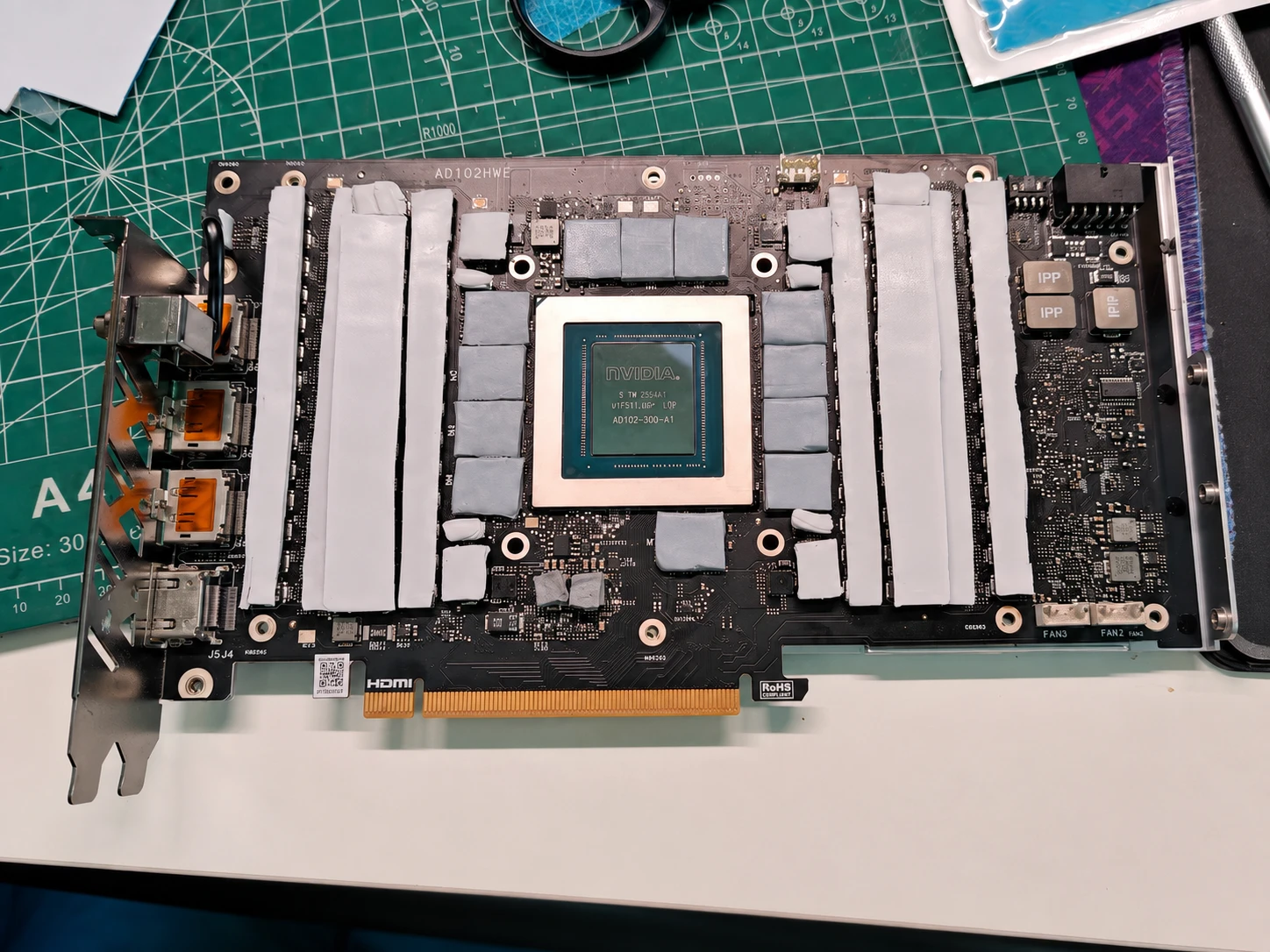
SF1500 is designed to fill the physical gap between a heat-generating component and a heatsink, enclosure, cold plate, or other cooling structure.
Without a conformable interface material, microscopic surface irregularities and assembly tolerances trap air between the two surfaces. Because air is a poor thermal conductor, these gaps create substantial contact thermal resistance.
Under compression, SF1500 conforms to the mating surfaces, displaces trapped air, and creates a more continuous heat-transfer path. At the same time, it can provide electrical insulation, vibration cushioning, sealing support, and tolerance compensation.
This makes the material suitable for compact and thin electronic designs in which thermal performance, mechanical compliance, and assembly efficiency must be considered together.
Key SF1500 Product Advantages
1. Ultra-High Thermal Conductivity
With a rated thermal conductivity of 15.0 W/(m·K), SF1500 is designed for high-power components and systems with demanding heat-transfer requirements.
2. Low Thermal Resistance
The pad fills surface gaps between the heat source and cooling component, reducing contact thermal resistance and limiting the temperature difference across the interface.
At 50 psi and a thickness of 1 mm, its thermal resistance is specified at no more than 0.07 °C·in²/W.
3. Softness and Gap-Filling Performance
SF1500 is soft and compressible, allowing it to conform to uneven surfaces and compensate for dimensional tolerances in heatsinks, housings, and other mechanical components.
Available thicknesses from 1.0 to 5.0 mm make it suitable for a wide range of assembly gaps.
4. Electrical Insulation
In addition to heat transfer, SF1500 provides electrical insulation, with a dielectric breakdown voltage of at least 4 kV at 1 mm thickness.
5. Low Bleed and Low Siloxane Volatility
For high-precision cameras, optical devices, communication equipment, and other contamination-sensitive systems, controlling oil bleeding and volatile siloxanes is critical.
Customer validation measured SF1500 siloxane volatility at below 0.05%.
6. Vibration Damping and Acoustic Cushioning
The soft silicone structure can help absorb vibration and reduce mechanical noise while maintaining contact between the heat source and cooling structure.
7. Easy Assembly and Maintenance
SF1500 has natural surface tack on both sides, making it easier to position during assembly. It can support installation, testing, maintenance, and—in suitable applications—repeated use.
The material can be installed manually or adapted for automated placement.
Typical Applications
SF1500 is suitable for filling assembly gaps between heat-generating electronic components and heatsinks, cold plates, metal housings, or chassis structures.
Typical applications include:
- Electronic control boards
- Networking equipment
- Telecommunications base stations
- Security and surveillance equipment
- Desktop computers
- Notebook computers
- Automotive electronic control systems
- New energy vehicle electronics
- Industrial power supplies
- Servo drive modules
- High-speed and high-precision camera systems
- Other high-power electronic equipment requiring efficient heat transfer
SF1500 Technical Specifications
| Item | Value | Norma de ensayo |
|---|---|---|
| Color | Gris | Visual inspection |
| Espesor | 1.0–5.0 mm | ASTM D374 |
| Densidad | 3.2 g/cm³ | ASTM D792 |
| Conductividad térmica | 15.0 W/(m·K) | ASTM D5470 |
| Hardness (Shore 00) | 35–90 | ASTM D2240 |
| Maximum Elongation | 1 | ASTM D412 |
| Resistencia a la tracción | 5 psi | ASTM D412 |
| Dielectric Breakdown Voltage (AC, 1 mm) | ≥4 kV | ASTM D149 |
| Flame Resistance | V-0 | UL 94 |
| Resistividad volumétrica | ≥10¹¹ Ω·cm | ASTM D257 |
| Dielectric Constant at 1 MHz | ≥6 | ASTM D150 |
| Temperatura de funcionamiento | -40 to 125°C | — |
| Thermal Resistance at 50 psi, 1 mm | ≤0.07 °C·in²/W | ASTM D5470 |
| RoHS | Pass | CEI 62321 |
| Sin halógenos | Pass | EN 14582 |
| REACH | Pass | EN 14372 |
Selection note: Published specifications are important, but final material selection should also consider the actual gap, compression ratio, mounting pressure, surface flatness, operating temperature, insulation requirements, and target service life.
Opciones de personalización
Sheen Materials can customize SF1500 according to the customer’s product structure and assembly process.
Available options include:
- Custom colors
- Custom shapes and die-cut dimensions
- Multiple thickness and hardness options within the available product range
- Natural tack for easier positioning
- Reusable handling where the application permits
- Formats suitable for manual assembly
- Configurations that can be adapted to automated placement
Why Test SF1500 for Your Application?
Sheen Materials has focused on thermal-management materials for 18 years and supplies materials to leading global companies, including Toyota, OPPO, and BYD. Our thermal materials are also widely recognized and used in new energy vehicle applications.
We know that engineers and sourcing teams have heard many performance claims. That is exactly why we do not expect you to make a decision based only on a product description.
If your application requires a 15 W/(m·K) thermal silicone pad with low bleed, low volatility, electrical insulation, and reliable gap-filling performance, request a sample and test it under your own operating conditions.
Start with a small validation order. Compare the data. Then decide.