-
ADD: Edificio 2, nº 8 de Hengzhutang Road, Dongguan
-
Teléfono: +86 135 4224 3751

Thermal Pad for Network Switch vs. Paste: Which One Wins?
Heat is the silent deal-breaker inside every crowded switch chassis, and choosing a thermal pad for Network Switch builds can save production from chaos. Paste may look slick on paper, but factory floors need consistency, not babysitting daily at scale.
In high-volume assembly, time is money and rework is a nightmare. Pads drop in place, stay put under vibration, and keep certifications clean, while paste demands precision and cleanup crews on site.
Types Of Thermal Pad For Network Switch
Modern switches run hot, and nobody likes random shutdowns. Choosing the right thermal pad for Network Switch hardware keeps traffic stable and hardware happy. From ASIC cores to VRMs, each chip needs proper contact, pressure, and transferencia de calor support. Let’s break down how different pads handle cooling inside a busy Network Switch.
Silicone vs. Graphite Pads for ASIC Cooling
Al seleccionar un thermal pad for Network Switch ASIC zones, the debate often centers on Silicona versus Grafito as the preferred material de interfaz térmica.
- Material Structure
- Silicona
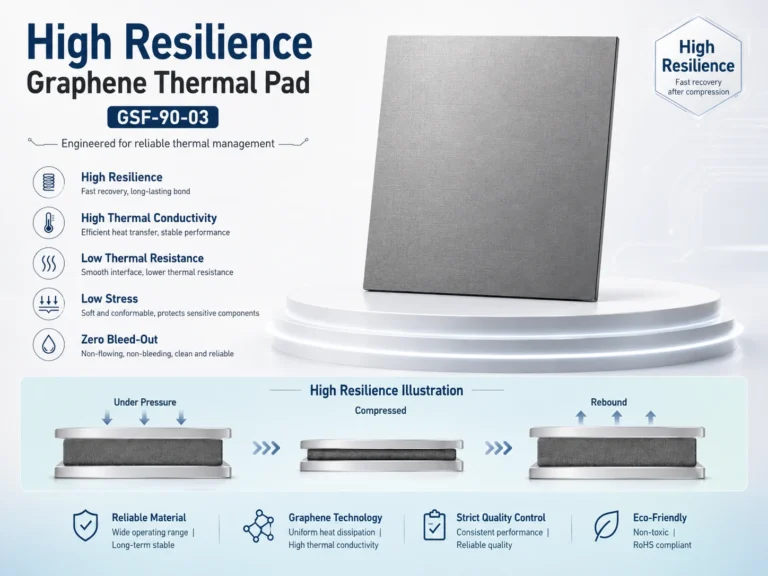
- Soft, compressible almohadilla térmica
- Strong dielectric insulation
- Good gap-filling between ASIC and heat sink
- Grafito
- Thin layered carbon sheet
- High in-plane transferencia de calor
- Functions as heat spreader toward vapor chamber
- Silicona
- Cooling Path in Network Switch
- Chip → Interface material → Heat sink base → Fins or chassis
- In high-density Network Switch thermal pad layouts, lateral spreading matters.
- Application Logic
- Choose Silicona when:
- Height tolerance varies
- Electrical isolation is critical
- Choose Grafito when:
- Surface is flat
- Rapid lateral Cooling is required
- Choose Silicona when:
According to Gartner’s 2025 data center infrastructure outlook, thermal density in switching equipment continues to rise with AI-driven traffic, increasing demand for higher-efficiency interface materials.
For brands like Materiales brillantes, balancing compressibility and conductivity in a thermal pad for Network Switch ASIC cooling is the daily grind.
Ceramic-filled Elastomer Sheets for CPU Heat Dissipation
Inside a switch control board, the CPU works nonstop. That’s where Ceramic-filled Elastomer Sheet solutions step in for stable Disipación del calor.
Why engineers like them:
- Fuerte aislamiento eléctrico
- Enhanced conductivity from ceramic fillers
- Durable under repeated thermal cycling
In practice, a almohadilla térmica for the Network Switch CPU areas must:
- Conform to uneven surfaces
- Maintain pressure over time
- Support consistent Thermal management
Short and simple:
Good compression.
Clean contact.
Stable performance.
In high-load routing environments, this type of material de interfaz térmica keeps processing units within safe limits. For integrators sourcing a thermal pad for Network Switch, Materiales brillantes offers tuned hardness options that make assembly smooth, not stressful.
Polymer-based Die-cut Parts for Transceiver Interfaces
Optical modules create localized heat near the cage. A Polymer Die-cut Part acts as a precision Thermal component between Transceiver housing and chassis.
- Design Flow
- Measure cage tolerance
- Define compression window
- Die-cut exact Part geometry
- Functional Layers
- Contact surface → optimized Interface
- Core material → conductive polymer matrix
- Backing → optional insulation layer
- Electronic device Stability
- Reduces vibration shift
- Maintains steady transferencia de calor
- Supports automated placement
For high-port-count platforms, a consistent thermal pad for Network Switch transceiver lanes prevents thermal stacking. A properly cut Network Switch thermal pad keeps modules cool without squeezing them too hard.
Adhesive-backed Custom Shapes for Voltage Regulator Modules
Power rails heat up fast. A thermal pad for Network Switch VRM zones must stay locked in place.
Here’s how adhesive-backed Custom shape pads help:
- Secure bonding to Voltage Regulator Module (VRM)
- Reduced movement under vibration
- Cleaner assembly workflow
Typical integration flow:
- Peel the liner from the adhesive-backed surface
- Align to Module footprint
- Apply uniform pressure
- Complete heat sink Attachment method
Small detail, big payoff.
Less shifting.
Mejor Heat transfer.
For switch makers pushing compact designs, a tailored thermal solution from Materiales brillantes ensures each thermal pad for Network Switch VRM circuits stays reliable during long uptime cycles.
4 Key Parameters Of Thermal Pad For Network Switch
Network gear runs hot, plain and simple. A thermal pad for Network Switch keeps chips cool, stable, and safe. When choosing a thermal interface pad for switch boards, four specs matter most: conductivity, thickness, compressibility, and insulation strength.
Conductividad térmica
Para cualquier thermal pad for Network Switch, Heat transfer performance decides how fast heat leaves the ASIC or CPU.
- Core performance factors
- Watt per meter Kelvin (W/mK) rating
- Higher values improve Heat flow from chip to sink
- Baja Resistencia térmica means better Disipación del calor
- Quality of the Interface material
- Filler type and dispersion
- Stability under long uptime
- Overall system Efficiency
- Contact pressure
- Surface flatness
- Watt per meter Kelvin (W/mK) rating
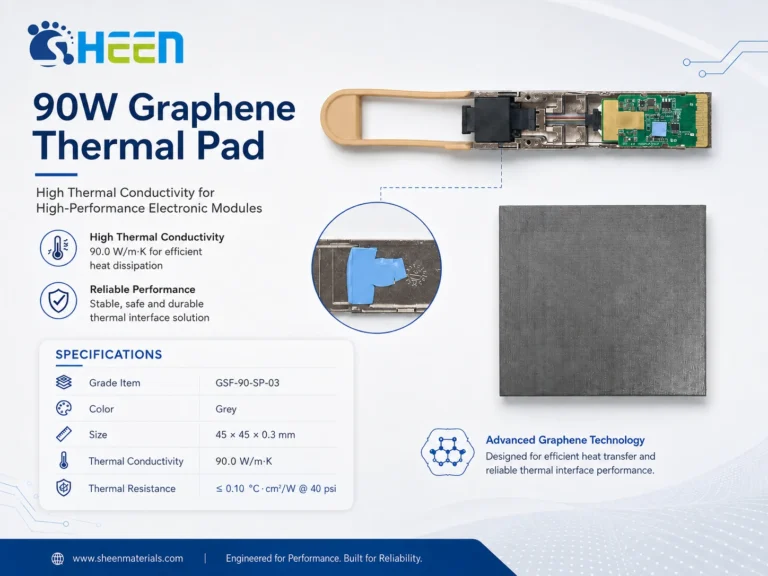
A network switch thermal pad with optimized conductivity helps avoid throttling and random shutdowns. Sheen Materials engineers its thermal pad for Network Switch to maintain steady Disipación del calor even in dense racks.
Espesor
Thickness affects both Gap filling and total Impedancia térmica.
- Match pad thickness to device spacing.
- Controlar Bond line thickness (BLT) under real assembly Pressure.
- Reduce Contact resistance by avoiding over-compression.
Too thin? Poor conformity. Too thick? Extra resistance. A balanced thermal pad for Network Switch keeps heat moving while handling mechanical tolerance. Sheen Materials offers custom sheets so your network switch thermal pad fits just right.
Compresibilidad
Compressibility keeps the thermal pad for Network Switch tight against uneven parts.
- Material behavior
- Conformabilidad to Surface irregularities
- Controlado Deformation with good Elasticity
- Mechanical benefits
- Incluso Pressure distribution
- Fiable Void filling
- Built-in Stress relief for solder joints
A good switch thermal pad adapts during assembly and stays stable over years of uptime.
Rigidez dieléctrica
Electrical safety is non-negotiable in a thermal pad for Network Switch.
- Insulation fundamentals
- Alta Aislamiento eléctrico
- Fuerte Electrical resistance
- Protection capability
- Rated Tensión de ruptura
- Demostrado Voltage withstand
- Eficaz Isolation between components
- Compliance focus
- Certified Insulator rendimiento
- Supports safety testing targets
With high dielectric strength, Sheen Materials ensures every thermal pad for Network Switch delivers both cooling and safe operation inside compact switching equipment.
Thermal Pad For Network Switch Vs Paste: Performance Comparison
In high-density switching gear, heat sneaks up fast. Choosing a thermal pad for Network Switch or paste is not just a materials call; it affects uptime, maintenance rhythm, and even assembly speed. Below, we break down how a thermal pad for Network Switch stacks up against grease in real racks, real traffic, real workloads.
Almohadilla térmica
Al seleccionar un thermal pad for Network Switch, performance hinges on structure and stability.
- Forma material
- Sólido, pre-formed sheet
- Fixed espesor for controlled application
- Engineered conductivity with defined compresibilidad
- Functional Behavior
- Maintains uniform transferencia de calor across ASIC and PHY chips
- Acts as dielectric barrier inside tight PoE layouts
- Supports repeatable application during mass production
- Assembly Impact
- Clean handling; no pump-out risk
- Easy die-cutting for custom switch heat sink footprints
- Ideal for automated placement in SMT-adjacent workflows
Performance comparison for a typical thermal pad for Network Switch:
| Tipo de material | Conductividad térmica (W/m-K) | Typical Thickness (mm) | Resistividad volumétrica (Ω-cm) | Rework Ease |
|---|---|---|---|---|
| Almohadilla de silicona | 3.0–6.0 | 0.5–2.0 | ≥10¹² | Alta |
| Graphite Pad | 5.0–12.0 | 0.2–1.0 | Anisotropic | Medio |
| Pasta térmica | 4.0–8.5 | Thin layer (<0.1) | Varies | Bajo |
Inside core switches:
- Heat Path Optimization
- Chip
- Direct contact via thermal pad for Network Switch
- Controlled gap spacing
- Heat Spreader
- Even pressure distribution
- Reduced air voids
- Chassis
- Stable long-term transferencia de calor
- Chip
For brands like Sheen Materials, the value lies in balancing conductivity with mechanical compliance, so the thermal pad for Network Switch handles vibration, transport shock, and years of uptime without drying or shifting.
Pasta térmica
A thermal pad for Network Switch often competes with paste, but paste plays a different game.
- Material Nature
- Viscous, semi-liquid compound
- Applied as a thin layer
- High initial conductivity when freshly spread
- Performance Dynamics
- Fuerte spreading ability across micro-gaps
- Excellent relleno de huecos in uneven surfaces
- Lower contact resistance at the start
Inside switch assemblies:
- Application Control
- 1) Metered dispensing onto ASIC
- 2) Heat sink compression
- 3) Excess compound squeeze-out check
- Risk Factors
- Pump-out under thermal cycling
- Dry-out affecting long-term transferencia de calor
- Shelf-life sensitivity before application
- Maintenance View
- Harder to rework cleanly
- Messier during RMA handling
- Requires curing or settling validation in some formulas
For operators weighing thermal pad for Network Switch against grease, the call often comes down to repeatability versus peak initial performance. Paste wins on ultra-thin interface efficiency. A well-designed thermal pad for Network Switch, especially from suppliers like Sheen Materials, wins on consistency, dielectric safety, and production rhythm.
Can a thermal pad for a network switch improve stability?
Modern data centers push hardware hard. Under heavy traffic, a thermal pad for a network switch can quietly make the difference between smooth uptime and random slowdowns. Let’s break down how a well-designed network switch thermal pad keeps systems cool, steady, and ready for real-world loads.
Enhancing Reliability under High Memory Module Loads
En Módulos de memoria run under High loads, heat builds up fast. Without proper Thermal management, sobrecalentamiento creeps in and quietly hurts System stability.
- Core stability drivers
- Heat concentration control
- A thermal pad for Network Switch fills microscopic gaps between chips and heat sinks.
- This improves Disipación del calor across uneven surfaces.
- Pressure balancing
- Even compression avoids board warping.
- Stable contact protects Reliability over time.
- Heat concentration control
- Impact on memory-intensive switching
- Sustained packet buffering
- High-speed routing tables
- Continuous data bursts
Below is a simplified performance comparison for a switch memory area using a thermal pad for Network Switch versus no pad:
| Condition | Avg Temp (°C) | Temp Variance (°C) | Error Rate (%) | Stability Score |
|---|---|---|---|---|
| No thermal interface | 92 | 14 | 0.38 | Medio |
| Standard pad | 78 | 7 | 0.12 | Alta |
| High-performance pad | 72 | 4 | 0.05 | Muy alta |
Una calidad thermal pad for Network Switch, especially from Sheen Materials, helps prevent thermal throttling during peak traffic. That means fewer crashes, fewer reboots, and less stress on sensitive silicon.
Maintaining Durability across Operating Temperature Ranges
Switches don’t live in perfect lab conditions. Operating temperature swings happen daily, and wide Temperature ranges can trigger Material degradation if the interface material is weak.
Consider how a thermal pad for Network Switch supports long-term Durabilidad:
- Under thermal cycling
- Repeated expansion and contraction
- Good elasticity absorbs movement.
- Poor pads crack or shift.
- Repeated expansion and contraction
- Under constant Heat stress
- Stable compressibility
- Low oil bleed
- Across environments
- Data centers
- Edge cabinets
- Industrial rooms
A fiable network switch thermal pad resists pump-out during vibration and constant load. That directly improves Component lifespan. Sheen Materials designs silicone-based pads that keep structure intact even after extended thermal cycling, helping switches stay stable year after year.
Meeting Certification and Environmental Standards
Compliance is not just paperwork. It affects global deployment.
A high-quality thermal pad for Network Switch should meet:
- Recognized Safety standards with certified flammability ratings.
- Verificado Regulatory compliance for export markets.
- Alignment with Environmental standards, including RoHS.
From a technical angle, proper Thermal compliance supports consistent Energy efficiency. Lower operating temperatures often reduce cooling demand, cutting overall system power draw.
For buyers sourcing a thermal pad for Network Switch, documentation matters. Test reports, aging data, and flame ratings build confidence with auditors and OEM partners. Sheen Materials provides traceable material data to simplify Certification reviews, helping network equipment move smoothly through approval pipelines without last-minute surprises.
In short, the right thermal interface material for switch chips is not just about cooling. It’s about protecting Reliability, extending hardware life, and keeping compliance teams happy—all while your network keeps humming.
Prevent Overheating: Thermal Pad For Network Switch Solution
Network rooms get hot, fast. A thermal pad for Network Switch keeps heat from piling up where it hurts most. This cluster breaks down how different pad designs protect power, chips, and memory, then tie into cooling hardware. The goal is simple: steadier uptime, fewer meltdowns, and switches that don’t fry under pressure.
Die-cut Silicone Pads for Power Supply Units
Dentro de un power supply, heat never spreads evenly. Die-cut silicona pads fix that with tight tolerances and predictable compression. In real builds, a thermal pad for Network Switch at the PSU plays three roles at once.
- Thermal interface consistency across transformers and MOSFETs
- Built‑in aislamiento eléctrico to avoid shorts
- Fiable transferencia de calor during peak PSU load
Engineers usually nest these pads by zone:
- Primary side
- High-voltage spacing
- Thicker silicone pads
- Secondary side
- Thinner cuts
- Faster heat flow into metal frames
Below is typical performance data used when sizing a thermal pad for Network Switch PSU designs:
| Pad Thickness (mm) | Conductividad térmica (W/m-K) | Dielectric Strength (kV) |
|---|---|---|
| 0.5 | 3.0 | 6 |
| 1.0 | 3.5 | 8 |
| 1.5 | 4.0 | 10 |
| 2.0 | 5.0 | 12 |
| 3.0 | 6.0 | 14 |
Laminated Elastomer for Chipset Heat Spreaders
A chipset hates air gaps. Laminated elastomer sheets bring soft touch and steady pressure. That combo boosts conductividad térmica while keeping chipset packages safe from board flex.
Most layouts follow a simple logic:
- Top layer
- Alta adhesion to heat spreaders
- Core layer
- Elastic recovery for vibration damping
Used right, a thermal pad for Network Switch here smooths contact with vapor chambers and keeps clocks stable. This is where Materiales brillantes earns trust by tuning lamination stiffness without killing flexibility.
Fiberglass-reinforced Pads on Memory Modules
Memory runs cooler than CPUs, yet fails faster when stressed. Fibra de vidrio reinforced pads add backbone. Short and sweet benefits show up quickly:
- Mejor estabilidad mecánica under shock
• Less creep after thermal cycling
• Safer electrical isolation
Designers often stack decisions:
- Pad body
- Thermal management grade elastomer
- Refuerzo
- Woven fiberglass for durabilidad
For dense racks, a thermal pad for Network Switch en memory modules prevents slow data errors that nobody spots until logs blow up.
Integration with Heat Sink and Fan Assemblies
Cooling only works when parts play nice. Disipador de calor contact, fan assemblies, and pad compression must agree.
- Pad fills surface gaps
- Sink spreads heat
- Fans move airflow
Under that flow sits smart integration:
- Mounting pressure control
- Baja resistencia térmica
- System view
- One thermal solution, not loose parts
When everything lines up, a thermal pad for Network Switch becomes the quiet hero. That’s the approach Materiales brillantes backs—pads designed to fit real cooling systems, not lab fantasies.
FAQs about the Thermal Pad for the Network Switch
Why is a thermal pad for a network switch preferred over thermal grease in mass assembly?
In high-volume fabrication, control matters more than improvisation. A thermal pad for a network switch keeps every ASIC, CPU, and Memory Module evenly supported without messy dispensing.
- Stable Thickness & Compressibility – Pre-set Thickness ensures uniform contact with Heat Sink or Vapor Chamber, while controlled Compressibility adapts to uneven Chipset surfaces.
- Clean Assembly Flow – Die-cutting and pre-cut adhesive-backed parts speed up Assembly, avoiding pump-out risks linked to Thermal Grease.
- Electrical Safety – High Dielectric Strength protects the Voltage Regulator Module and Power Supply Unit from leakage.
The result is better Reliability, longer Shelf Life in storage, and fewer surprises during large-scale fabrication.
How do material composition and properties affect cooling performance?
Performance lives at the intersection of composition and data sheet numbers. A mismatch can overheat a Transceiver under full load.
- Silicone or Elastomer + Ceramic fillers: Balanced Thermal Conductivity and flexibility across wide Operating Temperature ranges.
- Graphite or Non-silicone sheets: Higher conductivity for tight chassis, though insulation must be verified.
- Fiberglass reinforcement: Maintains shape stability during Curing and long-term vibration.| Property | Why It Matters in a Switch | | — | — | | Thermal Conductivity | Moves heat from ASIC/CPU to Heat Pipe or Heat Sink | | Thickness | Fills gap between Chipset and metal housing | | Surface Tack | Keeps contact stable under Fan vibration | | Flammability Rating | Protects dense rack environments | | | | | Material choice directly impacts Durability and steady thermal control inside compact enclosures. | |What should buyers verify before sourcing thermal pads for switch production?Bulk purchasing is less about price, more about risk control. Three checkpoints define safe sourcing:
- Testing Standard & Certification: Confirm dielectric breakdown, Flammability Rating, and Environmental Standard compliance.
- Form Factor Accuracy: Sheet, Roll, or Custom shape Die-cut part must match exact layout of ASIC and Power Supply Unit zones.
- Process Compatibility: Ensure Lamination, Molding, and Assembly steps fit existing production lines without rework.
When Certification, Compliance, and consistent Thermal Interface Material performance align, overheating fades from a daily concern to a controlled variable.