-
ADD: Edificio 2, nº 8 de Hengzhutang Road, Dongguan
-
Teléfono: +86 135 4224 3751

Can SHEEN’s AF1000 Silicone-Free Thermal Pad Meet 130°C+ Thermal Requirements in EV Battery Packs?
Thermal design for EV battery packs has one critical mission: move heat away from the cells quickly, safely, and reliably — without compromising electrical insulation or mechanical integrity.
As EV battery architecture moves toward CTP battery packs y 800V high-voltage platforms, the thermal interface system is no longer a simple “heat transfer layer.” It has become a safety-critical component that must handle heat, voltage, vibration, flame resistance, contamination control, and long-term aging at the same time.
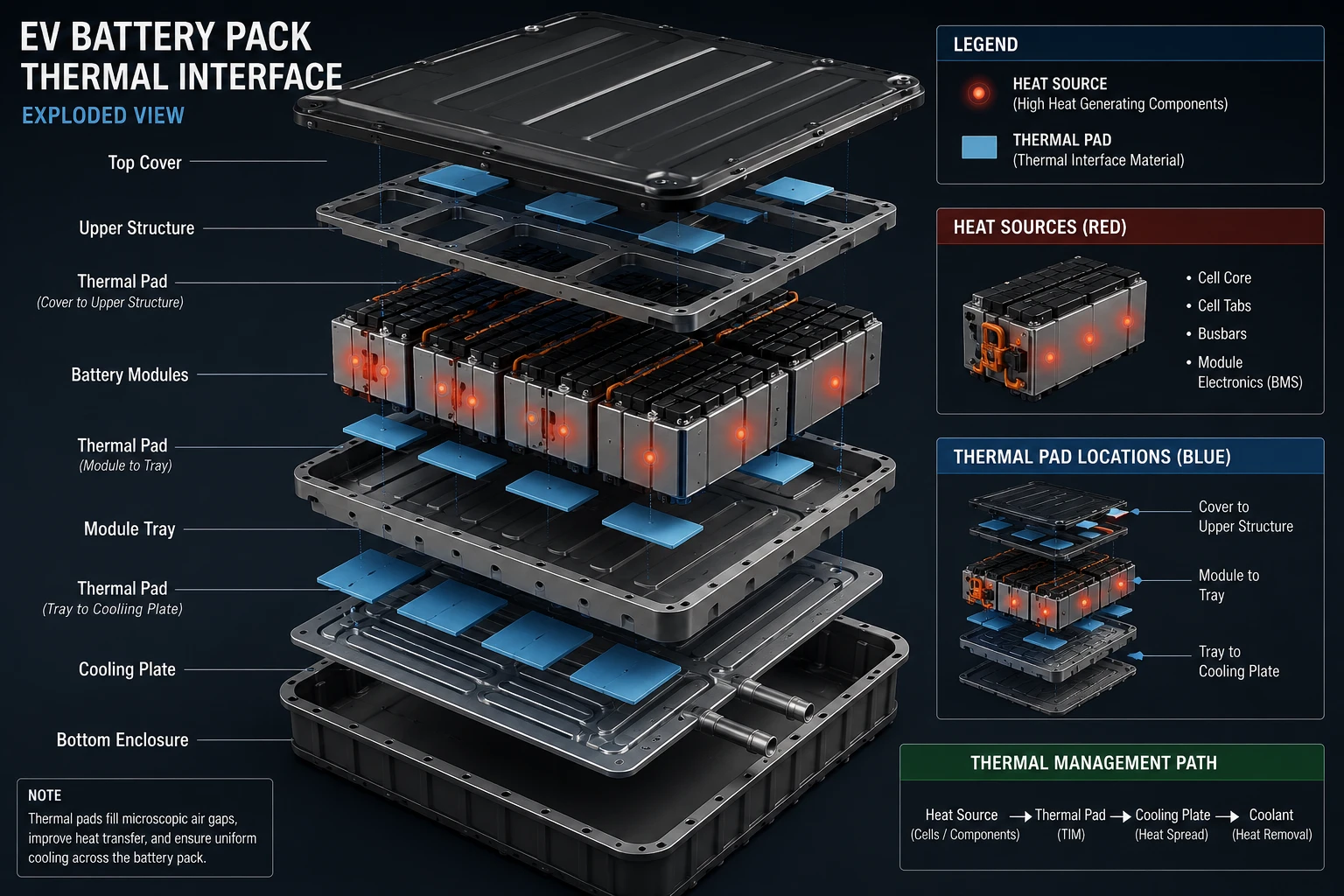
The following table summarizes the key thermal management requirements for modern EV battery packs.
| Performance Dimension | Key Requirement / Target | Por qué es importante |
|---|---|---|
| ⚡ High Thermal Conductivity | Thermal adhesive / thermal pad: mainstream demand is around 3–6 W/m·K, with some applications requiring 5 W/m·K or higher.Thermally conductive plastics: typically around 1.5–3 W/m·K, and can approach aluminum-like performance through structural design.Phase change materials (PCM): typically around 5–15 W/m·K, often enhanced with graphene or other high-performance fillers. | Heat generated by battery cells must be transferred rapidly to cooling components such as liquid cooling plates, helping control the maximum cell temperature within a safer range of around 50°C. |
| 🛡️ High-Voltage Electrical Insulation | Breakdown voltage: typically required to be >5 kV/mm.Volume resistivity: typically >10¹³ Ω·cm. | 800V EV platforms place much higher demands on insulation. Thermal materials must transfer heat while preventing high-voltage breakdown and electrical safety failures. |
| 🔥 Flame Retardancy and Temperature Resistance | Flame rating: should meet UL94 V-0.Operating temperature: stable performance from -40°C to 150°C. | In a thermal runaway scenario, the material must not accelerate fire spread. The thermal interface material itself must not become a weak link in battery safety. |
| 🔧 Reliable Mechanical Performance | Bonding strength: structural thermal adhesives often require shear strength >8 MPa.Flexibility: elongation at break typically >100% to absorb vibration and shock.Low thermal resistance: compression behavior is critical; contact resistance is often reduced by controlled compression, such as a 2.0 mm deflection design. | The material must remain mechanically stable under vehicle vibration while filling micro-gaps between cells and cooling plates, reducing interface thermal resistance. |
| ⚖️ Lightweight Design | Low density: target is typically below 3 g/cm³, with some advanced materials reaching around 2.3 g/cm³. | Battery pack weight directly affects vehicle range. Lightweight thermal materials, such as thermally conductive plastics, can reduce weight by 25%–45% compared with aluminum structures. |
| ⏳ Long-Term Reliability | Low volatile content: for example, low-molecular siloxane content <100 ppm.Aging resistance: should pass 1000+ hours of high-temperature/high-humidity aging, thermal cycling, or related reliability tests. | Volatile substances can contaminate cells, connectors, BMS circuits, or cause materials to dry out and crack. EV battery thermal materials must survive a service life of 10 years or more. |
According to the AF1000 silicone-free thermal pad datasheet, AF1000 can meet most of the critical thermal management requirements for EV battery packs, especially in thermal conductivity, flame retardancy, silicone-free contamination control, and reliability.
However, one point must be treated with engineering caution: AF1000’s breakdown voltage is slightly below the >5 kV/mm benchmark often expected in some high-end 800V battery platforms. For conventional voltage platforms or applications with additional insulation design, it can still be a very strong candidate.
Key Technical Parameters: AF1000 vs. EV Battery Pack Requirements
| Performance Dimension | Industry Requirement | AF1000 Tested Value | Compliance | Engineering Comment |
|---|---|---|---|---|
| 🔥 Thermal Conductivity | Mainstream demand: 3–6 W/m·K | 10,0 W/m-K | ✅ Exceeds Requirement | Far beyond mainstream thermal pad requirements. This gives AF1000 powerful heat transfer capability for battery pack thermal management. |
| 🛡️ Breakdown Voltage | >5 kV/mm | ≥4 kV/mm | ⚠️ Slightly Below | This is the key parameter to verify for 800V platforms. It is lower than the ideal high-voltage benchmark, but still strong for many standard EV battery applications. |
| 🔥 Flame Retardancy | UL94 V-0 | V-0 | ✅ Meets Requirement | Provides strong flame-retardant performance and helps reduce fire propagation risk. |
| 🌡️ Operating Temperature | -40°C to 150°C | -40°C to 150°C | ✅ Meets Requirement | Fully covers the typical extreme operating temperature range of EV battery packs. |
| ⚡ Volume Resistivity | Typically >10¹³ Ω·cm | 1×10¹² Ω·cm | ⚠️ Application-Dependent | Provides strong electrical insulation, but should be verified against the exact insulation requirement of the battery platform. |
| 🧪 Silicone-Free / Low Volatility | No siloxane volatility | Silicone-oil-free / siloxane-free | ✅ Core Advantage | Reduces the risk of contamination to BMS circuits, high-voltage connectors, and sensitive electronic components. |
| ⏳ Long-Term Reliability | Pass 1000h+ aging tests | Passed 1000-hour reliability testing | ✅ Meets Requirement | Supports long-term performance stability across the EV service life. |
| Tipo de producto | Norma de ensayo | AF1000 (2 mm) |
|---|---|---|
| Color | Visual | Gris |
| Espesor (mm) | ASTM D374 | 1–2 mm |
| Density (g/cm³) | ASTM D792 | 3.3 ± 0.2 |
| Conductividad térmica (W/m-K) | ASTM D5470 | 10 ± 1 |
| Hardness (Shore 00) | ASTM D2240 | 50–65 |
| Breakdown Voltage (kV, @AC) | ASTM D149 | ≥ 4 |
| Inflamabilidad | UL94 | V-0 |
| Volume Resistivity (Ω·cm, @250V) | ASTM D257 | ≥ 10¹² |
| Dielectric Constant (F/m, @1MHz) | ASTM D150 | ≥ 6 |
| Application Temperature (°C) | / | -40 ~ 150 |
| Thermal Resistance (°C·in²/W, @50psi) | ASTM D5470 | ≤ 0.13 |
| RoHS | CEI 62321 | PASE |
| Halógeno | EN 14582 | PASE |
| REACH | EN 14372 | PASE |

Three Core Advantages of AF1000: Stronger Heat Transfer, Cleaner Chemistry, Safer Battery Design
- High thermal conductivity — 10.0 W/m·K
With a thermal conductivity of 10,0 W/m-K, AF1000 is far above many conventional 3–6 W/m·K thermal pads on the market. This means it can transfer heat from battery cells to the liquid cooling plate much faster, helping suppress temperature rise and improve cell-to-cell thermal consistency. - Silicone-free formulation
This is one of AF1000’s most important differentiators. Unlike traditional silicone-based thermal pads, AF1000 contains no silicone oil and no volatile siloxane compounds. That matters because silicone migration can contaminate precision BMS circuits, high-voltage connectors, and other sensitive electrical interfaces. In EV battery packs, contamination is not a small defect — it can become a serious reliability risk. - Excellent flame retardancy
AF1000 reaches UL94 V-0 flame-retardant performance. In battery safety design, this is critical. When thermal runaway risk appears, the thermal interface material must help control the situation — not make it worse.
Key Features: Why AF1000 Is a Strong Choice for EV Battery Packs
Beyond thermal conductivity alone, AF1000 fits EV battery pack applications because it addresses several high-priority engineering concerns at the same time.
- 🔧 Silicone-free design
AF1000 uses an acrylic resin-based system and contains no silicone components. This helps eliminate the risk of siloxane volatilization or silicone oil bleeding, reducing potential contamination-related failures in circuits, connectors, and electronic control systems. - ⚡ High-performance heat transfer
Its 10.0 W/(m·K) thermal conductivity enables efficient heat transfer from battery cells to the cooling system, supporting stable battery pack thermal management under demanding operating conditions. - 🛡️ High reliability and safety
AF1000 provides strong electrical insulation performance and UL94 V-0 flame retardancy, both of which are essential for EV battery systems where safety margins cannot be compromised. - 🎯 Strong application fit
SHEEN’s AF series is positioned for applications such as Baterías para VE y BDU battery disconnect units. From a product positioning perspective, AF1000 is highly aligned with the thermal, electrical, and reliability requirements of EV battery systems.