-
ADD: Building 2, No. 8 Hengzhutang Road, Dongguan
-
Phone: +86 135 4224 3751

Effortless Heat Dissipation: Discover How Double-Sided Self-Adhesive Thermally Conductive Solutions Revolutionize Electronics
Heat is the silent party crasher in modern electronics—shows up uninvited, wrecks performance, and leaves you with warranty claims. Double-Sided Self-Adhesive Thermally Conductive Solutions step in like the cool-headed fixer, bonding components tight while channeling heat exactly where it needs to go. No greasy mess, no clunky brackets—just peel, press, and keep the line moving.
For procurement teams juggling deadlines and defect rates, that’s not fluff—that’s margin protection. When power density climbs and space shrinks, you need materials that pull their weight without slowing production. This is where smart thermal design stops being a headache and starts being your competitive edge.
Why Choose Thermally Conductive Adhesive Films?
Double-Sided Self-Adhesive Thermally Conductive Solutions sound technical, yet the idea is simple: better heat transfer, safer insulation, tighter bonding. In fast-moving electronics, Double-Sided Self-Adhesive Thermally Conductive Solutions keep chips cool, stable, and ready for long hours of work without drama.
The Role of Thermal Conductivity in Electronics
In electronic devices, thermal management often decides lifespan. Double-Sided Self-Adhesive Thermally Conductive Solutions support steady temperature control through smart material properties designed for fast heat flow.
- Heat Path Efficiency1.1 From chip to interface:
- Direct heat transfer away from hotspots
- Lower internal thermal buildup
1.2 From interface to sink:

*   Reduced thermal bottlenecks

*   Improved **component reliability**
- Performance Stability2.1 Continuous operation
- Maintains safe working temperatures
- Prevents thermal throttling
2.2 Environmental variation

*   Handles load spikes

*   Supports compact electronic devices
Double-Sided Self-Adhesive Thermally Conductive Solutions are widely used in processors, LED boards, and power modules because steady cooling simply keeps things running smoother.
Electrical Insulation and Its Importance in Power Electronics
Double-Sided Self-Adhesive Thermally Conductive Solutions must balance cooling with electrical safety.
- Insulation Performance1.1 Core metrics
- High dielectric strength
- Strong resistance to voltage breakdown
1.2 Material behavior

*   Reliable **insulating materials**

*   Stable performance under load
- System Protection2.1 Safeguarding power components
- Prevents short circuits
- Enhances long-term system protection
2.2 Compliance needs

*   Meets safety standards

*   Supports regulated applications
In power converters and inverters, Double-Sided Self-Adhesive Thermally Conductive Solutions quietly manage heat while guarding circuits from electrical risk.
How Adhesion Strength Impacts Heat Dissipation Efficiency
Adhesion is not just about sticking; it shapes thermal resistance and overall cooling.
- Interface Quality1.1 Surface bonding
- Maximized surface contact
- Controlled bond line thickness
1.2 Gap control

*   Effective **gap filling**

*   Reduced trapped air
- Mechanical Reliability2.1 Long-term hold
- Strong adhesive properties
- Improved mechanical stability
2.2 Thermal interface impact

*   Lower interface resistance

*   Better heat flow continuity
Double-Sided Self-Adhesive Thermally Conductive Solutions improve the thermal interface by pressing surfaces tightly together. That small detail cuts resistance and boosts cooling efficiency.
For manufacturers aiming at durable, high-output assemblies, Sheen Electronic Technology integrates Double-Sided Self-Adhesive Thermally Conductive Solutions into designs that simply work—cooler, safer, and built to last.
5 Steps To Apply Thermal Conductive Tapes
Double-Sided Self-Adhesive Thermally Conductive Solutions sound technical, yet the idea is simple: move heat fast and keep parts firmly attached. From LED boards to automotive modules, double-sided, self-adhesive, thermally conductive tapes help manage heat without messy grease or screws. This guide walks through practical actions that make Double-Sided Self-Adhesive Thermally Conductive Solutions perform at their best while keeping bonding strength solid and heat flow steady.
Step 1: Preparing the Surface for Optimal Adhesion
Proper surface preparation drives optimal adhesion when using Double-Sided Self-Adhesive Thermally Conductive Solutions.
- Surface condition
- Remove surface contaminants using approved cleaning agents
- Check substrate material compatibility
- Apply adhesion promoters if required
• Wipe oils and oxidation
• Dry completely
• Avoid touching bonding zones
Clean metal. Dry plastic. Stable base. That’s how self-adhesive thermally conductive tape bonds right.
Step 2: Selecting the Right Thermal Conductive Tape for Your Application
Choosing Double-Sided Self-Adhesive Thermally Conductive Solutions depends on real numbers, not guesswork.
1) Evaluate thermal conductivity and thermal impedance
2) Match adhesive type with material compatibility
3) Confirm application temperature and dielectric strength
4) Balance tape thickness with gap tolerance
Performance Comparison of Double-Sided Self-Adhesive Thermally Conductive Solutions
| Model | Thermal Conductivity (W/m·K) | Tape Thickness (mm) | Dielectric Strength (kV/mm) | Application Temp (°C) |
|---|---|---|---|---|
| TC-01 | 1.2 | 0.15 | 4.5 | -20 to 120 |
| TC-02 | 1.8 | 0.20 | 5.0 | -30 to 150 |
| TC-03 | 2.5 | 0.25 | 6.0 | -40 to 180 |
| TC-04 | 3.0 | 0.30 | 6.5 | -40 to 200 |
| TC-05 | 3.5 | 0.35 | 7.0 | -50 to 220 |
For stable performance, many engineers turn to Double-Sided Self-Adhesive Thermally Conductive Solutions from Sheen Electronic Technology.
Step 3: Proper Alignment for Effective Heat Dissipation
Alignment affects heat flow inside any thermal interface adhesive system.
- Positioning
- Center tape over the heat source
- Ensure full contact with the heat sink
- Maximize contact area
- Tools and checks
- Use alignment tools
- Confirm component placement
- Verify gap filling across the thermal interface
Misalignment creates hidden thermal resistance. A clean press-down ensures thermally conductive tape works as designed.
Step 4: Ensuring Strong Bonding with Double-Sided Adhesive
Bonding strength comes from controlled pressure application and correct cure time.
• Apply even force across the adhesive layer
• Prevent air pockets for void prevention
• Measure peel strength and shear strength
Good pressure improves bonding strength and long-term stability of Double-Sided Self-Adhesive Thermally Conductive Solutions. In compact electronics, that stability really matters.
Step 5: Testing and Verifying the Adhesive Performance
Verification keeps Double-Sided Self-Adhesive Thermally Conductive Solutions reliable over time.
- Thermal evaluation
- Measure thermal resistance
- Use thermal imaging
- Track key performance metrics
- Durability checks
- Conduct temperature cycling
- Perform adhesion testing
- Complete full reliability testing for long-term stability
Double-sided thermally conductive tape is more than sticky material. Done right, Double-Sided Self-Adhesive Thermally Conductive Solutions secure components, move heat efficiently, and keep electronics running cool without drama.
Top 3 Challenges In Electronic Heat Management
Electronic devices keep getting smaller, faster, and hotter. From high-powered electronics in data servers to compact control boards in cars, heat management is now a daily headache for engineers. The right Double-Sided Self-Adhesive Thermally Conductive Solutions can make or break performance. When thermal conductivity, adhesion, and durability don’t line up, trouble shows up fast. Let’s break down where the pressure really sits—and how smart material choices keep things cool without drama.
Managing Heat in High-Powered Electronics (Power Transistors & Microprocessors)
When power transistors and microprocessors run at full load, heat dissipation becomes mission-critical.
At the device level:
- Chip core generates concentrated heat.
- If not transferred quickly, signal drift begins.
- Long exposure accelerates material fatigue.
- Heat spreads to surrounding boards.
- Poor thermal solutions trap hotspots.
- Air gaps reduce effective thermal conductivity.
At the interface level:
- Contact resistance forms between chip and heatsink.
- Microscopic surface gaps block smooth transfer.
- Inconsistent bonding weakens thermal pathways.
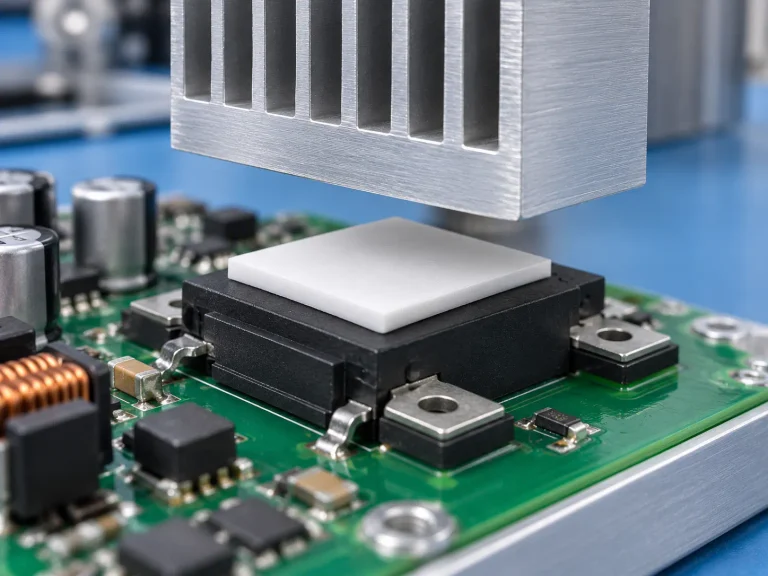
This is where Double-Sided Self-Adhesive Thermally Conductive Solutions step in. By combining thermal adhesive layers with conductive fillers, thermally conductive adhesive tapes create stable bridges between components. A well-designed double-sided thermal interface keeps pressure even and heat flowing.
Sheen Electronic Technology develops Double-Sided Self-Adhesive Thermally Conductive Solutions tailored for compact layouts, helping engineers maintain safe operating temperatures without bulky hardware. It’s simple: better contact, better cooling, fewer surprises.
Overcoming Adhesion Issues in Thermal Pads and Gap Fillers
Adhesion sounds basic—until it fails.
Common adhesion issues show up like this:
- Edge lifting after thermal cycling
- Slippage during assembly
- Weak bonding strength under vibration
Inside the material structure:
- Base layer: provides mechanical stability.
- Adhesive layer:
- Must balance tack and peel strength.
- Needs compatibility with aluminum and copper.
- Filler network:
- Drives heat through the thermal interface.
- Impacts long-term reliability.
Poorly matched thermal pads and gap fillers can delaminate once devices heat up and cool down repeatedly. A properly engineered Double-Sided Self-Adhesive Thermally Conductive Solutions system blends conformability with secure bonding.
With precision die-cutting and optimized adhesive chemistry, Sheen Electronic Technology enhances surface wet-out and minimizes air pockets. The result? Stronger attachment, smoother heat flow, and fewer returns from the field.
Ensuring Long-Term Durability in Automotive and Medical Device Applications
In automotive applications, materials face heat spikes, vibration, and moisture. In medical device applications, stability and compliance matter just as much as performance.
Durability challenges break down into layers:
- Environmental stress
- Extreme temperature swings
- Constant thermal cycling
- Humidity exposure
- Mechanical stress
- Road vibration
- Repeated movement
- Chemical stability
- Risk of material degradation over time
To secure long-term durability, manufacturers rely on Double-Sided Self-Adhesive Thermally Conductive Solutions that maintain adhesion and environmental stability across thousands of operating hours.
High-grade thermal interface materials with stable conductive fillers resist cracking and pump-out. That’s how reliability stays intact.
When every watt counts and downtime isn’t an option, smart Double-Sided Self-Adhesive Thermally Conductive Solutions quietly handle the pressure—keeping systems steady, compliant, and cool under real-world stress.
FAQs about Double-Sided Self-Adhesive Thermally Conductive Solutions
How do Double-Sided Self-Adhesive Thermally Conductive Solutions improve heat control in electronics?
In power electronics and LED lighting, heat builds fast around microprocessors, power transistors, and LED arrays. A thermally conductive tape works as both bonding layer and thermal interface material, forming tight contact between components and heat sinks.
- Efficient heat path – Stable thermal conductivity reduces hot spots in integrated circuits and memory modules.
- Electrical safety – High dielectric strength and electrical insulation protect sensitive circuits.
- Process simplicity – Compared with thermal grease or gap fillers, double-sided adhesive films support die-cutting, lamination, and assembly automation without messy dispensing.
The result is cleaner production, steadier temperature control, and longer service life in consumer electronics and telecommunications equipment.
Why is adhesion strength and surface preparation so critical?
A thin layer decides the fate of the whole system. Oil, dust, or oxidation can create micro air gaps that block heat flow.
- Clean surfaces → stronger adhesion strength → better conformability to uneven heat sinks.
- Strong bonding → resistance to vibration in automotive electronics.
- Stable contact → consistent temperature resistance during thermal cycling under ISO standards.
For manufacturers using surface mounting or automated lamination, precise preparation protects both thermal performance and long-term reliability.
What should buyers evaluate when sourcing Double-Sided Self-Adhesive Thermally Conductive Solutions?
Selecting the right thermal pads or thermally conductive tape is more than checking a datasheet. Buyers often compare performance, compliance, and supplier strength side by side:
| Key Factor | Why It Matters |
|---|---|
| Thermal conductivity | Matches power level of integrated circuits and power transistors |
| Temperature resistance | Ensures durability in medical devices and automotive electronics |
| RoHS compliance / REACH regulation / UL certification | Confirms environmental and safety standards |
| Quality control (JEDEC, ISO standards) | Verifies batch stability |
| Custom formulations & technical support | Adapts to specific LED arrays or telecommunications equipment |
| Lead time & bulk packaging | Supports global distribution and mass production plans |
A reliable supplier shortens lead time, maintains strict quality control, and provides global distribution—turning a simple double-sided adhesive into a dependable thermal interface material for demanding applications.