-
ADD: Building 2, No. 8 Hengzhutang Road, Dongguan
-
Phone: +86 135 4224 3751

Graphene Thermal Pads for Repeatable Thermal Test Fixtures
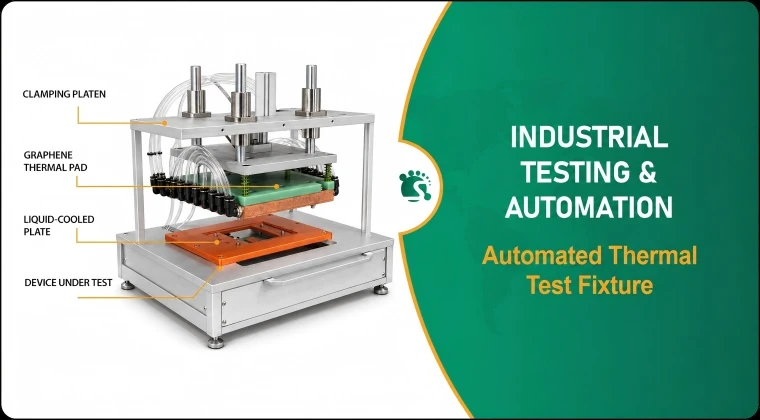
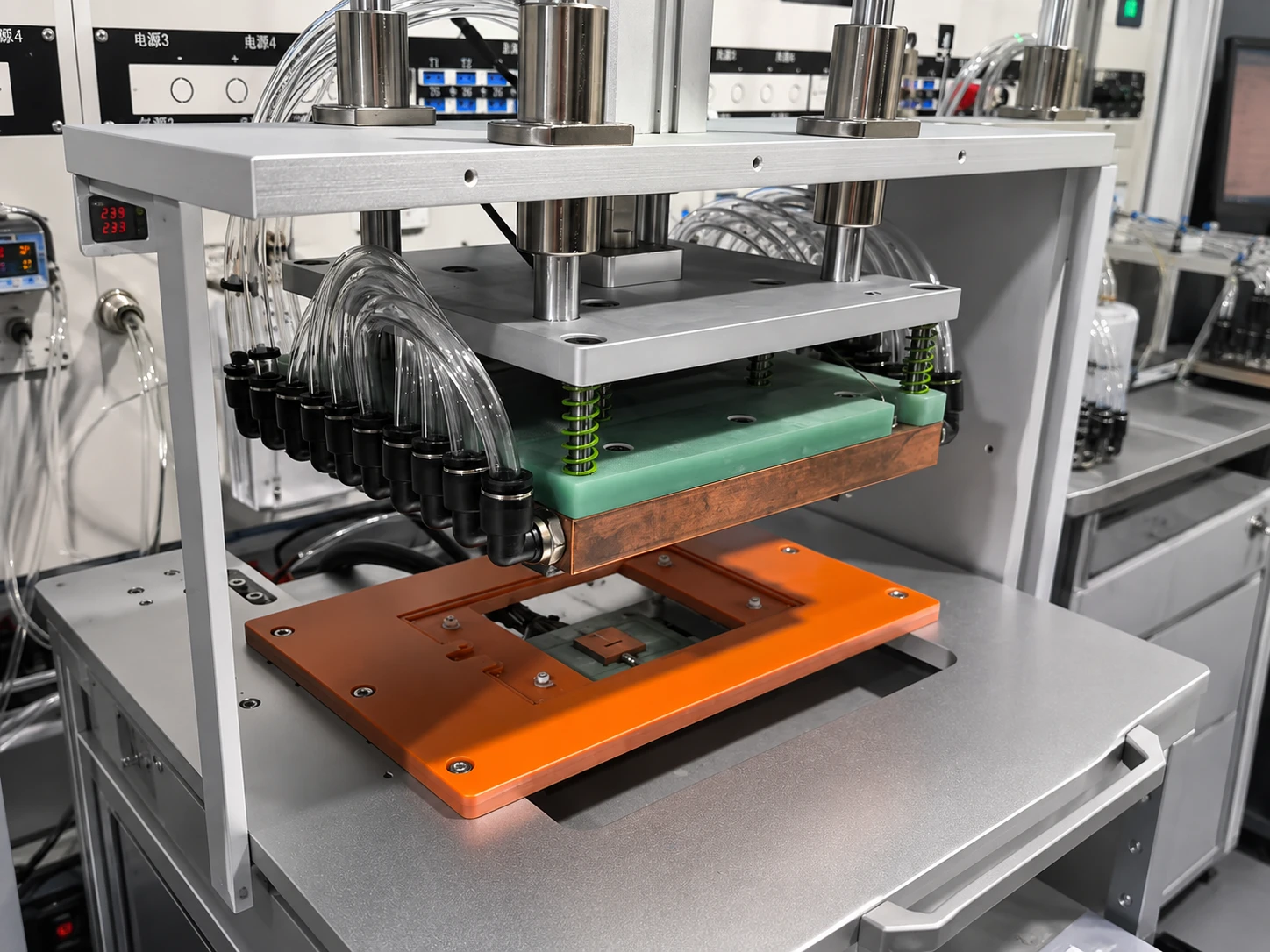
Sheen GSF75-03 and GSF90-03 graphene thermal pads can be evaluated as die-cut solid TIMs for automated thermal test fixtures. Controlled thickness and clean handling may reduce setup variation associated with grease dispensing. At the same time, actual thermal resistance and cycle life are qualified under your pressure, gap, heat load, and surface conditions.
Why the interface matters
A repeatable test begins with a controlled interface
Thermal grease can perform very well, but its bond-line thickness and coverage may change with dispensing volume, spreading method, surface condition and operator handling. In a production test fixture, those variables can become part of the measurement.
- Controlled geometry: pre-cut thickness and footprint reduce dispensing variation.
- Cleaner changeovers: a solid interface can reduce residue on the fixture and test sample.
- Defined process: installation orientation, compression and replacement criteria can be standardized.
- Measurable qualification: repeatability, cycle drift and station correlation can be compared with the current grease process.
A graphene pad is not automatically more accurate or lower in thermal resistance than grease.
The benefit must be demonstrated under the fixture’s real gap, pressure, heat load and surface conditions.
Application boundaries
Where a solid graphene TIM is worth evaluating
This solution is intended for fixtures that measure heat-transfer performance. It does not claim to improve fan airflow, motor electrical performance, noise or dynamic balance.
Cooling Module Testing
Thermal resistance and thermal performance testing for heat sinks, heat pipes, vapor chambers and assembled cooling modules.
Liquid-Cooling Testing
Cold plates, water blocks and liquid loops where interface pressure, inlet temperature and flow are controlled.
Semiconductor Thermal Fixtures
Thermal characterization, burn-in or automated fixtures that require a defined interface between a heat source and cooling structure.
Good candidate conditions
- Frequent fixture loading, unloading or line changeover
- Controlled clamping force or assembly torque
- A defined interface gap that matches an available pad thickness
- Residue and cleaning time affect test-station availability
- Repeatability is more valuable than the lowest material unit price
Validate carefully before use
- Electrical insulation is required at an exposed, powered interface
- The existing grease uses an ultra-thin bond line on very flat surfaces
- Clamping pressure is low, uncontrolled or uneven
- Historical test limits must remain directly comparable without correlation
- The gap, surface roughness or motion can damage the pad during cycling
IntegrityProfessionalismWin-WinUser-Oriented Sheen
Measurement discipline
Thermal conductivity alone does not predict fixture performance
The measured system result includes the pad’s bulk resistance and both contact interfaces. Pressure, bond-line thickness and surface condition must therefore be reported with every comparison.
MechanicalClamping pressure, torque, compression, parallelism and fixture-to-fixture variation.
ThermalInput power, heat flux, hot-side temperature, inlet temperature and steady-state criteria.
HydraulicCoolant type, flow rate, pressure drop and inlet/outlet temperature where liquid cooling is used.
InterfaceContact area, pad thickness, surface flatness, roughness, cleanliness and installation orientation.
Report the complete fixture result:
Rθ = (Thot − Tcold) / Q
and the test conditions used to obtain it.Published material options
Start with the interface requirement—not the highest W/m·K number
GSF75-03 and GSF90-03 are soft, vertically oriented graphene thermal pad candidates. Select the thinnest practical configuration that fills the real interface and maintains stable contact under the available fixture pressure.
| Model | Thermal Conductivity | Thermal Resistance | Thickness Range | Operating Temperature | Rebound |
|---|---|---|---|---|---|
| GSF75-03 | 75 W/m·K ASTM E1461, published value | ≤0.12 °C·cm²/W @40 psi ASTM D5470 | 0.3–2.0 mm | −40 to 150°C | ≥90% |
| GSF90-03 | 90 W/m·K ASTM E1461, published value | ≤0.10 °C·cm²/W @40 psi ASTM D5470 | 0.3–2.0 mm | −40 to 150°C | ≥90% |
These are published material specifications, not guaranteed fixture results. ASTM E1461 is
a flash diffusivity method; refer to the current TDS for the property calculation and test details.
Actual system thermal resistance depends on the full interface stack and operating conditions.
Electrical safety: the current public GSF75-03 and GSF90-03 specifications do not state a
dielectric strength or volume resistivity. If electrical isolation is required, request an
insulating construction or evaluate another qualified TIM before powered testing.
A fair comparison
Compare the real grease process with the real pad configuration
A generic conductivity comparison is not enough. The evaluation should use the customer’s current grease, dispensing process and acceptance limits as the baseline.
| Evaluation Item | Current Grease Baseline | Graphene Pad Candidate | Evidence Required |
|---|---|---|---|
| Bond-line control | Depends on dose, spreading and assembly pressure | Predefined nominal thickness; compression still matters | Loaded thickness and pressure record |
| Thermal performance | Can be excellent with a thin, well-controlled bond line | Must overcome greater pad thickness and both contacts | Fixture Rθ under identical conditions |
| Preparation and cleaning | Dispense, spread and clean according to the current SOP | Die-cut placement and defined removal procedure | Changeover time and residue inspection |
| Repeatability | Measure operator and station variation | Measure installation and compression variation | Standard deviation, CV and GR&R |
| Reuse / cycle life | Normally reapplied after disassembly | Possible only after cycle-life qualification | Drift, damage and replacement criteria |
| Electrical isolation | Verify the exact grease specification | Do not assume the graphene pad is insulating | Dielectric data and powered-fixture risk review |
| Total cost per valid test | Material, dispensing, cleaning, downtime and retest cost | Pad, die cutting, replacement, downtime and retest cost | Recorded test-station operating data |
Qualification and rollout
A four-stage path from sample to multi-station deployment
The goal is not to force a material substitution. It is to determine whether a controlled solid TIM improves the measurement process without compromising thermal performance, safety or correlation with historical data.
Define the fixture
Collect contact size, gap, pressure, power, surface material, temperature, current TIM and cycle target.
Screen the materials
Select GSF75-03 or GSF90-03 and the thinnest practical thickness. Verify fit, handling and electrical risk.
Run the A/B study
Compare the current grease process and pad under identical fixture conditions, operators and stations.
Lock the process
Define die-cut drawing, orientation, compression window, inspection, replacement limit and batch traceability.
| Study | Suggested Design | Record |
|---|---|---|
| Installation repeatability | At least 10 installations per condition; include multiple operators where manual handling remains | Mean Rθ, standard deviation, CV, placement observations |
| Station correlation | Repeat on three stations where practical using the same control sample and SOP | Bias, station-to-station spread, calibration status |
| Reuse and cycle drift | Inspect at cycle 0, 50, 100 and the intended service limit, such as 500 cycles | Rθ drift, thickness, cracking, contamination and replacement trigger |
| Operational impact | Time grease preparation/cleaning and pad placement/removal under the same workflow | Changeover time, downtime, residue, retest and total cost per valid test |
Qualification required before publishing results
Mean Fixture RθPad vs. current grease under identical conditions
Repeatability CVDistribution across repeated installations
Measurement GR&ROperator, station and repeatability contribution
Cycle DriftChange in Rθ and physical condition over service life

Production-scale support
From one qualified fixture to controlled multi-station supply
After the interface is qualified, Sheen can convert the approved material and geometry into a controlled consumable specification for repeatable supply.
- Freeze the drawing: contact footprint, cutouts, orientation, thickness and tolerances.
- Define handling: liner, optional single-side positioning aid, cleanliness and installation SOP.
- Define replacement: cycle count, visual defects, thickness or Rθ drift limits.
- Control supply: approved TDS, incoming inspection, lot traceability and change notification.
Engineering FAQ
Questions to resolve before changing the test interface
Can a graphene thermal pad always replace thermal grease?
No. Grease can achieve an extremely thin bond line on flat, well-clamped surfaces. A graphene pad should be treated as a candidate solid TIM and compared through fixture-level thermal resistance, repeatability, handling and safety testing.
Does a higher thermal conductivity guarantee a lower test temperature?
No. Total performance also depends on material thickness, contact resistance, pressure, surface flatness and heat flux. Compare the complete interface thermal resistance under the real fixture conditions.
Can the same pad be reused for multiple test cycles?
Potentially, but no universal cycle count should be assumed. Establish a replacement limit by measuring thermal drift and checking compression, cracks, contamination, edge damage and handling marks over the intended service life.
Are GSF75-03 and GSF90-03 electrically insulating?
Do not assume electrical insulation. The current public product specifications do not publish dielectric strength or volume resistivity. If the interface can contact powered conductors, request an insulating construction or another qualified TIM.
What information does Sheen need to prepare an A/B test kit?
Provide the contact drawing and area, nominal and maximum gap, clamping pressure or torque, surface materials, input power, operating temperature, current grease model and bond-line process, electrical isolation requirement and target cycle count.
Will changing the TIM affect historical test limits?
It may. The TIM is part of the measurement system. Run a correlation study against the existing method, document any systematic bias and complete change control before applying the new interface to production acceptance testing.
Engineering references: ASTM D5470 for steady-state thermal impedance methodology; current Sheen GSF75-03 and GSF90-03 product data. Product suitability and process compatibility must be verified before production use.