-
ADD: Building 2, No. 8 Hengzhutang Road, Dongguan
-
Phone: +86 135 4224 3751

Solve Overheating Issues With a High-Performance Non-Silicone Thermal Pad
A Non-Silicone Thermal Pad might sound like a tiny backstage player, but when your device starts running hotter than a July sidewalk, it suddenly becomes the headliner. Overheating isn’t just annoying—it throttles speed, shortens component life, and quietly chips away at reliability. In compact electronics packed tighter than a rush-hour subway, heat has nowhere polite to go. And when it lingers, performance pays the price.
Silicone pads and messy pastes have had their run, but outgassing, pump-out, and rework headaches can feel like patching a leaky roof with duct tape. You fix one issue, another pops up. Engineers know that game all too well.
A high-performance alternative keeps things cool, clean, and steady under pressure—no drama, no meltdown, just steady heat transfer that lets your hardware breathe easy.
Types of Thermal Interface Materials
Thermal management isn’t just lab talk anymore—it’s daily business for power modules, LEDs, and control boards. Choosing the right thermal pad, or Non-Silicone Thermal Pad, can significantly affect heat dissipation, reliability, and even warranty returns.
Silicone vs. non-silicone formulations
When comparing silicone and non-silicone formulations, it helps to break it down clearly:
- Silicone thermal pad
- Wide temperature tolerance
- High flexibility
- Proven long-term performance
- Non-Silicone Thermal Pad
- Low outgassing
- Cleaner for sensitive optics
- Better for sealed automotive housings
In practical electronics:
- For telecom boards → stable heat dissipation matters most.
- For automotive ECUs → low fogging from a non-silicone pad is critical.
- For medical devices → silicone-free thermal pad reduces contamination risks.
| Property | Silicone Pad | Non-Silicone Thermal Pad |
|---|---|---|
| Temp Range (°C) | -50 to 200 | -40 to 150 |
| Outgassing | Moderate | Low |
| Electrical Insulation (kV/mm) | 5–8 | 6–10 |
At Sheen Electronic Technology, both options are tuned for stable output, yet the Non-Silicone Thermal Pad line stands out in compact power electronics.
Polymer matrix pads reinforced with fiber and ceramic fillers
Performance here comes from structure, not hype.
- Core: polymer matrix
- Reinforcement: fiber reinforcement
- Conduction path: ceramic fillers
Inside a typical pad material:
- Matrix system
- Controls compressibility
- Maintains surface contact
- Filler network
- Boosts thermal conductivity
- Supports efficient heat transfer
- Structural layer
- Improves durability
- Prevents cracking under vibration
For industrial drives and LED modules, this mix keeps pressure balanced. Pairing a Non-Silicone Thermal Pad design with ceramic loading gives solid insulation and cleaner aging behavior. Sheen Electronic Technology fine-tunes filler ratios so the pad doesn’t pump out after long service cycles.
Graphite particle sheets for superior thermal conductivity
When heat needs to move fast, graphite particles in layered sheet material act like a highway.
- In-plane thermal conductivity is extremely high.
- Functions as a thin heat spreader.
- Suit high-performance routers and slim laptops.
Electrical conductivity exists, so insulation planning is key in thermal management layouts. A graphite layer may sit beside a non-silicone pad to isolate components while dissipating heat laterally. It’s a smart combo when airflow is limited.
Boron nitride gap fillers and acrylic binder pastes
This option focuses on balance—flow, adhesion, and insulation.
Key elements:
- Boron nitride for thermal interface efficiency
- acrylic binder to control viscosity
- Paste or gap filler format for uneven surfaces
Application path:
- Dispense paste formulation onto the target area.
- Compress between the heat sink and the device.
- Cure or settle to a stable thermal impedance.
For tight automotive control units, a Non-Silicone Thermal Pad may handle flat zones, while boron nitride paste fills micro gaps. Sheen Electronic Technology offers both, helping designers keep heat under control without messy residue or electrical risk.
Why Choose a Non-Silicone Thermal Pad?
In high-power electronics, heat is the silent troublemaker. A Non-Silicone Thermal Pad keeps things cool without the mess of silicone bleed. From CPUs to power modules, this non-silicone thermal solution supports cleaner assembly and steadier performance.
Enhanced heat dissipation through low thermal impedance
A Non-Silicone Thermal Pad is designed to improve heat dissipation while reducing thermal impedance.
- Material design focus 1.1 Engineered fillers increase thermal conductivity, thereby speeding up heat transfer.1.2 Stable structure reduces pump-out, supporting consistent temperature reduction.1.3 Balanced softness improves surface contact, enhancing overall performance.
- Application-level benefits2.1 CPUs and GPUs
- Maintains tight interface contact under pressure.
- Helps sustain clock speeds by stabilizing temperature.
2.2 LED lighting systems

*   Controls junction heat.

*   Extends service life with better **heat dissipation**.


2.3 Telecom base stations

*   Handles dense layouts.

*   Keeps **thermal impedance** low even in compact builds.
With a non-silicone thermal interface pad from Sheen Electronic Technology, cooling feels less like damage control and more like smart planning.
Electrical insulation and outgassing properties ideal for power electronics
When the voltage rises, safety can’t be taken for granted. A Non-Silicone Thermal Pad supports solid electrical insulation and dependable dielectric strength.
- Strong voltage resistance helps avoid short circuits.
- Low outgassing reduces the risk of contamination in sealed devices.
- A stable material structure improves long-term reliability and protects components.
In power electronics, automotive inverters, and industrial drives, a non-silicone pad keeps insulation tight while still moving heat. That balance matters. Sheen Electronic Technology designs each Non-Silicone Thermal Pad to handle thermal stress without compromising electrical safety, so engineers can focus on output rather than unexpected shutdowns.
RoHS-compliant, halogen-free pads with strong adhesive backing
Compliance isn’t just paperwork; it shapes material choice. A Non-Silicone Thermal Pad can meet strict environmental targets while staying practical on the line.
- Material compliance: 1.1 RoHS-compliant formulation supports global market access. 1.2 Halogen-free composition improves environmental safety. 1.3 Verified material compliance aligns with WEEE expectations.
- Assembly advantages: 2.1 Adhesive backing simplifies placement. 2.2 Reliable secure mounting reduces rework. 2.3 Strong bonding adds mechanical durability during vibration.
Choosing a non-silicone thermal pad from Sheen Electronic Technology means ticking the compliance box while keeping production smooth—four uses in one solution: cooling, insulation, mounting, and environmental care.
3 Key Benefits of Non-Silicone Thermal Pad
Heat problems can wreck performance fast. A Non-Silicone Thermal Pad addresses this by improving thermal management without silicone bleed. From CPUs to telecom racks, this non-silicone pad keeps gear cool, stable, and safe in tough, real-world conditions.
Benefit 1: Ultra-low thermal resistance for CPUs and telecom gear
A Non-Silicone Thermal Pad is built for serious heat dissipation. In high-density CPUs and telecom gear, lowering thermal resistance directly improves performance and energy efficiency.
- Core thermal pathway1.1 Heat source:
- CPU cores
- Power modules in telecom boards
1.2 Interface layer:

*   Non Silicone Thermal Pad fills micro gaps

*   Reduces air pockets that raise thermal resistance


1.3 Heat sink transfer:

*   Stable contact pressure

*   Faster heat flow to cooling plates
- Measurable impact on efficiency
| Material Type | Thermal Resistance (°C·cm²/W) | Typical CPU Temp Drop (°C) |
|---|---|---|
| Silicone Pad | 0.35 | 3–5 |
| Non-Silicone Thermal Pad | 0.18 | 6–9 |
| Phase Change | 0.22 | 5–7 |
Lower thermal resistance means fewer hotspots. That’s longer component life and steadier output. Sheen Electronic Technology fine-tunes each Non-Silicone Thermal Pad to meet telecom-grade thermal management demands without messy silicone residue.
Benefit 2: High conformability and Shore hardness balance
Not all thermal interface materials behave the same. A good Non-Silicone Thermal Pad nails the balance between conformability and Shore hardness.
- High conformability improves surface contact.
- Controlled Shore hardness prevents over-compression.
- Smart gap filling boosts overall thermal interface stability.
Here’s how it plays out:
1) When mounted, the non-silicone thermal pad flexes just enough to match uneven chips.
2) It maintains structural strength, so long-term durability isn’t compromised.
3) The result is consistent flexibility plus reliable pressure distribution.
In tight enclosures, that balance really matters. Too soft? Pump-out risk. Too hard? Poor surface contact. Sheen Electronic Technology designs each Non-Silicone Thermal Pad to keep that sweet spot, supporting stable thermal management across demanding electronics.
Benefit 3: Wide operating temperature range with UL certification
A Non-Silicone Thermal Pad must survive harsh, extreme conditions without losing shape or conductivity.
- Thermal stability1.1 Broad operating temperature span
- Low-end cold starts
- High-load heat spikes
1.2 Maintains structure across full **temperature range**
- Compliance and safety2.1 Verified UL certification2.2 Meets strict safety standards for flame resistance
- Application confidence3.1 Automotive control units3.2 Industrial power modules3.3 Outdoor telecom cabinets
From freezing mornings to overheated enclosures, the Non-Silicone Thermal Pad maintains consistent performance. This silicone-free thermal pad supports long-term thermal management while aligning with global safety rules. For engineers who hate surprises, that peace of mind is priceless.
Thermal Pad Vs. Thermal Paste
Heat control can make or break your device. From gaming rigs to EV modules, picking between a Non-Silicone Thermal Pad and paste is not just tech talk—it is about reliability, cleanup, and long-term stability.
Thermal Pad
A Non-Silicone Thermal Pad—broken down into Non-Silicone / Thermal / Pad—focuses on material purity, heat transfer, and physical form. This type of Non-Silicone Thermal Pad avoids silicone bleed, keeps surfaces clean, and handles tight assemblies with style.
- Material Composition
- Non-silicone base
- ✓ Reduces contamination risk
- ✓ Improves Durability in optical and automotive modules
- Ceramic or boron nitride fillers
- Enhances Thermal conductivity
- Supports stable Thermal transfer
- Non-silicone base
- Performance Factors
- Consistent thickness
- Reliable Gap Filling
- Maintains High-performance output
- Electrical insulation
- Prevents short circuits
- Ensures safe, easy application
- Consistent thickness
- Practical Benefits
- Clean install
- Reusable in some builds, boosting Reusability
- Strong mechanical body compared with grease
| Property | Non-Silicone Thermal Pad | Silicone Pad | Thermal Paste |
|---|---|---|---|
| Thermal Conductivity (W/m·K) | 3–12 | 1–6 | 4–13 |
| Thickness (mm) | 0.5–5 | 0.5–5 | N/A |
| Volume Resistivity (Ω·cm) | ≥10¹² | ≥10¹¹ | 10⁴–10⁹ |
| Rework Cycles | 1–3 | 1–2 | 1 |
| Pump-Out Risk | Low | Medium | High |
Brands like Sheen Electronic Technology offer advanced Non-Silicone Thermal Pad solutions for power modules and LED systems, where non-silicone thermal pad stability really matters. If you want neat assembly without the sticky mess, this thermal pad non-silicone option feels like a smart call.
Thermal Paste
Thermal paste plays a different game. It flows. It spreads. It fills micro-gaps that even a Non-Silicone Thermal Pad might miss on ultra-flat CPU surfaces.
Here is how it stacks up:
- Viscosity affects spread and bond line thickness.
- Application method—manual or stencil—impacts Thermal transfer.
- Over time, drying out can increase resistance.
• Pros:
- Low interface resistance
- Great for polished dies
• Cons:
- Pump-out effect under vibration
- Risk of Electrical conductivity in metal-filled grades
- Messy cleanup, no kidding
In high-vibration EV packs or telecom racks, paste can shift. That is where a Non-Silicone Thermal Pad, or non-silicone thermal interface pad, stands out. Sheen Electronic Technology often recommends matching load pressure and surface flatness before choosing paste over a Non-Silicone Thermal Pad, especially when long service life is the goal.
Overheating CPUs? Try Non-Silicone Pad
Compact devices are working overtime, and heat builds up fast. A Non-Silicone Thermal Pad offers a cleaner, steadier fix for rising chip temps. By improving heat dissipation and stabilizing temperature management, it keeps performance sharp without messy silicone residue.
How low thermal impedance curbs hotspots in consumer electronics
When thermal impedance drops, heat has fewer excuses to linger.
- Inside high-density consumer electronics: 1.1 CPU cores spike under gaming or AI tasks. 1.2 GPUs stack heat near VRMs. 1.3 Tight enclosures trap airflow.
- With a Non-Silicone Thermal Pad in place: 2.1 Heat transfers quickly from chip to heatsink. 2.2 Surface gaps get filled evenly. 2.3 Local hotspots fade before throttling kicks in.
- Resulting impact on performance3.1 Stable clock speeds3.2 Lower fan noise3.3 Longer component lifespan
Compared with a lower-grade silicone-free thermal pad, a well-engineered Non-Silicone Thermal Pad maintains tight, predictable contact resistance. That’s why brands like Sheen Electronic Technology focus on ultra-low-thermal-impedance materials that maintain clean interfaces over time.
Phase change temperature stability under heavy load
Under heavy load, chips heat up fast. The trick is controlling phase change temperature so the pad softens at the right moment, not too early, not too late.
- Consistent melting point
- Even surface wetting
- Reliable thermal stability
A Non-Silicone Thermal Pad with tuned phase-transition behavior adapts to changing operating conditions. During stress testing, it flows just enough to fill micro gaps, then stabilizes, locking in performance consistency and long-term durability.
Sheen Electronic Technology designs each Non-Silicone Thermal Pad to balance softness and structure. The result? Fewer thermal swings, steadier output, and hardware that doesn’t tap out when workloads spike.
Laptop Design: Ultra-Thin Thermal Pads
Ultra-slim laptops leave almost no room for heat dissipation. That’s where Non-Silicone Thermal Pad materials step in—thin, clean, and built for tight spaces without the silicone mess.
Sheet extrusion and die-cutting for sub-1 mm profiles
When working with sub-1 mm gaps, precision isn’t optional.
- Manufacturing process
- Sheet extrusion
- Controls thickness down to 0.3–0.8 mm
- Maintains uniform density across wide rolls
- Supports stable material handling during lamination
- Inline thickness monitoring
- Laser gauge calibration
- Real-time deviation correction
- Sheet extrusion
- Die-cutting
- CNC-guided die-cutting for complex GPU and VRM layouts
- Clean edge control for thin profiles
- Tight tolerance fit within aluminum housings
For ultra-slim notebooks, a Non-Silicone Thermal Pad must stay flat, resist oil bleed, and survive tight compression. A silicone-free thermal pad produced by advanced sheet extrusion prevents pump-out during repeated heating cycles. That’s a big win for mobile CPUs that run hot.
Sheen Electronic Technology refines every manufacturing process step to ensure that each Non-Silicone Thermal Pad fits compact cooling stacks without on-site trimming. Clean cuts. No fuss.
Dielectric strength and compressibility in ultra-slim builds
In ultra-slim builds, space is tight, and current paths are closer than ever. That’s risky business without proper electrical insulation.
Here’s what matters:
- High dielectric strength to prevent short circuits
- Balanced compressibility for even contact pressure
- Stable mechanical properties under repeated thermal cycling
A good thermal interface material must compress just enough to fill microscopic gaps, yet stay firm enough to avoid collapse. Too soft? You lose thickness control. Too hard? You lose contact. The sweet spot defines real-world performance.
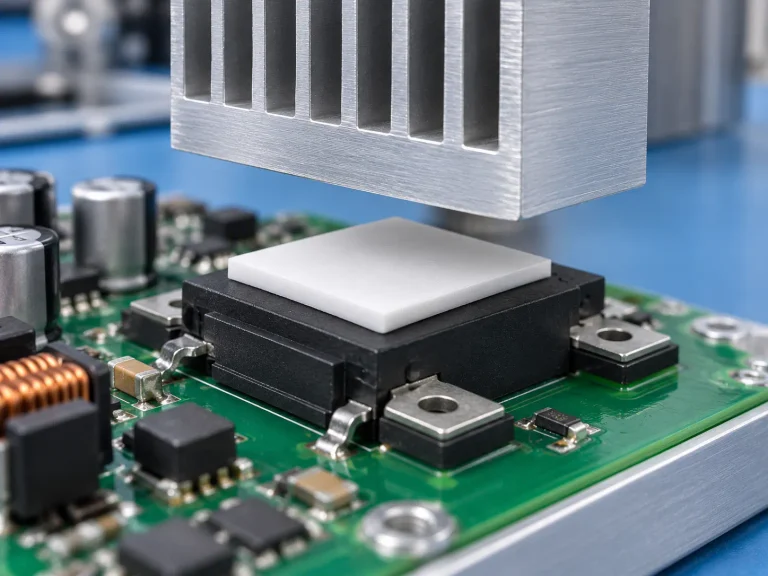
- The heat source presses downward.
- The Non-Silicone Thermal Pad deforms slightly.
- Air gaps vanish.
- Heat transfers smoothly to the heat spreader.
A silicone-free gap filler also reduces contamination risks around connectors and memory modules. That’s why many engineers now swap traditional pads for non-silicone thermal pads in thin gaming laptops. Sheen Electronic Technology tunes hardness and compression ratio to match the stacking needs of CPUs, GPUs, and SSDs.
Short version? Thin device. Tight stack. Smart pad choice.
REACH regulation compliance for mobile applications
Global laptop brands can’t ignore REACH regulation or compliance demands.
- Hazardous substances control
- No restricted SVHC materials
- Low VOC emissions
- Environmental safety
- Halogen-free formulation
- Clean disposal profile
- Product certification
- RoHS alignment
- Documentation for the global market
A Non-Silicone Thermal Pad designed for mobile applications must pass lab verification before mass production. That includes chemical screening, thermal aging, and dielectric retesting.
Under EU chemical policy updates through 2025, traceability and disclosure standards continue tightening. Choosing a silicone-free thermal pad that already meets REACH regulation expectations keeps supply chains smooth and audit-ready.
Sheen Electronic Technology supplies every Non-Silicone Thermal Pad with full compliance documentation, supporting laptop makers shipping worldwide. Safe chemistry. Stable heat transfer. No regulatory headaches.
FAQs about Non-Silicone Thermal Pad
What makes a Non-Silicone Thermal Pad ideal for sensitive electronics manufacturing?
A Non-silicone formulation is often chosen when contamination risks are unacceptable—especially in power and automotive electronics, where failure is costly.
1) Material stability
- Polymer matrix with ceramic fillers or boron nitride
- Low outgassing properties protect nearby components
2) Electrical & safety performance
- High dielectric strength for secure electrical insulation
- Verified UL certification and controlled flammability rating
3) Production compatibility
- Clean sheet extrusion, die-cutting, and lamination
- No unstable curing process, reducing line variability
The result is predictable heat dissipation across a wide operating temperature range, without the residual concerns common in silicone-based pads.
Which thermal and mechanical properties matter most when selecting a Non-Silicone Thermal Pad?
Procurement teams often balance heat flow with mechanical fit—too hard, and contact suffers; too soft, and stability fades.
Key thermal metrics:
- Thermal conductivity for fast heat dissipation
- Low thermal resistance and stable thermal impedance
- Defined phase change temperature if phase-transition behavior is required
Mechanical focus:
- Controlled compressibility and conformability for tight assemblies
- Stable Shore hardness and tensile strength under cycling
- Consistent electrical insulation in compact consumer electronics
In LED lighting and industrial controls, this balance determines long-term reliability more than peak conductivity alone.
How do material composition and compliance impact performance in telecom and industrial applications?
Material design shapes both cooling efficiency and regulatory approval.
| Component Element | Functional Impact | Typical Application Area |
|---|---|---|
| Graphite particles | High in-plane thermal conductivity | Telecommunications equipment |
| Boron nitride + acrylic binder | Surface tack + insulation stability | Power electronics modules |
| Fiber reinforcement | Improved tensile strength & durability | Industrial controls |
Compliance factors remain decisive:
- RoHS compliance and halogen-free composition
- REACH regulation alignment
- Support for WEEE directive requirements
In high-load systems, this mix of composition, heat dissipation control, and environmental compliance creates confidence under continuous operation.