-
ADD: Building 2, No. 8 Hengzhutang Road, Dongguan
-
Phone: +86 135 4224 3751

Why Fiberglass-Reinforced Thermally Conductive Insulating Sheet is Crucial for Automotive Electronics
Heat is the silent backseat driver in every EV, riding shotgun with your circuitry. A Fiberglass-reinforced thermally conductive insulating sheet steps in like a cool-headed traffic cop—moving heat along while keeping high voltage in its lane. In compact battery packs and power modules, there’s zero wiggle room for shorts or hotspots. One bad spike, and the whole system pays the price.
The International Energy Agency reports over 14 million electric cars sold in 2023. That’s a lot of electronics sweating under the hood. As UL notes, “thermal management is critical to electrical safety.”
Bottom line? If heat runs wild, reliability tanks. This material keeps the peace.
Quick Reading Notes: The Performance Logic and Safety Framework of Fiberglass-reinforced thermally conductive insulating sheet
- Thermal Control Foundation: In compact automotive electronics, effective thermal management prevents hotspots, preserves dielectric strength, and extends component lifespan. This material balances heat dissipation with electrical insulation to maintain operational stability.
- Material Composition Synergy: Fiberglass fabric, epoxy resin, and ceramic fillers work together to create structured heat-conductive pathways while maintaining high insulation resistance and dimensional stability.
- Filler Technology Advantage: Boron nitride enhances insulation with stable dielectric constant, while aluminum nitride offers higher thermal conductivity for advanced power modules requiring stronger heat transfer performance.
- Core Performance Parameters: Selection should prioritize thermal conductivity, dielectric strength, insulation resistance, tensile strength, and thermal expansion coefficient to ensure reliability under wide operating temperature ranges.
- Mechanical and Structural Reliability: High flexural strength, tear resistance, and dimensional stability ensure durability after cutting, punching, molding, and long-term vibration exposure in battery packs and control systems.
- Compliance and Safety Standards: RoHS compliance, UL certification, IEC standards, ASTM test methods, and REACH regulation collectively validate safety, flammability resistance, and global material conformity.
- Battery Pack Protection Role: In battery management systems, optimized thermal resistance supports accurate temperature sensing and helps reduce thermal runaway propagation risks.
- Application Versatility: Widely used in power electronics, LED lighting, automotive electronics, industrial control systems, and telecommunications equipment, this sheet provides a balanced solution for thermal spread and high-voltage isolation.
Overheating Electronics? Insulating Sheet Solutions
Modern cars are basically computers on wheels, and heat is the silent troublemaker. From inverters to LED drivers, controlling temperature with a Fiberglass-reinforced thermally conductive insulating sheet keeps systems steady, safe, and built to last.
The Importance of Thermal Management in Automotive Electronics
In today’s automotive electronics, rising operating temperature directly affects electronic components and long-term reliability. When thermal management is overlooked, heat dissipation slows down, and that’s when trouble starts.
- Heat buildup in power modules
- Increased internal resistance
- Gradual performance degradation
- Reduced dielectric strength
- Battery management systems
- High switching frequency
- Continuous current flow
- Localized hot spots
- Control units and ECUs
- Compact layouts
- Limited airflow
- Elevated thermal stress
A Fiberglass-reinforced thermally conductive insulating sheet works at the material level:
- Fiberglass base
- Mechanical strength
- Dimensional stability
- Thermally conductive fillers
- Faster lateral heat spread
- Lower interface resistance
- Insulating resin matrix
- Electrical isolation
- Stable performance across wide temperature swings
By combining fiberglass reinforcement with thermal conduction and insulation in one structure, this fiberglass-reinforced thermally conductive insulating sheet balances safety and cooling without adding bulk. In high-density automotive boards, that balance is everything.
How Fiberglass-Reinforced Insulating Sheets Prevent Overheating
A fiberglass-reinforced core strengthens insulating sheets, while engineered fillers enhance thermal conductivity and controlled heat transfer.
Key protective layers include:
- Surface layer
- Smooth bonding to heat sinks
- Stable electrical insulation
- Middle reinforced layer
- Crack resistance
- Vibration durability
- Thermal path network
- Efficient heat spreading
- Reliable overheating prevention
In practical applications:
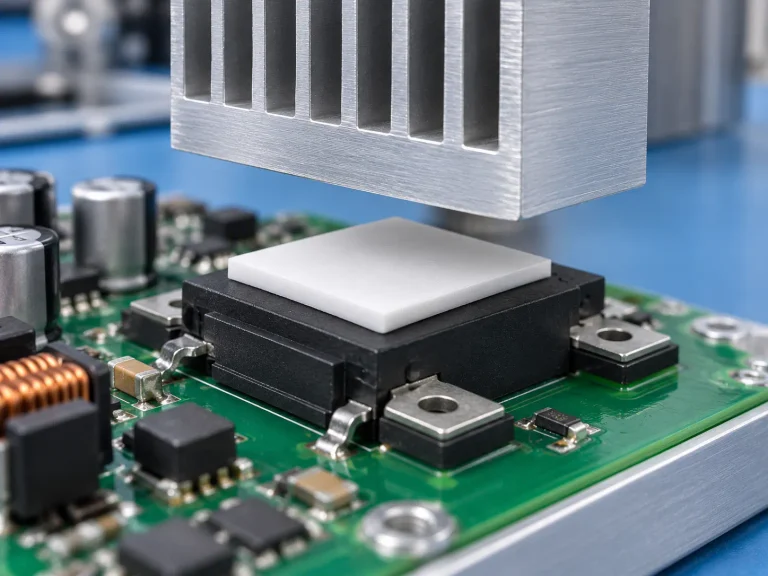
- Mounting between MOSFETs and aluminum bases
- Reducing thermal gaps
- Protecting circuits from short-circuit risk
This is where a Fiberglass-reinforced thermally conductive insulating sheet shines. It supports component protection in converters, onboard chargers, and LED modules without sacrificing insulation performance.
Manufacturers like Sheen Electronic Technology fine-tune resin ratios and ceramic loading so each thermally conductive insulating sheet delivers steady insulation resistance and consistent heat flow. The result? Cooler boards, fewer failures, longer service life.
Exploring Effective Heat Dissipation Solutions for Automotive Electronics
Effective heat dissipation in automotive electronics blends material science with smart thermal design.
Cooling strategy layers:
- Material level
- Thermal interface materials
- Fiberglass-based insulating materials
- Structural level
- Aluminum heat sinks
- Optimized airflow channels
- System level
- Integrated cooling systems
- Temperature monitoring feedback
A Fiberglass-reinforced thermally conductive insulating sheet sits between power devices and heat sinks, reducing thermal resistance while keeping circuits electrically isolated. Compared with standard thermal pads, this fiberglass-reinforced thermally conductive insulating sheet handles higher mechanical stress and maintains alignment under vibration.
Sheen Electronic Technology applies this approach across inverters and control modules, pairing fiberglass reinforcement with thermally conductive ceramic fillers. That mix improves heat flow, limits expansion mismatch, and supports stable operation even when the engine bay gets seriously hot.
In short, a well-designed fiberglass-reinforced thermally conductive insulating sheet is not just a spacer. It’s a quiet guardian of performance, making sure automotive systems stay cool, safe, and ready for the long haul.
Classification Of Thermal Conductive Insulators
In modern electronics, heat control is not optional. A Fiberglass-reinforced thermally conductive insulating sheet balances insulation and heat flow in one smart layer. From power modules to telecom cabinets, this material keeps systems cool, stable, and safe without overcomplicating design.
Types of Thermal Conductive Insulators: Fiberglass vs. Other Materials
When selecting thermally conductive insulators, material structure makes a real difference.
- Fiberglass-based systems
- Core: woven fiberglass fabric
- Matrix: epoxy in polymer composites
- Enhancement: embedded ceramic materials
→ Result: a stable **Fiberglass-reinforced thermally conductive insulating sheet** with high **dielectric strength**
- Silicone pads
- Flexible
- Lower tensile strength
- Moderate thermal path
- Rigid alternatives
- Mica: strong electrical barrier, brittle
- Graphite: excellent heat spread, weak electrical insulation
A Fiberglass-reinforced thermally conductive insulating sheet outperforms silicone in mechanical rigidity and long-term electrical insulation. For control cabinets and power drives, this fiberglass thermal insulating sheet holds shape under pressure and heat.
Brands like Sheen Electronic Technology fine-tune resin ratios so the fiberglass reinforced sheet stays dimensionally stable during thermal cycling.
Key Thermal Properties of Fiberglass-Reinforced Insulating Sheets
Performance depends on measurable data, not guesswork. A Fiberglass-reinforced thermally conductive insulating sheet is evaluated through ASTM and IEC standards.
| Property | Typical Range | Test Standard | Impact |
|---|---|---|---|
| Thermal conductivity | 0.8–2.5 W/m·K | ASTM D5470 | Faster heat dissipation |
| Thermal resistance | <0.5 °C·in²/W | ASTM D5470 | Lower interface loss |
| Dielectric strength | 15–25 kV/mm | IEC 60243 | Strong electrical insulation |
| Thermal expansion | 10–20 ppm/°C | ASTM E831 | Better temperature stability |
Inside a Fiberglass-reinforced thermally conductive insulating sheet:
- Heat moves through filler pathways.
- The thermal expansion rate stays controlled.
- Long-term temperature stability protects PCB assemblies.
That’s why this thermally conductive fiberglass sheet shows up in inverters and battery modules.
The Role of Ceramic Fillers in Enhancing Thermal Conductivity
A plain resin blocks heat. Add ceramic fillers, and things change.
• Fine particle size improves packing density.
• Higher filler loading builds stronger heat transfer channels.
• The matrix material locks particles in place.
In a Fiberglass-reinforced thermally conductive insulating sheet, fillers turn the resin into a bridge instead of a wall. During lamination and curing, particles connect into networks used in thermal interface materials.
Too much filler? Brittleness rises. Too little? Heat stalls. Balance is key. Sheen Electronic Technology adjusts filler ratios so the fiberglass-based insulating sheet keeps solid insulating properties without killing process efficiency.
Comparing Boron Nitride and Aluminum Nitride as Thermal Conductors
Within a Fiberglass-reinforced thermally conductive insulating sheet, filler choice shapes performance.
- Boron nitride
- Hexagonal crystal structure
- Stable dielectric constant
- Reliable electrical insulators behavior
→ Ideal for high-voltage modules
- Aluminum nitride
- Higher intrinsic thermal conductivity
- Sensitive to moisture during processing
- Demands tighter molding control
Both act as advanced thermal conductors while preserving insulation. A Fiberglass-reinforced thermally conductive insulating sheet using boron nitride offers safer dielectric margins. Aluminum nitride versions push thermal limits in dense power designs.
In real-world thermal management, the right filler inside a Fiberglass-reinforced thermally conductive insulating sheet decides how cool your system runs—and how long it survives.
How Does Fiberglass Structure Improve Conductivity?
Modern power modules run hot, and nobody likes fried circuits. A Fiberglass-reinforced thermally conductive insulating sheet solves two headaches at once: heat buildup and electrical risk. By breaking the keyword down—fiberglass + reinforced + thermally conductive + insulating sheet—you get a material that spreads heat fast while keeping current in check. It’s practical, tough, and widely trusted in automotive and industrial electronics.
Fiberglass Fabric and Its Thermal Conductivity Benefits
When engineers talk about boosting thermal conductivity in an insulating sheet, the conversation often starts with fiberglass fabric.
1) Structural contribution of fiberglass fabric
1.1) Heat pathway stabilization
- The woven structure keeps ceramic fillers evenly distributed.
- Even dispersion reduces hot spots inside a Fiberglass-reinforced thermally conductive insulating sheet.1.2) Dimensional control
- The fabric limits shrinkage during curing.
- Stable thickness improves heat dissipation in automotive electronics.
2) Material property enhancement
2.1) Mechanical alignment
- Reinforcement fibers prevent cracking under thermal cycling.
- Consistent fiber spacing supports predictable material properties.2.2) Thermal flow balance
- Conductive particles move heat laterally.
- The fiberglass skeleton prevents thermal bottlenecks.
3) Application-level advantages
3.1) In EV inverters
• Better thermal management under high current loads
• Lower interface resistance
3.2) In onboard chargers
• Steady insulation
• Reliable performance across wide temperature swings
A well-designed Fiberglass-reinforced thermally conductive insulating sheet acts like a traffic controller for heat—guiding it away from chips while keeping electricity where it belongs. That balance is what makes fiberglass-reinforced insulation sheets such a go-to option in demanding boards.
The Synergy of Fiberglass and Epoxy Resin for Superior Performance
Now let’s talk chemistry and structure working hand in hand. Fiberglass on its own adds strength, but pair it with epoxy resin, and you get a serious composite material.
Here’s how that combo plays out:
- Lamination
- Layers of fiberglass cloth are impregnated with epoxy resin.
- Curing
- Heat triggers cross-linking, locking fibers into place.
- Integration
- Ceramic fillers bond within the resin matrix, boosting thermal performance.
The result?
- High mechanical strength
- Strong electrical insulation
- Stable breakdown voltage
- Long-term durability in automotive applications
This material synergy turns a simple thermal insulating sheet into a Fiberglass-reinforced thermally conductive insulating sheet that handles vibration, voltage stress, and constant heat flow without falling apart.
At Sheen Electronic Technology, the focus stays on fine-tuning that resin-to-fiber ratio so every Fiberglass-reinforced thermally conductive insulating sheet delivers steady thermal conduction and insulation resistance. The brand works closely with OEM clients who need fiberglass reinforced thermally conductive insulation sheet solutions that don’t quit mid-cycle.
In short, fiberglass provides the backbone, epoxy resin locks it tight, and together they create a thermally conductive insulating sheet built for real-world pressure. That’s the kind of performance engineers can rely on.
3 Key Parameters For Sheet Selection
Choosing the right Fiberglass-reinforced thermally conductive insulating sheet for automotive systems isn’t just technical talk—it’s about keeping batteries cool, circuits safe, and parts steady under stress. When heat, voltage, and vibration show up together, material choice can make or break long-term reliability.
Thermal Conductivity: Essential for Heat Management in Automotive Applications
When selecting a Fiberglass-reinforced thermally conductive insulating sheet, heat flow sits at the top of the checklist.
- Heat Transfer Capability1.1 Core Metric
- High thermal conductivity improves heat dissipation in battery packs and power modules.
- Lower thermal resistance means faster heat transfer from hotspots to cooling plates.
1.2 Application Match

*   In **automotive electronics**, stable **temperature control** avoids thermal runaway.

*   For compact inverters, pairing the sheet with **thermal interface materials** enhances efficiency.
- System-Level Impact2.1 Battery Modules
- Even temperature distribution extends cycle life.
- Reduced peak temperatures cut failure rates.
- Material Design Factors3.1 Fiberglass Structure
- Reinforced layers guide heat while maintaining insulation.
- Optimized fillers raise conductivity without hurting insulation.
A properly engineered fiberglass reinforced thermal conductive insulation sheet keeps things cool under pressure, and that’s exactly where Sheen Electronic Technology focuses its material tuning.
Dielectric Strength and Insulation Resistance in Automotive Electronics
Electrical safety isn’t optional in high-voltage systems. A Fiberglass-reinforced thermally conductive insulating sheet must balance heat flow with solid electrical insulation.
- Voltage Endurance1.1 Dielectric strength
- High breakdown voltage prevents arcing in 800V platforms.
- Stable volume resistivity reduces energy loss.
- Material Stability2.1 Consistent dielectric constant across temperature swings.2.2 moisture resistance that could weaken the protection of electronic components.
- Compliance and Safety3.1 Alignment with automotive safety standards.3.2 Tested under continuous high voltage stress.
A thermally conductive insulating sheet that fails electrically simply isn’t an option. That’s why many OEM suppliers trust solutions like the Fiberglass-reinforced thermally conductive insulating sheet developed by Sheen Electronic Technology.
Mechanical Properties: The Role of Tensile Strength and Dimensional Stability
Heat and voltage matter, but mechanical stress in the automotive environment is just as real.
- Structural Strength1.1 Tensile strength
- Maintains structural integrity after die-cutting.
- Prevents cracking during assembly.
- Dimensional Control2.1 Low thermal expansion
- Keeps alignment steady under temperature cycling.
- Supports long-term material durability.
- Vibration and Long-Term Stress3.1 Vibration resistance in e-mobility platforms.3.2 Smart stress management under repeated load.3.3 Reliability across harsh automotive environment conditions.
A well-designed fiberglass thermally conductive sheet doesn’t warp, split, or creep over time. The right Fiberglass-reinforced thermally conductive insulating sheet holds shape, moves heat, and keeps circuits safe—three jobs, one material.
Key Standards For Automotive Thermal Materials
Automotive power modules, LED drivers, and control units run hot, and nobody wants thermal failure on the road. That’s why a Fiberglass-reinforced thermally conductive insulating sheet isn’t just a material choice; it’s a compliance story. From chemical control to fire safety, every fiberglass reinforced sheet, thermally conductive insulating sheet, and reinforced thermal insulation sheet must align with global rules. Let’s break down how standards shape safer, smarter insulation in today’s vehicles.
Understanding RoHS Compliance and Its Role in Material Safety
For any Fiberglass-reinforced thermally conductive insulating sheet, meeting the RoHS directive means controlling hazardous substances at the source.
- Material Composition Control1.1 Resin system
- Must follow material restrictions on heavy metals
- Verified as lead-free and cadmium-free
1.2 Flame retardant package

*   Avoids restricted **brominated flame retardants**
- Supply Chain Verification2.1 Supplier declarations aligned with environmental regulations2.2 Periodic lab screening of fiberglass reinforced thermally conductive insulating sheet samples
- Production Oversight
- Batch traceability
- Internal audits for thermally conductive insulating sheet compliance
A properly engineered Fiberglass-reinforced thermally conductive insulating sheet keeps power electronics cool while staying fully aligned with global substance controls.
UL Certification for Automotive Thermal Insulating Sheets
A Fiberglass-reinforced thermally conductive insulating sheet entering power electronics must pass strict UL standards.
- Safety Validation Path1.1 Electrical Testing
- Electrical insulation performance
- Verified insulation resistance
1.2 Fire Performance

*   Documented **flammability rating**

1.3 Thermal Evaluation

*   Stable **thermal performance** under load
- Certification Outcomes
- Official safety certification
- Component recognition for integration
- Clear mark of product safety
For brands like Sheen Electronic Technology, consistent UL alignment builds trust with OEM engineers who need a fiberglass reinforced insulating sheet that performs without drama.
Adhering to IEC and ASTM Standards for Thermal Materials
The technical credibility of a Fiberglass-reinforced thermally conductive insulating sheet often rests on IEC and ASTM standards.
- Electrical Benchmarks1.1 Measured dielectric strength1.2 Long-term insulation resistance1.3 Breakdown stability after thermal aging
- Thermal Metrics
- Verified thermal conductivity
- Heat dissipation consistency across reinforced thermal insulation sheet thickness
- Mechanical Integrity
- Tested mechanical properties
- Structured material testing for vibration resistance
When a fiberglass-reinforced, thermally conductive insulating sheet meets IEC and ASTM standards, integrating it into EV inverters and battery systems feels straightforward.
REACH Regulations and Their Impact on Fiberglass-Reinforced Sheets
The REACH regulation pushes chemical transparency across every Fiberglass-reinforced thermally conductive insulating sheet.
- Chemical Compliance Framework1.1 Chemical registration for resin components1.2 Screening against the SVHC list1.3 Review of substances of very high concern
- Control Mechanisms
- Formal authorization where required
- Substance restriction management
- Communication Flow3.1 Clear supply chain communication3.2 Documented chemical safety assessment
A compliant thermally conductive fiberglass sheet not only handles heat but also clears regulatory checks smoothly. That balance of performance and compliance is exactly what Sheen Electronic Technology focuses on when supplying the global automotive market.
Battery Packs: Ensuring Safe Thermal Spread
Battery packs work hard, and heat is part of the deal. Smart thermal management with a Fiberglass-reinforced thermally conductive insulating sheet keeps energy storage stable, safe, and built for the long haul.
The Role of Fiberglass-Reinforced Insulating Sheets in Battery Pack Safety
Within a battery module, protection happens on several linked levels:
1) Core Material Foundation
- Fiberglass reinforcement strengthens the base structure.
- The insulating sheets maintain high dielectric strength between cells.
- Resin and ceramic fillers tune thermal pathways.
2) Safety Barrier Functions
a. Electrical Isolation
- Prevents short circuits between adjacent cells.
- Supports battery pack safety under vibration and compression.b. Heat Flow Control
- A Fiberglass-reinforced thermally conductive insulating sheet allows controlled lateral heat spread.
- Limits rapid escalation during thermal runaway.
3) Structural Durability
- High mechanical integrity resists tearing during assembly.
- Stable thickness protects busbars and sensing lines.
In practice, a fiberglass insulating sheet acts like a quiet bodyguard—firm, heat-aware, and electrically reliable. The Fiberglass-reinforced thermally conductive insulating sheet blends insulation with directional conductivity, so heat moves where engineers want it, not where it can cause trouble.
How Thermal Resistance Enhances Battery Management Systems
Effective control depends on balance inside the stack:
1) Thermal Regulation Chain
- Managed thermal resistance shapes predictable heat gradients.
- Stable thermal conductivity improves sensor accuracy.
2) BMS Interaction
a. Data Accuracy
- Clean heat distribution sharpens temperature control signals.b. Operational Precision
- Supports real-time cell balancing.
- Lifts overall system efficiency.
3) Heat Path Optimization
- Encourages steady heat dissipation without electrical compromise.
- A thermally conductive insulating sheet prevents hotspots from skewing readings.
When a Fiberglass-reinforced thermally conductive insulating sheet is tuned correctly, battery management systems respond faster and with fewer false alarms. That steady rhythm keeps performance smooth and extends service life.
Molding and Curing Processes for Battery-Specific Thermal Sheets
Performance starts in production:
1) Material Preparation
- Balanced material formulation of resin, fiberglass, and ceramic filler.
- Even dispersion within composite materials.
2) Forming Phase
a. Precision molding processes
- Controlled pressure for uniform thickness.b. Layer Structuring
- Alignment of fibers for dimensional control.
3) Thermal Stabilization
- Calibrated curing processes lock internal structure.
- Ensures long-term dimensional stability under cycling stress.
Advanced manufacturing techniques make each Fiberglass-reinforced thermally conductive insulating sheet consistent from edge to edge. Brands like Sheen Electronic Technology focus on this tight process control, delivering fiberglass-reinforced thermal sheets that stay flat, resist cracking, and keep battery packs cool under pressure.
FAQs about Fiberglass-Reinforced Thermally Conductive Insulating Sheet
What makes a Fiberglass-reinforced thermally conductive insulating sheet reliable for power electronics and automotive electronics?
In high-load modules, heat builds fast and voltage spikes strike without warning. This sheet answers with a layered defense:
- Thermal control: High thermal conductivity and low thermal resistance speed up heat dissipation across power electronics and automotive electronics boards.
- Electrical safety: Strong dielectric strength, stable insulation resistance, and controlled dielectric constant prevent breakdown voltage under stress.
- Mechanical stability: Fiberglass fabric reinforced with epoxy resin delivers tensile strength, flexural strength, and dimensional stability across a wide operating temperature range.
- Compliance assurance: UL certification, RoHS compliance, REACH regulation, plus IEC standards and ASTM test methods validate performance.
The result is steady operation where failure is not an option.
How do material composition and fillers influence thermal and electrical performance?
Performance begins at the micro level and builds upward:
- Base framework: Woven fiberglass fabric forms a rigid skeleton, limiting thermal expansion coefficient and boosting tear resistance.
- Matrix system: Epoxy resin bonds layers during lamination and curing, preserving hardness and insulation resistance after cutting or punching.
- Thermal pathways: Ceramic fillers—especially boron nitride and aluminum nitride—create dense heat-transfer networks that raise thermal conductivity without sacrificing volume resistivity.
- Optional flexibility: In certain designs, silicone elastomer adjusts flexibility while maintaining electrical insulation.
Every ingredient has a task; remove one, and the balance shifts.
Which parameters should engineers review before selecting this insulating sheet?
Choosing the wrong sheet can trigger overheating, signal drift, or structural fatigue. Key checkpoints include:
- ◆ Target thermal conductivity (W/m·K) for required heat dissipation
- ◆ Verified dielectric strength (kV/mm) and breakdown voltage margin
- ◆ Volume resistivity and dielectric constant stability
- ◆ Mechanical data: tensile strength, flexural strength, hardness
- ◆ Operating temperature range and thermal expansion coefficient compatibility
Match these figures to the demands of LED lighting, telecommunications equipment, or industrial control systems to prevent costly redesigns.
Why is this material critical in battery management systems and high-density assemblies?
In battery management systems and compact LED lighting drivers, heat concentration can spiral quickly. A fiberglass-reinforced thermally conductive insulating sheet distributes thermal load evenly while maintaining insulation between conductive layers.
During molding, lamination, and controlled curing, the composite forms a stable barrier—resisting warping, resisting voltage stress, resisting time. Balanced heat flow protects cells, safeguards circuits, and keeps performance steady under continuous cycling.