-
ADD: Building 2, No. 8 Hengzhutang Road, Dongguan
-
Telefone: +86 135 4224 3751

How an EV Charger Thermal Pad Improves Charging Efficiency
An EV charger thermal pad isn’t a tiny accessory—it’s the quiet fixer that keeps power flowing fast instead of fizzling out in heat. When chargers overheat, efficiency tanks and downtime creep in, costing operators real money.
Heat chokes components, hikes resistance, and slows charging speeds across busy stations.
In 2025 briefs, Sheen Technology engineers stress stable thermal interfaces for efficiency.
Key Points: EV Charger Thermal Pad Essentials
→ Material: Silicone elastomer with ceramic or graphite fillers ensures high conductivity.
→ Reliability: Stable thermal resistance lowers junction temperature, boosting uptime.
→ Integration: Pre-cut pads simplify assembly with IGBT/MOSFET modules, eliminating air gaps.
→ Compliance & ROI: Meets UL94 V-0 and RoHS; cuts maintenance costs and energy use.
How An EV Charger Thermal Pad Works
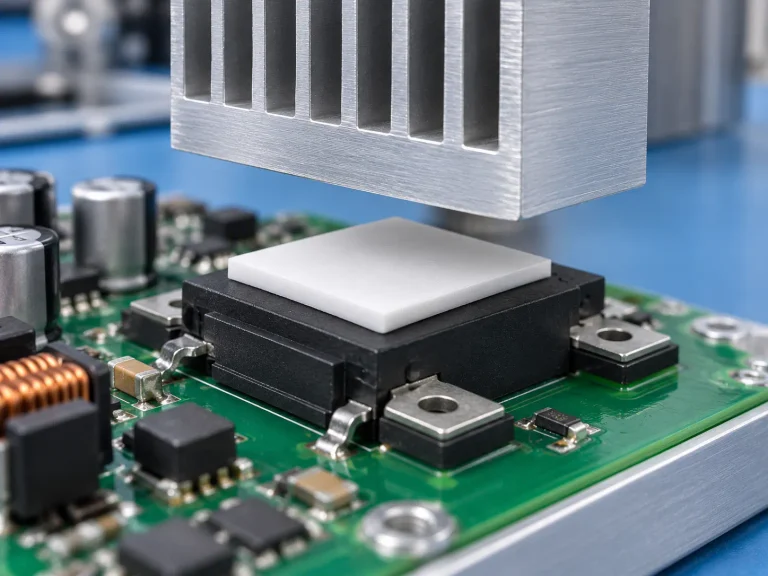
An EV charger thermal pad might look simple, yet it quietly keeps every EV charger running cool and steady. In high-power charging cabinets, heat builds up fast. That’s where the EV charger thermal pad steps in, moving heat away before trouble starts.
Thermal Conductivity in Action: How Silicone Elastomer Pads Transfer Heat
Quando um EV charger thermal pad sits between a module and a heat sink, condutividade térmica becomes the star of the show. The pad, made from elastómero de silicone, acts as a material de interface térmica that pushes heat out instead of trapping it.
- At the material level
- Elastómero de silicone forms a flexible base.
- Ceramic particles boost transferência de calor.
- The blend turns basic rubber into high-performance almofadas térmicas.
- At the interface level
- Microscopic air gaps block dissipação de calor.
- The EV charger pad compresses, filling those gaps.
- Contact improves, and gestão térmica gets real results.
- In EV charger systems
- Power modules heat up during fast charging.
- The EV charger thermal pad channels that energy to the heat sink.
- Stable temperature means fewer shutdowns and longer device life.
For engineers who need steady output in an EV charger cooling stack, even a 1°C drop can make a big difference. That’s why Sheen Technology fine-tunes filler ratios to keep condutividade térmica consistent across every EV thermal pad.
From Ceramic Filler to Graphite Sheet: Material Composition Overview
Not all EV charger thermal pads are built the same. The magic sits inside the composição do material.
Common building blocks include:
- Ceramic filler, such as aluminum oxide
- Boron nitride as an advanced thermal fillers
- Flexível graphite sheet layers
- A stable matriz polimérica
In many materiais de interface térmica, these elements form materiais compósitos designed for balance. High conductivity is great, but an EV charger thermal pad also needs dielectric strength to protect power circuits. Too stiff? It won’t conform. Too soft? It may pump out over time.
A quick comparison helps:
| Tipo de material | Condutividade térmica (W/m-K) | Resistência dieléctrica (kV/mm) | Compressibility (%) |
|---|---|---|---|
| Aluminum Oxide Pad | 1.5–3.0 | 6-10 | 10–20 |
| Boron Nitride Pad | 3.0–6.0 | 5-8 | 15–30 |
| Graphite Sheet Hybrid | 5.0–12.0 | 1-3 | 5–15 |
Choosing the right EV charger thermal pad for an EV charger isn’t guesswork. It’s about matching materiais de interface térmica to voltage, pressure, and cooling targets.
Reducing Junction Temperature Through Lower Thermal Impedance
Inside power devices, temperatura da junção is the number everyone watches. When an EV charger thermal pad lowers impedância térmica, the benefits stack up.
- At the chip level
- Semiconductor devices generate heat during switching.
- Heat flows through the solder and the substrate.
- The EV charger thermal pad reduces resistência térmica at the interface.
- At the module level
- Power devices like IGBTs face rapid load swings.
- Inferior impedância térmica melhora cooling efficiency.
- Temperature spikes shrink, boosting lifespan.
- At the system level
- Stable junction temperature supports higher power density.
- Heat reduction cuts failure risk.
- Maintenance cycles stretch out.
In an EV charger power block, even small drops in temperatura da junção can prevent derating. That’s why many designers treat the EV charger thermal pad as a core safety component, not just a filler sheet.
Integrating with IGBT Modules and MOSFET Cooling Systems
An EV charger thermal pad must fit smoothly into eletrónica de potência assemblies. That includes tight layouts packed with Módulos IGBT, MOSFETs, and layered semiconductor packaging.
Integration usually follows a practical flow:
- Check the surface flatness of dissipadores de calor and module bases.
- Select pad thickness to match clamping force.
- Verify insulation within thermal management systems.
- Test compression set after thermal cycling.
In real builds, uneven PCB substrates and metal bases create tiny height differences. The EV charger thermal pad compresses just enough to bridge those gaps. Good contact means stable cooling systems and fewer hot spots around MOSFET arrays.
Sheen Technology designs each EV charger thermal pad to match modern EV charger layouts, from compact wall boxes to high-power DC cabinets. The result is simple: better device integration, steadier charging, and hardware that keeps its cool when the grid gets busy.
Key Benefits Of Thermal Pads In EV Charging
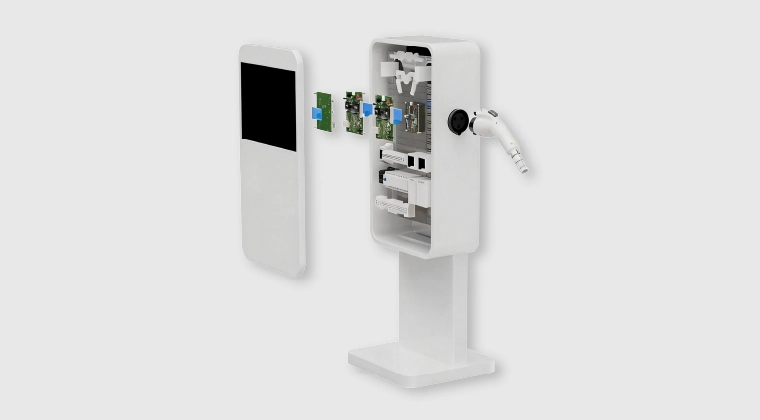
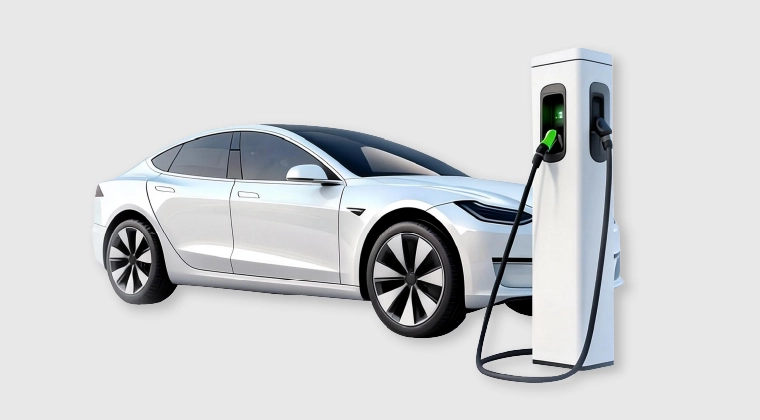
As EV stations push higher output, heat becomes a real headache. A well-designed EV charger thermal pad keeps power modules cool, stable, and safe. Let’s break down why this small layer makes such a big difference.
Enhanced Heat Dissipation for Higher Power Density
In high-power applications, dissipação de calor is everything. An EV charger thermal pad sits between the MOSFET or IGBT module and the heatsink, improving transferência de calor and overall gestão térmica.
- Core performance factors:
- Elevado condutividade térmica supports stronger cooling efficiency
- Low interface resistance improves sustained densidade de potência
- Stable compression avoids hot spots in EV fast chargers
Within a charging cabinet:
- Power module generates heat
- Heat flows through the EV charger pad
- Heatsink spreads energy outward
- Fans or liquid systems remove residual heat
Under heavy load, the right thermal pad for EV charger designs prevents derating. As noted in the IEA Global EV Outlook 2025:
“Fast-charging infrastructure is scaling rapidly, with higher average power ratings increasing thermal management requirements across components.”
That’s where materials from Sheen Technology step in, helping maintain safe operating limits without oversizing the cooling system.
Improved Reliability via Consistent Thermal Resistance
Long charging cycles test fiabilidade hard.
An EV charger thermal pad maintains a steady resistência térmica even after repeated ciclo térmico, unlike grease, which can pump out or dry out.
- Performance impact:
- Stable contact pressure
- Predictable consistent performance
- Melhorado estabilidade do sistema
For charging controllers:
- Camada eléctrica
- Ensures insulation
- Protects signal integrity
- Camada mecânica
- Absorbs tolerance gaps
- Reduces vibration stress
- Camada térmica
- Controls junction temperature
- Extends vida útil dos componentes
That steady behavior directly boosts durabilidade in DC fast chargers running daily.
Simplified Assembly Integration Over Thermal Grease and Gap Fillers
Production lines move fast. No one wants messy paste.
An EV thermal pad offers clean integration into the assembly process. Pre-cut shapes replace screen-printed thermal grease and injectable preenchedores de lacunas.
- Manufacturing advantages:
- Cleaner thermal interface material (TIM) manuseamento
- Faster installation
- Mais alto eficiência de fabrico
In practice:
- Position EV charger thermal pad
- Align the power module
- Apply torque
- Finish—no curing, no overflow
Less contamination. Less rework. Better installation ease for large-scale EV charger builds.
Extended Lifetime Performance with Low Volume Resistivity
High-voltage chargers demand strong insulation. A premium EV charger thermal pad combines low resistividade volumétrica with high isolamento elétrico força.
Material structure matters:
- Electrical properties
- High dielectric rating
- Controlled leakage current
- Mechanical properties
- Recuperação por compressão
- Resistência às fissuras
- Thermal properties
- Stable conductivity
- Longo prazo degradation resistance
Estes propriedades dos materiais protect capacitor banks and control chips, driving better estabilidade a longo prazo and overall lifetime performance.
For brands scaling global infrastructure, Sheen Technology delivers EV charger pad solutions built for real-world stress—heat, voltage, and time all included.
3 Steps To Install A Thermal Pad
Installing an EV charger thermal pad isn’t rocket science, but it’s not something you want to wing either. In EV charger systems, heat is the silent troublemaker. A well-fitted EV charger thermal pad keeps power modules cool, stable, and safe for the long haul.
Step 1: Surface Preparation and Die Cutting for Perfect Fit
To get the most out of an EV charger thermal pad, the groundwork matters.
- Preparação da superfície
- Inspect the component surface of the PCB and heat sink
- Remove dust, oil, and oxidation
- Use lint-free wipes and isopropyl alcohol
- Check flatness
- Uneven areas reduce adhesion
- Poor contact increases thermal resistance
- Inspect the component surface of the PCB and heat sink
- Die cutting and material shaping
- Measure mounting area precisely
- Account for screw holes and mounting posts
- Perform precision die cutting
- Ensure tight fit accuracy
- Maintain pad compressibility
- Avoid overstretching during material shaping
- Measure mounting area precisely
When handling a thermal interface pad for EV charger modules, even a 0.2 mm mismatch can create air pockets. That gap kills heat flow. Clean surfaces plus accurate trimming mean the almofada térmica sits flush, maximizing contact and long-term reliability.
Step 2: Placement Alignment on DC-DC Converter and Inverter Module
Correto placement alignment inside a power-dense EV charger is where real performance shows up.
- Target modules
- DC-DC converter
- MOSFETs
- Magnetic components
- Inverter module
- Módulos IGBT
- Power transistors
- DC-DC converter
- Thermal interface positioning
- Center the EV charger thermal pad over hotspots
- Confirm full coverage of the heat transfer path
- Prevent overlap onto connectors or signal traces
- Module assembly check
- Verify even compression after mounting
- Recheck component positioning before final torque
A recent 2025 International Energy Agency EV Outlook notes:
“As fast-charging infrastructure scales globally, thermal reliability of power electronics becomes a primary determinant of uptime and safety.”
That’s not just big talk. In high-power EV charging units, a single misaligned EV charger thermal pad can quickly spike temperatures. A properly placed EV thermal interface pad keeps the montagem do módulo stable and the charger running cool under peak load.
Step 3: Assembly Integration, Curing Process, and Performance Verification
Now it’s about locking everything in and proving it works.
- Assembly integration
- Apply controlled, uniform pressure
- Follow torque specs
- Avoid over-compression
- Confirm pad contact across the full footprint
- Apply controlled, uniform pressure
- Curing process (if adhesive-backed)
- Observe the recommended time and temperature
- Prevent movement during bonding
- Reinspect adhesion after curing
- Performance verification
- Conduct thermal imaging under load
- Measure case temperature vs. ambient
- Validate condutividade térmica assumptions
- Executar testes de fiabilidade cycles
For serious EV charger builds, this isn’t optional. It’s system validation.
Manufacturers like Sheen Technology design each EV charger thermal pad to match real-world compression ranges inside power modules. That balance supports stable gestão térmica e constante dissipação de calor across repeated fast-charge sessions.
When the EV charger thermal pad, the charger thermal pad layer, and the EV charging heat pad all work together, temperatures stay predictable. And in power electronics, predictable is exactly what you want.
Meeting Industry Standards For Thermal Pads
Modern charging hardware runs hot, and nobody wants a melted connector. For every EV charger thermal pad, meeting strict safety and compliance rules keeps systems stable, safe, and ready for daily fast charging. Let’s break down what really matters.
UL 94 V-0: Flammability Rating Requirements
An EV charger thermal pad must handle heat without becoming a hazard. That’s where flammability testing and fire safety rules kick in.
- In the vertical burn test, samples are exposed to flame twice.
- To earn V-0 material classification, the pad must show self-extinguishing behavior within 10 seconds.
- No flaming drips are allowed. That’s basic resistência à ignição under strict normas de segurança.
For an EV charger, charger thermal pad materials sit near MOSFETs and power modules. Inside a typical unit:
- Power conversion area
- a. High-current PCB
- b. Insulated gate drivers
- Thermal interface layer
- a. EV charger thermal pad
- b. Aluminum heat spreader
- Housing
- a. Fire-rated enclosure
If the EV thermal pad fails the burn test, the whole charger design is at risk. Sheen Technology engineers its EV charger thermal pad compounds to meet V-0 while keeping dielectric strength solid. No shortcuts. Just controlled chemistry and tight process control.
IEC 62631-3: Measuring Thermal Impedance Accurately
Heat transfer numbers can’t be guessed. Impedância térmica e condutividade térmica must be verified under recognized measurement standards e test methods.
Below is a simplified comparison for EV charger thermal pad samples tested per IEC 62631-3:
| Sample | Condutividade térmica (W/m-K) | Thermal Impedance (°C·cm²/W) | Test Pressure (kPa) | Espessura (mm) |
|---|---|---|---|---|
| A | 3.0 | 0.85 | 100 | 1.0 |
| B | 5.0 | 0.62 | 100 | 1.0 |
| C | 6.5 | 0.55 | 150 | 1.5 |
| D | 8.0 | 0.48 | 200 | 1.5 |
| E | 10.0 | 0.42 | 200 | 2.0 |
Accurate propriedades dos materiais data allows fair comparison between charger thermal pad options. Sheen Technology validates every EV charger thermal pad batch to keep numbers honest, not inflated.
RoHS & REACH: Ensuring Environmental and Dielectric Compliance
Compliance is not just paperwork. For an EV charger thermal pad, environmental compliance means:
- Control of substâncias perigosas e restricted substances
- Alignment with EU chemical regulations e EU directives
- Estável dielectric properties sob alta tensão
In EV charging stations:
- Power module insulation
- Ground isolation
- Long-term material safety
Each EV charger thermal pad must balance thermal performance with electrical insulation. A quality thermal interface pad should pass dielectric testing while staying within RoHS limits. Sheen Technology keeps material safety data transparent, helping charger makers avoid compliance headaches and ship with confidence.
Calculating ROI On Thermal Pad Upgrades
Upgrading an EV charger thermal pad may sound minor, but in high-power systems, it quietly shapes cost, uptime, and brand reputation. From heat flow to warranty returns, every charger thermal pad choice affects long-term numbers. Let’s break down how a smarter EV charger pad decision turns into real financial gains.
Assessing Material Cost Versus Lifetime Performance Gains
When comparing a standard pad to a premium EV charger thermal pad, ROI often unfolds in layers:
- Upfront Cost Factors
- Raw propriedades dos materiais
- Mais alto condutividade térmica
- Melhorado pad durability
- Processing compatibility with automated assembly
- Raw propriedades dos materiais
- Performance Impact
- Reduced junction temperature
- Melhorado transferência de calor
- Stable compression over time
- Lower pump-out risk
- Noticeable efficiency improvement
- Lifetime Value
- Alargado performance longevity
- Fewer thermal cycles cause solder fatigue
- Better stability in high-load EV charger units
A low-cost EV charger heat pad might save dollars today. A high-quality EV charger thermal pad protects power modules for years. That difference adds up fast, especially in DC fast-charging cabinets. Sheen Technology focuses on balancing condutividade térmica and durability so the investment holds over the charger’s service life.
Quantifying Energy Savings from Lower Thermal Resistance
Energy math becomes clearer when thermal resistance drops:
- Inferior resistência térmica melhora dissipação de calor.
- Improved cooling performance reduces fan workload.
- Reduced fan power cuts overall energy consumption.
In high-power charging stations:
- Less waste heat
- Melhorado eficiência energética
- Fewer electrical losses
BloombergNEF noted in a 2025 EV infrastructure outlook:
“Efficiency gains in charging hardware directly translate into lower operational expenditure across large-scale networks.”
Um projeto bem concebido EV charger thermal pad helps keep IGBTs and MOSFETs cooler, which stabilizes switching behavior. Over thousands of charging cycles, even small energy savings per unit become meaningful. An optimized EV thermal pad reduces cooling demand without redesigning the whole cabinet.
Estimating Maintenance and Downtime Reductions
Thermal stress drives failure. Control it, and maintenance frequency drops.
- Failure Prevention
- Inferior thermal stress
- Melhorado vida útil dos componentes
- Stable contact pressure in the EV charger thermal pad
- Operational Impact
- Mais alto operational uptime
- Mais forte fiabilidade do sistema
- Fewer emergency repairs
- Cost Outcome
- Reduzido repair costs
- Measurable downtime reduction
In busy charging hubs, one failed module can idle multiple connectors. A reliable EV charger pad keeps rectifier bridges and inverter modules steady. Sheen Technology designs each thermal interface pad for EV charger platforms where uptime is money.
Projecting Warranty Savings through Enhanced Reliability
Warranty budgets shrink when temperatures stay controlled.
- Mais baixo taxa de insucesso
• Stronger component integrity
- Melhorado product reliability
Melhor gestão térmica reduces solder cracks and silicon degradation. That extends longevidade do produto and trims warranty claims. Service teams spend less time swapping overheated boards. Customers notice fewer interruptions, which lifts customer satisfaction and lowers total service costs.
Escolher o melhor EV charger thermal pad is not just a thermal choice. It’s a financial one.
FAQs about EV Charger Thermal Pad
What makes an EV charger thermal pad reliable for high‑power electronics?
An EV charger thermal pad is built as a controlled thermal interface material between the IGBT module or MOSFET cooling surface and the heat sink inside power electronics.
Its reliability comes from a tight material system:
1. Silicone elastomer base for flexibility and surface conformity;
2. Ceramic filler such as boron nitride or aluminum oxide to raise thermal conductivity;
3. Optional graphite sheet or fiberglass reinforcement for dimensional stability。
Key performance indicators include:
1. High thermal conductivity for rapid heat dissipation;
2. Strong dielectric strength and volume resistivity for electrical isolation;
3. UL 94 V‑0 flammability rating for inverter module safety;
4. Controlled compressibility and Shore hardness to manage uneven PCB substrate gaps.
Compared with thermal grease or conductive paste, the pad keeps its thickness stable, reduces pump‑out, and protects lifetime performance under repeated thermal cycling in DC‑DC converter and charging controller systems.
How does an EV charger thermal pad reduce junction temperature in IGBT and MOSFET modules?
Inside an inverter module, heat flows from the power transistor or controller chip → through the thermal pad → into the heat sink. The pad lowers thermal impedance, which directly reduces junction temperature.
This impact can be understood in three layers:
1. Interface control: fills micro air gaps better than phase change material under moderate pressure.
2. Thermal resistance reduction: stable thickness keeps heat dissipation predictable.
3. Power density support: allows higher current in rectifier bridge and capacitor bank circuits without overheating.
Lower junction temperature means longer reliability, fewer thermal stress cracks, and improved lifetime performance for battery management systems and high‑voltage assemblies.
Why choose thermal pads over grease or adhesive in EV charger assembly?
In mass production, handling matters as much as performance.
Thermal pads support efficient assembly integration through:
1. Clean die cutting and molding processes;
2. No screen printing mess like thermal grease;
3. No curing process delay as with thermal adhesive;
4. Easy lamination and surface preparation.
For manufacturers integrating PCB substrate, inductor coil, and heat sink stacks, pads offer consistent thermal resistance and repeatable compressibility.
The result is simple: faster assembly, stable operating temperature, and reduced maintenance risk in high‑power EV charging platforms.