-
ADD: Building 2, No. 8 Hengzhutang Road, Dongguan
-
Telefone: +86 135 4224 3751

How to Use Boron Nitride Thermal Pad Heat Dissipation for High-Power Lasers
Heat is the silent saboteur in laser systems, and Boron nitride thermal pad Heat dissipation for high-power lasers steps in before things go haywire.
When temperatures spike, performance drops fast, parts warp, and downtime eats budgets like candy. That’s where a smart material choice earns its keep, pairing insulation with steady heat flow and fitting cleanly into production without drama or messy rework.
Essential Insights: Boron nitride thermal pad Heat dissipation for high-power lasers
➔ Rising temperatures spike thermal resistance, trapping heat and degrading diode arrays.
➔ Precise surface prep and alignment ensure minimal interfacial resistance and uniform heat spread.
➔ Optimal filler loading and strict thickness control balance conductivity with mechanical compliance.
➔ High dielectric strength and low outgassing rates preserve electrical insulation and optical integrity.
➔ Pyrolytic boron nitride’s superior diffusivity and durability prevent hotspots in multi-kW continuous operation.
Why Overheating Kills Laser Performance Instantly
High-power laser systems live fast and run hot. When heat builds up inside the package, performance drops almost immediately. That’s why Boron nitride thermal pad Heat dissipation for high-power lasers has become a go-to fix. By improving condutividade térmica at the interface, junction temperatures stay controlled, and output stays stable.
Heat-Induced Thermal Resistance Spike
When internal heat rises, a chain reaction begins:
- Rising temperatura da junção
- Increased resistência térmica
- Slower heat flow across the interface
- Accelerated degradation
Here’s how the spike unfolds:
- Localized heating forms near the die.
- Standard pads lose effective condutividade térmica.
- O resistência térmica spike traps more heat.
- Laser desempenho drops within seconds.
Now break that down further:
- Core Cause
- Poor contact at the interface
- Pump-out of grease-based materials
- Immediate Effect
- Sharp resistência térmica spike
- Mais alto temperatura da junção
- Long-Term Risk
- Material degradation
- Permanent output loss
Using a Boron nitride thermal pad Heat dissipation solution for high-power lasers keeps the interface stable. Materiais de brilho designs pads that resist pump-out and maintain consistent heat flow, especially in high-density laser modules.
Laser Diode Array Damage from Thermal Expansion
A laser diode array handles serious power. But with uneven expansão térmica, trouble starts fast.
• Different materials expand at different rates
• Tensões mecânicas builds at solder joints
• Micro-cracking e delamination follow
Step-by-step failure path:
- Rapid heating during operation
- Mismatch in expansão térmica coefficients
- Internal tensão mecânica concentration
- Structural damage
- Early failure
Nested reliability impact:
- Structural Level
- Chip warpage
- Substrate cracking
- Optical Alignment Level
- Emitter shift
- Beam distortion
- System Level
- Reduzido fiabilidade
- Catastrophic failure
Boron nitride thermal pad: Heat dissipation for high-power lasers reduces temperature gradients, easing expansion stress. That’s a quiet win for durability. Many integrators turn to Materiais de brilho for this exact reason.
Optical Efficiency Loss at Elevated Operating Temperatures
As temperatura de funcionamento climbs, optical efficiency slides.
- Rising threshold current
- Falling power output
- Inferior quantum efficiency
Sequence of decline:
- Carrier leakage increases at elevated temperature.
- Fewer carriers generate each photon.
- Wavelength shift destabilizes cavity behavior.
- Output drops and degradation accelerates.
Layered effect analysis:
- Electrical Layer
- Higher drive current
- More internal heating
- Optical Layer
- Reduzido quantum efficiency
- Noticeable wavelength shift
- Performance Layer
- Inferior power output
- Faster material degradation
A stable Boron nitride thermal pad helps with heat dissipation for high-power laser setups and keeps temperatures predictable. Boron nitride thermal pad solutions from Materiais de brilho help maintain beam quality, steady photons, and real-world reliability when power demand spikes.
4 Key Steps for Boron Nitride Thermal Pad Setup
High-power laser modules run hot, and sloppy setup ruins performance fast. Getting Boron nitride thermal pad Heat dissipation for high-power lasers right means tighter control, cleaner interfaces, and smarter material handling from start to cure.
Step 1: Surface Prep and Cleaning
For stable Boron nitride thermal pad Heat dissipation for high-power lasers, the preparação da superfície stage sets the tone.
- Remove oils using approved agentes de limpeza
- Completo remoção de resíduos before bonding
- Inspect the substrate for scratches and pits
A closer look at the interface:
- Check surface roughness (target Ra ≤ 0.8 μm).
- Eliminate contaminants that block adhesion.
- Confirm full contact at the interface area.
Key control points:
- ✦ Dry surface completely
- ✦ Avoid fiber-shedding wipes
- ✦ Verify no oxidation marks
Even minor debris increases contact resistance. For Boron nitride thermal pad Heat dissipation for high-power lasers, poor cleaning means trapped micro-voids, higher thermal resistance, and unstable laser output.
Step 2: Aligning Boron Nitride Film on the Laser Module
Correto alignment of the boron nitride film on the laser module prevents uneven dissipação de calor.
Core alignment logic:
- Position film to fully cover chip hotspots.
- Maintain uniform pressure during placement.
- Prevent intervalos de ar by slow rolling contact.
Nested positioning checklist:
- Film Handling
- Controlo orientation relative to heat flow.
- Avoid bending edges.
- Placement
- Match outline to heat spreader.
- Ensure continuous contact zone coverage.
- Compression
- Apply calibrated torque.
- Recheck parallelism.
Quando Boron nitride thermal pad Heat dissipation for high-power lasers is installed off-center, thermal gradients spike. Good alignment keeps the boron nitride thermal interface material working evenly across the chip.
Step 3: Controlling Filler Loading and Thickness Tolerance
The performance of a almofada térmica depends heavily on carga de enchimento, material consistency, and strict thickness tolerance.
Material balance:
- High ceramic content improves thermal conductivity.
- Excess filler reduces compliance.
- Pobres uniformity increases resistência térmica.
Process control inside the processo de fabrico:
- Raw material mixing
- Monitor viscosity shift.
- Confirm dispersion of boron nitride particles.
- Sheet forming
- Control calender gap.
- Track shrinkage behavior.
- Final inspection
- Measure cross-sheet deviation.
- Record mechanical flexibility.
Performance Reference Table
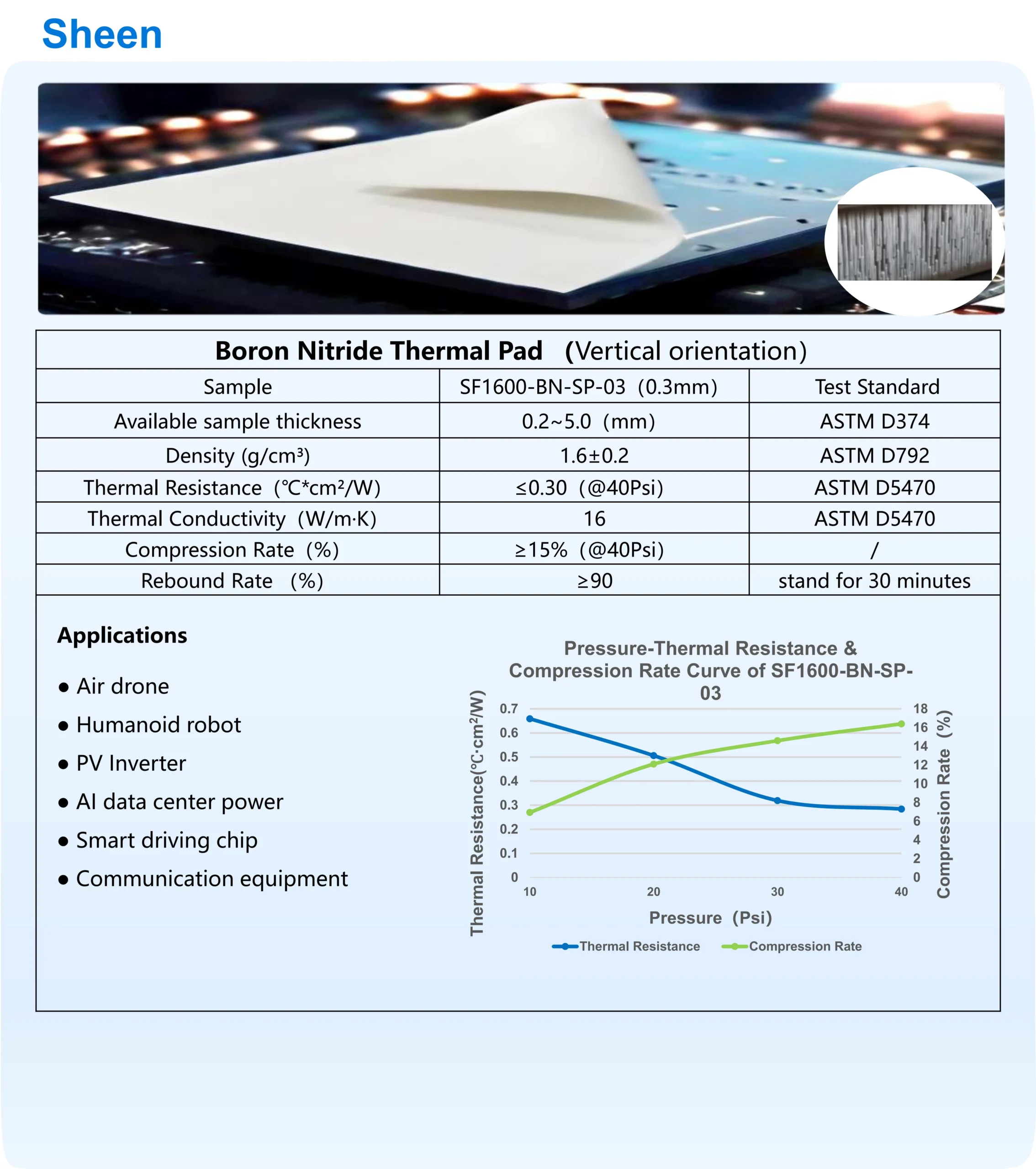
| Filler Loading (%) | Espessura (mm) | Condutividade térmica (W/m-K) | Resistência térmica (°C-cm²/W) |
|---|---|---|---|
| 60 | 0.30 | 3.2 | 0.85 |
| 70 | 0.25 | 4.8 | 0.62 |
| 75 | 0.20 | 6.1 | 0.48 |
Para Boron nitride thermal pad Heat dissipation for high-power lasers requires tight tolerance control to keep performance predictable. Brands like Materiais de brilho fine-tune propriedades dos materiais to balance conductivity and flexibility in real production lines.
Step 4: Curing Process to Maximize Thermal Conductivity
O curing process defines the long-term stability of the thermal interface material.
Curing fundamentals:
- Controlado temperatura ramp
- Precise curing time
- Completo polymerization
Layered curing strategy:
- Pre-gel phase
- Low heat to avoid bubble formation.
- Crosslink phase
- Stabilize bonding network.
- Post-cure stabilization
- Enhance structural density for stronger condutividade térmica.
The International Energy Agency’s 2025 electrification outlook notes that thermal management materials for power electronics must achieve “higher reliability under sustained thermal cycling exceeding 10,000 hours.”
Para Boron nitride thermal pad Heat dissipation for high-power lasers: incomplete curing leads to voids and drift in performance. Proper bonding boosts dissipação de calor, supports high-power laser output, and ensures that boron nitride heat dissipation pads remain stable over time.
In demanding systems, manufacturers such as Materiais de brilho optimize curing windows so Boron nitride thermal pad Heat dissipation for high-power lasers stays consistent across production batches.
What Are Thermal Pad Conductivity Ratings?
High-power laser systems throw off serious heat, and that heat has to go somewhere. When engineers talk about Boron nitride thermal pad Heat dissipation for high-power lasers, they’re really talking about how fast, how safely, and how consistently heat moves away from delicate components. Let’s break it down in plain terms.
Thermal Conductivity vs. Heat Transfer Coefficient Explained
Ao selecionar um Boron nitride thermal pad for heat dissipation for high-power lasers, two metrics often get mixed up: condutividade térmica e heat transfer coefficient.
- Condutividade térmica
- Defined by Fourier’s Law
- Driven by gradiente de temperatura
- Expressed through internal heat flux
- Controlled by intrinsic propriedades dos materiais
- Heat transfer coefficient
- Depends on surface flatness
- Influenced by mounting pressure
- Affected by convection conditions
- Reflects real interface efficiency
In short, condutividade térmica tells you how well heat travels inside the pad. The heat transfer coefficient tells you how well that heat actually crosses the interface.
Para Boron nitride thermal pads for high-power lasers, both must align. High conductivity without good surface contact? Heat stalls. Great contact with poor conductivity? Same problem.
Role of Operating Temperature Range and Specific Heat Capacity
Laser modules don’t run cool. A smart Boron nitride thermal pad for heat dissipation for high-power lasers must survive wide temperatura de funcionamento swings while keeping estabilidade térmica intact.
• Wide temperatura de funcionamento range reduces degradação dos materiais
- Mais alto specific heat capacity improves short-term heat absorption
• Stable structure resists ciclo térmico
When pulse loads spike, pads with strong specific heat capacity buffer sudden rises, improving overall gestão térmica.
“Advanced thermal interface materials are increasingly required to manage higher power densities in photonics and laser applications,” notes a 2025 MarketsandMarkets report on thermal interface materials.
That trend explains why boron nitride pads are widely adopted for laser heat control.
Balancing Dielectric Strength with Thermal Resistance
High-power lasers demand insulation and cooling at the same time. That’s tricky.
Increasing rigidez dieléctrica melhora isolamento elétrico and raises tensão de rutura. However, boosting insulation fillers can increase resistência térmica and overall impedância térmica.
Engineers weigh:
- Required electrical conductivity limites
- Target resistência térmica thresholds
- Acceptable seleção de materiais trade-offs
For reliable Boron nitride thermal pad Heat dissipation for high-power lasers, the goal is simple: strong insulation, low resistance, and stable performance under stress. When those factors balance, laser systems run cooler—and last longer.
Boron Nitride vs. Graphite Thermal Pads
High-power laser systems run hot—really hot. Choosing between graphite and boron nitride thermal pad Heat dissipation in high-power laser solutions can make or break long-term stability, insulation safety, and overall dissipação de calor desempenho.
Almofadas térmicas de nitreto de boro
When engineers talk about Boron nitride thermal pad Heat dissipation for high-power lasers, the focus usually lands on three pillars: condutividade térmica, isolamento elétrico, and dielectric reliability under voltage stress.
- Key strengths
- Elevado condutividade térmica for steady dissipação de calor
- Verdadeiro isolamento elétrico
- Forte rigidez dieléctrica for high-voltage modules
1) Material foundation
- a) Nitreto de boro estrutura cristalina
- i. Hexagonal alignment improves lateral heat flow
- ii. Stable dielectric constant across wide frequencies
- b) Ceramic-like behavior
- i. Handles high temperature spikes
- ii. Maintains interface integrity
2) Application logic for High-power lasers
- a) Laser diode packaging
- i. Prevents current leakage
- ii. Supports compact optical assemblies
- b) Power driver boards
- i. Acts as a material de interface térmica
- ii. Enhances long-term dissipação de calor stability
3) Why insulation matters
- a) High-voltage risk control
- b) Cleaner signal environments
“Thermal management materials enabling both insulation and conductivity are seeing accelerated adoption in power photonics,” notes a 2025 Yole Group photonics packaging outlook.
For brands like Sheen Materials, Boron nitride thermal pad Heat dissipation for high-power lasers isn’t just a spec line—it’s the backbone of safer, tighter laser builds. If you need boron nitride heat dissipation for high-power lasers, this route simply makes sense.
Graphite Sheet Thermal Pads
Grafite sheets play a different game.
- Ultra-high in-plane condutividade térmica
- Flexible and thin
- Excellent for propagação de calor
Here’s the catch.
- Structure: highly anisotropic
- Strength: spreads heat sideways fast
- Limitation: zero inherent isolamento elétrico
For systems where Boron nitride thermal pad Heat dissipation for high-power lasers is mandatory, graphite can’t replace it. A graphite thermal interface material may move heat efficiently, but in high-voltage laser drivers, leakage risk is real.
Think of it like this:
- ➤ Need insulation + heat control? Go with a boron nitride thermal pad for heat dissipation for high-power lasers.
- ➤ Need lateral propagação de calor on grounded metal plates? Graphite works.
Many integrators even combine both: graphite for plane diffusion, boron nitride thermal pad Heat dissipation for high-power lasers at the critical electrical boundary.
Sheen Materials supports this hybrid logic, helping designers balance condutividade térmica, voltage safety, and long-term reliability—without overcomplicating the stack.
Can Pads Handle Multi-kW Lasers?
Multi-kW laser modules run hot—really hot. If dissipação de calor slips, output drops and lifetime shrinks fast. That’s why engineers keep searching for smarter materials like the Boron nitride thermal pad a solution for heat dissipation for high-power lasers. Let’s break down how it performs under real pressure.
Thermal Diffusivity Assessment under High-Power Load
Quando um high-power load hits a diode stack, the key metric isn’t just condutividade térmica—it’s thermal diffusivity. A fast-spreading material smooths the gradiente de temperatura before hotspots form.
- Heat Flow Path
- Junção de chips
- Interface layer
- Boron nitride thermal pad Heat dissipation for high-power lasers
- Cold plate
- Junção de chips
- Performance Drivers
- Elevado thermal diffusivity → rapid lateral dissipação de calor
- Estável laser cooling → controlled case temperature
- Uniform spreading → reduced thermal stress
| Tipo de material | Condutividade térmica (W/m-K) | Thermal Diffusivity (mm²/s) | Temperatura máxima (°C) |
|---|---|---|---|
| Almofada de silicone | 6 | 3.8 | 180 |
| BN Pad | 35 | 18.5 | 300 |
| Folha de grafite | 150 | 92 | 400 |
In multi-kW lasers, pairing boron nitride thermal pad layers with copper bases tightens heat dissipation for high-power lasers. Sheen Materials fine-tunes filler alignment so the Boron nitride thermal pad Heat dissipation for high-power lasers setup spreads heat sideways, not just down.
Electrical Insulation: Dielectric Constant and Breakdown Voltage
Power density climbs, and so does electric field strength. A pad must insulate without choking thermal flow.
- Baixa constante dieléctrica keeps signal distortion minimal.
- Elevado tensão de rutura ensures safe resistência à tensão.
- Equilibrado permittivity protects densely packed emitters.
3 design checkpoints matter:
- Medida isolamento elétrico under peak voltage.
- Validate material isolante stability at 200–300°C.
- Confirm no dielectric drift after 1,000-hour burn-in.
“Thermal interface materials that combine high conductivity with reliable dielectric strength are critical to next-generation laser platforms,” noted a 2025 Yole Group photonics materials update.
In practice, Boron nitride thermal pad Heat dissipation for high-power lasers works because boron nitride is naturally insulating. That means solid heat dissipation for high-power lasers without risking short circuits. Sheen Materials engineers tweak ceramic loading to keep the tensão de rutura high while maintaining strong condutividade térmica—a tricky balance, but worth it.
Mechanical Durability: Shore Hardness and Compressive Strength
Pads sit under constant clamp force. Over time, weak ones creep, crack, or pump out.
- Load Environment
- Continuous bolt pressure
- Thermal cycling
- Expansion mismatch
- Material fatigue
- Mechanical Indicators
- Adequado Dureza Shore prevents extrusion
- Elevado compressive strength supports stack alignment
- Forte deformation resistance maintains contact
- Estabilidade a longo prazo
- Sustentado tensão mecânica
- Preserved integridade dos materiais
- Fiável pad resilience e structural stability
For multi-kW lasers, stable compression equals stable photons. The Boron nitride thermal pad Heat dissipation approach for high-power lasers keeps surfaces mated even after thousands of on–off cycles. In field tests, boron nitride thermal interface pads showed minimal thickness loss under repeated load, supporting consistent dissipação de calor and safe insulation.
Bottom line: when thermal spread, dielectric safety, and mechanical strength line up, Boron nitride thermal pad Heat dissipation for high-power lasers isn’t hype—it’s practical engineering that keeps high-power beams running cool and steady.
Laser Cutting: Stable Temperature with BN Pads
Laser systems running all day can’t afford thermal swings. Boron nitride thermal pad Heat dissipation in high-power lasers play a quiet but critical role in keeping beams stable, optics clean, and output consistent. When heat moves fast and contamination stays low, cutting quality simply stays sharp.
Cooling the Laser Cavity during Continuous Operation
In high-duty cycles, Cooling is not optional; it defines beam stability. Inside a Laser cavity, temperature drift directly affects wavelength and power density.
- Core objective:
- Maintain Temperature stability during Continuous operation
- Strengthen Dissipação de calor pathways
- Support safe output in High-power lasers
- Heat generation sources
- Gain medium absorption
- Pump diode inefficiency
- Optical coating losses
- Thermal transfer chain
- Junction → submount
- Submount → Boron nitride thermal pad Heat dissipation for high-power lasers
- Pad → heat spreader → liquid plate
- Risk control points
- Interface resistance
- Mounting pressure uniformity
- Surface flatness
Thermal management improves when Boron nitride thermal pad Heat dissipation for high-power lasers reduces interfacial hotspots and evens out cavity temperature.
| Operating Power (W) | Cavity Temp without BN Pad (°C) | Cavity Temp with BN Pad (°C) | Stability Drift (nm) |
|---|---|---|---|
| 500 | 62 | 55 | 0.18 |
| 800 | 74 | 63 | 0.26 |
| 1000 | 88 | 70 | 0.41 |
| 1500 | 104 | 82 | 0.65 |
| 2000 | 121 | 95 | 0.93 |
Lower cavity temperature. Smaller wavelength shift. That’s the difference between clean cuts and scrap.
Pyrolytic Boron Nitride for Rapid Heat Spreading
Pyrolytic Boron Nitride stands out because of its Anisotropic structure. Heat travels extremely fast in-plane, while through-thickness conduction stays controlled.
- Key material traits:
- Elevado Condutividade térmica (in-plane)
- Forte High thermal diffusivity
- Chemically stable surface
In practice, Heat spreading happens laterally before heat stacks up vertically. That reduces peak stress around the gain region.
Step-by-step effect inside laser packages:
- Heat leaves the active zone.
- O Thermal interface material layer distributes it sideways.
- A broader area contacts the cold plate.
- Local thermal gradients flatten.
The result? Fewer thermal spikes, longer component life, and steadier beam quality. When engineers specify a boron nitride thermal pad for heat dissipation for high-power lasers, they are usually targeting this lateral equalization effect.
Material properties matter here. Density uniformity, crystalline alignment, and surface finish all influence real-world performance more than brochure numbers.
Ensuring Material Uniformity and Low Outgassing Rate
Inside sealed or semi-Vacuum environments, even tiny contaminants hurt optics. So Material uniformity and low Outgassing rate are not small details; they protect mirrors and lenses.
The control path typically runs like this:
- Raw material screening
- Verificar Purity levels
- Monitor trace metallic content
- Forming and lamination
- Maintain thickness tolerance
- Control binder residues in the manufacturing process
- Thermal treatment
- Drive off volatiles
- Stabilize microstructure
- Final inspection
- Medida Outgassing rate
- Validate pad density consistency
Low contamination reduces internal Contamination buildup during long cutting cycles. Stable Thermal pads then maintain contact quality without pumping out gases under heat.
In short, steady Heat dissipation for high-power lasers depends not only on conductivity numbers but also on reliability. When uniform structure meets low emissions, laser systems keep running cool—and clean—for the long haul.