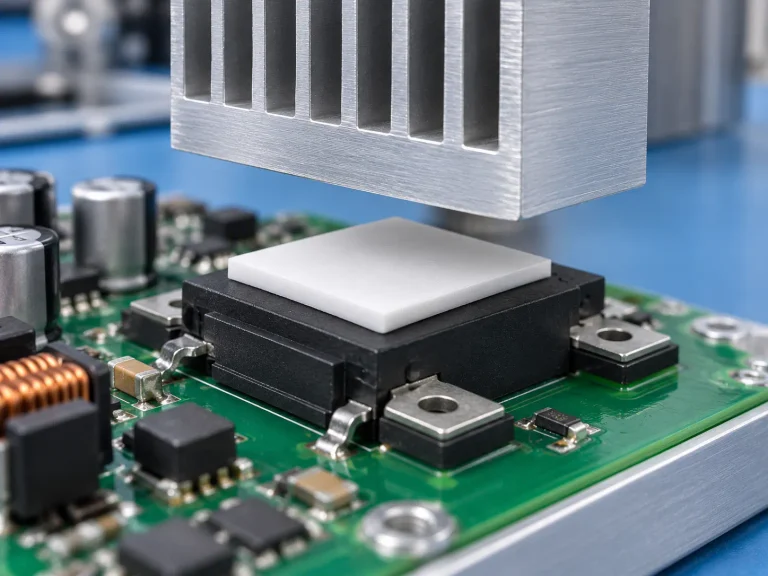
-
ADD: Bâtiment 2, No. 8 Hengzhutang Road, Dongguan
-
Téléphone: +86 135 4224 3751

Phase Change Material vs Traditional Thermal Pad: How to Choose
Phase change material vs traditional thermal pad decisions hit hard when overheating kills performance and budgets spiral out of control fast.
IDC 2025 research highlights growing demand for advanced thermal interface materials across AI servers and power electronics, citing reliability and efficiency as key procurement drivers.
Pick wrong, heat lingers, margins shrink, and assembly lines feel the pain real.
Quick Insights: Phase Change Material vs Traditional Thermal Pad Showdown
➔ PCM cuts junction temperatures by melting into micro-voids, slashing contact resistance under peak loads.
➔ Thermal pads offer instant conformability with varied hardness but struggle under transient heat spikes.
➔ PCM’s latent-heat buffering smooths thermal cycling, enhancing reliability in CPUs, GPUs, and power semiconductors.
➔ Pads excel in storage stability and shelf life, while PCMs require controlled environments for consistent die-cutting and dispensing.
➔ Choose PCMs for high-flux, fluctuating applications; opt for pads when ease of assembly and long-term storage take priority.
Thermal Interface Basics: PCM Vs Pad Classifications
When engineers compare Phase change material vs traditional thermal pad, the debate usually circles heat transfer, fit, and long-term reliability. In laptops, GPUs, and power modules, picking between a phase change material and a traditional thermal pad can make or break cooling efficiency. Here’s how PCM vs pad decisions really stack up in daily applications.
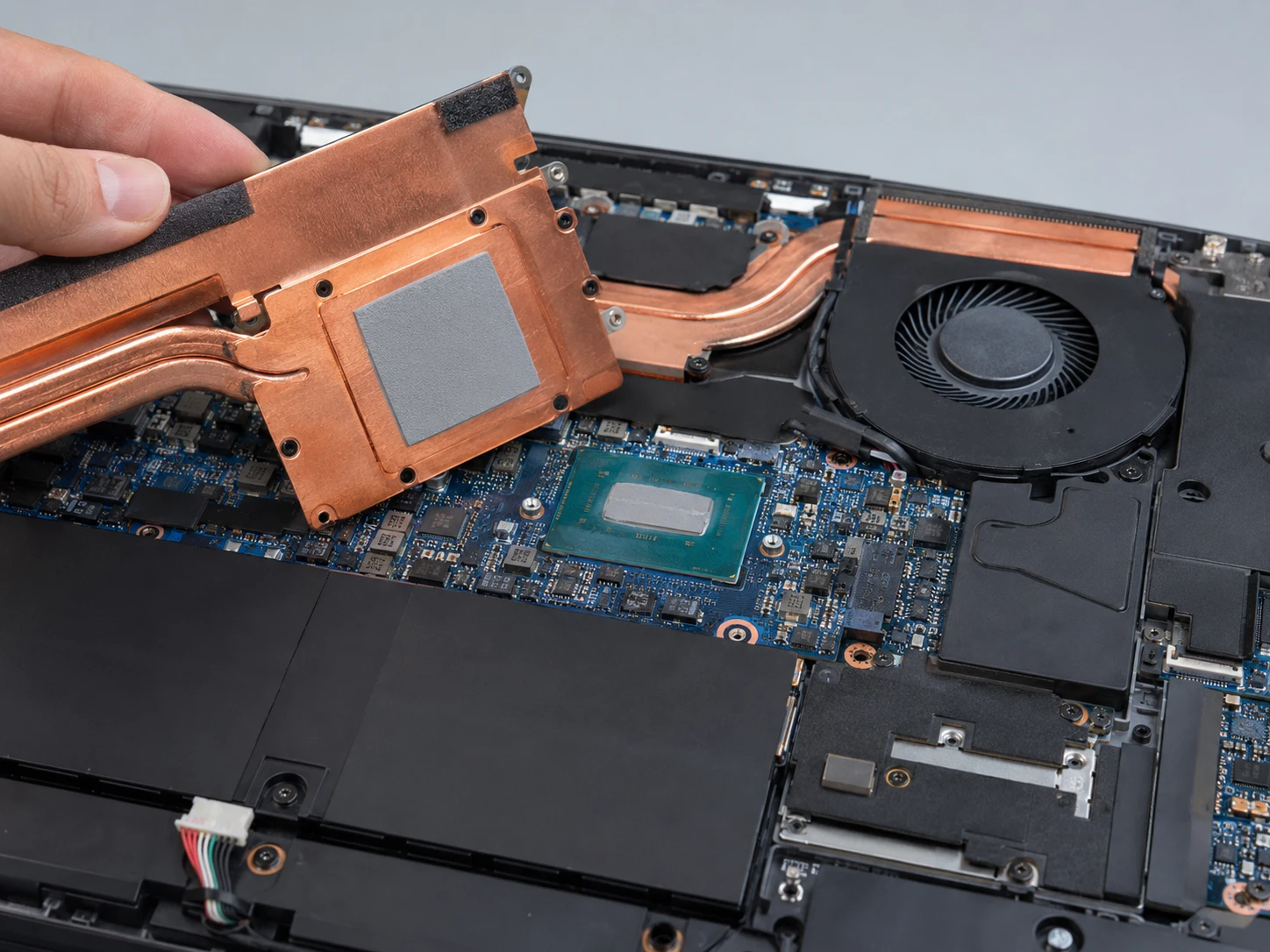
Thermal Pad Varieties and Material Hardness
A coussin thermique isn’t just a soft spacer. Its material hardness defines how well it compresses, fills gaps, and maintains pressure over time.
- Silicone pads: stable, flexible, common in consumer electronics
- Non-silicone pads: lower outgassing, better for optics
- Haut compressibilité pads: ideal for uneven heatsinks
- Firmer pads: better stacking strength in server boards
- Shore 00 hardness impacts conformité
- Compression set affects lifespan
- Filler loading shifts conductivity
- Dielectric strength protects sensitive ICs
Lorsque l'on compare les Phase change material vs traditional thermal pad, hardness becomes the turning point. A stiff pad may resist pump-out but lose surface contact. A softer pad hugs surfaces yet risks long-term deformation.
In real builds:
Brands like Matériaux brillants fine-tune filler ratios to balance hardness and conductivity. In the broader thermal pad vs PCM debate, pads win where gap filling and electrical isolation matter most.
- Gaming laptops prefer mid-soft pad varieties
- Industrial controls choose firmer grades
- Memory modules demand tight thickness tolerance
Phase Change Material: Melting Point and Latent Heat Profiles
A phase change material (PCM) operates differently. It softens near its melting point, triggering a solid-liquid transition that boosts surface wetting and lowers résistance thermique.
Below is a comparative thermal profile overview relevant to Phase change material vs traditional thermal pad decisions:
| Type de matériau | Melting Point (°C) | Latent Heat (J/g) | Typical Thermal Resistance (°C·cm²/W) |
|---|---|---|---|
| Wax-based PCM A | 48 | 120 | 0.08 |
| Wax-based PCM B | 55 | 140 | 0.07 |
| Silicone Pad Soft | N/A | N/A | 0.15 |
| Silicone Pad Firm | N/A | N/A | 0.18 |
Voici comment cela se passe :
- Heat rises
- PCM reaches the melting threshold
- Heat absorption spikes due to latent heat
- Contact resistance drops
Unlike a traditional thermal pad, a phase change thermal interface reacts dynamically. Under CPU bursts, that quick heat absorption smooths temperature swings. In compact systems, this often tips the scales toward PCM vs pad solutions supplied by innovators such as Matériaux brillants.
Comparing Polymer Matrix Pads and Wax-Based PCMs
In a clean material comparison, two paths dominate: polymer matrix pad and wax-based PCM.
A. Polymer Matrix Pad
- Built on a silicone or elastomer base
- Conductivity from ceramic fillers
- Stable thickness across cycles
B. Wax-Based PCM
- Paraffin or synthetic wax core
- Activated by temperature
- Reduced interface gaps during melt
Pour application suitability, consider:
- Gap >1 mm → polymer pad
- High transient spikes → PCM
- Need reworkability → pad
- Tight clamping force → PCM
Recent 2025 electronics cooling outlooks note rising PCM adoption in AI hardware:
“Advanced phase change materials are gaining share in high-density compute modules due to improved interface wetting and lower operational resistance.” — 2025 thermal management market brief, IDTechEx
That trend keeps the Phase change material vs traditional thermal pad debate alive. Some designers stick with pads for structural spacing. Others chase lower résistance thermique with wax systems.
Matériaux brillants positions both options side by side, helping engineers weigh transfert de chaleur, cost, and lifecycle demands. At the end of the day, choosing between a thermal pad vs PCM is less about hype and more about real operating conditions.
5 Factors Influencing Thermal Interface Selection
Choosing between Phase change material vs traditional thermal pad can feel like picking the right tool from a packed toolbox. Both serve as interface materials, yet their conductivité thermique, handling style, and long-term stability shift the outcome in high-power electronics. From GPUs to power modules, small material differences shape real heat transfer results.
Thermal Conductivity: From Ceramic Fillers to Silicone-Based Pads
At the core of Phase change material vs traditional thermal pad decisions sits conductivité thermique. Heat moves through charges céramiques, across particules de remplissage, and into heatsinks.
- Key material elements:
- Material composition
- Filler loading ratio
- Bond-line thickness
- Higher filler density
- Plus bas résistance thermique
- Améliorée transfert de chaleur
| Type de matériau | Conductivité thermique (W/m-K) | Typical Thickness (mm) | Application Pressure (kPa) |
|---|---|---|---|
| Phase change material | 3–8 | 0.05–0.2 | 50–150 |
| Coussinets en silicone | 1-6 | 0.5–3.0 | 20–100 |
| High-fill pads | 6–12 | 0.5–2.0 | 30–120 |
- In practical selection:
- Phase change material
- ▸ Thin bond lines
- ▸ Lower interface gaps
- Traditional thermal pad
- ▸ Easier handling
- ▸ Consistent thickness control
- Phase change material
The debate around PCM vs thermal pad often comes down to balancing conductivity with assembly comfort.
Conformability and Compression Deflection in Gap Fillers
When surfaces aren’t perfectly flat, conformité wins the day. A traditional thermal pad behaves like a cushion, absorbing height differences through controlled compression deflection.
- Material response depends on:
- Elasticity
- Material softness
- Applied pression de contact
Multi-level considerations:
- Interface adaptation
- Surface roughness
- Micro voids
- Air pockets
- Surface roughness
- Résultats des performances
- Réduit void filling gaps
- Mieux interface contact
A phase change material softens under heat, flowing slightly to minimize air gaps. That’s why phase change vs pad discussions often revolve around irregular substrates and stacked tolerances.
Surface Tack vs Contact Resistance for Reliable Heat Dissipation
Haut surface tack improves placement accuracy but may affect résistance de contact. The trick is dialing in adhesion without hurting performance thermique.
Short takes:
- Too sticky → tricky rework.
- Too dry → poor interface quality.
- Balanced wetting → stable dissipation de la chaleur.
The 2025 IDC hardware outlook noted that thermal interface optimization is now “a primary limiter of sustained processor performance in compact AI systems.”
That insight keeps phase-change material vs traditional thermal pad comparisons front and center in server and edge device design.
Reworkability and Pump-Out Resistance during Automated Assembly
Pendant automated assembly, stability matters. Materials face vibration, torque, and cycle thermique.
Sequence of evaluation:
- Assess pump-out resistance under cycling.
- Measure material migration after 500–1,000 cycles.
- Confirmer reworkability without residue damage.
Nested reliability checks:
- Processus de fabrication
- Dispensing accuracy
- Placement tolerance
- Long-term reliability
- Material stability
- Bond-line integrity
A PCM thermal interface may resist pump-out better due to phase transition behavior, while some pads offer easier swap-out during maintenance.
Storage Stability and Shelf Life in High-Volume Manufacturing
In high-volume manufacturing, idle inventory can quietly degrade performance. Storage stability et shelf life influence yield rates and quality audits.
Core control factors:
- Environmental factors
- Temperature (5–25°C typical)
- Humidity below 60%
- Propriétés des matériaux
- Oil bleed resistance
- Filler sedimentation control
- Quality control
- Periodic conductivity testing
- Aging simulations
A thermal pad alternative like phase change material may demand stricter packaging, while pads often show longer warehouse tolerance.
So when engineers weigh phase-change material vs traditional thermal pad, the real call isn’t hype—it’s matching physics, process flow, and storage reality to the job at hand.
Why Choose Phase Change Material Over Thermal Pad?
When engineers compare phase-change material vs traditional thermal pad, the real talk usually comes down to cooling efficiency, uptime, and cost. Let’s break down how phase change thermal interface materials shift the balance in modern electronics.
Lower Junction Temperature: How PCM Beats Thermal Pads
In the debate around Phase change material vs traditional thermal pad, the metric that matters most is température de jonction. Lower it, and you extend fiabilité des composants. Miss it, and performance throttles.
• Reduced résistance thermique after softening
- Améliorée transfert de chaleur across microscopic gaps
• Stronger long-term performance thermique
- Solid at room temperature
- Softens near the operating range
- Fills surface irregularities
- Cuts interface voids
| Type de matériau | Typical Thermal Conductivity (W/m·K) | Interface Thickness (mm) | Resulting ΔT (°C) |
|---|---|---|---|
| Coussin thermique | 3–6 | 0.5–1.0 | 8–15 |
| PCM | 4–8 | 0.1–0.3 | 3–8 |
| High-End PCM | 8+ | 0.1–0.2 | 2–5 |
The thinner bond line plus phase softening reduces contact gaps, improving dissipation de la chaleur without excessive mounting pressure.
- Interface material behavior
- Solid handling during assembly
- Controlled flow at temperature
- Lower void ratio
- Stable bond line
Brands like Sheen Materials fine-tune PCM chemistry to maintain stable conductivity over repeated cycles, making the phase change material vs traditional thermal pad comparison tilt clearly toward PCM in high-density systems.
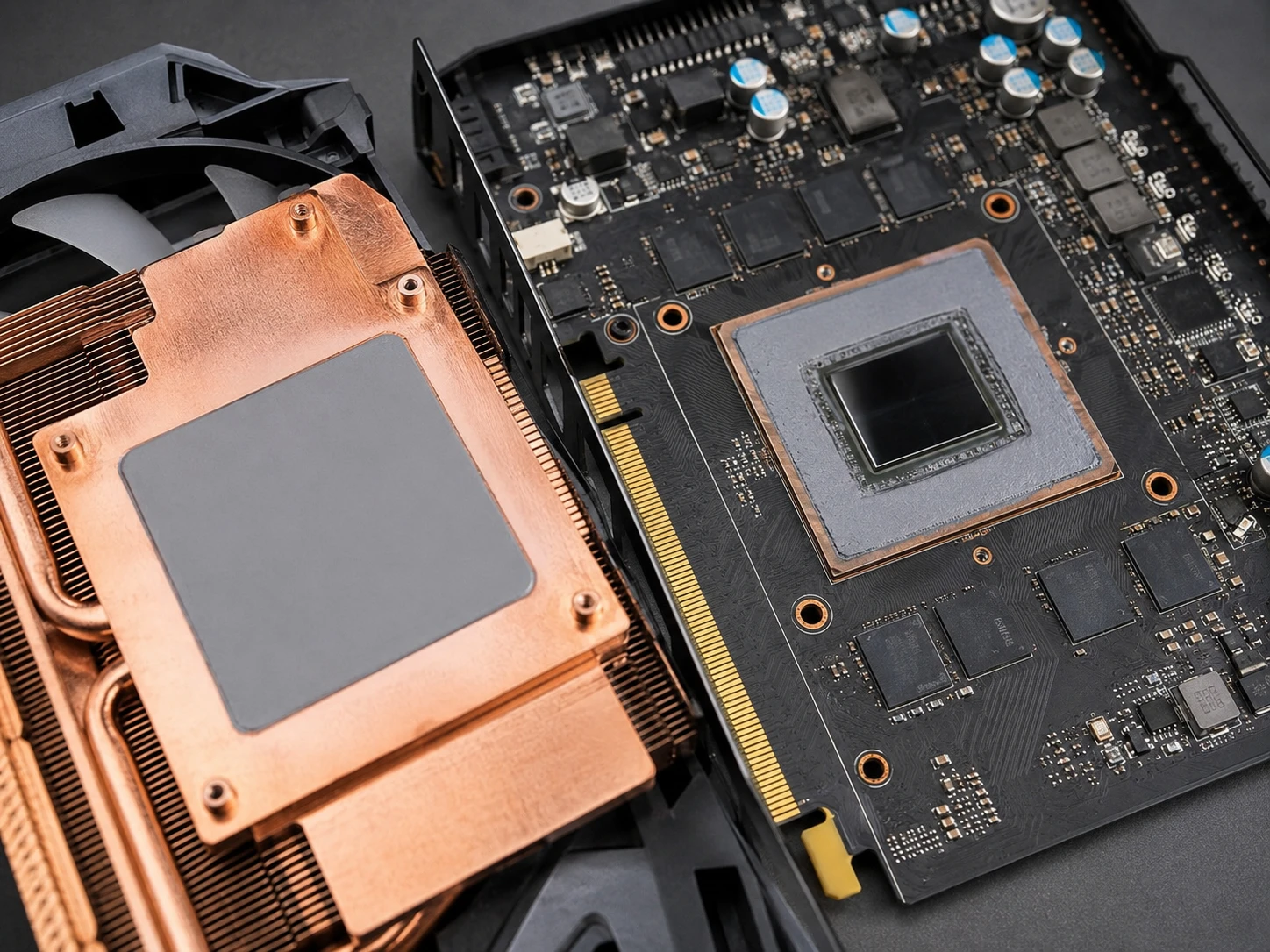
Phase Transition Advantages for CPU and GPU Cooling
Here’s where phase transition changes the game for CPU cooling et GPU cooling.
- Solid-to-semi-liquid transition
- Active heat absorption via latent heat
- Improved contact during load spikes
A 2025 IDC thermal management outlook noted:
“Advanced thermal interface material adoption in AI accelerators is rising due to improved thermal cycling durability and reduced impedance.”
That durability matters. During cycle thermique, PCM adapts, while pads can pump out or dry.
- Cooling dynamics
- Under idle
- Maintains structure
- Under load
- Softens
- Enhances surface conformity
- Lower interface impedance
- Stable performance thermique
- Under idle
When weighing Phase change material vs traditional thermal pad, fluctuating workloads clearly favor materials designed for controlled phase behavior.
Ease of Die-Cutting and Automated Dispensing with PCMs
Manufacturing teams care about throughput. So the processus de fabrication matters just as much as lab data.
• Clean découpe formats
• Reel-ready sheets
• Precise automated dispensing
- Select material form
- Align to the component footprint
- Integrate into the assembly process
- Validate thickness consistency
- Production workflow
- Material form options
- Film
- Sheet
- Syringe
- Application methods
- Pick-and-place
- Jet dispensing
- Reduced labor
- Plus élevé production efficiency
- Material form options
Sheen Materials supports both pre-formed PCM sheets and automated deposition formats, making the shift from thermal pad vs PCM surprisingly smooth.
In real-world assembly lines, fewer reworks and consistent bond lines often seal the deal in the ongoing Phase change material vs traditional thermal pad discussion.
Case Study: PCM In Power Electronics Cooling
Power electronics run hot, and cooling choices make or break system life. In the ongoing debate around Phase change material vs traditional thermal pad, engineers look beyond hype. This case breaks down real application logic, measurable gains, and long-term stability in plain terms.
Scenario Overview: PCM Application on Power Semiconductors
Lorsque l'on compare les Phase change material vs traditional thermal pad, the real shift happens at the interface between Power semiconductors and the Dissipateur thermique inside tight Electronic packaging layouts.
- Interface Design Logic1.1 Contact Surface Challenges
- Microscopic gaps form due to uneven mounting.
- Air pockets raise Résistance thermique.
- Haut Heat flux worsens hot spots.
1.2 Material Response

*   A **Phase Change Material** softens near operating temperature.

*   It flows into voids, acting as an advanced **Thermal interface material**.

*   After cooling, it stabilizes without pump-out.
- Practical Integration Path2.1 Replace pad with PCM sheet or coating.2.2 Apply pressure during Die attachment.2.3 Allow thermal cycling to complete conformity.
Compared with a traditional pad vs PCM setup, this approach improves surface wetting without adding thickness. That’s why the phase-change material vs traditional thermal pad discussion often ends with PCM in high-power builds.
Sheen Materials supports this transition with tailored PCM formats that drop into existing mounting frames without redesign headaches.
Performance Metrics: Thermal Impedance and Heat Dissipation Gains
Engineers judge Phase change material vs traditional thermal pad by numbers tied to Performance evaluation.
- Plus bas Impédance thermique
- Réduit Junction temperature
- Faster Dissipation de la chaleur
Under load testing:
- Baseline with thermal pad
- Swap to PCM
- Re-measure steady-state delta
Results often show measurable reduction in Résistance thermique, especially where Conductivité thermique alone was not the core bottleneck. The gain comes from interface conformity, not just bulk material specs.
In short bursts of high current, PCM handles spikes better. During continuous duty, it maintains consistent contact. That’s the quiet win in the phase change material vs thermal pad comparison.
Long-Term Reliability: Outgassing and Dielectric Strength Results
Reliability decides the final call in Phase change material vs traditional thermal pad selections.
- Faible Dégazage under elevated temperature
- Stable Rigidité diélectrique pour Isolation électrique
• Resistance to cracking during Thermal cycling
Testing typically follows this layered approach:
- Environmental Exposure1.1 High humidity → check moisture resistance 1.2 Repeated heat cycles → monitor Material stability
- Electrical Validation2.1 Measure insulation breakdown levels2.2 Confirm no degradation after cycling
A thermal pad vs phase change material comparison sometimes favors pads in ultra-low-cost builds. Yet in demanding converters and inverters, the Phase change material vs traditional thermal pad decision often leans toward PCM because stability and interface recovery hold up over time.
That’s why teams working with Matériaux brillants keep PCM on the shortlist when uptime truly matters.