-
ADD: Bâtiment 2, No. 8 Hengzhutang Road, Dongguan
-
Téléphone: +86 135 4224 3751

Solving Thermal Throttle: Phase Change Material for AI Server CPUs
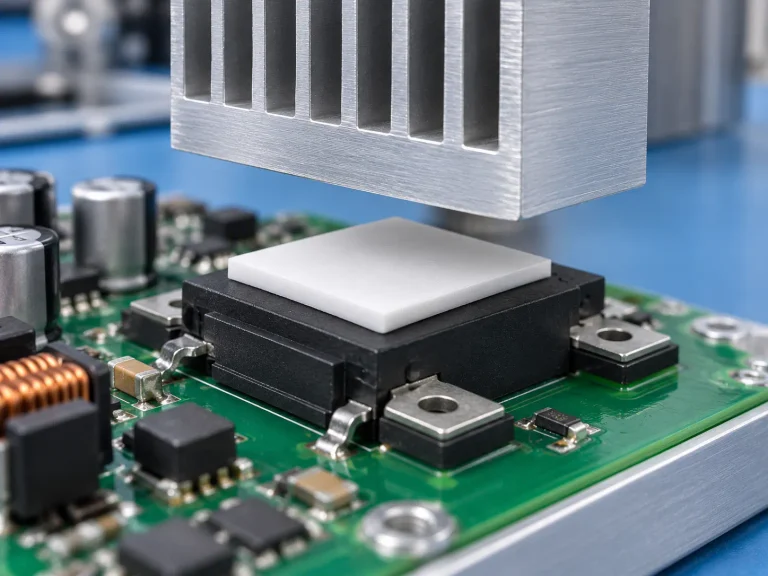
Data centers are hitting a wall, and Phase change material for AI server CPUs steps in like a pressure valve, soaking up heat spikes that fry performance and quietly drain revenue during peak compute bursts.
Conventional cooling grinding, hotspots slip through, nudging, throttling, and wear. PCM adds a buffer, steadies temps, trims energy waste, and fits into builds without blowing up budgets or timelines.
Key Takeaways for Peak Cooling: Phase Change Material for AI Server CPUs
➔ Thermal Buffering: PCM soaks up transient heat spikes from high-power CPUs/GPUs, reducing hotspots and preventing thermal throttling without complex upgrades.
➔ Intégration transparente: Embed organic or inorganic PCMs via microencapsulation and vacuum impregnation into cold plates or polymer-enhanced liquid cooling, boosting conductivity and structural stability.
➔ Balanced ROI: Evaluate material costs against performance metrics—latent heat, thermal conductivity, cycling reliability—and choose PCMs that meet server temperature ranges while controlling budget and maintenance overhead.
Why Thermal Throttle Hits AI Servers So Hard
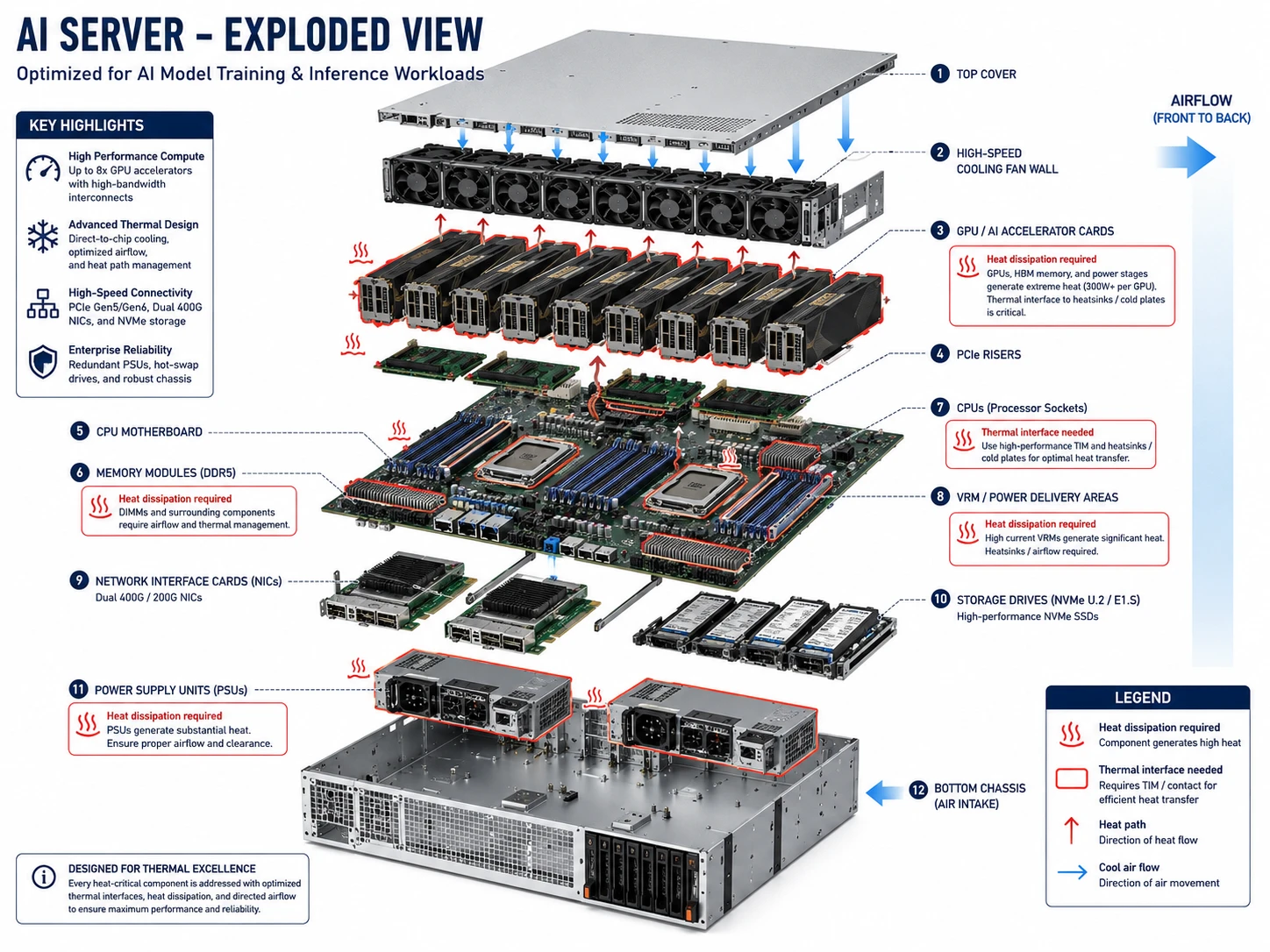
AI racks are running hot, and not in a cool way. As Phase change material for AI server CPUs becomes critical in data centers, the fight against thermal throttle is now about physics, materials, and smart engineering. Let’s break it down.
Explosive Heat Flux from High-Power CPUs and GPUs
The problem starts at the chip level.
Moderne CPU et GPU architectures push staggering densité de puissance, creating intense heat flux within tiny footprints. When AI inference spikes, the thermal load climbs fast, and dissipation pathways struggle to keep up.
Here’s how the heat stacks up:
- Concentrated transistor switching
- Chiplet stacking inside compact packages
- High rack-level power budgets
- Heat flux rises sharply at localized cores.
- Thermal resistance builds between the die and the spreader.
- Cooling systems lag behind instantaneous peaks.
Pour Phase change material for AI server CPUs, the role becomes strategic:
- Buffer sudden densité de puissance surges
- Absorb transient thermal load through phase change
- Stabilize junction temperature before throttle triggers
Nested impact chain:
- Die level
- Hotspot formation
- Uneven heat flux distribution
- Package level
- Interface gaps
- Increased résistance thermique
- Niveau du système
- Airflow limits
- Rack-scale dissipation bottlenecks
That’s why advanced Phase change material for AI server CPUs isn’t optional anymore—it’s survival gear for AI silicon.
Limitations of Conventional Heat Sinks and Vapor Chambers
Traditional dissipateur thermique et vapor chamber setups worked fine for moderate workloads. AI servers? Different story.
Conventional cooling technology faces:
- Fin surface area limits
- Delayed transfert de chaleur under sudden peaks
- Localized hotspot persistence
Let’s unpack it deeper.
- Material constraint
- Aluminum or copper spreads heat, but can’t buffer spikes
- Structural limit
- Vapor chambers handle steady loads better than abrupt bursts
- Interface gap
- Contact resistance reduces overall performance
A quick look at the physics:
- Dissipateur thermique → passive conduction
- Vapor chamber → phase-based spreading
- Phase change material for AI server CPUs → transient absorption + delayed release
That buffering effect is the game changer.
According to a 2025 data center thermal outlook by the International Energy Agency:
“AI-optimized servers are driving rack densities beyond traditional air-cooling design thresholds, requiring advanced thermal materials to maintain performance stability.”
This is exactly where Phase change material for AI server CPUs steps in. And brands like Matériaux brillants are pushing smarter PCM integration that works alongside existing cooling technology, not against it.
Impact of Operating Temperature on Latent Heat and Density
Not all PCM behave the same at different température de fonctionnement ranges.
Core factors shaping performance thermique:
- Latent heat capacity
- Densité changes during phase change
- Precise melting point alignment
Layered influence:
- Propriétés des matériaux
- Plus élevé density can improve volumetric efficiency
- Optimisé latent heat extends absorption window
- Thermal window
- Too low melting point → premature saturation
- Too high → ineffective buffering
- System integration
- Rack airflow
- CPU hotspot mapping
Pour Phase change material for AI server CPUs, tuning the melting point near peak safe température de fonctionnement ensures:
- Delayed throttle
- Stable compute bursts
- Better energy-to-performance ratio
A solid PCM design doesn’t just melt. It melts at the right time.
Matériaux brillants engineers focus on balancing propriétés des matériaux so the Phase change material for AI server CPUs keeps consistent performance thermique across heavy AI training cycles.
Thermal Cycling Stability vs. Peak Power Dissipation
AI workloads fluctuate. Hard.
That creates repeated cycle thermique, which stresses interfaces and materials.
Key stress chain:
- Rapid peak power spikes
- Expansion and contraction
- Micro-fatigue and dégradation des matériaux
Multi-level durability breakdown:
- PCM layer
- Intégrité de l'encapsulation
- Volume stability
- Interface layer
- Résistance au pompage
- Bond strength
- System reliability
- Long terme stability
- Predictable power dissipation comportement
Risks include:
- Fatigue cracks
- Loss of thermal contact
- Réduit fiabilité
The sweet spot for Phase change material for AI server CPUs is simple but tough to execute:
- Haut latent heat
- Strong cycling stability
- Cohérent power dissipation manipulation
That’s why Matériaux brillants invests in reinforced encapsulation strategies to ensure the Phase change material for AI server CPUs survives thousands of heavy cycle thermique events without breaking down.
AI servers don’t get a day off. Their cooling materials shouldn’t either.
5 Steps to Integrate PCM into Server Cooling
AI servers run hot, no sugarcoating it. Choosing the right Phase change material for AI server CPUs can calm temperature spikes, smooth workloads, and cut energy waste. Here’s how smart integration actually plays out in real builds.
Step 1: Selecting Organic and Inorganic PCMs for CPU Packages
Choosing a phase change material for a CPU package is less about hype and more about numbers that match real chip behavior.
| PCM Type | Typical Melting Temperature (°C) | Latent Heat (kJ/kg) | Conductivité thermique (W/m-K) |
|---|---|---|---|
| Organic PCM (Paraffin) | 50–70 | 150–220 | 0.2–0.3 |
| Fatty Acid | 45–65 | 180–210 | 0.2–0.4 |
| Inorganic PCM (Salt Hydrate) | 55–75 | 200–260 | 0.5–0.8 |
| Metallic Alloy | 60–90 | 80–120 | 10–30 |
Lors de la sélection d'un Phase change material for AI server CPUs, evaluate:
- ✔ Matching melting temperature to sustained boost clocks
- ✔ Sufficient latent heat for workload spikes
- ✔ Safe integration inside sealed CPU substrates
Nested considerations often guide procurement:
- Material class: 1.1 Organic PCM; 1.2 Inorganic PCM.
- Thermal targets: 2.1 Desired junction temperature; 2.2 Peak transient heat flux.
- Reliability constraints: 3.1 Non-toxicity; 3.2 Long-term stability.
For AI racks pushing dense GPU-CPU nodes, a well-matched Phase change material for AI server CPUs prevents thermal throttling before liquid loops even react.
Step 2: Microencapsulation Techniques for Enhanced Encapsulation Integrity
Microencapsulation protects the core material—your phase change material—with a durable shell material. It’s about keeping leakage and degradation off the table.
Key performance pillars:
- Shell chemistry impacts stabilité thermique
- Capsule wall thickness defines résistance mécanique
- Uniforme microcapsule dispersion ensures steady heat flow
Encapsulation design often unfolds like this:
- Shell selection: 1.1 Polymer-based coatings; 1.2 Inorganic ceramic shells.
- Core-shell ratio tuning: 2.1 Higher PCM fraction for capacity; 2.2 Thicker shells for durability.
- Stress validation: 3.1 Repeated thermal shock; 3.2 Vibration resistance in server racks.
Pour tout Phase change material for AI server CPUs, microencapsulation boosts cycle life, especially in edge data centers where uptime is king.
Step 3: Embedding PCM in Cold Plates via Vacuum Impregnation
Embedding PCM inside a cold plate upgrades it from a simple heat spreader to a thermal buffer.
Core manufacturing flow:
- Porous metal dissipateur thermique preparation
- Vacuum impregnation to remove air
- Contrôlé void filling with molten PCM
Engineering logic runs deeper:
- Cold plate structure: 1.1 Porosity level; 1.2 Surface roughness for better interface thermique.
- PCM embedding: 2.1 Saturation under vacuum; 2.2 Sealing against leakage.
- Integration: 3.1 Contact with CPU lid; 3.2 Proximity to liquid channels.
This hybrid approach lets a Phase change material for AI server CPUs absorb heat bursts while coolant stabilizes steady loads.
Step 4: Integrating Polymer Composites with Liquid Cooling Plates
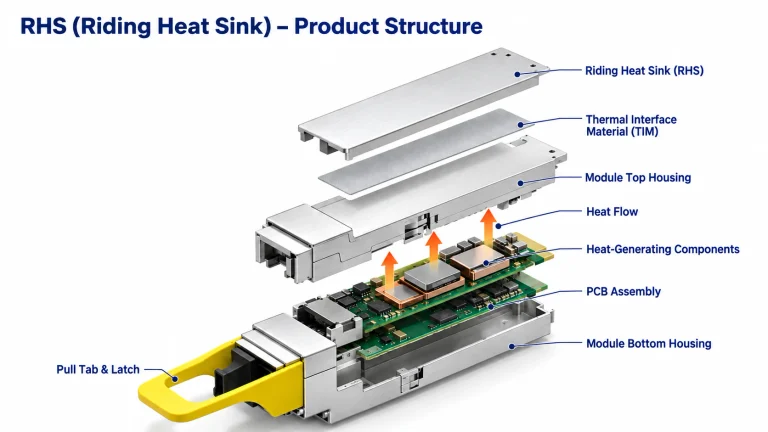
A polymer composite matrix can host PCM and still bond smoothly to a liquid cooling plate.
Integration checkpoints:
- Composite filler raises transfert de chaleur rates
- Chemical compatibility with cooling fluid
- Stability near turbulent flow channel regions
Design layering often looks like:
- Composite selection: 1.1 PCM-loaded polymer; 1.2 Graphite-enhanced matrix.
- Interface control: 2.1 Bonding to the metal plate; 2.2 Avoiding galvanic corrosion.
- System alignment: 3.1 Flow distribution; 3.2 Thermal expansion matching.
Brands like Matériaux brillants optimize composite dispersion so that the phase change material for AI server CPUs stays evenly distributed, not clumped in hot zones.
Step 5: Validating Thermal Cycling Reliability and Energy Efficiency
No data center manager buys promises. Testing decides everything.
Core validation layers:
- Thermal cycling endurance: 1.1 1,000+ melt-freeze loops; 1.2 Monitoring degradation.
- Performance metrics: 2.1 Stable dissipation de la chaleur; 2.2 Consistent energy efficiency.
- Long-term outcome: 3.1 Defined cycle life; 3.2 Clear performance validation reports.
BloombergNEF’s 2025 data center outlook notes:
“Thermal management efficiency is emerging as one of the most cost-sensitive levers in AI infrastructure expansion.”
That’s not abstract talk. Lower peak temperatures mean less throttling and fewer emergency shutdowns.
Matériaux brillants validates each Phase change material for AI server CPUs under sustained AI workloads, tracking real-world performance thermique rather than lab-only numbers. In high-density racks, that practical mindset makes all the difference.
Phase Change Material: Cost Versus Performance
High-density racks are pushing thermal limits, and Phase change material for AI server CPUs is no longer a niche tweak—it’s a core thermal strategy. When choosing a Phase change material for AI server CPUs, cost and performance move together. Cheap upfront can mean expensive downtime. Let’s break it down in plain terms.
Cost Considerations
Data center buyers looking at Phase change material for AI server CPUs usually compare Manufacturing expenses, Material acquisition, and long-term Lifecycle cost instead of sticker price alone.
“Thermal management materials are now evaluated on total cost of ownership rather than unit price,” notes a 2025 IDC data center infrastructure outlook, pointing to rising AI rack densities.
- Upfront Investment
- Raw inputs
- Paraffin blends: lower Material acquisition cost
- Salt hydrants: reduced base cost but higher containment needs
- Processing
- Microencapsulation increases Production scale complexity
- Corrosion inhibitors add to Manufacturing expenses
- Raw inputs
- Deployment Economics
- Installation
- Surface prep
- Integration with cold plates
- Impact on Installation Costs
- Operational phase
- Reduced fan loads cut Maintenance expenditures
- Stable temps improve Economic viability
- Installation
- Long-Term Financial Impact
- Plus bas CPU operating temperature reduces hardware failure rates
- Fewer emergency swaps shrink unplanned service budgets
- Extended service cycles decrease total Lifecycle cost
Quick cost checklist for a Phase change material for AI server CPUs project:
- Initial material price
- Integration tooling
- Corrosion mitigation
- Expected service years
Brands like Sheen Materials focus on scaling encapsulation without inflating unit economics, keeping performance gains aligned with budget goals.
Performance Metrics
Lors de la sélection d'un Phase change material for AI server CPUs, performance numbers must justify every dollar spent. The same logic applies to any PCM for AI server processors in dense GPU clusters.
- Core Thermal Properties: 1.1 Heat Handling.
- Haut Latent heat absorbs spikes during AI inference bursts
- Fort Conductivité thermique supports rapid Dissipation de la chaleur
1.2 Stability Range

"  Operating band aligned with "  "CPU operating temperature "
"    Consistent"  "Temperature reduction"  " under peak load "
- System-Level Outcomes
- Plus bas Throttling frequency
- Améliorée Cooling efficiency
- Greater System stability
- Comparative Data Snapshot
| Type de matériau | Conductivité thermique (W/m-K) | Latent Heat (kJ/kg) | Avg. Temp Reduction (°C) |
|---|---|---|---|
| Paraffin PCM | 0.2–0.4 | 180–220 | 6–8 |
| Salt Hydrate | 0.5–0.8 | 200–250 | 8–11 |
| Composite PCM | 1.0–3.0 | 170–210 | 10–14 |
| Graphite-Enhanced PCM | 3.0–6.0 | 160–200 | 12-16 |
Performance isn’t just lab data. It’s about keeping AI clusters steady when workloads spike hard and fast. A well-tuned Phase change material for AI server CPUs smooths those peaks, keeps throttling rare, and protects silicon over the years.
Matériaux brillants aligns conductivity tuning with real rack conditions, helping operators balance cost pressure against cooling performance without cutting corners.