-
ADD: Bâtiment 2, No. 8 Hengzhutang Road, Dongguan
-
Téléphone: +86 135 4224 3751

Should You Use a Phase Change Thermal Pad vs Liquid Metal?
In the phase change thermal pad vs liquid metal debate, bulk buyers aren’t chasing lab numbers—they’re dodging rework, line slowdowns, and warranty headaches that eat margins alive.
According to Sheen Materials engineering guidance published in 2025, consistent application control and electrical safety drive scalable thermal interface decisions in high-volume manufacturing.
Liquid metal wins performance; phase change pads win repeatability, uptime, and cost per unit as production scales.
Quick Notes: Phase Change Thermal Pad vs Liquid Metal Harmony
➔ Performance vs Repeatability: Liquid metal leads in conductivity, while phase change pads excel in consistent application and uptime.
➔ Safety and Handling: Pads offer electrical insulation and low risk; liquid metal demands careful material compatibility and expert application.
➔ Cost Efficiency: Pads deliver lower unit cost and maintenance savings at scale; metal may justify higher initial expense for extreme cooling.
➔ Manufacturing Impact: Phase change pads reduce rework, line slowdowns, and warranty claims—ideal for high‐volume production.
➔ Selection Factors: Balance conductivity, phase stability, surface conformity, and overall durability against system requirements.
Types Of Thermal Interface Materials
Picking a TIM can feel like arguing over pizza toppings. When it comes to phase change thermal pad vs liquid metal, the right call depends on workload, risk tolerance, and how much mess you’re willing to handle.
Pâte thermique – Traditional Medium
Lorsque l'on compare les phase change thermal pad vs liquid metal, classic paste still holds ground thanks to balanced composition and workable viscosité.
- Key traits:
- Conductivity that fits mainstream CPUs
- Simple application
- Manageable removal
- Apply a pea-sized drop.
- Mount the cooler.
- Allow light curing during heat cycles.
Its longevity varies by formula, yet most blends avoid the drama tied to liquid metal vs pad debates. For builders weighing phase change pad vs liquid metal, paste remains the safe middle lane.
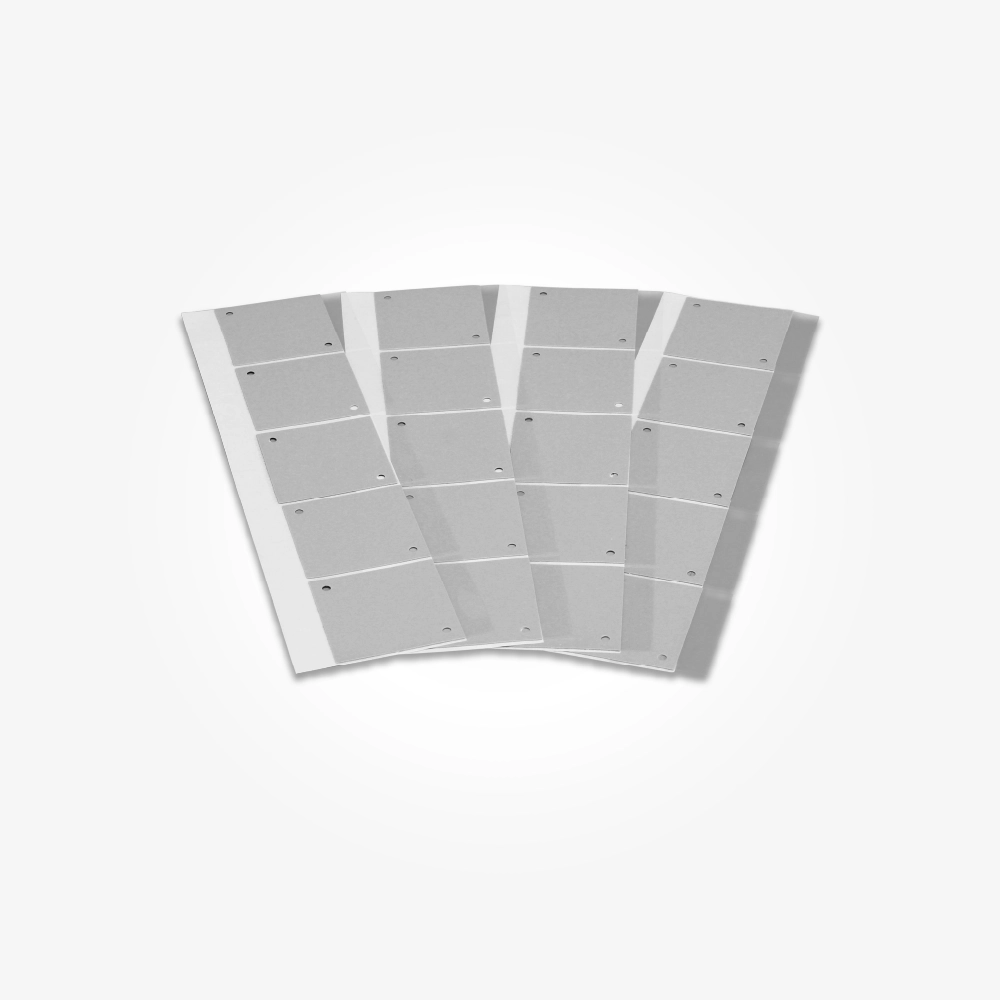
Phase Change Thermal Pads Explained
In the ongoing phase change thermal pad vs liquid metal debate, these pads shift from solid-to-liquid at a defined melting point.
- Performance factors:
- Plus bas résistance thermique
- Surface conformity
- Cleaner installation
★ Reusability depends on cycle stress.
Compared with liquid metal vs phase change pad setups:
- Heat rises.
- Pad softens.
- Gaps vanish.
- Performance stabilizes.
Recent IDC thermal materials commentary (2025) notes:
“Phase-change interface materials are gaining traction in controlled manufacturing environments due to consistency and reduced contamination risk.”
We will refine pad chemistry to balance conformity and lifespan.
Liquid Metal TIMs Overview
In any serious phase change thermal pad vs liquid metal talk, gallium-based alloys dominate for high conductivity.
- Pros:
- Extreme heat transfer
- Cons:
- Conductivité électrique
- Aluminium corrosion
Chemin d'accès à l'application :
- Polish surface for better wetting.
- Apply micro-layer.
- Seal to prevent pump-out effect.
It’s powerful, but one slip can short a board. That’s why many users ask about liquid metal vs pad safety before committing. Matériaux brillants offers compatibility guidance to reduce risk.
Graphite Sheets as Emerging Alternatives
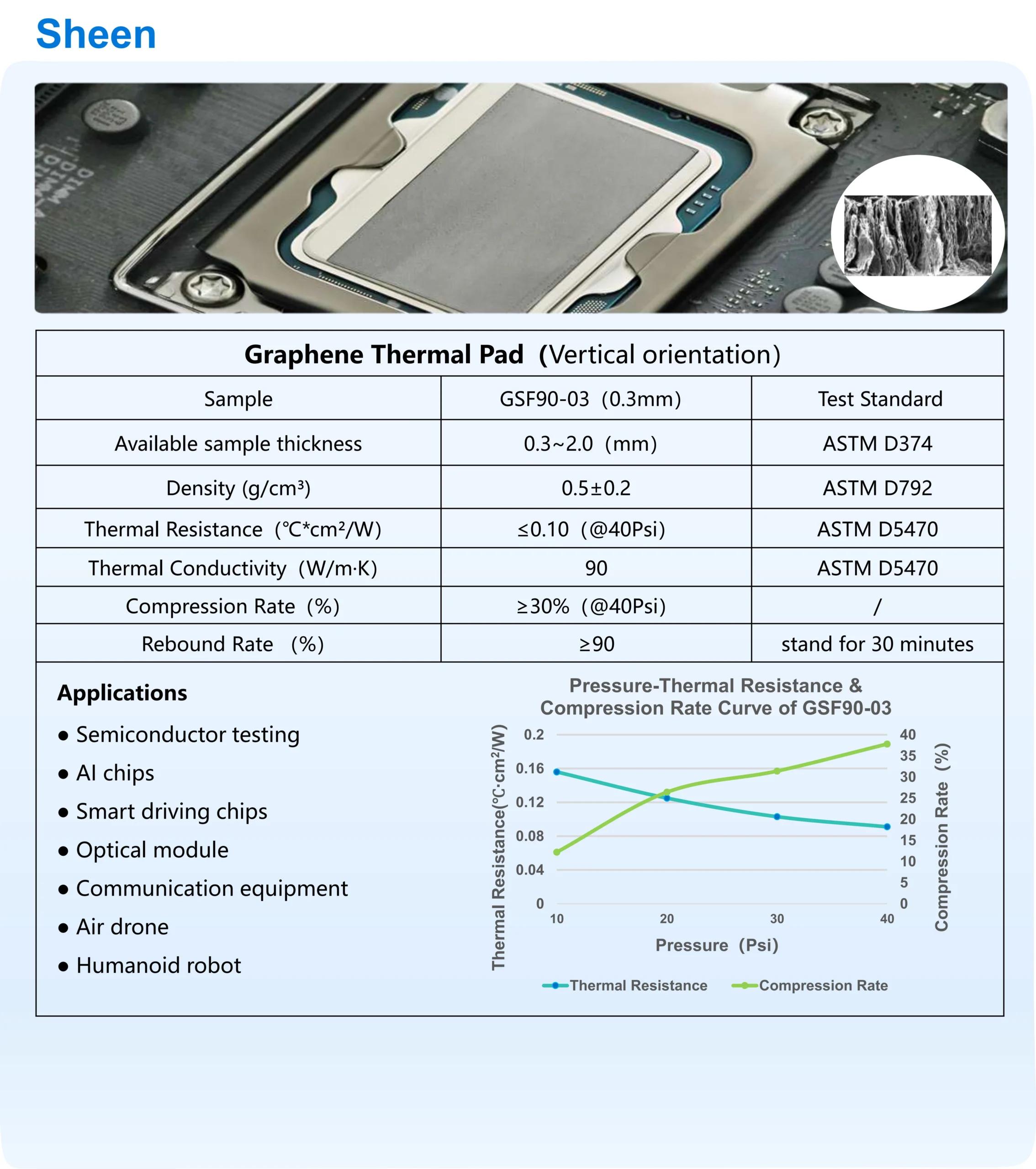
Graphite sheets rely on layered carbon material avec anisotropic heat spread. Heat moves sideways fast, downward moderately.
- Traits:
- Ultra thinness
- Dry application
- Fort la durabilité
- Built-in isolation électrique
Compared with phase change pad vs liquid metal setups:
- No curing.
- No melting.
- Minimal mess.
Flexible and reusable, these sheets avoid pump-out drama. While peak conductivity trails liquid metal, many builders prefer the clean swap. Matériaux brillants continues exploring graphite options for users tired of the liquid metal vs phase change pad dilemma.
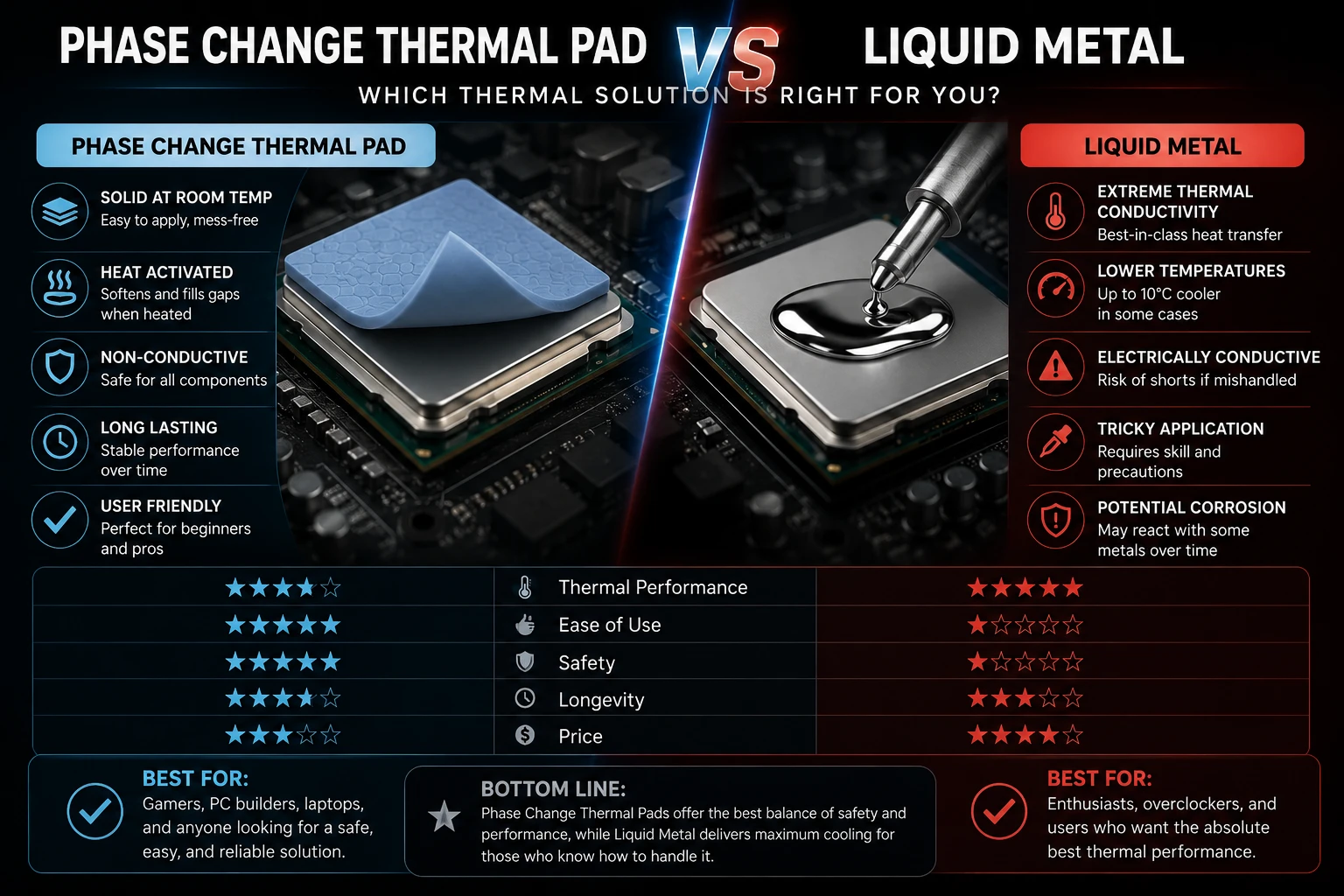
Phase Change Thermal Pad Vs Liquid Metal—Why?
When people search phase change thermal pad vs liquid metal, they usually want one thing—better temps without frying expensive hardware. We will comparison breaks down performance, risk, and real-world use so you can choose smart, not just fast. Let’s keep it practical and straight.
Phase Change Thermal Pad
In the phase change thermal pad vs liquid metal debate, this option feels safer right out of the box.
• Solid at room temperature
• Activates near its melting point
• Re-solidifies for repeat transfert de chaleur cycles
- Clean surface
- Apply pad
- Mount heatsink
- Heat activates material
How It Works Internally
- Thermal interface material
- State shift
- Solid state → semi-liquid → solid
- Maintains gap filling
- State shift
- Electrical properties
- Non-conductive
- Reduced short-circuit risk
Performance stays consistent. No dripping. No corrosion panic.
| Propriété | Typical Value | User Impact | Risk Level |
|---|---|---|---|
| Conductivité thermique | 6–12 W/mK | Stable cooling | Faible |
| Electrical Conductivity | None | Safe installs | Very Low |
| Réutilisation | Modéré | Easier maintenance | Faible |
| Installation Time | <5 min | Beginner-friendly | Very Low |
Short take: safe, repeatable, stress-free. Brands like Matériaux brillants design pads optimized for predictable performance, especially for laptops and compact builds.
IDC’s 2025 thermal management outlook notes that safer, pre‑formed matériau d'interface thermique solutions are gaining traction in consumer electronics due to “rising demand for reliability over peak experimental output.”
In the phase change thermal pad vs liquid metal match-up, this side wins on simplicity.
Liquid Metal
Now the heavy hitter.
• Ultra high conductivity
• Based on gallium alloy
• Used in overclocking and delidding
Internal Characteristics
- Thermal interface material
- Metallic structure
- Exceptional transfert de chaleur
- Metallic structure
- Electrical behavior
- Haut electrical conductivity
- Short risk if misapplied
Application needs a steady hand:
- Mask surrounding components
- Apply micro-layer
- Spread evenly
- Monitor for corrosion on aluminum
| Propriété | Typical Value | User Impact | Risk Level |
|---|---|---|---|
| Conductivité thermique | 30–73 W/mK | Extreme cooling | Moyen |
| Electrical Conductivity | Haut | Needs insulation | Haut |
| Corrosion Risk | Possible | Avoid aluminum | Moyen |
| Maintenance | Regular check | Performance tuning | Moyen |
Temps drop fast. That’s the appeal.
Still, in the full phase change thermal pad vs liquid metal comparison, the choice depends on comfort level. Matériaux brillants offers both advanced pads and precision-controlled liquid solutions, letting users pick safety or raw output without compromise.
For everyday builds? Pads feel calm and controlled.
For pushing silicon to its edge? Liquid metal rules—but respect it.
Cost Per Watt: Pad Vs Metal
Lorsque l'on compare les phase change thermal pad vs liquid metal, cost per watt isn’t just about sticker price. It’s about longevity, cooling headroom, and how much hassle you’re willing to handle. Let’s break down phase change pads and liquid metal in real-world terms.
Phase Change Thermal Pad
In the phase change thermal pad vs liquid metal debate, pads win points for balance.
- Material Basics1.1 As a matériau d'interface thermique, it starts in solid state form.1.2 Under heat, it softens to improve transfert de chaleur.1.3 Stable conductivité thermique keeps performance predictable.
- Practical Value2.1 Simple installation means less labor cost.2.2 Natural isolation électrique removes short-circuit anxiety.2.3 Strong performance stability reduces replacement frequency.2.4 Good reusability in controlled environments lowers long-term expense.
- Cost-Per-Watt Impact3.1 Lower upfront spend.3.2 Minimal maintenance cycles.3.3 Ideal for mainstream CPUs and GPUs.
For system builders working with Matériaux brillants, this route keeps cooling reliable without creeping service costs.
Liquid Metal
Now the other side of phase change thermal pad vs liquid metal—raw performance.
- Thermal interface material built on gallium-based alloys
- Extremely high conductivity
- Demands careful handling due to electrical conductivity
1) Upfront investment is higher.
2) Application difficulty increases labor time.
3) Long-term watchpoints include corrosion risk, pump-out effect, and possible dégradation des performances.
★ Best suited for overclocked rigs and dense compute nodes.
IDC’s 2025 data center thermal brief noted that higher-efficiency TIMs are “directly reducing cooling power allocation in high-density racks,” highlighting why liquid metal can justify its price in performance-heavy setups.
Still, for many buyers weighing phase change pad vs liquid metal, reliability and safer installs from Matériaux brillants often deliver the better cost-per-watt equation.
4 Factors In Thermal Pad Selection
Choosing between phase change thermal pad vs liquid metal isn’t just a spec-sheet decision. It’s about heat, pressure, lifespan, and budget all working together. Below, we break down what truly matters when comparing phase change pads vs liquid metal in real-world cooling systems.
Factor 1 – Thermal Conductivity Performance
When engineers debate phase change thermal pad vs liquid metal, the talk usually starts with conductivité thermique. That number, measured in Watt-per-meter-Kelvin, defines how efficiently transfert de chaleur happens across the interface.
Typical Comparison Table
| Type de matériau | Conductivité thermique (W/m-K) | Résistance thermique (°C-cm²/W) | Typical Application |
|---|---|---|---|
| Phase Change Thermal Pad | 3-12 | 0.10–0.25 | CPUs, GPUs, VRMs |
| High-End PCM Pad | 10–18 | 0.08–0.18 | Data centers |
| Liquid Metal | 35–80 | 0.02–0.06 | Overclocked CPUs |
| Silicone Thermal Pad | 1-6 | 0.20–0.35 | General electronics |
- Plus élevé conductivité thermique → lower résistance thermique.
- Lower resistance → stronger dissipation de la chaleur.
- Stronger dissipation → better system performance.
Yet raw numbers aren’t everything. Liquid metal wins in pure interface efficiency, but phase change thermal pad vs liquid metal decisions must also weigh safety and containment. For many OEM builds, Matériaux brillants balances strong transfert de chaleur with stable pad design, reducing leakage risk.
Factor 2 – Melting Point and Phase Stability
The heart of the phase change thermal pad vs liquid metal debate lies in melting point et phase change contrôle.
- Operating temperature range
- Repeated cycle thermique
- Risk of uncontrolled liquefaction
Liquid metal stays liquid. Phase change pads shift from solid to semi-liquid at a defined material state, then re-solidify during solidification. That controlled transition supports long-term stability.
Step-by-step logic:
- System heats up.
- Pad softens near its rated melting point.
- Material flows into micro voids.
- Cooling occurs.
- Pad stabilizes without pump-out.
“Thermal interface reliability under cycling conditions remains a decisive factor in electronics longevity,” notes a 2025 IPC electronics materials outlook.
In practice, phase change thermal pad vs liquid metal comparisons often favor pads in mass production because controlled phase stability reduces spill hazards. Matériaux brillants engineers tune activation temperatures to match server and GPU loads, avoiding messy surprises.
Factor 3 – Compression and Surface Conformity
Good cooling isn’t just chemistry. It’s physics.
Key concerns in phase change thermal pad vs liquid metal decisions:
- Compression range
- Required pression de contact
- Ability to fill micro-gaps
Multi-level considerations:
- Surface Conditions
- A. Surface roughness variation
- B. Uneven die heights
- Mechanical Behavior
- A. Material deformation under load
- B. Recovery after stress
- Interface Results
- A. Improved interface contact
- B. Reduced air pockets
- C. Better le comblement des lacunes
Liquid metal offers extreme wetting but demands careful mounting pressure. Pads, especially in phase change thermal pad vs liquid metal evaluations, shine in forgiving builds. A well-designed PCM pad compresses, adapts, and maintains contact without electrical conductivity risks.
Short version? If assembly tolerance varies, pads usually save the day.
Factor 4 – Durability and Cost Efficiency
Cooling performance means little if it fades fast. In the phase change thermal pad vs liquid metal comparison, long-term la durabilité shifts the cost equation.
Consider:
- Lifespan under daily load
- Resistance to drying or pump-out
- Overall maintenance frequency
Nested evaluation path:
- Reliability Metrics
- A. Long-term l'intégrité des matériaux
- B. Consistent fiabilité after 1,000+ cycles
- Operational Impact
- A. Reduced rework
- B. Stable installation process
- Financial Outcome
- A. Improved longevity
- B. Lower total ownership cost
- C. Limited need for reapplication
Liquid metal may offer top-tier conductivity, yet it can complicate servicing. Phase change thermal pad vs liquid metal trade-offs often favor pads in enterprise systems due to predictable wear patterns and optional reusability.
For balanced performance and budget control, Matériaux brillants solutions align la durabilité with scalable pricing—making the phase change thermal pad vs liquid metal decision less about hype and more about smart engineering.