-
ADD: Edificio 2, nº 8 de Hengzhutang Road, Dongguan
-
Teléfono: +86 135 4224 3751

Struggling with Temps? Thermal Putty vs Thermal Pad Breakdown
Hot components can turn a tiny interface flaw into an expensive headache, so thermal putty vs thermal pad is really about installed performance, not flashy conductivity claims alone.
IEA’s 2025 Energy and AI report says global data-center electricity demand is set to more than double by 2030, driven heavily by AI.
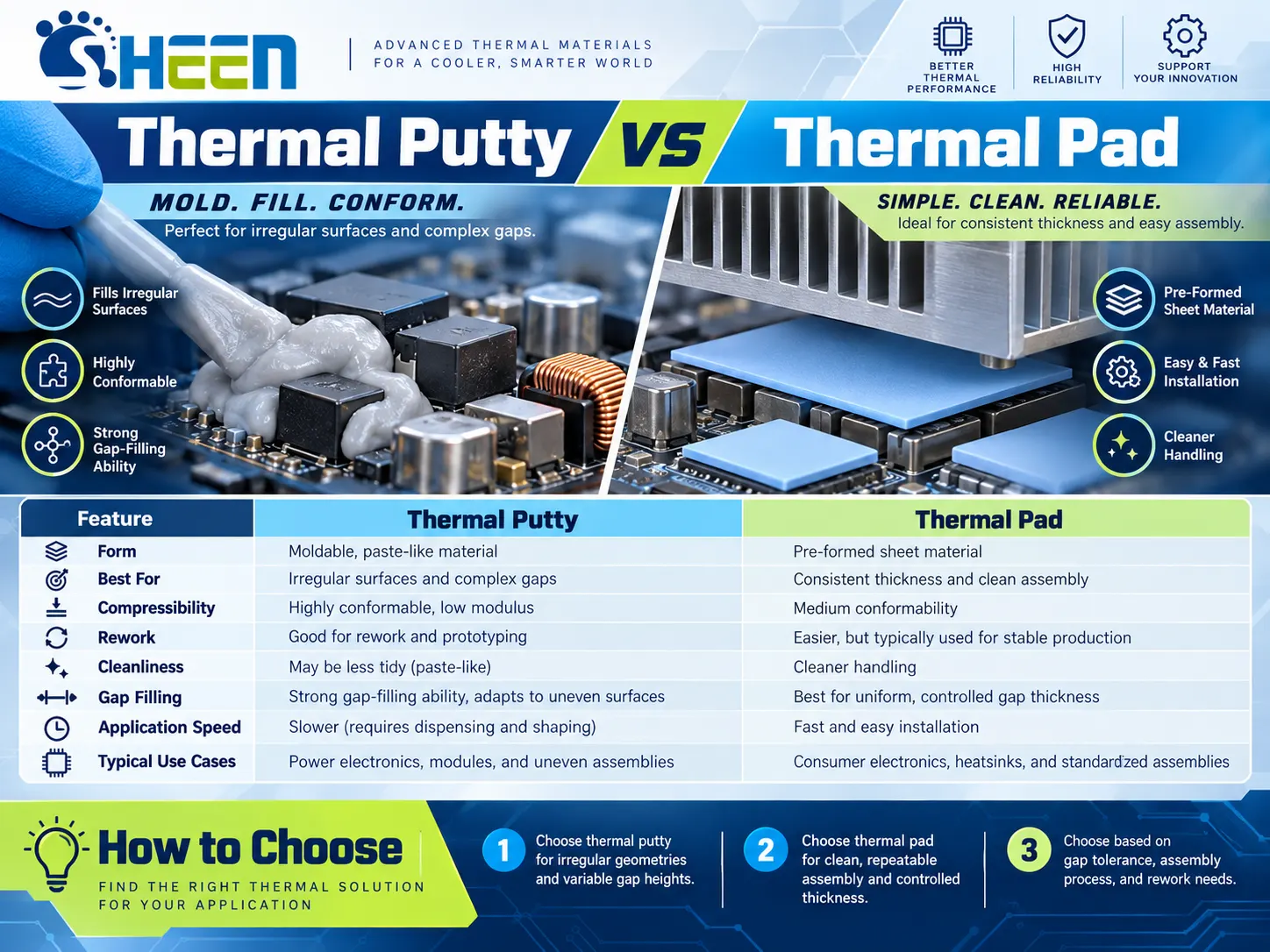
Putty hugs uneven gaps; pads bring controlled thickness and repeatable assembly. At scale, compare impedance, compression, automation, rework, reliability, traceability, and cost.
Quick Insights: thermal putty vs thermal pad
- Thermal Putty excels at filling uneven gaps, offering low contact resistance and reworkability.
- Almohadilla térmica delivers controlled thickness, repeatable assembly, and reliable impedance at scale.
- Evaluate compression deflection and Shore OO hardness for optimal conformity and stress management.
- Compare material costs, die-cutting waste, dispensing automation, and batch size in total cost analysis.
- Test for long-term reliability: thermal aging, oil bleed resistance, vibration endurance, and humidity cycles.
Types Of Thermal Interface Materials Explained
Choosing a thermal interface material gets tricky fast. This thermal putty vs thermal pad guide compares five practical options, helping designers match heat transfer, insulation, assembly needs, and tight cooling spaces.
Silicone Thermal Putty
For thermal putty vs thermal pad decisions, silicone putty handles irregular spaces especially well.
- Fit
- Adjustable viscosidad supports precise relleno de huecos and strong conformabilidad.
- Service
- An uncured elastomer tolerates vibration, while good reusability makes repairs less of a headache.
- Adecuado conductividad térmica helps control temperatures, though the pump-out effect needs consideration.
Sheen Materials can support applications needing disposable thermal putty.
Phase Change Material
A phase change material shifts from a solid-liquid state around its designed melting point. That change improves substrate wetting with modest mounting pressure, cutting interface resistance y impedancia térmica; latent heat also describes energy absorbed during the transition.
For thermal putty vs thermal pad comparisons, aging stability matters too.
Gap Filler Pad
- Mechanical fit
- Controlado compresibilidad y Dureza Shore provide useful cushioning.
- Estrecha thickness tolerance simplifies assembly.
- Electrical and thermal behavior
- Refuerzo de fibra de vidrio can improve handling.
- Dielectric breakdown ratings and resistencia térmica guide pad selection for ECUs, telecom gear, and electronics.
Ceramic-Filled Elastomer
- Óxido de aluminio o nitruro de boro raises heat transfer while maintaining aislamiento eléctrico.
- A silicone matrix balances tear strength, hardness, y estabilidad térmica. Sheen Materials offers choices suited to demanding power-electronics designs, including flame-rated options.
Graphite Thermal Sheet
- Heat movement
- Anisotropic conductivity favors rapid in-plane conduction and broad difusión del calor.
- Thin designs
- An ultra-thin, flexible carbon structure fits phones and LEDs.
- Graphite is electrically conductive, so insulation may be required.
Compared with a thermal pad or thermal putty, graphite mainly spreads heat sideways.
5 Factors Affecting Thermal Pad Performance
Choosing thermal putty vs thermal pad gets tricky once real hardware enters the mix. A pad may look great on paper yet behave quite differently after assembly. Comparing thermal putty vs thermal pad means checking conductivity, softness, compression, contact, and long-term resistance. Sheen Materials can help match these traits to practical cooling needs rather than relying on one headline specification.
Thermal Conductivity Variations
- Conductivity reflects how readily transferencia de calor occurs.
- Más alto W/mK can lower bulk resistencia térmica.
- Yet composición del material, filler density, and thickness change real energy dissipation.
So, thermal pad ratings need context.
Hardness (Shore OO) Impact
- Consulte Shore OO o durometer.
- Lower values indicate greater material softness y conformabilidad.
- Firmer pads may increase estrés mecánico, making protección de componentes especially important.
This softness difference also matters when comparing thermal putty vs thermal pad.
Compression Deflection Behavior
Useful compression is a balancing act:
- Thickness reduction
- accommodates gap tolerance
- changes distribución de la presión
- Load deflection
- indicates required assembly force
- depends partly on elasticidad y deformación
Too much force can stress boards or chip.
Surface Wetting and Adhesion
Mejor interfacial contact limits insulating micro-gaps y air voids. Surface tack and surface energy influence spreading y bonding, though very sticky pads can make servicing a pain.
| Contact state | Air-gap estimate | Relative contact resistance |
|---|---|---|
| Pobre | 80 µm | 1.00 |
| Moderado | 40 µm | 0.65 |
| Bien | 15 µm | 0.35 |
Values are illustrative, not product specifications.
Thermal Impedance Fluctuations
- Installed impedance combines bulk and interface resistance.
- Greater flujo de calor can create a measurable gradiente de temperatura.
- Repeated ciclo térmico may introduce efectos del envejecimiento.
- Compression changes contact.
- Humidity and freeze cycles can affect performance stability.
That’s why a thermal putty vs thermal pad decision should include application testing, not just datasheet numbers.
Thermal Putty Vs Thermal Pad: Conduction Rates
Comparing thermal putty vs thermal pad performance takes more than checking a conductivity number on a data sheet. Heat transfer also changes with contact quality, gap size, pressure, and material thickness. In real hardware, thermal putty and thermal pad materials can therefore behave quite differently despite similar published ratings.
Thermal Putty
Thermal putty is soft enough to flow into uneven spaces. That high conformabilidad can improve relleno de huecos around components of different heights, cutting thermal contact resistance where rigid interfaces may leave tiny air pockets.
- Material behavior
- Conductividad térmica sets the basic ability to carry heat through the putty.
- Viscosidad controls how readily the material spreads or stays in place.
- Installation factors
- Application thickness matters: a needlessly thick layer creates a longer heat path.
- A silicone base can provide flexibility, while filler content strongly affects heat transfer.
- Repeated heating may contribute to the pump-out effect, so cycling conditions matter too.
That is the catch with thermal putty vs thermal pad comparisons: conductivity alone does not tell the whole story.
Almohadilla térmica
A thermal pad brings more predictable geometry. Its fixed espesor helps control the heat path, while suitable compresibilidad allows the pad to settle against small surface variations.
For practical pad vs putty selection:
- Consulte hardness against the pressure delicate components can safely tolerate.
- Compare impedancia térmica, which reflects resistance to heat flow under specified test conditions.
- Account for fiberglass reinforcement, since added support can affect flexibility and compression.
- Consulte rigidez dieléctrica when electrical isolation is important.
Some pad materials also use phase change behavior to improve surface contact as temperature rises. In short, pad performance is repeatable, but proper compression still counts.
Thermal Pad Vs Putty In Server Farms
Choosing thermal putty vs thermal pad affects assembly speed, service work, and cooling stability across a server fleet. Pads bring controlled dimensions and tidy handling, while putty adapts to uneven hardware. In practice, thermal pad and thermal putty choices come down to gap size, production needs, and long-term heat behavior. Here’s where each option fits.
Almohadilla térmica
For standardized server builds, a thermal pad is easy to control and replace.
- Manufacturing consistency
- Die-cut pieces provide predictable placement.
- Estrecha thickness tolerance supports repeatable relleno de huecos and pressure across matching components.
- Thermal and electrical needs
- Conductividad térmica influences heat transfer into the cold plate or heat sink.
- Dielectric breakdown ratings matter where electrical isolation is required.
- Service planning
- Pads usually make rework less messy.
- Some designs use phase change material to improve interface contact as temperatures rise.
That repeatability makes pads a practical server cooling choice when thermal putty vs thermal pad comparisons involve thousands of similar assemblies.
Thermal Putty
Putty earns its keep when component heights vary, or tight layouts leave awkward gaps.
- Fit and application
- Alta conformabilidad lets material flow around uneven surfaces.
- Controlado viscosidad supports automated dispensing.
- A silicone base can provide useful thermal and mechanical stability.
- Alta conformabilidad lets material flow around uneven surfaces.
- Long-term cooling
- Bajo resistencia de contacto supports efficient disipación del calor.
- Oil bleed and the pump-out effect need aging tests.
- Reutilización varies by formulation and service condition.
- Bajo resistencia de contacto supports efficient disipación del calor.
For thermal putty vs thermal pad selection, putty offers more freedom around mixed component heights, but process control is a bigger deal.
Thermal Pad Vs Thermal Putty: Cost Analysis
Comparing thermal putty vs thermal pad means looking past the sticker price. Material use, labor, tooling, storage, and rework all count, so the cheaper option on paper may cost more on the production floor.
Almohadilla térmica
For thermal putty vs thermal pad budgeting, pads offer predictable unit costs, but customized parts bring a few extra charges.
- Production costs
- Pre-cut shapes require die tooling, while liner waste adds material expense.
- Fixed espesor y controlada hardness make assembly repeatable, which is handy for high-volume work.
- Operating costs
- Simple installation can keep labor and cycle times steady.
- Silicona formulations with suitable conductivity y durabilidad may justify higher purchase prices through long service life.
Minimum batch sizes can still tie up cash in unused stock. For buyers comparing thermal pad formats, Sheen Materials can support size and material selection around production needs.
Thermal Putty
The thermal putty vs thermal pad cost balance shifts when hardware has irregular gaps, since putty avoids dedicated cutting dies.
- Application economics
- Alta conformabilidad supports flexible gap-filling across changing shapes.
- Controlado viscosidad y consistency matter because excess material quickly becomes waste.
- Production economics
- Automated dispensing adds equipment cost but can improve repeatable application at scale.
- Packaging and storage conditions also affect usable material life.
- Rework economics
- Practical reusability or easy removal can lower repair labor in suitable designs.
So, thermal putty vs thermal pad purchasing works best when total applied cost—not price per gram or pad—drives the call.