-
ADD: Edificio 2, nº 8 de Hengzhutang Road, Dongguan
-
Teléfono: +86 135 4224 3751

Thermal Pad vs Liquid Metal: How to Choose for Your Next Build
Almohadilla térmica vs Liquid Metal looks like a conductivity showdown, but that’s the trap. For volume buyers, fit, insulation, compatibility, and repeatability can make or break production.
Pads bridge gaps cleanly; liquid metal cuts interface resistance but brings electrical and gallium risks.
Grand View Research reports that electronics is driving thermal interface materials demand, reinforcing qualification around application needs, not headline conductivity alone.
Key Notes: Thermal Pad vs Liquid Metal
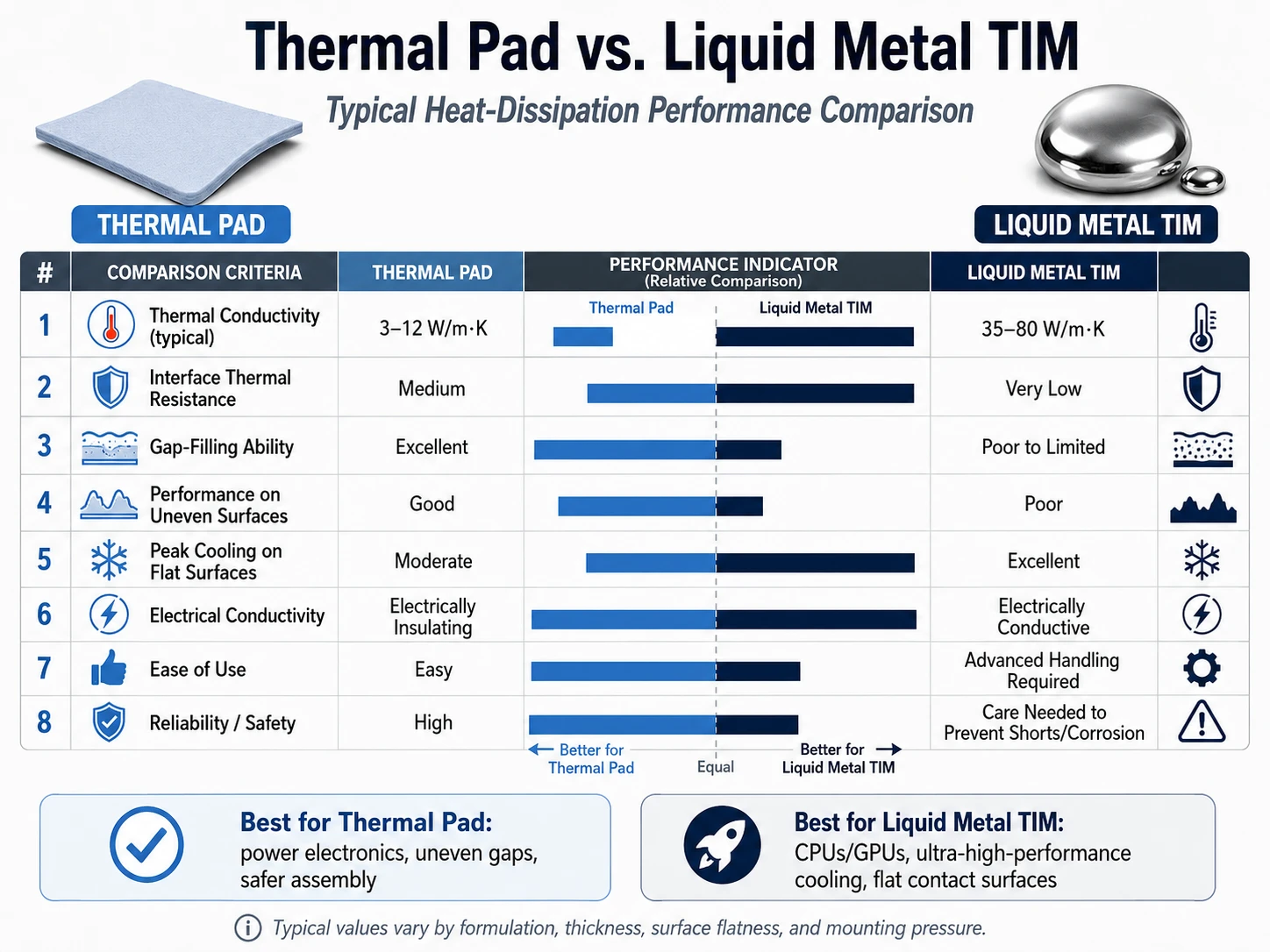
➔ Gap Bridging: Pads conform to varied clearances; liquid metal demands ultra-flat surfaces.
➔ Heat Transfer: Liquid metal offers lower interface resistance; pads excel across wider thicknesses.
➔ Electrical Safety: Pads are dielectric; liquid metal conducts electricity and needs isolation.
➔ Reliability: Pads resist pump-out and aging; liquid metal may corrode or migrate under cycling.
➔ Compatibility: Verify plating and module materials; test purity grade, bake, and impedance for longevity.
Thermal Pad Vs Liquid Metal Explained
Thermal Pad vs Liquid Metal comes down to heat transfer, safety, fit, and maintenance. One option is forgiving and tidy; the other pushes harder on cooling. For everyday builders, knowing those trade-offs makes picking the right interface much easier.
Almohadilla térmica
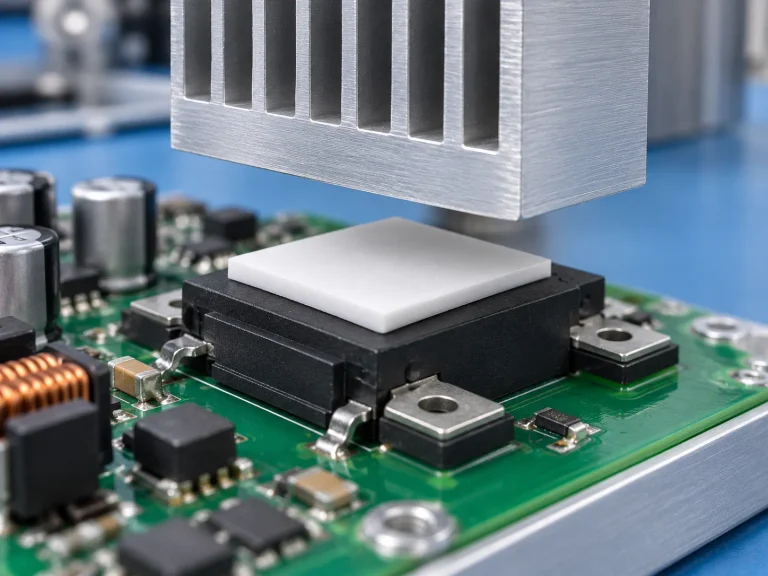
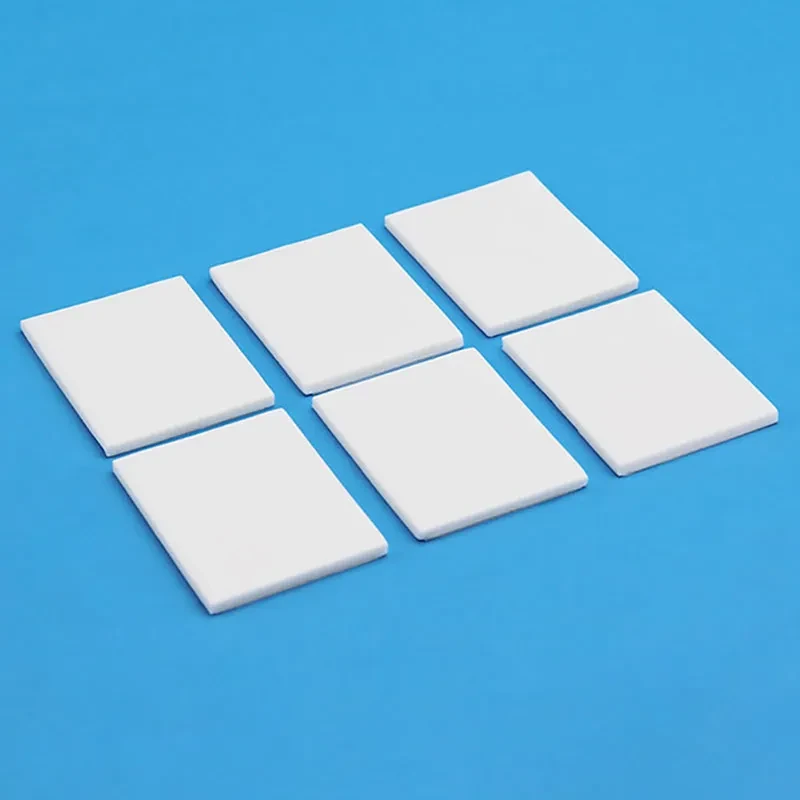
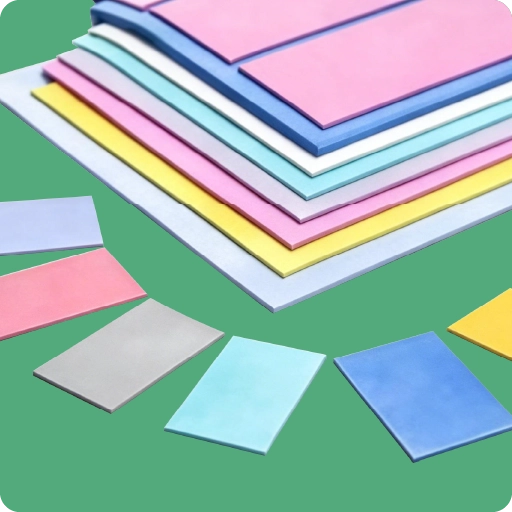
A thermal pad uses a silicona base loaded with ceramic particles. Its moderate conductivity cannot match liquid metal, but its fixed thickness makes installation simple and repeatable.
- Practical fit
- Gap filler role
- Pads conform to uneven spaces between chips, heat spreaders, and heat sinks.
- Thickness can cover gaps that ordinary thermal paste cannot handle well.
- Seguridad eléctrica
- Most silicone thermal pads are non-conductive, reducing short-circuit risk around exposed components.
- Bien durabilidad also suits systems that need long service intervals.
- Gap filler role
- Common selection
- Thickness matters
- Too thin leaves poor contact.
- Too thick can add thermal resistance or unwanted mounting pressure.
- Material choice matters
- Sheen Materials offers thermal interface options for applications where controlled thickness and straightforward assembly are priorities.
- Thickness matters
Here, Thermal Pad vs Liquid Metal favors pads when easy handling, electrical insulation, and dependable gap coverage matter more than peak temperatures.
Liquid Metal
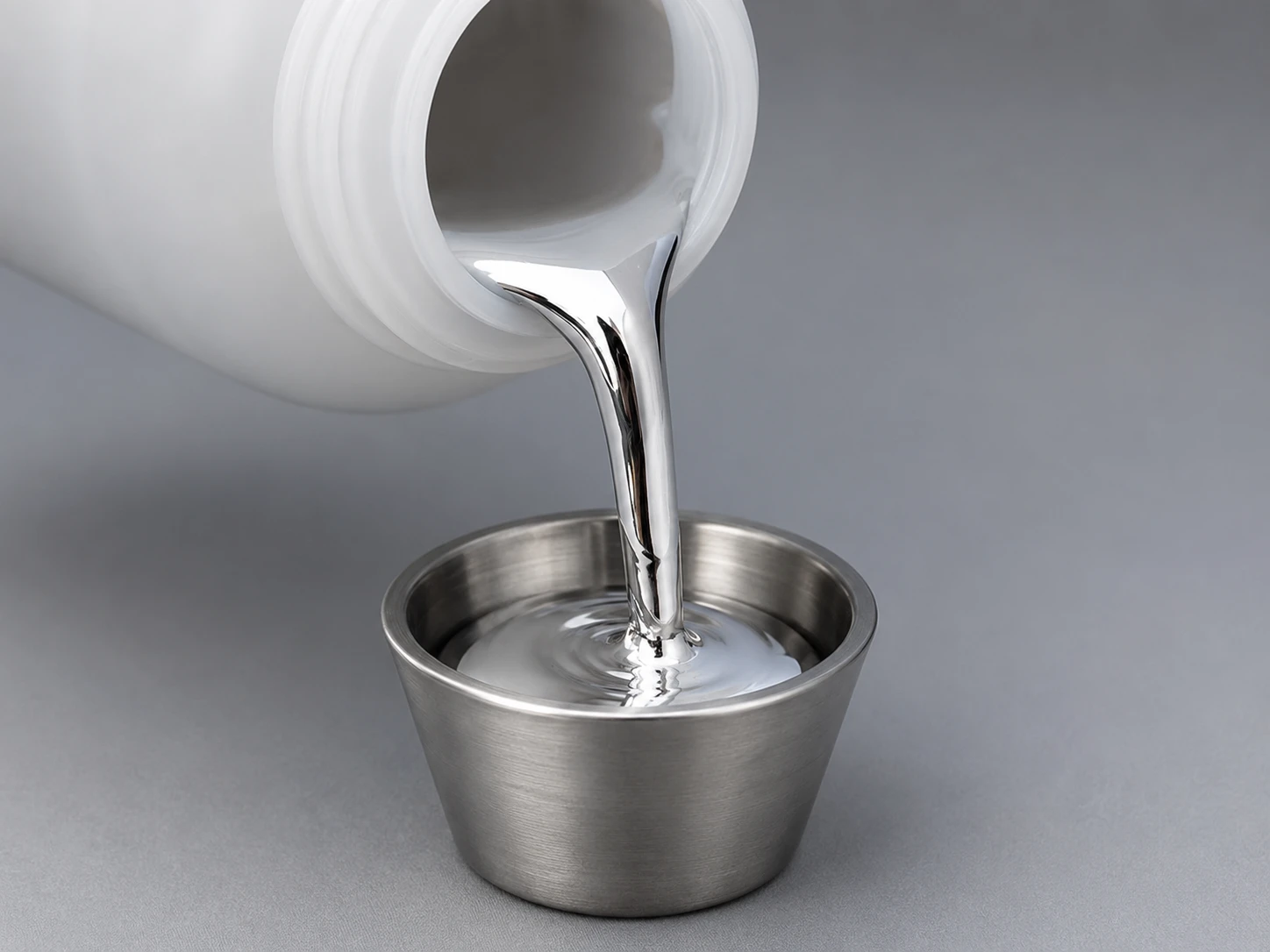
Liquid metal is usually a gallium-based alloy, often blended with indium or tin. It can deliver very high conductivity, making it attractive for CPU cooling and demanding overclocking, but careful application is no joke.
| Interface | Typical conductivity (W/m·K) | Typical layer (mm) | Electrical risk | Relative handling |
|---|---|---|---|---|
| Almohadilla de silicona | 3-12 | 0.5–3.0 | Bajo | 1 |
| High-performance pad | 12–20 | 0.5–2.0 | Bajo | 1 |
| Thermal paste | 4–15 | 0.02–0.10 | Usually low | 2 |
| Gallium liquid metal | 20–70+ | <0.05 | Alta | 4 |
Values are representative ranges; product specifications vary.
Because liquid metal is electrically conductive, spills can damage nearby circuitry. Gallium can also react with aluminum, so compatible copper or nickel-plated surfaces are essential. Its cooling performance can be excellent on suitable hardware, yet the thermal-pad alternative wins when simpler servicing and lower electrical risk matter most.
5 Performance Factors To Compare
Thermal Pad vs Liquid Metal performance comes down to heat flow, physical stability, temperature behavior, electrical safety, and mechanical fit. Comparing these factors makes choosing a thermal interface for real hardware much less tricky.
Conductividad térmica
Thermal conductivity in W/mK is useful, but thermal resistance tells the fuller story.
- Liquid metal
- Delivers rapid transferencia de calor across very thin contact layers.
- Works especially well against a compatible copper baseplate.
- Thermal pad
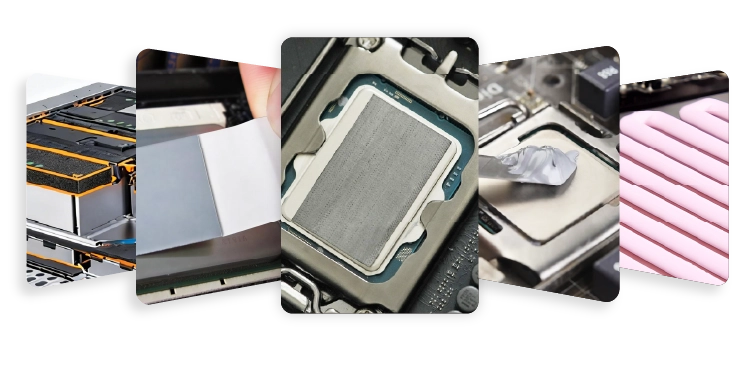
- A silicone matrix fills wider gaps and uneven surfaces.
- Real-world resistencia térmica can stay competitive when the interface needs substantial thickness.
For Thermal Pad vs Liquid Metal comparisons, fit often matters as much as the headline conductivity or dissipation rate.
Viscosity and Pump-out Effect
Viscosity affects how a thermal material spreads and stays put.
- Liquid metal
- Low viscosity changes rheology under shear stress.
- Repeated ciclo térmico can encourage migration if mounting control is poor.
- Almohadillas
- Handle greater gap thickness without flowing away.
- Mejor interface stability can be a big deal in laptops and GPUs.
Sheen Materials can help match pad thickness and compression to demanding assemblies.
Phase Change Temperature
Temperature shifts can change interface behavior fast.
- Gallium-based liquid metal may approach a solid-liquid transition near room temperature, depending on its melting point.
- Some pad designs use microcapsules or controlled reflow behavior to improve contact.
- Latent heat y activation energy matter when phase-changing materials must perform across storage and operating ranges.
Electrical Conductivity and Dielectric Breakdown
The safety gap between the thermal pad and liquid metal is pretty significant.
- Conductive interface
- A gallium alloy can cause a short circuit if it reaches exposed electronics.
- Metal contact can also promote galvanic corrosion with incompatible materials.
- Insulating pad
- An insulator supports electrical separation.
- Voltage threshold ratings help assess dielectric protection, while material choice may also affect capacitance.
Hardness and Thermal Expansion
Mechanical behavior deserves equal attention in Thermal Pad vs Liquid Metal selection.
- Pad mechanics
- Shore durometer indicates hardness.
- Compression modulus helps predict deformación under mounting pressure.
- Thermal movement
- Expansion mismatch can change contact force.
- Bien stress relief reduces gaps during heating and cooling.
For GPUs, servers, and power modules, Sheen Materials pad options can simplify mechanical fit where electrical insulation and controlled compression matter.
Can Liquid Metal Harm Your CPU?
Thermal Pad vs Liquid Metal is not just about peak temperatures. Material compatibility, contact aging, and alloy quality matter too. For everyday builds, knowing these differences can save a CPU setup from a costly mess.
Gallium Corrosion Risks
Thermal Pad vs Liquid Metal becomes especially important when cooler materials enter the equation. Liquid gallium can seriously weaken aluminum, so an incompatible disipador de calor is a no-go.
- Material compatibility
- Amalgamation is often used loosely here; more precisely, gallium penetrates aluminum and changes its microstructure.
- Continued diffusion can make aluminum brittle, increasing cracking and metal fatigue risks.
- Safer contact
- Nickel-plated copper is commonly preferred, while bare copper can work but may discolor as gallium interacts with it.
- A thermal pad avoids conductive liquid leakage, though cooling performance differs.
Sheen Materials recommends checking cooler composition before choosing Thermal Pad vs Liquid Metal, rather than chasing temperature numbers alone.
Vapor Pressure and Impedance Measurement
Liquid metal has very low vapor pressure, so normal CPU temperatures do not make evaporation the main headache. Contact quality deserves more attention.
- Medida impedancia térmica, meaning resistance to heat flow, across the interface.
- Track interface resistance and the gradiente de temperatura during repeated heating.
- Compare disipación del calor as cycling continues; oxidation or movement can reduce effective conductividad térmica even when volatile compounds are minimal.
That makes Thermal Pad vs Liquid Metal testing about long-term contact, not simply a fresh benchmark result.
Accelerated Aging and Purity Grade Impact
A controlled aging test reveals changes that a quick CPU stress run can miss.
- Long-term behavior
- Repeated stress testing
- exposes thermal degradation after heating and cooling cycles;
- highlights oxidation that may hurt wetting and contact.
- Material control
- Más alto purity grade can reduce unwanted contaminants.
- Consistente alloy composition supports repeatable flow and cooling behavior.
- Repeated stress testing
- Practical buying
- Storage conditions and batch consistency also affect estabilidad a largo plazo.
- Sheen Materials can support buyers in comparing controlled material specifications for thermal-interface applications.
For Thermal Pad vs Liquid Metal choices, stable quality can matter just as much as day-one temperatures.