-
ADD: Gebäude 2, Nr. 8 Hengzhutang Road, Dongguan
-
Telefon: +86 135 4224 3751

Expert Guide to Non-Silicone Thermal Pad Materials and Applications
Heat is killing your hardware, and a Non-Silicone Thermal Pad fixes it without the messy silicone fallout.
In 2025, Glänzende Materialien engineers state in official materials that non-silicone formulations reduce siloxane migration and protect sensitive components.
That means cooler boards, cleaner optics, fewer warranty headaches, and steadier performance.
What Are Non-Silicone Thermal Pad Types
Non-Silicone Thermal Pad solutions are gaining traction in electronics where silicone bleed just won’t cut it. By splitting the term into Non-Silicone, Thermische, und Pad, engineers focus on material chemistry, heat flow, and mechanical fit. Let’s break down the main types in plain language.
Polymer Matrix with Ceramic Fillers
A Nicht-Silikon-Wärmeleitpad built from polymer und Keramikfüller blends is a classic Verbundwerkstoff approach.
- Material Composition 1.1 Matrix base
- Forms the structural backbone
- Unterhält elektrische Isolierung
1.2   Ceramic  particles

  Boost   thermal conductivity pad

  Support stable heat transfer
- Functional Performance 2.1 Heat Path
- IC → pad → heat sink
- Reduced thermal resistance
2.2 Electrical Safety

   Strong dielectric strength

   Prevents short circuits
- Application Fit
- Power modules
- Automotive ECUs
- Industrial drives
For brands like Glänzende Materialien, tuning the Polymermatrix ratio means dialing in both Wärmeleitfähigkeit and insulation without silicone migration.
Pure Graphite Thermal Pads
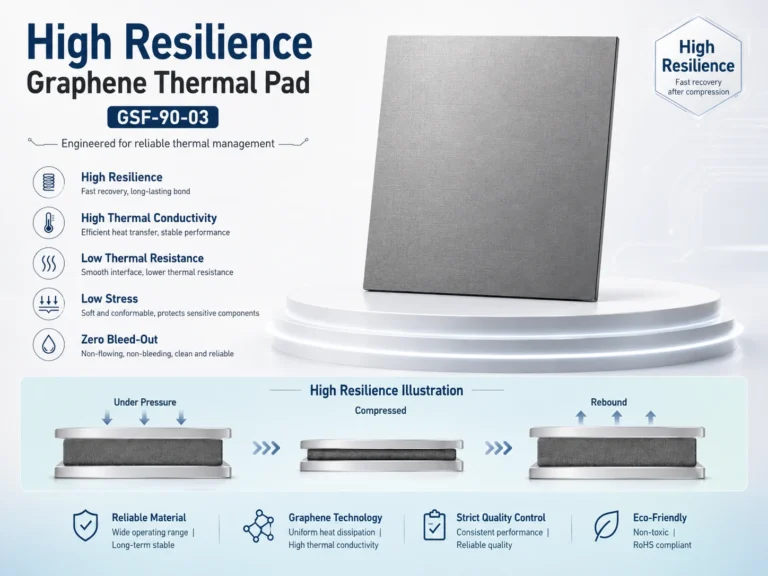
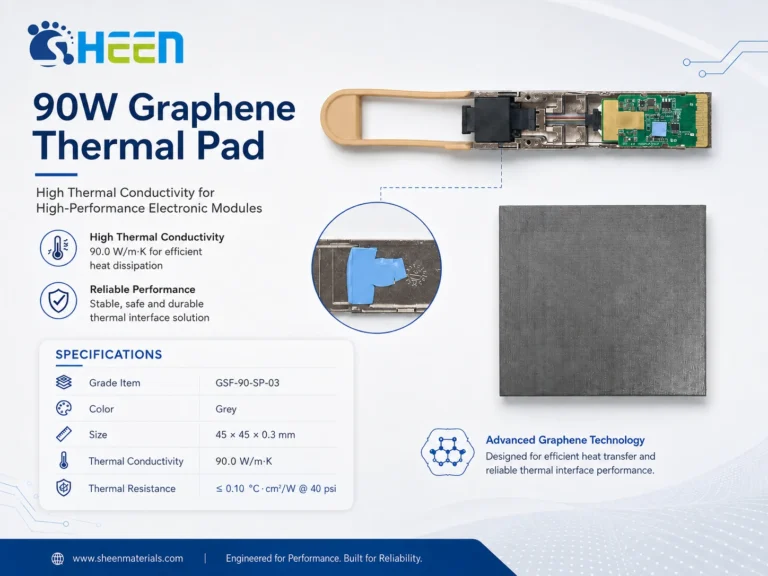
A Nicht-Silikon-Wärmeleitpad made from graphite relies on layered carbon Blätter. The big win? High conductivity along the plane.
Key traits:
- Anisotropic Wärmestrom
- Ultra-thin profile
- Naturally flexible
In LED panels and telecom boards, a graphite-based Material der thermischen Schnittstelle spreads heat sideways fast. That’s heat dissipation done smart.
Still, it needs pairing with insulation layers since graphite conducts electricity. For tight stacks where height matters, this non-silicone thermal pad type keeps things slim and efficient.
Bornitrid–Reinforced Elastomer Pads
Diese Nicht-Silikon-Wärmeleitpad mixes Bornitrid into a soft elastomer.
- Core Structure 1.1 Base Layer
- Soft, conformable elastomer
- Handles surface gaps
1.2 Reinforcement

Boron nitride particles
Raise thermal management capacity- Performance Benefits
- Stark electrical isolation
- Stable at high temperatures
- Maintains compression set
- Use Cases
- EV battery controllers
- Motor drives
- Power conversion units
Because the pad is soft, it hugs uneven chips. That reduces air gaps. Less air, better heat flow. Sheen Technology often fine-tunes particle loading to balance softness with strength.
Acrylic with Fiberglass Reinforcement
An acrylic-based Nicht-Silikon-Wärmeleitpad reinforced by Fiberglas focuses on structure.
- Material Framework 1.1 Acrylic Binder
- Gut adhesive traits
- Stabil Durchschlagsfestigkeit
1.2 Fiberglass Mesh

Adds mechanical stability

   Controls thickness
- Performance Characteristics
- Einheitlich Wärmebeständigkeit
- Strong electrical barrier
- Zuverlässig Konformität
- Typical Installations
- Voltage regulators
- Consumer PCB stacks
- Compact power boards
This type of thermal pad works when engineers want predictable thickness and firm handling. In the world of non-silicone thermal pad materials, it’s the steady, no-drama option—clean processing, solid insulation, and dependable heat control.
3 Key Attributes of Non-Silicone Thermal Pads
Non-Silicone Thermal Pad materials are getting serious attention in electronics cooling. When heat rises, and space gets tight, you need smart thermal management. From thermal pad performance to insulation safety, here’s what really counts in a non-silicone thermal solution.
Thermal Conductivity for Optimal Heat Dissipation
A Nicht-Silikon-Wärmeleitpad works as a Material der thermischen Schnittstelle that pushes Wärmestrom away from chips and into the Wärmesenke. Its job sounds simple, yet the physics behind Wärmeübertragung und Wärmebeständigkeit can make or break device life.
- Core thermal metrics
- Thermal conductivity (W/mK) defines how fast heat moves across the pad.
- Lower thermal resistance means less blockage between the processor and the cooler.
- A stable Temperaturgefälle prevents hotspots and throttling.
- Performance comparison snapshot
| Material Typ | Thermal Conductivity (W/mK) | Wärmewiderstand (°C-cm²/W) | Typical Thickness (mm) | Operating Temp (°C) |
|---|---|---|---|---|
| Standard-Silikonkissen | 3.0 | 0.45 | 1.0 | -40 bis 180 |
| Nicht-Silikon-Wärmeleitpad | 6.0 | 0.28 | 1.0 | -40 bis 150 |
| High-End Non Silicone Pad | 8.5 | 0.20 | 0.5 | -40 bis 150 |
| Thermisches Schmierfett | 4.0 | 0.35 | 0.1 | -50 bis 200 |
| Phase Change Material | 5.5 | 0.30 | 0.2 | -20 to 130 |
- System impact
- Lower junction temperature
- Better long-term Wärmeleistung
- Improved device reliability
A well-designed Non-Silicone Thermal Pad keeps processors cool without messy pump-out issues.
Compressibility and Thickness for Gap Filling
Every PCB stack-up has tiny height differences. A Nicht-Silikon-Wärmeleitpad acts as a smart Lückenfüller, adjusting through controlled Komprimierbarkeit und deflection.
- Mechanical adaptation
- Hoch Konformität absorbs surface variation caused by surface roughness.
- Ausgewogene Elastizität maintains steady contact under mounting pressure.
- Verwaltet Dicke der Verbindungslinie keeps heat paths short.
- Structural balance
- Too soft: excessive squeeze-out and unstable Compliance.
- Too hard: poor contact, rising interface resistance.
- Application logic
- Measure gap distance.
- Select the correct thickness.
- Confirm compression ratio (often 20–40%).
This is where a thermal pad without silicone really shines. It fills space cleanly, avoids oil bleed, and protects delicate memory modules from stress.
Dielectric Strength and Electrical Insulation
Heat control is only half the story. A Non-Silicone Thermal Pad must also prevent short circuits through strong electrical isolation.
- Electrical protection layer
- Hoch Durchschlagsfestigkeit resists dielektrischer Durchschlag unter hohem voltage.
- Stark Isolationswiderstand Grenzen Ableitstrom.
- A stable Dielektrizitätskonstante supports predictable behavior in compact layouts.
- Safety performance
- Maintains spacing between conductive traces.
- Reduces the risk of arc faults.
- Meets safety expectations in telecom and medical hardware.
- Material advantage
- Non-conductive filler system
- Silicone-free chemistry
- Clean processing profile
In tight electronic assemblies, a non-silicone thermal pad isn’t just about cooling. It quietly guards circuits, keeping power and signal lines safely separated while heat keeps moving out.
Non-Silicone Thermal Pad Vs. Silicone Alternatives
Thermal management is no small thing in today’s tight, high-power devices. From EV control units to LED modules, heat builds up fast. That’s why picking the right Nicht-Silikon-Wärmeleitpad or silicone-based option matters. Let’s break down how Non-Silicone, Thermal Pad materials, and silicone elastomer pads really stack up.
Nicht-Silikon-Wärmeleitpad
A Nicht-Silikon-Wärmeleitpad is built for clean performance where contamination just isn’t acceptable. The idea sounds simple, but the material science behind a non-silicone thermal interface pad gets detailed.
- Material Core Options
- Graphit
- High in-plane conductivity
- Naturally low siloxane content
- Ceramic
- Stark Elektrische Isolierung
- Stable under pressure cycling
- Polymer matrix blends
- Erweitert Konformität
- Tuned with Phase change material
- Graphit
- Performance Drivers
- Hohe Wärmeleitfähigkeit
- Moves heat fast from the IC to the heat sink
- Geringe Ausgasung
- Protects optical lenses and sensors
- Structural stability
- Reduced pump-out risk compared to soft gels
- Hohe Wärmeleitfähigkeit
- Application Logic
- Automotive ECUs
- Industrial power modules
- Optical assemblies requiring contamination control
Ein gut durchdachtes Nicht-Silikon-Wärmeleitpad keeps surfaces clean, especially in sealed systems. MarketsandMarkets noted in a 2025 thermal interface materials update:
“Low-outgassing, non-silicone thermal interface solutions are gaining share in automotive electronics due to rising reliability standards.”
That shift is real. Sheen Technology develops Nicht-Silikon-Wärmeleitpad solutions that balance Hohe Wärmeleitfähigkeit with tight cleanliness specs, so your Thermal Pad choice doesn’t come back to haunt you.
Silicone Alternative Pads
Silicone-based pads, usually built on Silikon-Elastomer, still dominate many designs.
- Core Characteristics
- Breit Thermal stability range
- Hoch Komprimierbarkeit
- Stark Durchschlagsfestigkeit
- Materialzusammensetzung
- Base elastomer
- Leitfähig Filler particles
- Additives to manage softness
- Operational Risks
- Oil bleeding
- Can migrate onto PCB surfaces
- Abpump-Effekt
- Under vibration or thermal cycling
- Long-term drift in interface thickness
- Oil bleeding
Silicone pads are flexible and easy to handle. For low-pressure assemblies, that flexibility helps a lot. Still, in high-reliability builds, engineers often compare them directly with a Nicht-Silikon-Wärmeleitpad or other non-silicone thermal pad designs to avoid contamination issues.
In practice, the choice comes down to environment, lifetime goals, and cleanliness tolerance. Sheen Technology supports both paths, but when low outgassing and stability matter most, a carefully engineered Nicht-Silikon-Wärmeleitpad usually wins the argument.
Can Non-Silicone Pads Withstand High Temps?
When gear runs hot, the heat interface can make or break the system. A Nicht-Silikon-Wärmeleitpad sounds simple, yet its real test comes under sustained load and rising temperatures. Let’s break down how a non-silicone thermal pad handles 200 °C, pressure, and long service life without falling apart.
Operating Temperature Range to 200 °C
A Nicht-Silikon-Wärmeleitpad built for 200 °C must balance Wärmestabilität with real-world Wärmebeständigkeit. The trick isn’t just surviving peak heat; it’s staying reliable across cycles.
- Material system design
- Polymer-Matrix
- Controls maximum operating temperature
- Slows Materialverschlechterung
- Keramische Füllstoffe
- Improve high-temperature performance
- Enhance Temperaturwechselbeanspruchung endurance
- Polymer-Matrix
- Temperature limit validation
- Continuous exposure testing
- Confirms safe Temperaturgrenzwerte at 180–200 °C
- Intermittent overload checks
- Measures recovery after spikes
- Continuous exposure testing
- Application match
- Power modules
- Automotive heat sinks
- Industrial drives
Sheen Technology engineers each Non-Silicone Thermal Pad to stay stable under repeated heating and cooling. That consistency keeps chips protected instead of cooking over time.
Shore Hardness Stability Under Heat
Heat can soften weak pads. A solid thermal pad with a non-silicone formula keeps its durometer value steady, even after long heat exposure.
- Mechanical stability control
- Base resin selection
- Unterstützt material stiffness retention
- Filler distribution
- Protects overall Materialintegrität
- Base resin selection
- Thermal aging resistance
- Extended oven aging
- Tracks Wärmealterung Verhalten
- Compression testing
- Limits compression set
- Extended oven aging
- Elastic response
- Unterhält elasticity retention
- Prevents pump-out under vibration
The result? A Non-Silicone Thermal Pad that keeps pressure balanced across the interface. Sheen Technology focuses on this stability, so the pad doesn’t thin out or crack when the system gets seriously hot.
Long-Term Thermal Impedance Performance
High heat is one thing. Holding low Wärmebeständigkeit year after year is another story.
- Initial interface quality
- Surface wet-out
- Reduziert interface resistance
- Optimized thickness
- Verbessert heat transfer efficiency
- Surface wet-out
- Aging behavior
- Monitored material aging effects
- Tracks shifts in Wärmeleitfähigkeit
- Cyclic load simulation
- Measures Leistungsverschlechterung
- Monitored material aging effects
- Sustained operation
- Stabil langfristige Zuverlässigkeit
- Consistent, sustained thermal performance
A well-designed Non-Silicone Thermal Pad keeps thermal impedance low instead of creeping upward with time. That means cooler processors, longer component life, and fewer surprise failures. For demanding electronics, Sheen Technology delivers non-silicone thermal pad solutions that stay cool even when everything else heats up.
Scenario-Based: Automotive Electronics Cooling
Automotive electronics work hard and run hot. From electronic control units to power boards, heat builds up fast. Smart cooling with a Nicht-Silikon-Wärmeleitpad, smart layout, and stable materials keeps cars running smoothly, even on long, hot drives.
Power Transistors Heat Dissipation in ECUs
In modern Automobilelektronik, Leistungstransistoren inside electronic control units handle high switching loads. That means serious Wärmeabfuhr challenges.
- Heat Flow Path Optimization 1.1 Source
- Hoch Sperrschichttemperatur forms at the transistor die.
- Rising Wärmebeständigkeit reduces efficiency.
1.2 Interface
   A Non-Silicone Thermal Pad bridges the gap to the heat sink.
   Stable **thermal conductivity ensures consistent transfer.
1.3 Sink
Aluminum housing spreads heat outward.- Why Non-Silicone Matters
- 2.1 Oil bleed risks drop to near zero.
- 2.2 Cleaner surfaces protect solder joints.
- 2.3 Long-term reliability improves under vibration.
A well-matched non-silicone thermal pad keeps the temperature curve steady. With the right thermal pad, ECU lifespan climbs, and failure rates shrink. Sheen Technology fine-tunes each Nicht-Silikon-Wärmeleitpad for tight automotive specs, keeping performance steady mile after mile.
Voltage Regulator Thermal Management
Hoch Leistungsdichte makes voltage regulators sensitive to poor Wärmeübertragung.
- Core Thermal Control Logic 1.1 Heat Generation
- Conversion losses raise local temperature.
- A Nicht-Silikon-Wärmeleitpad acts as the primary Material der thermischen Schnittstelle.
- Ausgewogene Temperaturkontrolle supports stable automotive power output.
- Material Selection Focus 2.1 Non-silicone materials resist pump-out.2.2 Consistent compression lowers interface gaps.2.3 Electrical insulation protects PCB traces.
A silicone-free thermal pad keeps regulators cool without contamination risk. In compact layouts, that small detail makes a big difference.
Gap Filler Solutions for Automotive Heat Sinks
Tolerance stack-up is real in Wärmesenken and PCB assemblies. Gaps vary. Surfaces aren’t perfect.
- Gap Management Strategy 1.1 Mechanical Fit
- Custom die-cut Lückenbüßer absorb height variation.
- A Nicht-Silikon-Wärmeleitpad boosts heat transfer efficiency.
- Reduced stress improves Bauteilzuverlässigkeit.
- Application Layers 2.1 Between MOSFETs and housing.2.2 Between regulators and aluminum frames.2.3 Across multi-device modules.
A high-quality non-silicone gap filler handles vibration, heat cycling, and pressure changes without drama. Sheen Technology supplies automotive-grade thermal interface options tailored for real-world automotive cooling, keeping systems cool, clean, and ready for the long haul.
Häufig gestellte Fragen zu Nicht-Silikon-Wärmeleitpads
What makes the Non-Silicone Thermal Pad suitable for sensitive electronics?
In Automotive electronics, Telecommunications equipment, and Medical devices, contamination control is critical. A Non-Silicone Thermal Pad built on a polymer matrix with ceramic fillers oder Bornitrid avoids siloxane migration near integrated circuits und Mikroprozessoren.
1. Maintains high Durchschlagsfestigkeit for electrical insulation.
2. Stable Betriebstemperaturbereich up to 200 °C.
3. Controlled Wärmeimpedanz for steady heat dissipation.
4. Supports junction temperature reduction in Leistungstransistoren und Wärmesenken.
The result: cleaner assemblies and longer reliability improvement across printed circuit boards.
How do material choices affect thermal performance?
Material composition shapes thermal management outcomes:
1. Polymer matrix + ceramic fillers → balanced thermal conductivity and compressibility for gap filler use.
2. Graphit → high in-plane thermal conductivity, ideal for LED lighting modules.
3. Boron nitride elastomer → electrical insulation with stress relief under cycling.
4. Acrylic with fiberglass reinforcement → dimensional stability for consumer electronics.
Each option tunes thickness, Shore hardness, and heat dissipation based on interface needs.
Where are Non-Silicone Thermal Pads most commonly applied?
Across industries, performance goals differ, but the interface challenge is similar—move heat, protect components.
1. Power electronics → between power transistors and heat sinks.
2. Automotive electronics → inside ECUs and industrial control systems.
3. Consumer electronics → over memory chips and voltage regulators.
4. LED lighting → sheet material lining aluminum housings.
In every case, thermal management drives lifetime extension.
How can buyers verify quality before a bulk purchase?
Serious suppliers provide transparent documentation:
1. UL certification records;
2. RoHS compliance and REACH compliance statements;
3. Halogen-free declarations;
4. Technical data sheet detailing thermal conductivity, thickness, and Shore hardness;
5. Material safety data sheet for safe handling.
Clear quality control builds trust before large-scale orders.
What customization options are available for large projects?
Nicht-Silikon-Wärmeleitpad formats adapt to real assembly lines.
| Product Form | Interface Focus | Performance Objective |
|---|---|---|
| Die-cut pads | Integrated circuits | Precise heat dissipation |
| Rollenware | Printed circuit boards | Flexible thickness control |
| Kleberückseite | Heat sinks | Fast installation, stress relief |
| Custom geometries | Irregular enclosures | Reliable gap filler contact |
Tailored shapes and pre-cut designs reduce assembly time while keeping thermal conductivity and compressibility aligned with demanding applications.