-
ADD: Gebäude 2, Nr. 8 Hengzhutang Road, Dongguan
-
Telefon: +86 135 4224 3751

How Custom Boron Nitride Thermal Solutions Fix Complex Heat Loads
Heat is killing performance, and Custom boron nitride thermal conductive solutions are stepping in where standard materials can’t keep up with today’s dense, high-power electronics.
Off-the-shelf fixes look fine on paper, but real systems run hot, uneven, and stubborn, pushing engineers to hunt for materials that match the job.
In 2025 briefs, Glänzende Materialien engineers point to tailored BN geometries and controlled interfaces as paths to stable heat flow and longer component life.
Quick Insights on Custom Boron Nitride Thermal Conductive Solutions
-> Heat Transfer Mastery: Leverage hexagonal and pyrolytic BN composites to achieve high thermal conductivity, low expansion, and uniform heat flow in complex geometries.
-> Performance & Reliability: Deploy tailored BN-based thermal interface materials with superior dielectric strength and temperature stability for power electronics and microprocessors.
-> Vielseitigkeit der Anwendung: Utilize BN films, powders, and nanotubes via CVD, sintering, and additive manufacturing to meet scalability, long-term stability, and quality control in integrated circuits and LED substrates.
Why Custom Boron Nitride Thermal Conductive Solutions Matter
Heat keeps getting tougher to manage as devices shrink and power density climbs. That’s where Custom boron nitride thermal conductive solutions step in. By blending tailored boron nitride composites, smart geometry, and precise interface design, engineers can handle serious thermal challenges without sacrificing insulation or reliability.
Solving Complex Heat Transfer Challenges with Boron Nitride Composites
Complex Wärmeübertragung paths demand more than off-the-shelf fillers. Custom boron nitride thermal conductive solutions break the problem into layers:
- Material purity
- Filler orientation
- Interface bonding
- Define heat flux zones
- Match anisotropic high thermal conductivity
- Optimize thickness for stable Wärmemanagement
Inside modern modules:
- Core layer
- Aligned boron nitride composites
- Controlled porosity
- Interface layer
- Surface-treated particles
- Reduced contact resistance
Diese advanced materials maintain electrical insulation while boosting Wärmeabfuhr. That balance is the whole game.
Performance Snapshot
| Material Typ | Wärmeleitfähigkeit (W/m-K) | Durchschlagfestigkeit (kV/mm) | Density (g/cm³) |
|---|---|---|---|
| Standard BN Filler | 3-5 | 15 | 2.1 |
| Oriented BN Composite | 10–18 | 18 | 2.0 |
| Sintered BN Plate | 25–60 | 20 | 2.2 |
| Polymer-BN TIM | 6–12 | 16 | 1.9 |
| Ceramic-BN Hybrid | 15–30 | 19 | 2.3 |
That’s why Custom boron nitride thermal conductive solutions are gaining traction across demanding builds.
Enhancing Power Electronics Reliability via Customized Thermal Interface Materials
Unter Leistungselektronik, heat spikes fast. A weak interface means early failure of elektronische Komponenten.
Here’s how tailored thermische Grenzflächenmaterialien work:
- Reduce voids
- Increase surface wetting
- Stabilize dielectric behavior
Inside high-voltage stacks:
- Substrate
- BN-enhanced interface
- Heat spreader
Each layer supports Gerätezuverlässigkeit und langfristig Wärmemanagement. Short bursts. Heavy loads. No drama.
“Advanced thermal interface materials are becoming critical as EV and power module densities rise beyond 30% over previous generations,” notes a 2025 Yole Group power electronics report.
Custom boron nitride thermal conductive solutions answer that demand with consistent Wärmeabfuhr under stress. Brands like Glänzende Materialien refine particle morphology and dispersion so customized solutions actually perform, not just look good on spec sheets.
Meeting Long-term Stability Demands in Microprocessors with Tailored BN Designs
Für Mikroprozessoren and dense semiconductor devices, it’s about staying cool year after year.
- Low thermal expansion
- Stabil Temperaturwechselbeanspruchung Verhalten
- Controlled interface aging
Within package design:
- Die level
- Thin BN layer
- Lid level
- High-conductivity spreader
- System-Ebene
- Optimized airflow
That layered logic supports langfristige Stabilität und beständig Leistungsoptimierung.
Custom boron nitride thermal conductive solutions don’t just move heat—they manage it intelligently. And with engineered boron nitride designs, companies like Glänzende Materialien help systems run cooler, longer, and with fewer surprises.
4 Key Parameters That Define Thermal Conductivity
Efficient heat control is not just lab talk; it keeps chips alive and power systems stable. When engineers look for Custom boron nitride thermal conductive solutions, they are really balancing heat flow, insulation, and durability. Here’s how each parameter shapes real-world performance.
Thermal Conductivity: Hexagonal Boron Nitride’s Role in Efficient Heat Transfer
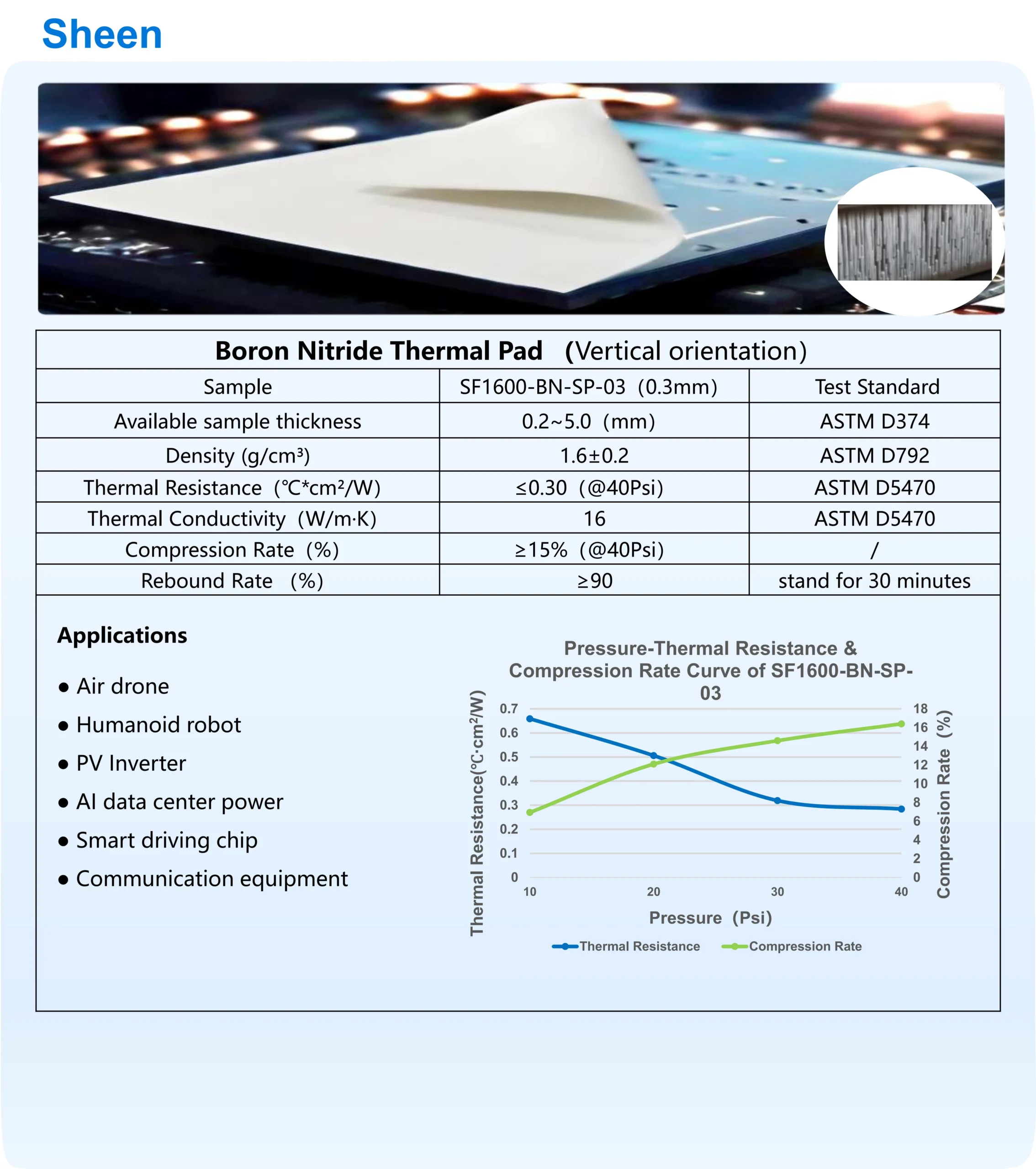
Custom boron nitride thermal conductive solutions often start with hexagonal boron nitride (hBN) because its layered structure drives strong in-plane Wärmeleitfähigkeit and fast Wärmeübertragung.
- Key material traits
- High in-plane heat flow
- Low dielectric constant
- Strong chemical stability
- Crystal alignment
- Phonon transport efficiency
- Interface contact resistance
Performance Snapshot of hBN
| Eigentum | Typical Value | Impact on Thermal Management |
|---|---|---|
| In-plane thermal conductivity | 200–400 W/m·K | Rapid lateral heat spreading |
| Through-plane conductivity | 2–30 W/m·K | Controlled vertical transfer |
| Dielectric constant | ~3–4 | Stable insulation |
| Dichte | ~2.1 g/cm³ | Lightweight substrates |
| Max operating temp (air) | ~900°C | High reliability |
In real material science practice, heat rarely moves in just one direction.
It flows across layers, through fillers, into heat sinks.
That’s why Custom boron nitride thermal conductive solutions tune:
- ➤ Filler orientation
- ➤ Particle size distribution
- ➤ Interface bonding
Sheen Materials works closely with device designers to adjust hBN loading levels so Wärmeabfuhr improves without hurting mechanical strength. It’s practical engineering, not theory.
Thermal Resistance: Leveraging Pyrolytic Boron Nitride for Low Coefficient of Thermal Expansion
Pyrolytic boron nitride (PBN) brings extremely low Wärmebeständigkeit along preferred directions and a carefully controlled CTE.
When building Custom boron nitride thermally conductive solutions, thermal expansion mismatch can quietly ruin performance. Chips expand. Substrates resist. Stress builds.
A closer look:
- Material Properties
- Highly anisotropic structure
- Ultra-low impurity levels
- Stable under repeated heat cycles
- Funktionale Auswirkungen
- Reduced interfacial stress
- Verbessert Wärmestrom uniformity
- Longer module lifetime
Multi-layer packaging often follows this path:
- Base substrate selection
- CTE matching with PBN
- Thermal interface optimization
- Reliability testing under cycling
Short bursts of heat are manageable.
Repeated expansion is the real enemy.
With Custom boron nitride thermal conductive solutions, PBN minimizes deformation and keeps alignment tight. Sheen Materials fine-tunes thickness tolerances to match specific packaging stacks.
Dielectric Strength: Balancing Electrical Insulation and Thermal Dissipation
Hoch Durchschlagsfestigkeit means strong elektrische Isolierung without sacrificing thermal dissipation. That balance defines next-generation power modules.
Für Custom boron nitride thermal conductive solutions, insulation and heat removal must coexist. No shortcuts.
Core electrical metrics include:
- Durchschlagsspannung
- Durchgangswiderstand
- Partial discharge resistance
Nested performance logic:
- Electrical Properties
- High breakdown threshold
- Stable under high frequency
- Thermal Pathways
- Continuous ceramic network
- Reduced thermal bottlenecks
- Device Outcome
- Safer operation
- Besser heat removal in compact elektronische Geräte
Thin insulation layers sound good on paper.
But if heat cannot escape, efficiency drops fast.
That’s where boron nitride thermal management materials stand out. They keep current contained while letting heat move freely.
High Temperature Stability: Cubic Boron Nitride under Extreme Operating Conditions
Cubic boron nitride (cBN) is known as a superhard material, yet its Wärmestabilität under high temperature is just as impressive.
Extreme environments demand:
- Mechanische Festigkeit
- Structural integrity
- Einheitlich material performance
Under harsh Betriebsumgebung conditions:
- Temperature climbs above 1000°C
- Mechanical stress increases
- Oxidation risks grow
cBN resists deformation and maintains meaningful Wärmeleitfähigkeit even in these scenarios.
In demanding aerospace or heavy industrial systems, Custom boron nitride thermal conductive solutions built with cBN maintain shape, insulation, and thermal pathways when many ceramics fail.
Short sentence. It holds up.
Across hBN, PBN, and cBN platforms, Custom boron nitride thermal conductive solutions combine heat control, electrical safety, and endurance. That’s the engineering mindset Sheen Materials brings to advanced thermal management—steady performance, no drama.
Multi-Chip Arrays: Custom BN Solutions Shine
Multi-chip arrays push heat to the limit. When power density climbs, Custom boron nitride thermal conductive solutions keep things steady, cool, and reliable. From integrated circuits to semiconductor devices, smart Wärmemanagement isn’t optional anymore—it’s survival.
Integrated Circuits — BN Films for Uniform Thermal Management
In dense microelectronics, heat builds fast. BN films produced through CVD are engineered for precise Wärmeabfuhr and electrical insulation.
- Core objective: maintain uniform temperature across stacked integrated circuits
- Key material: high-purity BN thin films
- Outcome: stable elektronische Geräte under heavy loads
- Film deposition control
- Layer thickness tuning
- Interface adhesion optimization
At scale, Custom boron nitride thermal conductive solutions align film conductivity with chip architecture. The logic flows like this:
- Material Design
- Crystal orientation control
- Dielectric strength calibration
- Thermal Path Engineering
- Interface resistance reduction
- Cross-plane conductivity balancing
- Reliability Validation
- Thermal cycling
- Power surge simulation
| Parameter | Standard IC | BN Film IC | Improvement |
|---|---|---|---|
| Wärmeleitfähigkeit (W/m-K) | 1.5 | 8.5 | +466% |
| Junction Temp (°C) | 105 | 82 | -22% |
| Durchschlagfestigkeit (kV/mm) | 15 | 35 | +133% |
That’s why teams looking for custom BN thermal solutions often turn to Sheen Materials for consistent film quality and scalable output.
LED Substrates and Boron Nitride Powders in Volume Production
High-power LED substrates run hot. Real hot. So the trick is pairing boron nitride powders with tight process control.
- Hot pressing improves density
- Sintering boosts Wärmeleitfähigkeit
- Quality checks lock in repeatability
Production rhythm matters:
- Powder purity screening
- Controlled particle grading
- Pressing under calibrated pressure
- Sinter stabilization
The result? Reliable thermische Schnittstelle performance across thousands of units. In volume production, even tiny conductivity shifts change lumen stability.
According to a 2025 IDC materials outlook:
“Thermal management materials with stable conductivity above 5 W/m·K are now considered baseline for next-generation high-power LEDs.”
That benchmark aligns perfectly with Custom boron nitride thermal conductive solutions, where boron nitride thermal conductive fillers are tailored for cost control and output consistency. Sheen Materials supports manufacturers balancing scale with performance—no drama, just steady numbers.
Semiconductor Devices: Scalable Additive Manufacturing of BN Nanotubes
Next-gen semiconductor devices demand lighter, stronger, cooler builds. Enter BN nanotubes shaped through additive manufacturing.
Das läuft folgendermaßen ab:
- Material Preparation
- Nanotube dispersion stability
- Binder compatibility
- Layer-by-Layer Structuring
- Precision deposition
- Controlled porosity
- Post-Processing
- Thermal curing
- Mechanical reinforcement
Benefits stack up quickly:
- Faster Wärmeübertragung
- Higher mechanical strength
- Improved lifespan of elektronische Komponenten
Custom BN material solutions allow scalable production without losing nano-level control. That balance—between nanotechnology precision and factory-level throughput—is what makes Custom boron nitride thermal conductive solutions a serious edge in modern chip packaging.
When thermal pressure rises, smart material design keeps everything cool—and competitive.