-
ADD: Building 2, No. 8 Hengzhutang Road, Dongguan
-
Phone: +86 135 4224 3751

Analysis of the Prospects for Boron Nitride Thermal Interface Materials
The significance of boron nitride thermally conductive interface materials
As a technology R&D engineer, I’m reluctant to exaggerate the value of the products we’re developing. But to be frank, high-thermal-conductivity boron nitride interface materials do indeed have strategic significance.
Although thermally conductive materials are not the main focus of the semiconductor industry, boron nitride thermal interface materials are indeed very important.
Whether a semiconductor chip can operate stably for a long time depends on the heat dissipation system’s ability to transfer heat efficiently, and the interface is the most vulnerable part of that system.
The thermal resistance of the interface material accounts for 35%-60% of the total thermal resistance of the entire heat dissipation system. For example, the best diamond-copper composite material (used in the heat dissipation system of NVIDIA’s Rubin Platform) can reduce the chip temperature, meaning that all the heat can be immediately dissipated.
However, when the heat is transferred to the interface material, the thermal resistance drops immediately. The thermal conductivity of diamond-copper and the heat sink is in the hundreds, even exceeding 1000, but the thermal conductivity of the interface material is only in the single digits. The performance of the interface material determines the upper limit of the efficiency of the heat dissipation system.
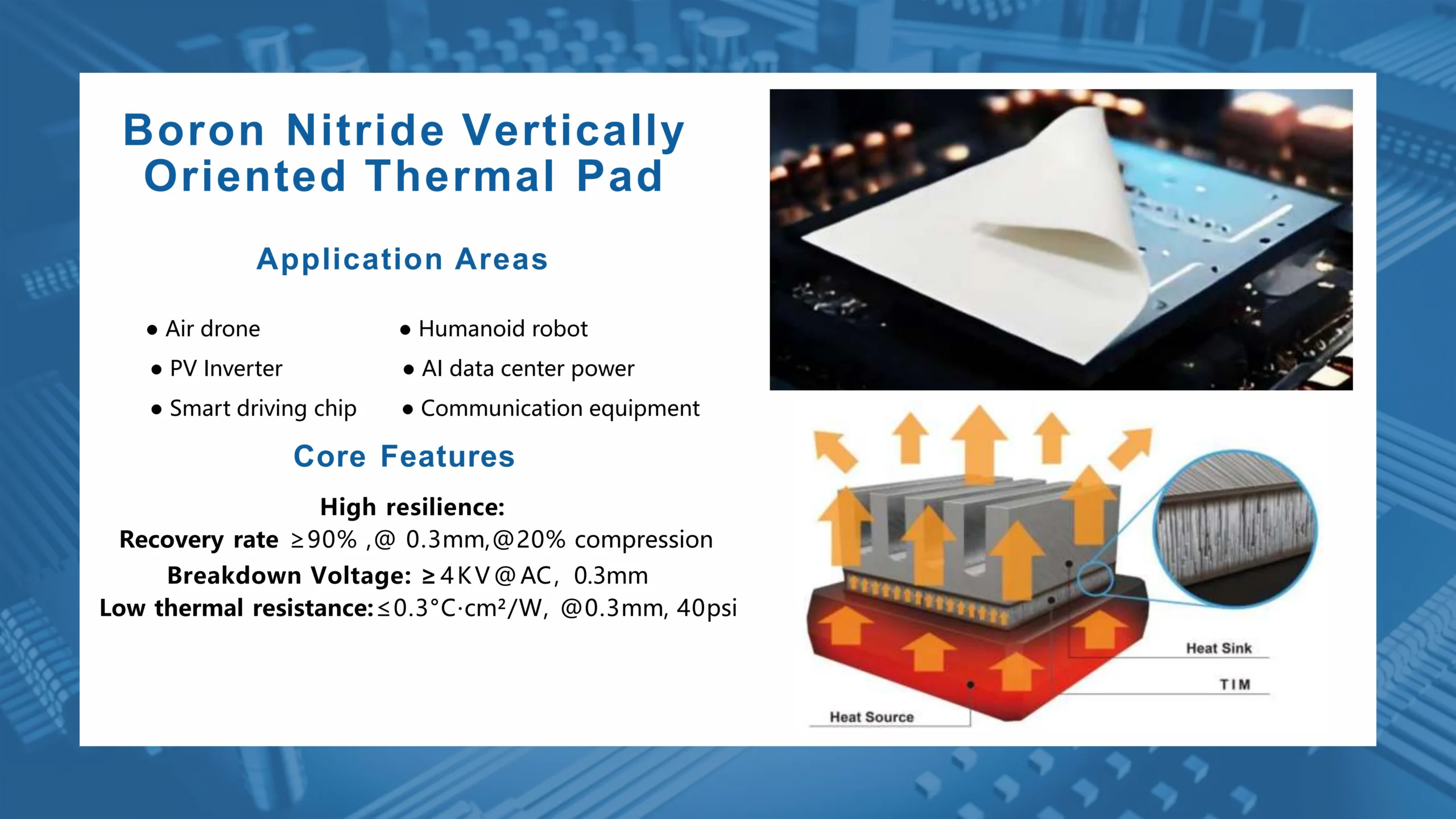
While current thermal interface materials can still meet the needs of the semiconductor industry, the cost is more complex heat dissipation systems to compensate for the inefficiency of these materials. For example, larger heat sinks and higher fan speeds mean that both hardware and operating costs are at the expense of the limitations of thermal interface materials. Reducing the thermal resistance of the thermal interface material by 10% could improve the efficiency of the entire heat dissipation system by 10%, resulting in an immediate and significant improvement.
One of our partners, a telecommunications company, found that replacing the boron nitride thermal interface material with 6W thermal gel in their tests resulted in an 8°C drop in chip temperature. Furthermore, modifying the hardware design to better suit the pads would have yielded even better cooling. In application testing on a packaging and testing platform, the effect was comparable to, if not more expensive than, carbon fiber thermal conductive materials.
This alternative not only significantly reduces material costs but also simplifies assembly processes and improves production efficiency. With increasingly stringent heat dissipation requirements in fields such as 5G base stations and high-performance computing, high thermal conductivity interface materials will become an industry necessity. In the future, optimizing filler structure and interfacial wettability to further overcome thermal resistance bottlenecks will be the core direction of materials research and development. This will not only alleviate the size and noise pressures of heat dissipation systems but also improve the stability and lifespan of electronic devices from the source, providing crucial support for the continued miniaturization and high performance of the semiconductor industry.
In the intricate “heat game” of the semiconductor industry, thermal interface materials, though seemingly caught in the middle, are precisely the “last mile” that determines the success or failure of a system.
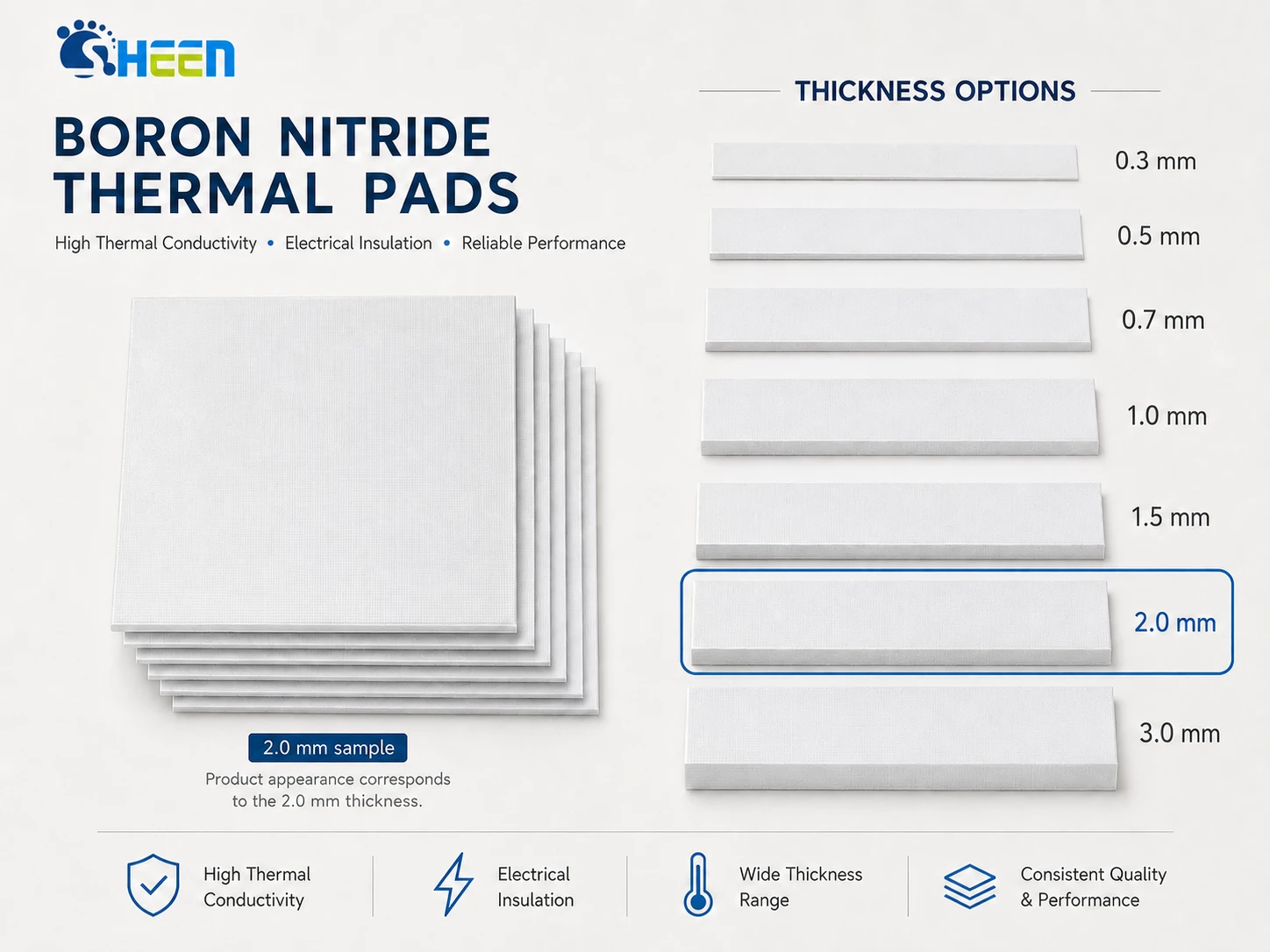
In addition to its excellent thermal conductivity, boron nitride thermal conductive materials also possess a comprehensive range of advantages, including oil impermeability, pump-out resistance, high heat resistance, high insulation, low dielectric constant, low density, no powder shedding, and prevention of thermal crosstalk. Furthermore, boron nitride thermal conductive materials can be customized in terms of performance, offering options for high viscosity, insertion and removal resistance, and custom thickness; Sheen Materials’ boron nitride thermal conductive materials can achieve a minimum thickness of 0.3mm.
What’s even more remarkable is that, despite these outstanding performance advantages, boron nitride thermal conductive materials remain cost-competitive. By optimizing raw material ratios and production processes, we have maintained a stable thermal conductivity of 16 W/m·K while controlling unit costs to approximately 70% of traditional high-end thermal conductive gels. This means that customers can achieve superior heat dissipation while also realizing significant cost reduction and efficiency gains.
Currently, this material has passed reliability verification by several leading communication equipment manufacturers, demonstrating stable thermal conductivity and insulation properties under harsh environments such as high temperature and humidity, and low-temperature impact, fully meeting the long-term service requirements of outdoor equipment such as 5G base stations.
In scenarios such as 5G base stations, data centers, and new energy vehicles, boron nitride thermal conductive materials are transforming from “optional” to “essential.” They are no longer just performance benchmarks in laboratories, but have truly entered the production line, becoming the “standard answer” for engineers to solve heat dissipation anxieties. Our SF1600 series boron nitride thermal conductive materials are redefining the industry’s understanding of thermal interface materials with their dual advantages of “high cost-effectiveness + full-scenario adaptability.”
The above content reflects only the author’s personal views and does not represent the position or opinion of the company.