-
ADD: Building 2, No. 8 Hengzhutang Road, Dongguan
-
Phone: +86 135 4224 3751

Silicone-Free Phase Change Thermal Conductive Material vs. Traditional TIMs
Heat failure kills uptime fast, and Silicone-free phase change thermal conductive material steps in where greasy pads fall short, cutting mess, drift, and costly breakdowns.
Sheen Materials engineers note in 2025 briefs that phase change interfaces stabilize resistance after cycling and prevent silicone migration across sensitive assemblies.
Pick the wrong TIM, and you pay in rework, downtime, and warranty hits; pick the right systems run.
Harmonic Highlights: Silicone-Free Phase Change Thermal Conductive Material
→ Core Composition: Combines paraffin wax, polymer matrix, and ceramic or graphite fillers to balance thermal conductivity and structural integrity during phase transitions.
→ Performance Advantages: Delivers low outgassing, stable thermal resistance after cycling, strong adhesion, and RoHS compliance—eliminating silicone migration and pump-out issues.
→ Integration Tips: Choose the right form factor (pads, films, gels), verify compliance (dielectric strength, halogen-free), and optimize application via surface preparation and controlled dispensing for consistent heat spreading.
| Model | Color | Thermal Conductivity | Thermal Impedance (1 mm, @30 psi) | Thickness | Standard Hardness | Selection Note |
|---|---|---|---|---|---|---|
| AF100 | White | 1.0 W/m·K | 1.1 ℃·in²/W | 0.25 ~ 5.0 mm | 50 / 70 ± 5 Shore 00 | Entry-grade option for general low thermal loading and silicone-sensitive assemblies. |
| AF300 | White | 2.0 W/m·K | 0.8 ℃·in²/W | 0.25 ~ 5.0 mm | 50 / 70 ± 5 Shore 00 | Moderate step-up for more demanding insulated gap-filling applications. |
| AF500 | White | 3.0 W/m·K | 0.6 ℃·in²/W | 0.25 ~ 5.0 mm | 50 / 70 ± 5 Shore 00 | Balanced choice for broader use across industrial, storage, and communication equipment. |
| AF600 | White | 5.0 W/m·K | 0.3 ℃·in²/W | 0.5 ~ 5.0 mm | 50 / 70 ± 5 Shore 00 | Higher-performance option for tighter thermal targets with insulation requirements. |
| AF600G | White | 6.0 W/m·K | 0.25 ℃·in²/W | 0.5 ~ 5.0 mm | 50 / 70 ± 5 Shore 00 | High-performance series member for more demanding communication and AI hardware. |
| AF800 | White | 8.0 W/m·K | 0.2 ℃·in²/W | 0.5 ~ 5.0 mm | 50 / 70 ± 5 Shore 00 | Top public-performance grade on the current series page for advanced thermal interface requirements. |
What Is Phase Change Thermal Conductive Material?
Introduction
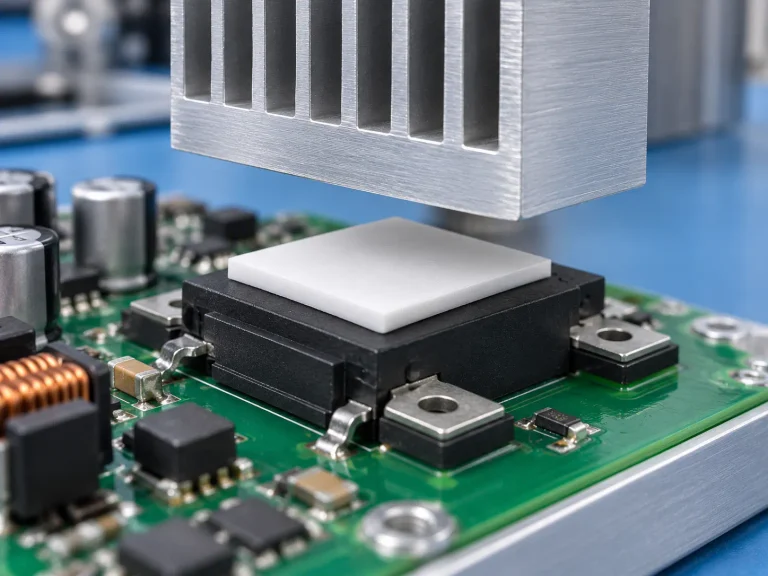
Phase-change thermal-conductive material sounds technical, yet it solves a simple problem: moving heat quickly, then damping spikes. In electronics, this balance matters daily, especially when a silicone-free phase-change thermal-conductive material is required.
Core Composition: Paraffin Wax and Polymer Matrix
- Paraffin wax handles heat absorption through phase change.
- Polymer matrix keeps shape during repeated melt–solid cycles.
- Ceramic particles and graphite composites boost thermal paths.
Under the hood, the structure works like this:
1) Solid at room temperature for clean handling.
2) Softens near the target heat range.
3) Fills micro-gaps without dripping.
Now the layered view, where details matter most:
- Base system
- Paraffin wax
- stores latent heat
- stabilizes temperature swings
- Polymer matrix
- resists deformation
- limits material migration
- Paraffin wax
- Enhancement fillers
- Ceramic particles
- electrical insulation
- moderate conductivity
- Graphite composites
- high in-plane heat flow
- Ceramic particles
This balance defines many silicone-free phase change thermal conductive material designs used by Sheen Materials in compact devices.
Key Thermal Properties: Conductivity, Latent Heat, Phase Change Temperature
- Conductivity moves heat away fast.
- Latent heat absorbs sudden spikes.
- Phase change temperature keeps systems stable.
Short notes engineers care about: quick response, predictable melt point, repeatable behavior.
Here’s a practical comparison used in lab screening of phase-change thermal interface material options:
| Material Type | Conductivity (W/m·K) | Latent Heat (J/g) | Phase Change Temp (°C) |
|---|---|---|---|
| Paraffin-based PCM | 3.5 | 180 | 45 |
| Graphite-enhanced PCM | 6.8 | 165 | 50 |
| Ceramic-filled PCM | 4.2 | 150 | 55 |
| Traditional grease | 2.0 | 0 | N/A |
| Silicone-free PCM gel | 5.1 | 170 | 48 |
“Demand for silicone-free thermal interface solutions is rising as reliability and contamination control become critical,” noted a 2024 update from Yole Intelligence.
In real builds, Silicone-free phase change thermal conductive material wins by staying clean while managing heat cycles.
Physical Traits: Viscosity, Adhesion Strength, Flowability
★ Low viscosity after melting improves surface wetting.
★ Adhesion strength reduces air gaps.
★ Controlled flowability stops pump-out.
Think in steps during operation:
- Install as a solid sheet or gel.
- Device heats up; material softens.
- Micro-voids disappear.
- Cooling returns it to solid form.
Grouped behavior engineers watch closely:
- Mechanical response
- viscosity drop rate
- recovery after cooling
- Interface stability
- adhesion to copper lids
- resistance to vibration
These traits separate a decent silicone-free phase change thermal conductive material from one that lasts for years.
Available Form Factors: Thermal Pads, Film Laminates, Gels
- Thermal pads suit CPUs and power modules.
- Film laminates fit thin stacks.
- Gels allow automated dispensing.
Natural mixes appear in practice: pads for prototypes, gels for volume lines, laminates for tight assemblies.
Nested selection logic often looks like this:
- Application need
- High pressure tolerance
- Choose thermal pads
- Ultra-thin profile
- Choose film laminates
- Irregular surfaces
- choose gels
- High pressure tolerance
- Process flow
- manual assembly
- automated pick-and-place
For OEMs chasing clean production, Sheen Materials supports multiple formats of silicone-free phase-change thermal-conductive material, keeping performance steady without silicone-related risks.
Comparative Study: Silicone-Free Vs. Silicone-Based TIMs
Thermal interface choices feel small, yet they quietly decide stability, lifespan, and even maintenance costs. This comparison lays out how material chemistry shifts real-world outcomes, without the lab-coat stiffness.
Silicone-Free Phase Change Thermal Conductive Material
This silicone-free phase-change thermal-conductive material relies on paraffin, organic binders, and tuned fillers, melting just enough to flow, then settling back into place.
- Material behavior
- Heat rise triggers phase change
- Cooling locks the interface again
- Compliance fit
- Meets RoHS needs
- Low outgassing suits data centers
Under the hood, silicone-free phase change thermal conductive material works like this:
- Solid at room conditions
- Softens at target temperature
- Fills micro-gaps evenly
- Stabilizes after cooldown
Performance snapshot
| Operating Temp (°C) | Thermal Conductivity (W/m·K) | Outgassing (mg) | Lifespan (Cycles) |
|---|---|---|---|
| 40 | 3.2 | 0.1 | 5,000 |
| 60 | 3.5 | 0.1 | 7,000 |
| 80 | 3.8 | 0.2 | 10,000 |
| 100 | 4.0 | 0.2 | 12,000 |
| 120 | 4.1 | 0.3 | 15,000 |
Nested benefits stack up naturally:
- Reliability
- No silicone bleed
- Clean surfaces in automotive electronics
- Integration
- Drop-in sheets
- Minimal rework
Suppliers like Sheen Materials focus heavily on this silicone-free phase change thermal conductive material category, especially where contamination anxiety runs high. Short-tail terms such as silicone-free thermal material and phase change TIM show up often in buyer specs.
Silicone-Based Thermal Interface Materials
Silicone-based TIMs blend silicone oils with ceramic particles, staying flexible across brutal temperature swings.
- Key traits:
- Wide operating window
- Soft compression feel
- Watch-outs:
- Pump-out risk
- Volatility during thermal cycling
Numeric checks help frame expectations:
- Initial conductivity stays steady
- Repeated cycles thin the bond line
- Migration can creep beyond the die
Short takes from the field land fast. Flexible. Familiar. Easy to apply. Yet in dense racks or sealed housings, residue worries linger. Silicone-based thermal interface materials still dominate legacy designs, but hybrid planning is common. Sheen Materials often positions silicone options beside silicone-free phase change thermal conductive material so engineers can balance cost, cleanliness, and long-term calm.
3 Steps To Choose The Right TIM
Picking the right thermal interface material doesn’t have to feel like a lab experiment. This quick guide breaks down what actually matters, mixing hands-on tips with real-world engineering logic, while keeping Silicone-free phase change thermal conductive material firmly in focus.
Step 1: Evaluate Thermal Conductivity & Heat Spreading Efficiency
Heat problems rarely come from one number alone. Thermal conductivity sets the pace, but heat transfer quality depends on how the interface material behaves once squeezed between surfaces.
- Material performance checks usually bundle:
- Bulk thermal resistance under pressure
- Lateral heat spreading across uneven contact zones
- Real-world thermal performance after repeated heating cycles
A quick comparison helps engineers avoid guesswork:
| TIM Type | Thermal Conductivity (W/m·K) | Thermal Impedance (°C·cm²/W) | Heat Spreading Rating | Typical Use Case |
|---|---|---|---|---|
| Silicone grease | 3.5 | 0.25 | Medium | Legacy designs |
| Phase change pad | 5.0 | 0.18 | High | CPUs, power modules |
| Silicone-free PCM | 6.0 | 0.12 | Very High | High-density electronics |
| Graphite sheet | 10.0 | 0.30 | Extreme | Flat heat sources |
| Hybrid TIM | 7.5 | 0.15 | High | Mixed assemblies |
Silicone-free phase change thermal conductive material stands out when tight tolerances and cycling reliability matter. That’s why Sheen Materials keeps pushing this category for compact, high-power layouts.
Step 2: Verify Compliance and Safety – Dielectric Strength & RoHS
Electrical safety is non-negotiable. Dielectric strength protects against short circuits, while electrical insulation keeps sensitive components calm under load.
Key checks usually sound casual in meetings, yet they carry weight:
- RoHS compliance and material composition clarity
- Verified material safety during long-term operation
- Alignment with global regulatory standards and reduced environmental impact
Silicone-free phase change thermal conductive material also helps avoid silicone migration, a quiet failure risk in optical and high-voltage systems. Sheen Materials highlights this advantage for designers dealing with mixed-signal boards.
Step 3: Optimize Application – Surface Preparation & Dispensing Method
Even the best thermal interface fails with sloppy handling. Surface preparation comes first, always. Clean, flat, dry.
Then comes control:
- Dispensing method selection affects bond line thickness
- Screen printing suits volume builds; automated dots fit flexible lines
- Stable interface contact improves material adhesion and thermal cycling life
Think of the application process as the final performance multiplier. With silicone-free phase-change thermal-conductive material, consistency is easier to lock in, especially when the installation technique is dialed in early. Sheen Materials often sees yield gains right here.