-
ADD: Building 2, No. 8 Hengzhutang Road, Dongguan
-
Phone: +86 135 4224 3751

Unlock Superior Heat Management with an IGBT Module Thermally Conductive Insulating Sheet
Heat is the silent troublemaker in power electronics. Push an IGBT too hard and it pushes back—through drift, downtime, and fried components. That’s where an IGBT module thermally conductive insulating sheet earns its keep, acting like a bouncer and a bodyguard at the same time—kicking heat out fast while keeping high voltage in line. In high-density drives and inverters, poor heat flow isn’t a hiccup; it’s a budget-eating headache.
“Thermal stability is now a design constraint, not an afterthought,” notes a senior engineer at Sheen Electronic Technology in a 2025 industry briefing.
With EV chargers and renewable inverters scaling fast—global power electronics demand continues climbing per 2025 market analyses—the margin for thermal error keeps shrinking. Get the interface right, and uptime follows. Get it wrong, and the smoke test gets real.
Reading Notes & Key Points: The Design Logic Behind IGBT Module Thermally Conductive Insulating Sheet Performance
→ Thermal Conductivity Priority: High thermal conductivity (measured in watt per meter kelvin) enables fast heat transfer from the IGBT module to the heat sink, reducing thermal resistance and preventing thermal drift in high-density power electronics systems.
→ Dielectric Strength & Electrical Safety: Strong electrical insulation and dielectric strength (rated in volts per mil) protect against leakage current and breakdown voltage failures between baseplate and heat sink, ensuring operational safety in high-voltage environments.
→ Material Composition Strategy: Silicone elastomer combined with ceramic fillers such as aluminum nitride or boron nitride balances thermal conductivity, mechanical flexibility, and long-term reliability across demanding operating temperature ranges.
→ Thermal Resistance & Performance Stability: Lower thermal impedance improves switching stability, extends service life, and enhances performance in electric vehicle chargers, server power supplies, and renewable energy inverters.
→ Mechanical Flexibility Advantage: Conformal adaptability minimizes air gaps between contact surfaces, maintaining consistent heat dissipation efficiency even under vibration or uneven heat sink conditions.
→ Material Comparison Insight: Aluminum nitride delivers higher thermal conductivity, while boron nitride offers superior electrical insulation and surface resistivity—selection depends on system voltage and heat density priorities.
→ Critical Selection Metrics: Evaluate thermal impedance, breakdown voltage, surface resistivity, operating temperature range, and insulation ratings to ensure safe, efficient integration into power semiconductor devices.
→ Manufacturing & Compliance Factors: Precision processes such as lamination, coating technology, die cutting, and roll slitting influence thickness uniformity and durability, while certifications like UL, RoHS, REACH, and flammability ratings validate safety and regulatory compliance.
→ System-Level Integration Perspective: As a thermal interface material within power semiconductor devices, the IGBT module thermally conductive insulating sheet functions as both heat pathway and electrical barrier—an essential safeguard in modern motor drives and industrial control systems.
How IGBT Module Thermally Conductive Insulating Sheets Work
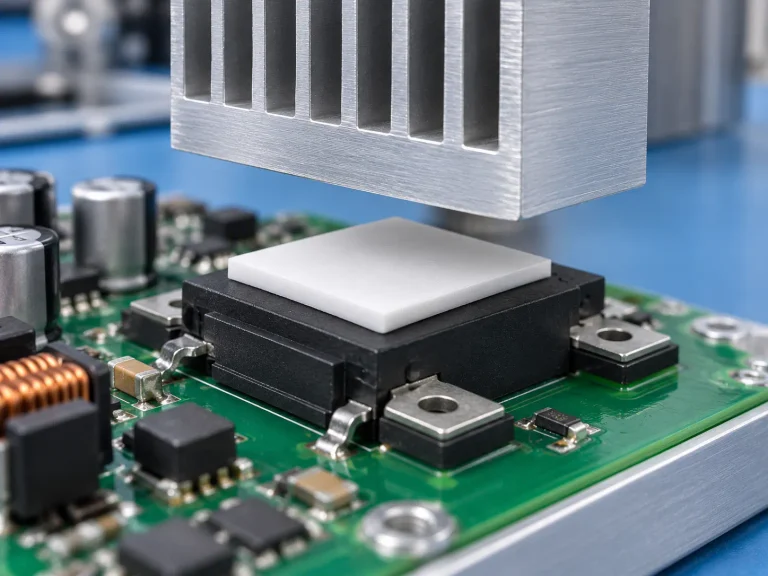
Power devices run hot, and heat is the silent killer. The IGBT module thermally conductive insulating sheet sits right between power and failure, guiding heat away while blocking stray current. In modern power electronics, this thin layer handles thermal management, supports heat dissipation, and keeps systems steady under pressure.
Understanding the Role of Thermal Conductivity in IGBT Modules
Within IGBT modules, heat starts at the chip and travels outward. The path looks like this:
- Chip junction
- Solder layer
- Baseplate
- IGBT module thermally conductive insulating sheet
- Heat sink
At each interface, thermal resistance adds up. Lower it, and junction temperature drops. That’s the game.
- Heat generated by switching increases power density.
- Heat must pass through a thermal interface material.
- The IGBT module thermally conductive insulating sheet improves heat transfer by filling micro air gaps.
Short version? Better thermal conductivity means longer device reliability. A well-designed IGBT module thermally conductive insulating sheet reduces hotspots and keeps performance stable even during heavy cycling.
How IGBT Modules Benefit from Dielectric Strength and Electrical Insulation
Heat is only half the story. Voltage isolation matters just as much.
- High dielectric strength
- Stable electrical insulation
- Reliable voltage isolation
Inside IGBT modules, the electrical path and thermal path run side by side:
- Electrical path
- Chip → substrate → baseplate
- Thermal path
- Chip → baseplate → IGBT module thermally conductive insulating sheet → heat sink
The insulating layers prevent breakdown voltage events while maintaining electrical safety. A properly engineered IGBT module thermally conductive insulating sheet handles thousands of volts without leakage. That balance—cooling plus isolation—is what keeps converters alive.
Material Composition: Why Silicone Elastomers and Ceramic Fillers Matter
Material science decides performance.
At the core:
- Silicone elastomers (flexible polymer matrix)
- Provide surface conformity
- Absorb mechanical stress
Inside the matrix:
- Ceramic fillers
- Aluminum nitride
- Boron nitride
These composite materials boost material properties like thermal conductivity while staying electrically insulating. In quality insulating materials, filler distribution must be even. Too little, and heat stalls. Too much, and flexibility drops.
An advanced IGBT module thermally conductive insulating sheet blends elasticity with conductivity. That’s how thermal interface materials survive vibration, aging, and thermal cycling in real projects.
The Integration of Insulating Layers in Power Semiconductor Devices
During module assembly, placement is precise:
- Clean baseplate surface.
- Position the IGBT module thermally conductive insulating sheet.
- Apply controlled pressure.
- Mount heat sink.
Inside power semiconductor devices, both electrical path and thermal path must stay independent yet efficient. Packaging counts.
Sheen Electronic Technology fine-tunes thickness, hardness, and conductivity so each IGBT module thermally conductive insulating sheet fits smoothly into modern packaging technology. In motor drives and solar inverters, that detail makes the difference between stable output and early shutdown.
A reliable IGBT module thermally conductive insulating sheet may look simple. In reality, it’s the quiet backbone of safe, cool, high-power operation.
Improved Heat Dissipation with IGBT Module Thermally Conductive Insulating Sheets
Power density keeps climbing in power electronics, and heat is the quiet troublemaker. An overheated IGBT module can lose efficiency fast, even if the circuit design looks perfect on paper. That’s why the IGBT module thermally conductive insulating sheet—broken down into IGBT module + thermally conductive + insulating sheet—plays such a big role. Get the right thermal interface material, and thermal management suddenly feels a lot less stressful.
How Thermal Resistance Reduction Boosts Performance in Power Electronics
When an IGBT module thermally conductive insulating sheet lowers thermal resistance, the impact unfolds in layers:
1) At the device level
- Reduced junction temperature
- Lower thermal impedance
- Improved heat transfer from chip to heat sink
2) At the system level
- Stable switching in power electronics
- Higher device efficiency
- Fewer thermal shutdown events
3) At the lifecycle level
- Slower material fatigue
- Better solder reliability
- Longer service intervals
Typical comparison data:
| Material Type | Thermal Conductivity (W/m·K) | Thermal Resistance (°C·cm²/W) | Max Temp (°C) | Dielectric Strength (kV/mm) |
|---|---|---|---|---|
| Silicone Pad | 3.0 | 0.45 | 150 | 6 |
| AlN Sheet | 170 | 0.12 | 200 | 15 |
| BN Sheet | 60 | 0.20 | 180 | 18 |
| Ceramic-Filled | 5.5 | 0.38 | 160 | 8 |
| PI Composite | 12 | 0.30 | 180 | 10 |
An optimized IGBT module thermally conductive insulating sheet simply keeps heat moving instead of letting it linger.
The Importance of Mechanical Flexibility in Heat Dissipation Efficiency
Performance isn’t just about conductivity numbers. It’s also about mechanical flexibility and real-world fit.
A practical breakdown:
- Contact behavior
- Surface irregularities exist on every heat sink.
- Flexible insulating sheets adapt to micro-gaps.
- Better thermal contact reduces trapped air pockets.
- Reliability under stress
- During thermal cycling, rigid materials crack.
- Flexible pads absorb expansion mismatch.
- Lower stress means steady heat dissipation.
- Material properties
- Elastic modulus matters.
- Compression set affects long-term thermal contact.
- Stable conductivity across temperature swings keeps the IGBT module thermally conductive insulating sheet dependable.
In fast-charging piles and server racks, that flexibility is the quiet hero.
Comparing Aluminum Nitride and Boron Nitride for Enhanced Heat Management
For advanced heat management, two insulating ceramics dominate:
A. Aluminum nitride
- Very high thermal conductivity
- Strong substrate for high-power density
- Ideal for compact IGBT module layouts
B. Boron nitride
- Balanced conductivity and high dielectric strength
- Excellent surface resistivity
- Safer choice in sensitive industrial control systems
C. Application pairing
- EV chargers → favor AlN for raw heat flow
- Industrial drives → often prefer BN for insulation margin
- Hybrid stacks → combine ceramic substrate materials with an IGBT insulation sheet for tuned performance
A well-designed IGBT module thermally conductive insulating sheet, including advanced IGBT thermal pad options, bridges electrical isolation and cooling. Brands like Sheen Electronic Technology focus on aligning conductivity, insulation, and mechanical compliance so engineers don’t have to trade one for the other.
3 Key Factors For Choosing The Right Insulating Sheet For IGBT Modules
Power devices run hot and fast. Picking the right IGBT module thermally conductive insulating sheet is not just about specs on paper; it shapes thermal management, safety margins, and long-term stability in serious power electronics systems.
Evaluating the Operating Temperature Range for Optimal Performance
When selecting an IGBT module thermally conductive insulating sheet, temperature tolerance sits at the core of material selection. Heat builds up quickly inside IGBT modules, and the sheet must handle it without losing electrical insulation strength.
- Operating window alignment1.1 Continuous operating temperature rating1.2 Short-term peak tolerance1.3 Margin above real working load
- Stability under stress2.1 Resistance to material degradation at high heat2.2 Retention of thermal stability after cycling2.3 Consistent thermal performance during rapid switching
- Impact on reliability3.1 Efficient heat dissipation to baseplate3.2 Reduced thermal fatigue3.3 Improved device reliability over years
A high-quality IGBT module thermally conductive insulating sheet keeps flexibility at low temperature and structure at high temperature. In real builds, that balance makes the difference between smooth inverter output and surprise shutdowns.
Performance Metrics to Look for: Thermal Impedance, Breakdown Voltage, and Surface Resistivity
Key numbers define how an IGBT module thermally conductive insulating sheet behaves inside a stacked module.
- Thermal pathway control1.1 Low thermal impedance1.2 Stable thermal conductivity (W/m·K)1.3 Even contact to minimize hotspots
- Electrical safety2.1 High breakdown voltage (volts per mil)2.2 Strong dielectric strength2.3 Reliable insulation resistance
- Surface behavior3.1 Controlled surface resistivity3.2 Balanced electrical properties under humidity3.3 Long-term insulation integrity
In short: thermal moves out, electricity stays in. A well-designed IGBT module thermally conductive insulating sheet nails that balance and keeps both efficiency and safety in check.
How Manufacturing Processes Affect the Quality of Thermally Conductive Insulating Sheets
Behind every dependable IGBT module thermally conductive insulating sheet sits disciplined manufacturing processes.
- Sheet formation1.1 Precision lamination for thickness control1.2 Advanced coating technology for uniform filler spread1.3 Tight process control to prevent voids
- Conversion accuracy2.1 Clean die cutting to avoid edge cracks2.2 Roll slitting for consistent width2.3 Controlled sheet fabrication to reduce material defects
- Compliance and safety3.1 Verified UL certification3.2 RoHS compliance3.3 Stable flammability rating
Poor production techniques lead to uneven thermally conductive sheets, which hurt both material quality and long-term thermal management. Partnering with experienced suppliers such as Sheen Electronic Technology helps ensure every IGBT module thermally conductive insulating sheet meets strict standards for real-world power electronics.
FAQs about IGBT Module Thermally Conductive Insulating Sheet
What key properties define a high-performance IGBT module thermally conductive insulating sheet?
In power electronics, heat and voltage fight for control. The insulating sheet stands between failure and stability.
A reliable sheet balances:
- Thermal conductivity (W/m·K) – Faster heat flow from the IGBT module baseplate to the heat sink.
- Low thermal resistance / thermal impedance – Keeps junction temperature steady in motor drives and renewable energy inverters.
- High dielectric strength (volts per mil) & breakdown voltage – Protects the power semiconductor device from electrical insulation failure.
- Mechanical flexibility – Ensures tight surface contact despite assembly tolerances.
- Wide operating temperature range – Essential for electric vehicle chargers and server power supplies.
When these parameters align, the insulating layer becomes more than a thermal interface material—it becomes system insurance.
How do material composition choices influence thermal and electrical performance?
Material design decides how the sheet behaves under pressure, heat, and voltage stress.
| Component | Function | Impact on Performance |
|---|---|---|
| Silicone elastomer | Elastic matrix | Provides mechanical flexibility and vibration tolerance |
| Ceramic filler (aluminum nitride) | Heat conductor | Raises thermal conductivity for high-load power electronics |
| Ceramic filler (boron nitride) | Electrical stabilizer | Enhances surface resistivity and long-term insulation |
| Fiberglass reinforcement | Structural support | Improves dimensional stability during lamination |
| Polyimide film | Insulating barrier | Increases dielectric strength and thermal resistance balance |
Aluminum nitride suits high-power industrial control systems; boron nitride favors environments demanding stronger electrical insulation stability. The right blend defines both efficiency and safety margin.
What should buyers evaluate before bulk purchasing for industrial applications?
Bulk procurement carries pressure—performance gaps become costly at scale.
Key checkpoints include:
- Thermal conductivity value (watt per meter kelvin) matched to application load
- Dielectric strength and breakdown voltage for high-voltage IGBT modules
- Verified thermal impedance under real mounting pressure
- Surface resistivity for insulation reliability
- Manufacturing precision through lamination, coating technology, die cutting, and roll slitting
- Compliance marks: UL certification, RoHS compliance, REACH regulation, halogen-free status, flammability rating
When manufacturing control meets certified safety standards, the insulating sheet supports long service life across renewable energy inverters, motor drives, and heavy-duty power semiconductor device assemblies.