-
ADD:AGGIUNGI UN APPUNTAMENTO PER IL PROSSIMO ANNO Edificio 2, n. 8 Hengzhutang Road, Dongguan
-
Telefono: telefono +86 135 4224 3751

Why Compression Recovery Matters in AI Server Thermal Design
AI server cooling can go sideways when a Thermal Interface Material stops springing back. A High Elastic Recovery Graphene Thermal Pad targets that contact problem, keeping microscopic gaps from turning heat into a throttling risk.
For buyers, recovery is where specs meet reality—and procurement begins.
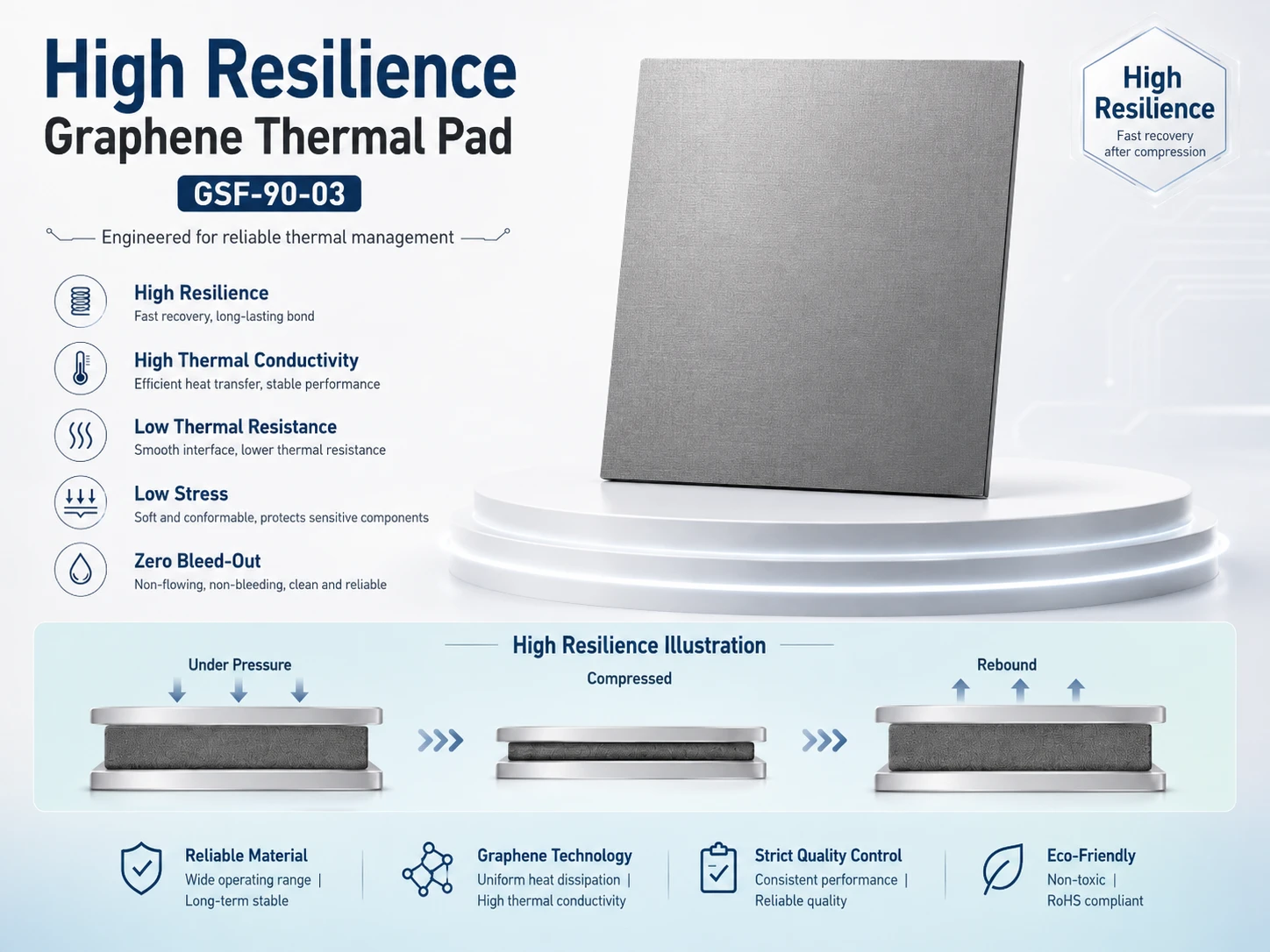
Sheen Materials High Elastic Recovery Graphene Thermal Pad GSF-90-03
- Ensures lasting interface conformity by resisting compression set and maintaining low thermal impedance under repeated AI workloads.
- Validated via Hot Disk and Laser Flash Analysis to track impedance rise and diffusivity loss over cycling and temperature extremes.
- Outperforms metal contacts through superior compressibility, vibration tolerance, and consistent heat transfer across chip and heat sink.
Data Proves: 30% Performance Drop With Poor Compression Recovery
A 30% performance drop can make poor recovery hard to shrug off, but the exact loss needs workload test data to back it up. A High Elastic Recovery Graphene Thermal Pad supports progettazione termica by keeping pressure and contact stable as an AI server heats, cools, and repeats demanding jobs.
Correlating Compressibility Loss with Throughput Decline
- High Elastic Recovery Graphene Thermal Pad behavior links mechanical recovery with computing stability.
- Repeated loading can cause compressibility loss.
- A graphene thermal pad that fails to rebound may leave small air gaps.
- Those gaps hinder cooling, raising the risk of hardware degradation.
- Higher processor temperatures can then affect data processing.
- Clock throttling may produce measurable throughput decline.
- A claimed 30% decline should therefore be tied to controlled workload measurements, not assumed from compression data alone.
- Repeated loading can cause compressibility loss.
Thermal Impedance Rise Measured by Hot Disk Method
High Elastic Recovery Graphene Thermal Pad testing can pair compression cycling with the Hot Disk method, a transient measurement technique used to characterize heat transport.
- Record baseline conduttività termica.
- Cycle the interface material under realistic pressure.
- Retest trasferimento di calore behavior and compare any temperature rise.
This makes changes in impedenza termica easier to connect with contact aging. Pretty practical.
Processor Heat Dissipation Efficiency from Laser Flash Analysis
- Laser Flash Analysis measures thermal diffusivity, showing how quickly heat travels through a sample.
- For a High Elastic Recovery Graphene Thermal Pad:
- compare fresh and aged material;
- check graphene or graphite thermal performance;
- relate results to processor cooling.
- For the semiconductor system:
- stable conductivity supports dissipazione del calore;
- retained efficienza helps preserve cooling performance during sustained AI workloads.
- For a High Elastic Recovery Graphene Thermal Pad:
3 Common Recovery Failure Modes
Recovery problems rarely start with a dramatic breakdown. Heat, pressure, and material aging slowly change interface behavior. A High Elastic Recovery Graphene Thermal Pad from Sheen Materials targets repeatable contact, but tracking deformation, layer bonding, and hardness remains key for reliable processor cooling.
Silicone Elastomer Compression Set
A Compression Set Test checks how much rebound is lost after heat and clamping. In a High Elastic Recovery Graphene Thermal Pad, polymer chain movement initially supports elastic deformation, but aging brings stress relaxation.
- Pressure effects
- Falling clamping force can create permanent deformation.
- Poor rebound raises resistenza di contatto, hurting the materiale di interfaccia termica. That’s where small changes really add up.
| Test temperature | Compression | Set after 24 h |
|---|---|---|
| 70°C | 25% | 8% |
| 100°C | 25% | 14% |
| 125°C | 25% | 21% |
| 150°C | 25% | 30% |
Values are illustrative test targets, not product specifications.
Graphite Composite Delamination
Graphene thermal pad layers face repeated mechanical and thermal loads.
- Bond stability
- Debole interlayer adhesion can trigger micro-cracking.
- Shear stress during cicli termici may split an anisotropic structure.
- Heat path
- Binder degradation can reduce through-plane conduttività termica.
Once layers separate, cooling consistency can go south fast.
Phase Change Material Hardness Drift
A phase change thermal pad depends on stable flow after repeated heating.
- Aging changes
- Thermal aging may increase cross-linking density nel matrice polimerica.
- That hardening effect unità viscosity variation.
- Interface impact
- Povero bagnatura della superficie leaves microscopic gaps.
- Stabile latent heat behavior alone cannot restore lost contact.
Sheen Materials designs recovery-focused interfaces around this long-term balance.
High Elastic Recovery Graphene Thermal Pad vs. Metal Interface
AI hardware needs steady heat transfer even when parts shift slightly during assembly, operation, or repeated heating and cooling. A High Elastic Recovery Graphene Thermal Pad from Sheen Materials addresses those everyday fit issues through flexible contact, while metal depends on tighter mating surfaces. The practical difference comes down to contact quality over time.
High Elastic Recovery Graphene Thermal Pad
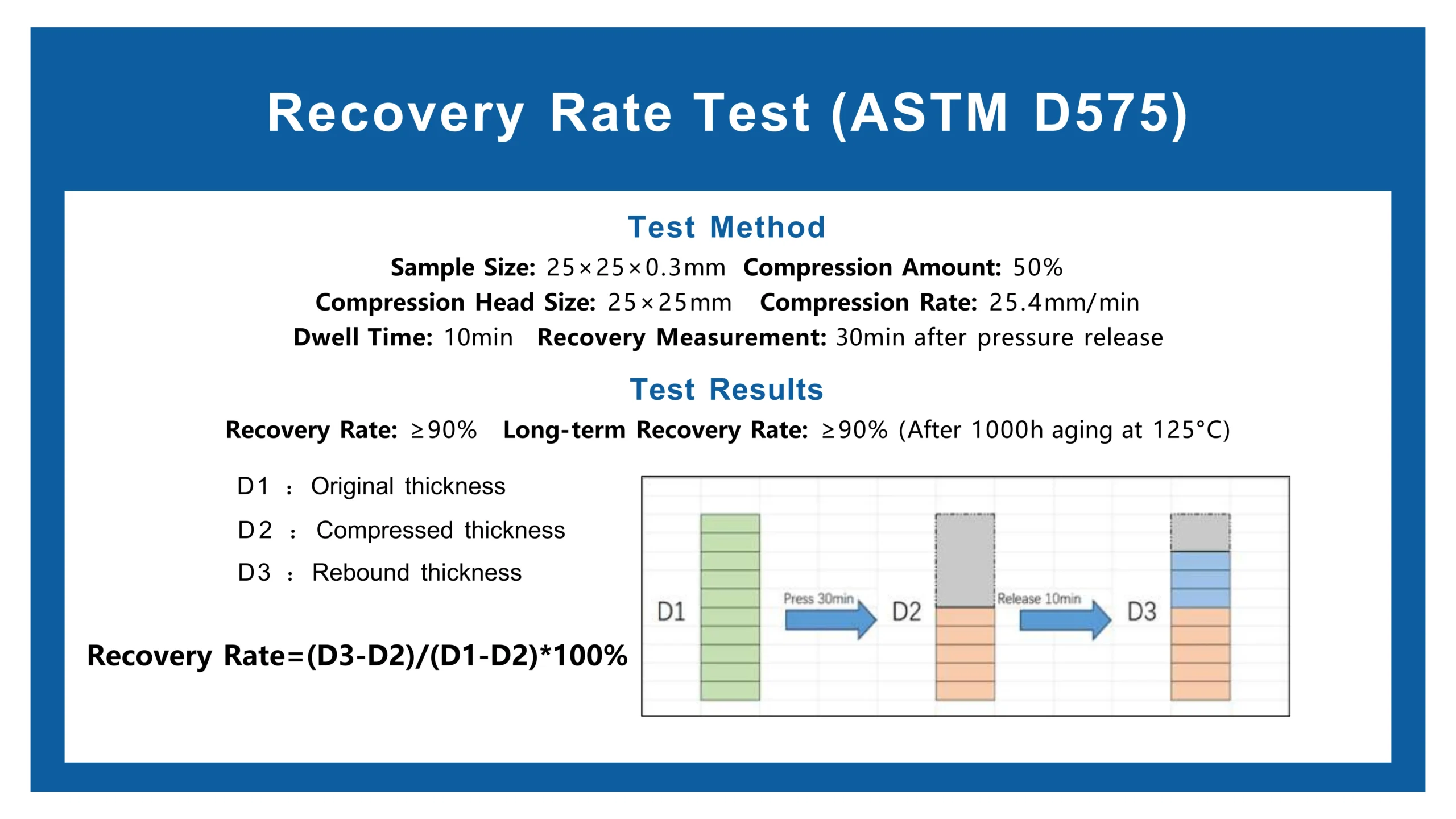
A High Elastic Recovery Graphene Thermal Pad combines graphene material con elastic recovery, helping the interface follow small height changes without losing contact. In plain terms, the pad can bounce back rather than staying crushed.
- Contact stability
- Gap filling helps cover uneven component heights.
- Controllato interface pressure supports close contact without demanding perfectly flat parts.
- Thermal performance
- Alto conduttività termica carries heat toward the cold plate or heat sink.
- Più basso resistenza termica can result when fewer air pockets remain.
- Service conditions
- Deformation resilience helps the graphene pad handle vibration and thermal cycling.
- Sheen Materials designs this elastic thermal pad approach for demanding IC-to-cooler contact where tolerances can be tricky.
Metal Interface
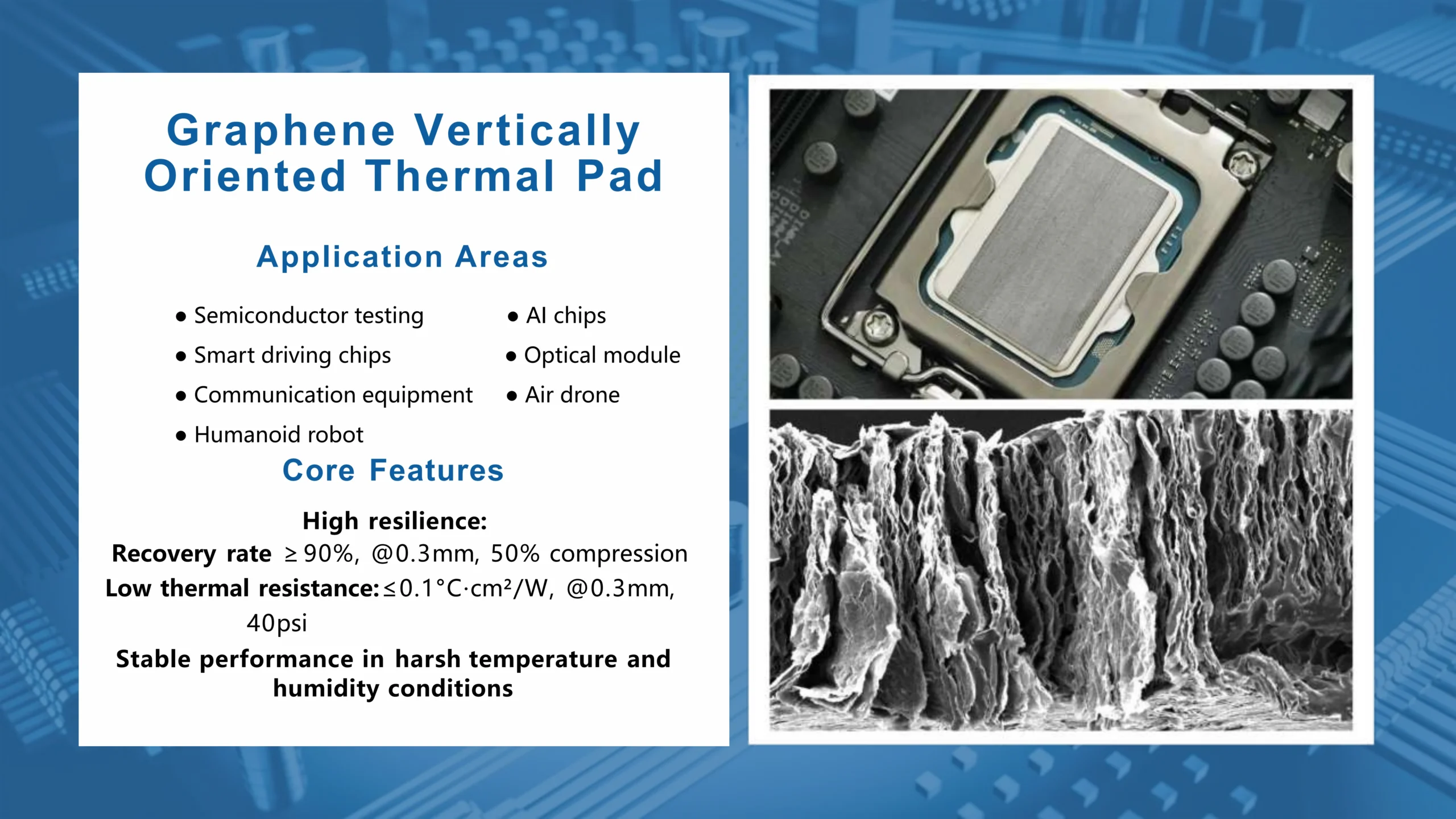
Metal moves heat well, but good numbers on paper do not guarantee good contact in a real assembly.
- A metal materiale di interfaccia termica forms rigid contact, so thickness tolerance matters a lot.
- Microscopic surface roughness can leave insulating micro-voids between mating faces.
- Repeated espansione termica may change local pressure as server temperatures rise and fall.
- Precise machining can improve conductivity efficiency, yet it adds tighter mechanical requirements.
- For sustained dissipazione del calore, engineers must balance raw conductivity against actual interface contact; that’s where a conformable graphene solution may offer a practical edge.
AI Training: Thermal Stress Scenario
AI training hardware can run hard for hours, so small contact changes quickly matter. A High Elastic Recovery Graphene Thermal Pad helps handle repeated heating, concentrated chip loads, and cooling interruptions while keeping heat moving through tightly packed hardware.
Temperature Cycling Beyond Operating Temperature Range
- Temperature swings create thermal stress as parts expand at different rates.
- Il coefficiente di espansione termica sets how strongly neighboring surfaces shift.
- Repeated movement can cause mechanical fatigue, compression set, or delamination.
- A High-Elastic-Recovery Graphene Thermal Pad uses an elastomer to regain thickness after deformazione.
- When the gradiente di temperatura gets steep, good interface material recovery helps maintain contact. That’s a big deal during back-to-back training runs.
- Il coefficiente di espansione termica sets how strongly neighboring surfaces shift.
Integrated Circuit Hot-Spot Formation
Concentrated heat flux can push die temperature upward fast. A graphene thermal pad with high elastic recovery helps the materiale di interfaccia termica stay in contact as surfaces move.
- Rising power dissipation increases temperatura di giunzione.
- Better contact lowers local resistenza termica, helping heat reach the baseplate or heat sink.
- For very dense systems, microchannel cooling can carry that transferred heat away. A High Elastic Recovery Graphene Thermal Pad still has to bridge surface gaps reliably.
Cooling Fan Airflow Interruption
- Fan loss cuts forced convection e air velocity.
- Ridotto static pressure weakens airflow through crowded fins.
- Dissipazione del calore drops, so temperature climbs quickly.
- Thermal throttling may reduce processor power before damage occurs.
- Ridotto static pressure weakens airflow through crowded fins.
- Cooling redundancy limits this failure mode.
- Meanwhile, a high-recovery graphene thermal pad keeps a conductive heat path active.
Real-World Application Cases of Graphene Thermal Pads GSF90-03
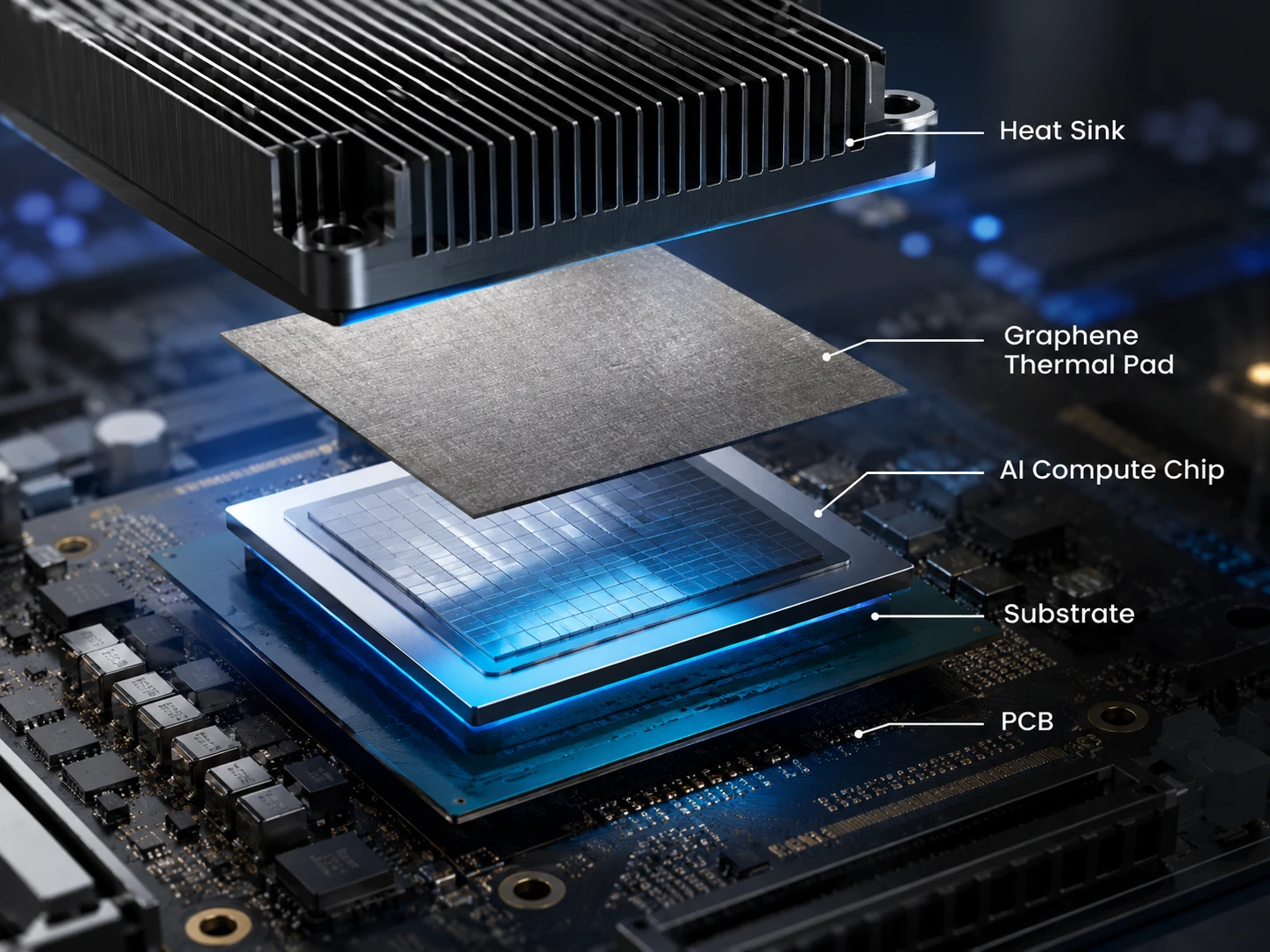
Cooling for AI Server Accelerator Cards – Solving the Issue of Thermal Throttling Under Full Load
A computing company’s next-generation AI accelerator card features a full-load power consumption exceeding 480W. Initially, standard 12W/m·K thermal pads were used; however, during prolonged large-model training, the GPU core temperature exceeded 92°C, frequently triggering thermal throttling.
This resulted in a 15% fluctuation in computing output, while long-term high-temperature operation also posed risks such as accelerated component aging.
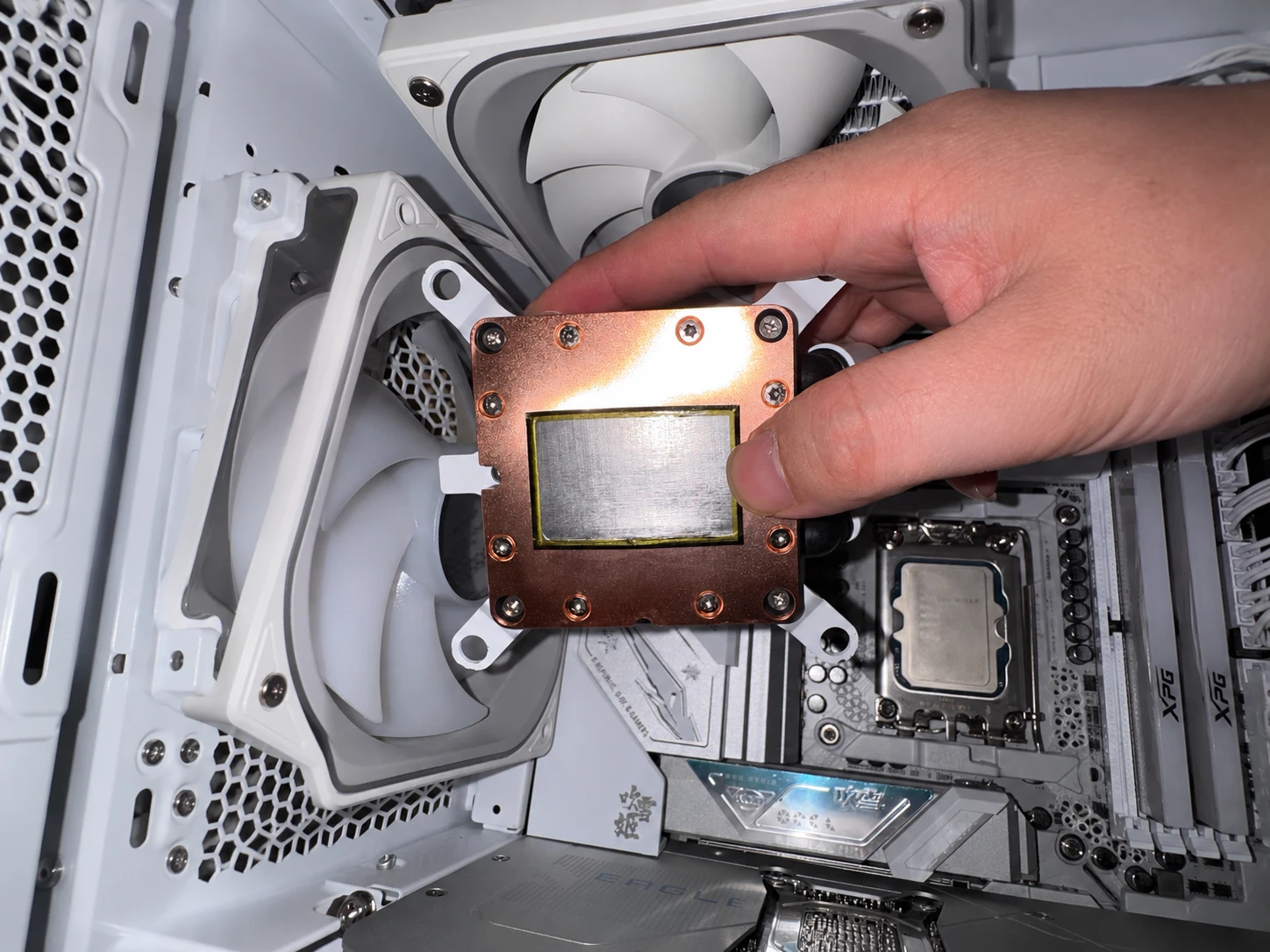
After comparing Sheen Materials’ GSF series graphene thermal pads with existing options, the company replaced the thermal silicone pads previously used in the project with graphene thermal pads boasting a thermal conductivity of 75 W/m·K.
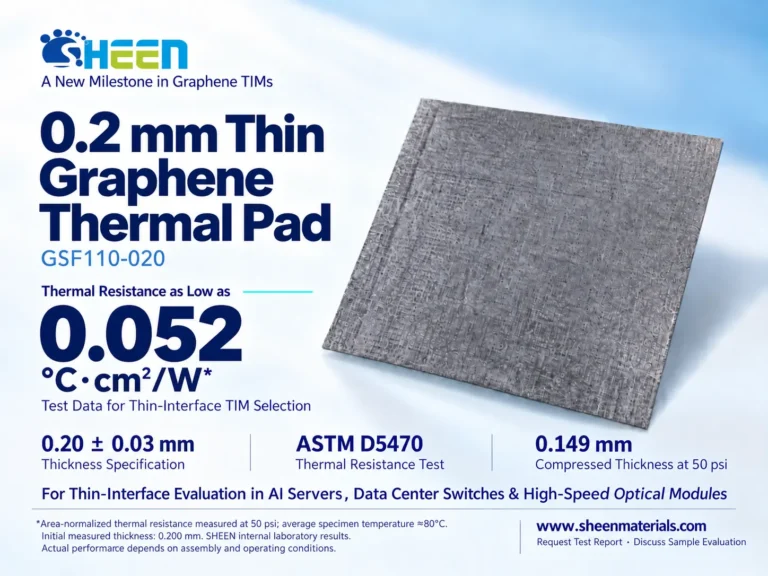
These graphene thermal pads feature high resilience, allowing them to perfectly fill minute gaps between the chip and the heatsink and compensate for warping caused by thermal expansion and contraction; they offer an interfacial thermal resistance as low as 0.04 ℃·cm²/W.
Data from a 72-hour continuous full-load stress test showed that the server’s GPU core temperature remained stable below 76°C with no thermal throttling, ensuring maximum stability in computing performance. Furthermore, the material exhibited no silicone oil bleed-out or failure due to drying, meeting the requirement for an 8-year service life and significantly reducing server room operation and maintenance costs.