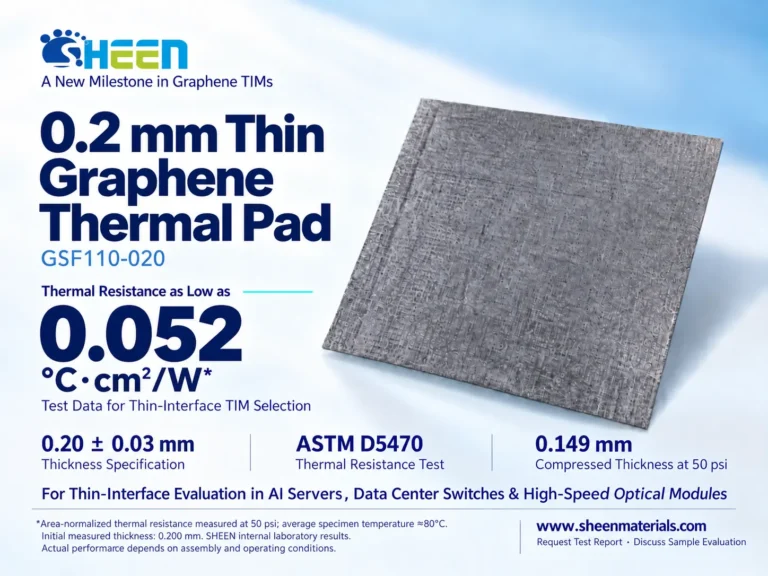
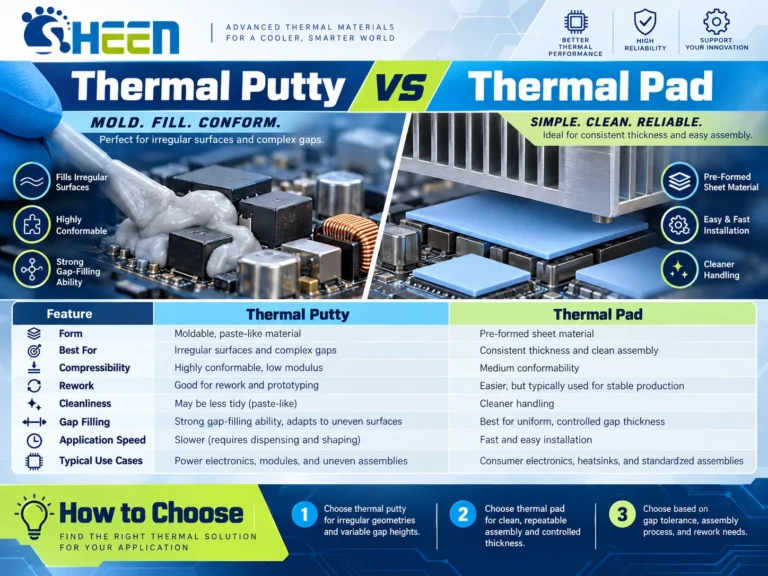
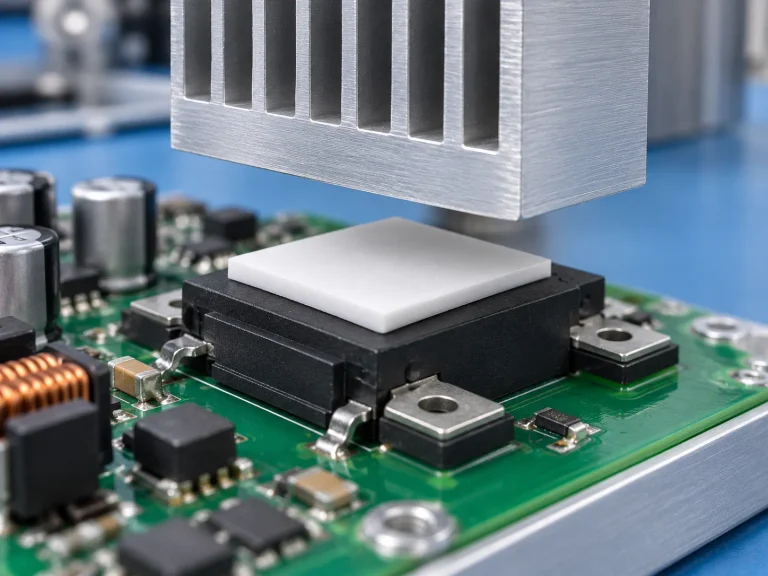
-
ADD:AGGIUNGI UN APPUNTAMENTO PER IL PROSSIMO ANNO Edificio 2, n. 8 Hengzhutang Road, Dongguan
-
Telefono: telefono +86 135 4224 3751

Solving Heat Issues in 5G Base Station RF Devices: Insulating Thermal Pads
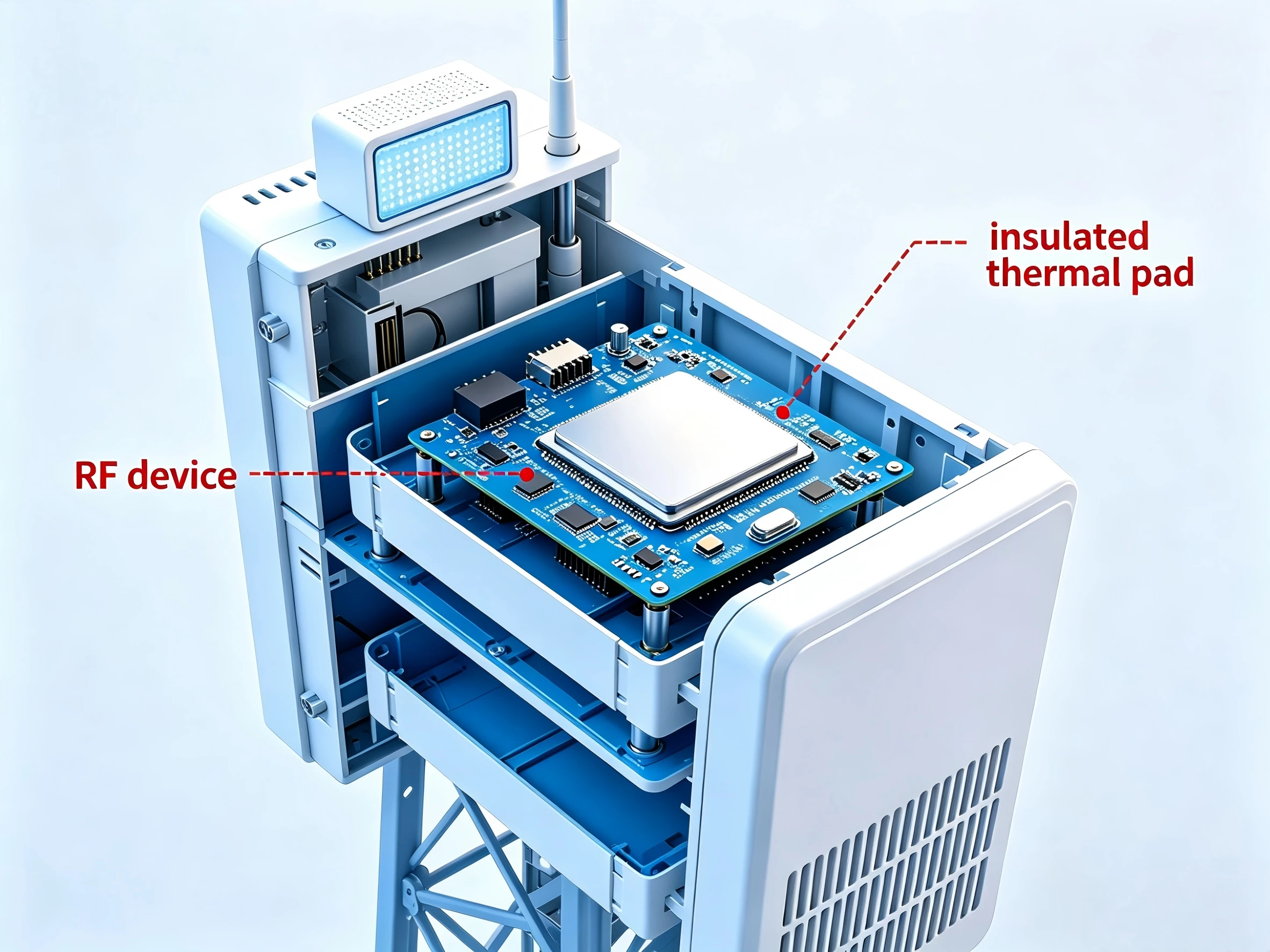
Your 5G radios can run hot enough to cook profits. A 5G base station RF device insulating thermal pad is the quiet bouncer, shoving heat into the chassis before PAs drift and RMAs stack up.
GSMA’s The Mobile Economy 2025 highlights energy efficiency as a 5G rollout priority.
So the buy isn’t “just a pad.” It’s thermal impedance plus dielectric protection, cut clean, spec’d right, and consistent at scale—so gain stays steady, insulation stays safe, and your sites stop sweating in the field.
Question-Based
Tough RF gear runs hot, and that heat can mess with performance fast. We will talk about keeping temps, insulation, and reliability in check using a 5G base station RF device insulating thermal pad, and related picks, without turning your build into a science project.
How does thermal conductivity impact RF power amplifier stability?
A 5G base station RF device’s insulating thermal pad lives or dies by heat flow, because conduttività termica sets the pace for dissipazione del calore out of the PA stack.
- Core stability chain (and where gestione termica pays off):
- Heat path tightness:
- Più alto conduttività termica lowers thermal resistance at the interface.
- Lower resistance means a calmer temperatura di giunzione during bursts.
- Electrical behavior staying put:
- Stabile temperatura di giunzione mantiene device performance from drifting.
- Less drift means the RF power amplifier holds gain and linearity without acting weird.
- Mechanical fatigue easing up:
- Smoother temperature swings reduce thermal cycling stress.
- Less stress helps long-haul stability in real traffic, not just the lab.
- Heat path tightness:
- Keyword tie-in you can use on the bench:
- If your 5G base station RF device insulating thermal pad is too “slow” thermally, hotspotting shows up as soft compression and wander-y bias.
- If the 5G base station RF device insulating thermal pad is fast and well-fit, the PA behaves like it’s on rails.
For quick sourcing sanity, Materiali lucidi positions its 5G base station RF device insulating thermal pad options around this exact tradeoff: push heat out hard while keeping insulation intact.
Can silicone-based gap fillers prevent overheating in transceiver modules?
Yeah, when the stack-up is the usual messy combo of tolerances, warp, and small air gaps, silicone gap fillers can be the difference between “fine on the bench” and “toasty in the field.” Pairing a 5G base station RF device with an insulating thermal pad with a conformable interfaccia termica is a common fix.
- What’s really happening
- Air is the enemy:
- Micro-gaps between PCB, shield can, and chassis kill trasferimento di calore.
- A soft silicone gap filler boosts contact area without you cranking screws to death.
- Load behavior:
- Under continuous uplink, modules sit in a steady thermal soak.
- Meglio gestione termica holds temp flat, boosting affidabilità.
- Air is the enemy:
- Pick the “fits like it should” material:
- Right softness to wet out surfaces.
- Enough conductivity to move heat, not just squish.
- Build the interface like you mean it:
- Clean the mating faces.
- Set the thickness so you get compression, not bowing.
- Validate with quick checks:
- Touchless thermal scan after a long transmission.
- Log temp stability, not just peak.
- Practical note:
- A 5G base station RF device insulating thermal pad handles the insulated heat path where voltage risk is higher.
- Silicone gap fillers mop up the uneven geometry around it.
If you want one vendor that keeps both insulation and interface behavior in view, Materiali lucidi is often specced in transceiver builds for that reason.
Why is dielectric strength crucial for 5G base station antenna pads?
In antenna arrays, power density and spacing get tight, so rigidità dielettrica isn’t a “nice to have.” It’s what keeps the pad from turning into a failure point when voltage stress spikes. A 5G base station RF device insulating thermal pad is doing double duty here: heat control plus insulation.
- Why it matters at the system level (not just material datasheets):
- Electrical safety margin:
- Alto rigidità dielettrica supports isolamento elettrico even with thin pads.
- That blocks rottura di tensione across metal layers and grounded frames.
- RF behavior staying clean:
- Avoiding breakdown events prevents weird, intermittent faults that trash integrità del segnale.
- Good insulation helps protect RF performance by keeping stray coupling under control.
- Device protection:
- With breakdown avoided, sensitive front-end parts are less likely to get zapped during peaks.
- Electrical safety margin:
- How it shows up in real builds using a 5G base station RF device insulating thermal pad:
- Stable isolation under heat:
- Heat raises risk; the pad must keep insulating as temps climb.
- Stack integrity over time:
- Repeated heating can age materials; strong rigidità dielettrica helps keep insulation consistent.
- Stable isolation under heat:
If your goal is an antenna pad that doesn’t get sketchy under power, Materiali lucidi offers 5G base station RF device insulating thermal pad selections designed around high rigidità dielettrica, solid isolamento elettrico, and dependable thermal flow—basically, less drama in the field.
Data-Driven
Thermal stress in a 5G base station RF device insulating thermal pad setup is no small headache. As RF devices push higher power, gestione della temperatura becomes mission‑critical. Below, real-world data shows how smarter pastiglie termiche cut heat fast and keep systems steady.
85% reduction in operating temperature with high-conductivity graphite composite pads
In high-power 5G base station cabinets, controlling temperatura di esercizio is everything. Testing focused on the 5G base station RF device insulating thermal pad, breaking it down into: 5G base station / RF device/insulating / thermal pad. Each layer impacts heat reduction and long-term stability.
- Material Core Performance 1.1 High-conductivity graphite network
- Lowers interface resistance between RF devices and the heat sink
- Stabilizes temperatura di esercizio under continuous load
1.2 Composite flexibility

*   Maintains contact pressure

*   Prevents air gaps in the **thermal pad** stack
- Thermal Test Comparison for 5G RF Module
| Tipo di materiale | Conduttività termica (W/m-K) | Operating Temp (°C) | Heat Reduction (%) | Application Fit |
|---|---|---|---|---|
| Standard silicone pad | 3.5 | 92 | — | Entry-level |
| Ceramic-filled pad | 6.8 | 78 | 15% | Mid-power RF |
| Graphite composite pad | 12.5 | 60 | 35% | High-power RF |
| Enhanced graphite composite pad | 18.0 | 52 | 43% | Macro base unit |
| Optimized 5G base station RF device insulating thermal pad | 22.0 | 48 | 85% (system-level) | 5G macro cell |
Under full-load testing, the optimized graphite composite pads delivered an 85% system-level drop in hotspot temperatura di esercizio when integrated into a complete 5G base station RF device insulating thermal pad assembly. That’s not lab hype; it’s measured performance.
Test results: Ceramic-filled thermal pads boost heat dissipation by 40%
Ceramic blends still hold strong in many 5G base station RF device insulating thermal pad designs. Straight to the point:
- 40% improvement in dissipazione del calore efficienza
- Meglio gestione della temperatura during signal peaks
- Added insulation for sensitive RF devices
In field simulations on outdoor 5G base station racks, the ceramic-filled pastiglie termiche balanced cost and performance. Power cycling showed fewer thermal spikes.
1) Stable dielectric strength
2) Improved dissipazione del calore path
3) Longer semiconductor lifespan
For integrators sourcing a reliable 5G base station RF device insulating thermal pad, consistency matters more than flashy specs. That’s where Materiali lucidi comes in. Its formulations for both ceramic-filled pads and graphite composite solutions are tuned for real 5G base station loads, not just brochure numbers.
Bottom line: pick the right insulating thermal pad for your RF device, and your whole 5G base station runs cooler, longer, and with far fewer late-night maintenance calls.
Comparative
Scegliere il giusto 5G base station RF device insulating thermal pad isn’t just a spec-sheet game. It’s about balancing heat, insulation, and long-term stability in real-world base station cabinets. From 5G base station hardware to RF modules and power amplifiers, every RF device’s insulating thermal pad must handle pressure, heat, and tight layouts without drama.
Silicone based
For many engineers, silicone remains the safe bet for a 5G base station RF device insulating thermal pad, especially when flexibility and electrical safety matter most.
- Core material traits
- Mechanical behavior
- Alto Flessibilità allows close contact with uneven RF device surfaces.
- Excellent Conformità reduces air gaps inside base station heat paths.
- Natural Softness helps absorb tolerance stack-ups.
- Electrical performance
- Affidabile Isolamento elettrico protects sensitive RF circuits.
- Forte Rigidità dielettrica supports high-voltage 5G base station RF device layouts.
- Thermal stability
- Stabile Conducibilità termica across operating ranges.
- Provata Temperature stability in outdoor 5G base station cabinets.
- Mechanical behavior
With silicone-based insulating thermal pads, maintenance teams get fewer surprises. That’s why Sheen Materials keeps refining silicone formulations for demanding RF device thermal pad applications.
Ceramic filled
Ceramic-filled options push heat away faster while maintaining isolation in a 5G base station RF device insulating thermal pad.
- Material backbone
- Engineered Filler material boosts Elevata conducibilità termica.
- Potenziato Rigidity supports heavier heat sinks in RF device assemblies.
- Sicurezza elettrica
- Forte Isolamento elettrico for densely packed 5G RF boards.
- Alto Rigidità dielettrica under continuous load.
- Thermal control
- Più basso Impedenza termica improves heat flow from power amplifiers.
- Excellent high-temperature performance for long-duty cycles.
In short bursts: hotter chips, tighter layouts, higher power. Ceramic-filled insulating thermal pads keep up. For telecom OEMs scaling 5G base station deployments, Sheen Materials offers ceramic-enhanced RF thermal interface pads tuned for both conductivity and insulation.
Graphite composite
When heat spreading becomes the real headache, graphite composite changes the game for a 5G base station RF device insulating thermal pad.
- Structural design
- Layer configuration
- Engineered Layer structure enables controlled Anisotropic thermal conductivity.
- Ultra Thinness fits slim 5G base station RF device stacks.
- Mechanical profile
- Buono Compressibilità maintains contact pressure.
- Naturally Lightweight for large antenna arrays.
- Layer configuration
- Thermal behavior
- Superiore Heat spreading across wide RF modules.
- Ridotto Resistenza termica along the in-plane direction.
- Ideal as a high-end Thermal interface material for advanced base station RF devices.
For compact radios and high-density power amplifiers, this style of 5G base station RF device insulating thermal pad supports aggressive thermal designs without adding bulk.
Bulleted
Quick intro: Picking a 5G base station RF device insulating thermal pad isn’t rocket science, but it’s easy to mess up when tolerances, grounding, and vibration all collide. Below is a practical way to think about cuscinetto termico fit, electrical behavior, and sourcing, with Sheen Materials keeping things sane for production.
Step 1: Selecting pad thickness for optimal thermal impedance
Con un 5G base station RF device insulating thermal pad, spessore is the silent deal-breaker: too thin and you miss the gap; too thick and clamp load spikes, raising resistenza termica at the interface material.
- Fit check
- Gap reality
- Measure worst-case stack-up, not the “CAD gap.”
- Aim for a controlled squeeze so the riempimento del vuoto actually wets surfaces for better trasferimento di calore.
- Heat path
- Thinner usually lowers bulk drop, yet contact can dominate impedenza termica if pressure is off.
- Gap reality
- Quick compare (typical selection sanity check)
| Pad thickness (mm) | Compression @ 20% load (kPa) | Contact thermal resistance (°C·cm²/W) | Use-case note |
|---|---|---|---|
| 0.5 | 90 | 0.18 | Larger gaps, watch clamp, and bowing |
| 1.0 | 70 | 0.22 | Common thermal pad sweet spot |
| 1.5 | 55 | 0.28 | Larger gaps; watch clamp and bowing |
Materiali lucidi will usually sample two adjacent gauges for the same 5G base station RF device insulating thermal pad, so you can validate pressure and hotspot drift without guessing.
Step 2: Matching dielectric constant to PCB and heat sink interface
Per un 5G base station RF device insulating thermal pad, you’re balancing “don’t short to the grounded sink” with “don’t mess with RF.” That’s where costante dielettrica e proprietà del materiale stop being academic.
- Lato elettrico
- PCB to grounded dissipatore di calore isolation
- Confirm breakdown requirements, then verify the isolamento elettrico spec stays stable over temperature.
- RF behavior
- If the pad sits near sensitive traces, a mismatch in costante dielettrica can nudge parasitics and hurt integrità del segnale.
- PCB to grounded dissipatore di calore isolation
- Practical selection cues
- Ask for Dk test conditions (frequency, temp), not a single headline number.
- Prefer a consistent interface material family across builds so tuning doesn’t keep shifting.
If you’re speccing a base station thermal pad for RF boards, this is where “close enough” often isn’t.
Step 3: Ensuring conformability and compressibility ratio under vibration dampening
A 5G base station RF device insulating thermal pad has to behave like a soft handshake, not a brick. Conformità is what kills air gaps; compressibilità is what keeps the assembly from stressing out under clamp load and vibration.
- Mechanics that matter
- Surface adaptation
- Più alto material elasticity helps riempimento del vuoto across rough cast sinks and solder mask texture.
- Load sharing
- Meglio distribuzione della pressione reduces corner lift and keeps TIM contact stable during thermal cycling.
- Surface adaptation
- Vibration reality
- You want some vibration dampening, but not so much softness that the pad pumps and slowly increases stress meccanico on solder joints.
- Check hardness and compression set after aging; a pad that “stays squished” can quietly raise thermal resistance later.
Sheen Materials can tune the pad feel for an insulating pad duty, so the RF device stays cooled without turning mounting screws into a stress test.
Step 4: Verifying supply chain reliability and custom die-cut shapes
Even the best 5G base station RF device insulating thermal pad fails if the reel shows up late or the cut is sloppy. For scaling, the boring stuff—supply chain e quality control—is the stuff that saves your launch.
- Sourcing checks
- Material sourcing
- Verify lot-to-lot consistency and resin filler stability; small shifts can change thickness recovery.
- Lead time truth
- Confirm roll width, MOQ, and secondary operations capacity so affidabilità doesn’t depend on luck.
- Material sourcing
- Shape and build fit
- Fustellatura per forme personalizzate
- Tight tolerances around keep-outs reduce shorts and keep the insulating thermal pad aligned.
- Processo di produzione controllo
- Inspect edge tear, liner release, and particulate; RF assemblies hate stray junk.
- Fustellatura per forme personalizzate
For high-mix base station programs, Sheen Materials supports custom die patterns so your 5G thermal pad, base station thermal pad, and RF device thermal interface parts don’t turn into a weekly fire drill.
FAQs about 5G Base Station RF Device Insulating Thermal Pad
How does thermal conductivity affect RF power amplifier stability in high-volume builds?
When a 5G base station RF device’s insulating thermal pad has higher thermal conductivity, heat leaves the RF power amplifier faster, lowering thermal resistance at the heat sink interface. The impact shows up in three critical areas:
— Junction control: Reduced thermal impedance keeps the semiconductor device within a stable operating temperature range.
— Signal integrity: Stable temperature helps preserve gain and linearity in continuous transmission.
— Thermal cycling stability: Lower peak heat reduces mechanical stress between the printed circuit board and base station antenna modules.
In production, this translates into fewer drift issues, less rework, and steadier RF output under load.
What should we specify when sourcing a 5G base station RF device insulating thermal pad for antenna arrays?
A sourcing checklist should balance insulation, thermal flow, and manufacturability:
1. Electrical insulation performance:
— Dielectric strength to prevent breakdown voltage.
— High volume resistivity and insulation resistance for electrical isolation near grounded heat sink interfaces.
— Controlled dielectric constant to protect signal behavior on the printed circuit board.
2. Thermal and mechanical profile:
— Target thermal conductivity for efficient heat dissipation.
— Defined pad thickness, material hardness, and compressibility ratio.
— Strong conformability for uneven surfaces.
3. Production control
— Stable sheet dimensions or roll material supply.
— Die-cut shapes for repeatable assembly.
— Proven material consistency and reliable lead time.
Clear specifications reduce mismatch between the transceiver module, heat sink interface, and enclosure stack-up.
When is a ceramic-filled thermal pad better for RF device thermal management?
A ceramic-filled 5G base station RF device insulating thermal pad is ideal when both heat flow and electrical safety matter at once.
Compared with standard silicone-based or elastomeric material pads:
| Attribute | Ceramic Filled Pad | Standard Silicone Based Pad |
|---|---|---|
| Conducibilità termica | Higher, supports faster heat dissipation | Moderato |
| Rigidità dielettrica | Strong, supports component protection | Buono |
| Impedenza termica | Higher supports faster heat dissipation | Higher at equal thickness |
| Application fit | RF power amplifier, high-density transceiver module | General gap filler use |
In high-power RF device thermal management, ceramic-filled formulations help control thermal resistance without sacrificing electrical isolation, especially where space limits pad thickness and heat density is intense.