-
ADD: Bâtiment 2, No. 8 Hengzhutang Road, Dongguan
-
Téléphone: +86 135 4224 3751

Solve Thermal Bottlenecks with a Low Thermal Resistance Graphene Thermal Conductive Sheet
Heat is killing performance, and a low-thermal-resistance graphene thermal-conductive sheet is quickly becoming the fix engineers can’t ignore in high-power electronics.
The Energy Agency and IDTechEx report thermal constraints in power-dense systems, with advanced materials gaining procurement attention across data centers and EV platforms.
This shift matters because interfaces mean cooler chips, longer lifespans, and fewer redesigns, pulling decision-makers toward graphene as a practical upgrade, not lab curiosity.
Key Points: Symphony for Low thermal resistance graphene thermal conductive sheet
➔ Thermal Bottleneck Relief: Overcomes hotspots by replacing rigid ceramic pads and silicone TIMs with ultra-thin graphene films, boosting in-plane heat spreading.
➔ 64% Rth Reduction: Leverages CVD-grown crystalline layers to achieve exceptionally low boundary resistance and uniform surface contact.
➔ Intégration transparente: Apply plasma-treated substrates, controlled lamination, and rapid diffusivity testing to ensure adhesion, minimal interface gaps, and long-term stability.

Why Thermal Bottlenecks Persist in High-Power Electronics
High-power chips keep getting faster, but heat still piles up in stubborn ways. From heat flux spikes to interface resistance, today’s gestion thermique tools often lag behind real device demands. Let’s unpack why.
Heat Flux Concentration: Limits of Conventional Thermal Management
Quand high-power electronics operate at extreme loads, heat flux no longer spreads evenly. It clusters.
- Tiny transistor regions generate intense local energy.
- Traditional pads struggle with rising résistance thermique.
- Standard solutions de refroidissement can’t react fast enough.
This creates points chauds that quietly damage reliability.
- Heat forms in nanometer-scale junctions.
- It travels through silicon toward a TIM layer.
- If the layer lacks low resistance, dissipation de la chaleur slows.
Now consider material hierarchy:
- Device Level
- Chip surface roughness
- Uneven pressure distribution
- Interface Level
- Air gaps
- Pump-out under cycling
- System Level
- Heat sink limits
- Airflow constraints
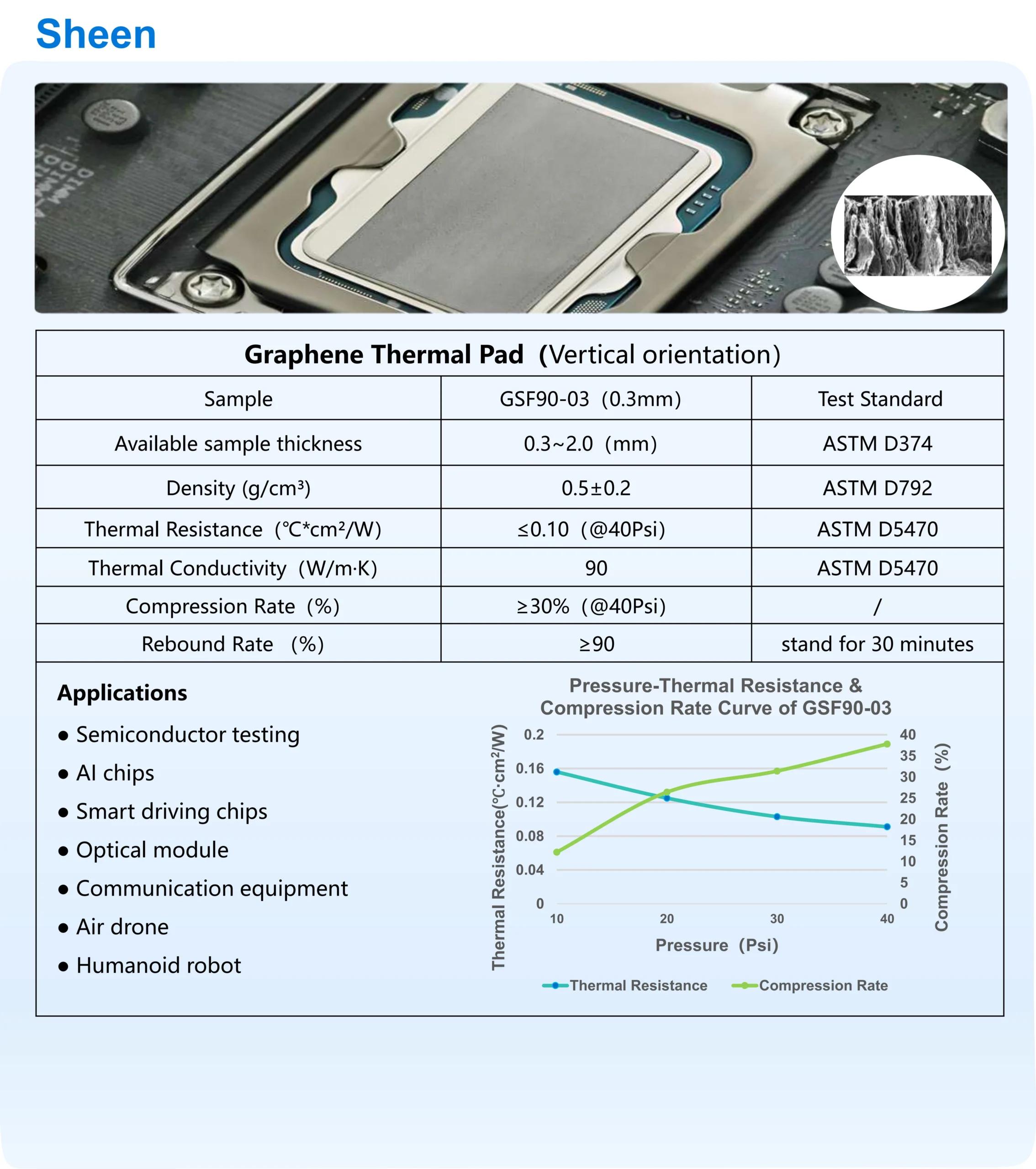
A Low thermal resistance graphene thermal conductive sheet reduces bottlenecks by spreading heat laterally before vertical transfer. In plain terms, it moves heat fast and wide. A graphene thermal sheet with low resistance changes the game by easing peak load zones.
High Interface Resistance from Ceramic Pads and Silicone TIMs
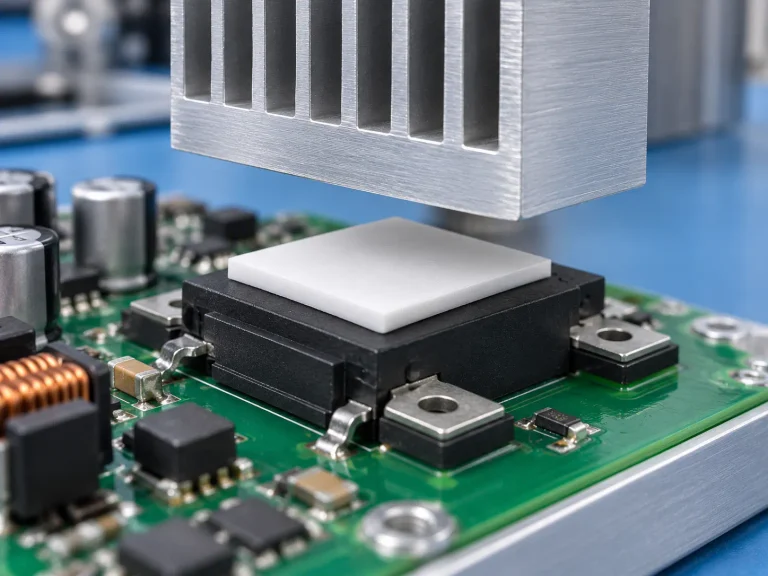
The issue often hides at the boundary. Ceramic pads et silicone TIMs show high interface resistance due to surface mismatch.
• Microscopic voids
• Weak wetting behavior
• Rising impédance thermique
Layer breakdown:
- Contact Zone
- Surface roughness mismatch
- Limited real contact area
- Material Core
- Modéré conductivité thermique
- Aging under stress
A low-thermal-resistance graphene thermal-conductive sheet improves conformity. It lowers résistance de contact while keeping strong in-plane conduction. That means less trapped heat and fewer surprise failures.
Material Constraints: Polymers, Fillers, and Nanostructure Defects
Most matériaux d'interface thermique rely on polymers packed with fillers.
- Nitrure de bore
- Oxyde d'aluminium
- Carbon particles
Yet inside matériaux composites, trouble builds:
- Nanostructure defects interrupt heat paths.
- Poor bonding raises phonon scattering.
- Voids weaken overall propriétés des matériaux.
At the microscopic scale:
- Filler Network
- Random orientation
- Limited percolation
- Polymer Matrix
- Low intrinsic conductivity
- Thermal aging
A low thermal resistance graphene thermal conductive sheet bypasses heavy filler loading. Graphene’s continuous lattice reduces phonon scattering, supporting higher conductivité thermique with fewer structural flaws. In short, fewer weak links, smoother heat flow.
64% Lower Rth with Graphene Sheet Templates
Thermal limits can quietly choke performance. A Low thermal resistance graphene thermal conductive sheet changes that fast by shrinking résistance thermique while keeping devices slim. When graphene, smart structure, and tight processus de fabrication meet, heat simply moves better—no drama, just cooler hardware.
Ultra-Thin Graphene Film: Maximizing Thermal Conductivity per Thickness
A Low thermal resistance graphene thermal conductive sheet starts with an ultra-thin graphene film engineered for extreme conductivité thermique at minimal l'épaisseur. Less bulk, more transfert de chaleur.
- Material Core1.1 Graphène lattice alignment
- High in-plane conductivité thermique
- Réduit résistance thermique
1.2 Film Control

*   Micron-level **thickness** tuning

*   Flexible form for compact **thermal management**
- Performance Snapshot
| Type de matériau | Thickness (µm) | Conductivité thermique (W/m-K) | Relative Rth |
|---|---|---|---|
| Graphene Film | 10 | 1500–2000 | Faible |
| Feuille de graphite | 25 | 400–600 | Moyen |
| Aluminum Foil | 50 | 205 | Plus élevé |
| Polymer Pad | 100 | 3–8 | Haut |
- Practical Edge
- Ultra-thin stack height
- Fast lateral transfert de chaleur
- Cleaner interface contact
That’s why a low-thermal-resistance graphene thermal-conductive sheet feels almost unfair in tight builds. Even a thin graphene thermal sheet spreads heat like it’s got somewhere important to be. Brands like Matériaux brillants refine film density so the gestion thermique gains aren’t just lab talk—they show up in real devices.
Layered Crystalline Structure Enabling Superior Heat Transfer
The magic sits inside the layered structure. A tightly ordered crystalline lattice gives phonon movement a smooth highway for thermal dissipation.
- Rapid in-plane transfert de chaleur
- Controlled cross-plane conduction
- Stable thermal properties under load
A Low thermal resistance graphene thermal conductive sheet benefits from this anisotropic behavior. Heat spreads wide before it travels down, lowering hotspots in chips and power modules.
In 2025, the International Energy Agency noted:
“Improved thermal materials are becoming critical to power-dense electronics and energy-efficient systems.”
That lines up with what engineers see daily. A well-designed graphene heat spreader cuts peak temperature, stabilizes clocks, and extends lifecycle. The low-thermal-resistance graphene thermal-conductive sheet format simply makes integration easier—thin, light, effective.
CVD vs. Exfoliation: Impact on Sheet Density and Surface Roughness
Choisir le bon graphene synthesis route shapes final propriétés des matériaux more than most expect.
- CVD Route1.1 Deposition Contrôle
- Uniforme sheet density
- Plus bas surface roughness
1.2 Output Traits

*   Consistent **thermal conductivity**

*   Reduced interface gaps
- Exfoliation Route2.1 Mechanical or chemical separation2.2 Possible defects in crystalline regions
- Variability in thermal properties
- Interface Consequences
- Smoother films = lower contact résistance thermique
- Rough layers = trapped air, weaker transfert de chaleur
Pour un Low thermal resistance graphene thermal conductive sheet, smoother is better. That’s why Matériaux brillants focuses on controlled CVD-based processus de fabrication tuning—balancing surface roughness, density, and scalable output.
Bottom line? The difference between average cooling and serious performance often comes down to how that graphene film was born.
3 Key Steps to Integrate Graphene Conductive Sheets
Integrating a low-thermal-resistance graphene thermal-conductive sheet into real devices is not just plug-and-play. It takes smart Preparation, tight process control, and solid Testing to keep heat transfer smooth and stable.
Preparing the Substrate: Surface Treatment for Better Adhesion and Electrical Insulation
A clean Substrate sets the tone. If the Interface is messy, even a premium Low thermal resistance graphene thermal conductive sheet will underperform.
- Remove dust, oil, and oxide layers
- Apply targeted Surface treatment
- Add thin Isolation électrique coatings where required
Key control points usually break down like this:
- Cleaning with solvent or plasma
- Surface activation to improve Adhesion
- Insulation verification before bonding
When working with a graphene thermal sheet, teams often structure prep in layers:
- Surface readiness
- Mechanical polishing
- Plasma enhancement
- Sécurité électrique
- Dielectric coating
- Thickness validation
- Interface stability
- Roughness measurement
- Contact angle testing
A properly treated Substrate reduces micro air gaps. That’s how a low-thermal-resistance graphene thermal-conductive sheet achieves real low thermal resistance instead of just claiming it.
Lamination Process: Ensuring Uniform Contact and Minimal Thermal Resistance
Bon Lamination is about balance. Too much Pressure damages the sheet; too little increases Résistance thermique.
Typical lamination control matrix:
| Paramètres | Recommended Range | Impact on Heat Transfer | Risk if Out of Range |
|---|---|---|---|
| Pressure (MPa) | 0.2–0.6 | Improves Uniform contact | Delamination |
| Temperature (°C) | 40–90 | Enhances Bonding | Material degradation |
| Alignment tolerance (mm) | ≤0.1 | Maintains Heat transfer path | Edge hotspots |
| Dwell time (sec) | 10–45 | Stabilizes interface | Weak adhesion |
Process logic often follows a layered validation path:
- Alignement mécanique
- Edge calibration
- Planarity check
- Controlled compression
- Pressure ramp-up
- Uniform load distribution
- Thermal settling
- Temperature stabilization
- Cooling under load
A well-bonded low-thermal-resistance graphene thermal conductive sheet reduces interfacial resistance dramatically. That’s where Matériaux brillants positions its solutions—stable bonding, repeatable results, and clean graphene heat spreader integration.
Quality Validation: Measuring Thermal Diffusivity, Stability, and Mechanical Strength
You can’t guess Performance. You measure it.
Core Quality validation blocks include:
- Thermal diffusivity testing
- Reliability cycling for long-term Stability
- Peel and tensile checks for Résistance mécanique
Validation typically unfolds in nested layers:
- Thermal metrics
- Laser flash Measurement
- In-plane conductivity mapping
- Environmental durability
- −40°C to 125°C cycling
- Exposition à l'humidité
- Structural integrity
- Peel strength (N/cm)
- Shear resistance
According to a 2025 IDC materials outlook:
“Thermal interface materials with verified low interfacial resistance and cycling durability are seeing accelerated adoption in EV power modules and AI servers.”
A Low thermal resistance graphene thermal conductive sheet must hold steady under load, not just in lab air. Low thermal resistance graphene thermal conductive sheet performance is confirmed only after repeated Testing across real operating ranges.
From prep to lamination to validation, the low-thermal-resistance graphene thermal-conductive sheet works best when every Interface, bonding layer, and inspection step lines up. That’s why manufacturers scaling advanced graphene thermal sheet integration often turn to Matériaux brillants for a consistent, production-ready supply.
Comparing Metal Pads vs. Graphene Sheets
Modern chips run hot, and no one likes a throttled device. Picking the right Thermique interface isn’t just a technical detail; it decides how efficiently Heat escapes and how long hardware survives. Here’s a grounded look at Metal solutions versus advanced graphene options, especially the low-thermal-resistance graphene thermal-conductive sheet now gaining traction.
Metal Pads
Metal Pads sound simple: solid Conducteur layers placed between a chip and a heatsink. In practice, things get tricky.
- High bulk Thermique conductivity
- Noticeable Interface gaps on uneven surfaces
- Oxidation risks over time
- Rigid structure
- Limited surface conformity
- Rising contact Resistance
At the material level:
- Core: solid Metal matrix
- Surface: micro-scale roughness
- Result: trapped air → thermal Bottlenecks
When mounted:
- Surface inspection
- Flatness check
- Oxide layer review
- Clamping pressure applied
- Uneven force
- Localized stress points
- Long-term operation
- Oxidation growth
- Increased Resistance
The outcome is predictable. Even with decent bulk Conducteur values, poor contact raises overall Thermique resistance. Heat struggles at the Interface, and bottlenecks build up fast.
Graphene Sheets
A Low thermal resistance graphene thermal conductive sheet changes the game by combining flexibility with extreme in-plane Thermique conductivity. It bends. It adapts. It seals gaps.
Key traits of Graphene Sheets:
- Ultra-thin Sheets reduce stack height
- Fort Conducteur network for fast Heat spreading
- Low contact Resistance
Performance logic:
- Conform to micro-rough surfaces
- Increase real contact area
- Minimize air gaps
- Cut Thermique bottlenecks
Material hierarchy:
- Graphene layer
- High phonon transport
- Stable lattice
- Composite backing
- Mechanical support
- Fiable Interface bonding
Le Low thermal resistance graphene thermal conductive sheet works where rigid pads fall short. A low-thermal-resistance graphene sheet handles pressure cycles without cracking, keeps Resistance low, and solves classic bottlenecks.
Matériaux brillants refines the low-thermal-resistance graphene thermal-conductive sheet for tight electronics, offering consistent Thermique control and long-term stability that metal pads simply can’t match.