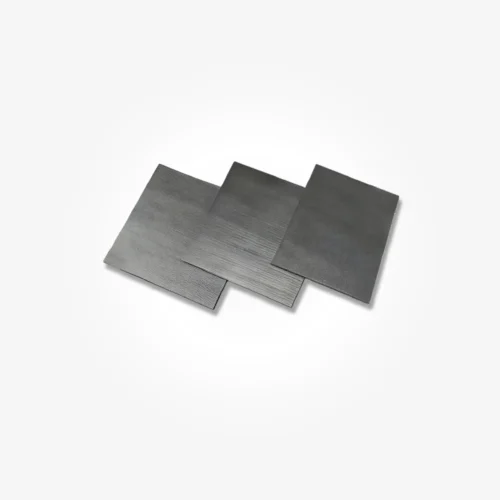
Graphene Thermal Pad GSF110-020
SHEEN GSF110-020 is a 0.20 mm graphene thermal pad with oriented, laminated heat-transfer pathways for compact, high-power electronics.
- Thermal conductivity: 110 W/m·K; ASTM E1461 listed in the TDS.
- Thermal resistance: ≤0.06 °C·cm²/W at 50 psi; ASTM D5470.
- Supplied thickness: 0.20 ± 0.02 mm.
- Rebound rate: ≥90%; soft, conformable structure.
- Application temperature: −40 to 150°C; UL94 V-0 rating listed.
- Evaluation areas: AI chips, optical modules, automotive domain controllers and semiconductor testing.
Thermal resistance is pressure-dependent. Confirm interface fit, allowable load and electrical requirements before selection.
Graphene Thermal Pad GSF110-020
110 W/m·K Graphene Thermal Pad for Ultra-Thin Interfaces, Low Thermal Resistance, and Controlled Contact
GSF110-020 is a 0.20 mm graphene thermal pad for compact, high-power electronics. Graphene filler, vertically oriented alignment and laminated processing form through-interface heat-transfer pathways. Its soft, conformable structure supports mating-surface contact, with a TDS thermal conductivity of 110 W/m·K and thermal resistance ≤0.06 °C·cm²/W at 50 psi.
技術情報
Review the product positioning, core parameters, interface behavior, handling requirements and application fit for GSF110-020 graphene thermal pad.
Q1
What is GSF110-020 designed for?
GSF110-020 uses oriented lamination with graphene filler to establish vertical heat-transfer pathways between the heat source and cooling surface. Its soft structure supports conformity to mating surfaces, while a specified rebound rate of ≥90% provides an additional mechanical selection parameter.
Evaluate a thinner interface before increasing material thickness. The 0.20 mm model is a candidate where the assembly has a narrow, well-controlled gap.
Defined thermal performance
Use the model-specific thermal resistance at 50 psi alongside conductivity, interface area and compressed thickness to shortlist a candidate.
Conformable material structure
Evaluate contact coverage and tolerance accommodation under the allowable package load. Rebound rate alone does not define a recommended compression ratio or reuse life.
Q2
What are the core technical data for GSF110-020?
| プロパティ | GSF110-020 | Listed test method |
|---|---|---|
| 熱伝導率 | 110 W/m·K | ASTM E1461 |
| Area-normalized thermal resistance at 50 psi | ≤0.06 °C·cm²/W | ASTM D5470 |
| Supplied thickness | 0.20 ± 0.02 mm | ASTM D374 |
| Application temperature | −40 to 150°C | Not specified |
| Rebound rate | ≥90% | Not specified |
| Tensile strength, orientation direction | ≥0.05 MPa | ASTM D412 |
| カラー | Black | ビジュアル |
| 密度 | 0.3–0.7 g/cm³ | ASTM D792 |
| Oil bleeding rate | ≤3% | Not specified |
| 引火性 | V-0 | UL94 |
The thermal resistance value is area-normalized and specified at 50 psi (approximately 345 kPa). It must not be treated as °C/W or applied unchanged to other pressures, thicknesses or mating surfaces. ASTM E1461 is listed for the conductivity data; request the underlying measurement details if required for qualification.
The TDS states that the series meets RoHS 2.0, halogen-free and REACH requirements. Request the applicable declarations and supporting reports for your material and order.
GSF110-020: measured pressure–interface behavior
Alongside the TDS limit of ≤0.06 °C·cm²/W at 50 psi, SHEEN publishes a separate test result of 0.052 °C·cm²/W for a specimen with an initial measured thickness of 0.200 mm, at approximately 80°C mean sample temperature. The following values describe that test specimen.
| Pressure | Thermal resistance | Compressed thickness | 圧縮 |
|---|---|---|---|
| 10 psi | 0.262 °C·cm²/W | 0.197 mm | 1.5% |
| 30 psi | 0.065 °C·cm²/W | 0.171 mm | 14.5% |
| 50 psi | 0.052 °C·cm²/W | 0.149 mm | 25.5% |
These measured results supplement the TDS; 0.052 is not a universal limit for every batch, pressure or assembly. The compressed specimen thickness is not an installation-gap guarantee.
Read the GSF110-020 pressure and thermal resistance test discussion.
Choose between the three graphene models
| モデル | 厚さ | Conductivity | Thermal resistance | リソース |
|---|---|---|---|---|
| GSF110-020 | 0.20 ± 0.02 mm | 110 W/m·K | ≤0.06 °C·cm²/W | TDS (PDF) |
| GSF110-030 | 0.30 ± 0.03 mm | 110 W/m·K | ≤0.08 °C·cm²/W | TDS (PDF) |
| GSF130-030 | 0.30 ± 0.03 mm | 130 W/m·K | ≤0.06 °C·cm²/W | TDS (PDF) |
Choose supplied thickness from the mechanical stack-up first, then compare performance under equivalent pressure and contact conditions. A higher conductivity number alone does not predict the final device temperature.
Browse the graphene thermal pad range. Where electrical isolation is essential, discuss boron nitride insulating thermal pads with SHEEN.
Q3
How should interface contact and reliability be evaluated?
- Define the interface: provide the actual gap, contact area, surface materials, flatness and dimensional tolerances.
- Check mechanical loading: relate pressure to contact area and allowable device force. The 50 psi test point is not a universal assembly recommendation.
- Validate thermal contact: compare samples under the same pressure, surface preparation, heat load and operating conditions.
- Review electrical and cleanliness requirements: the TDS provides no dielectric-strength or volume-resistivity specification. It also does not establish zero bleeding or zero outgassing.
- Qualify the duty cycle: verify cycling, vibration, retention and any repeated-contact requirement before production use.
The TDS describes no pump-out and specifies oil bleeding ≤3%. Request the relevant test conditions when evaluating a grease-replacement or contamination-sensitive application.
Q4
How should GSF110-020 be stored and supplied?
- Storage: temperature ≤30°C; relative humidity ≤75%.
- Shelf life: 12 months from the production date.
- Packaging: customizable according to customer requirements.
- Sample request: confirm the model, dimensions, quantity and handling requirements with SHEEN.
Q5
Which applications should be evaluated for GSF110-020?
Candidate interfaces include GPU / CPU package lids, accelerator modules and switch ASIC cooling interfaces with tight height tolerances. The application areas below are selection starting points; component and assembly tests establish suitability.
AI chips and server cooling
Screen package-lid-to-heatsink or cold-plate contact against heat load, flatness, warpage and permitted mounting force. Review SHEEN server thermal management applications.
High-speed optical modules
Evaluate fixed thermal interfaces for dimensional fit and controlled compression. Repeated sliding or insertion requires separate wear, particle and contact-retention testing. Explore optical-module thermal solutions.
Automotive domain controllers
Consider processor cooling in autonomous-driving electronics. Confirm vibration, thermal cycling and project qualification requirements; the TDS is not a vehicle-level approval. See automotive electronics applications.
通信機器
Assess compact power-dense interfaces using the available contact pressure and actual operating temperature. View communication base-station applications.
Semiconductor and thermal-module testing
Evaluate fixture contact, surface cleanliness, indentation and thermal stability. If repeated use is required, establish cycle life and thermal drift experimentally.
UAVs and humanoid robots
Screen compact computing and control electronics for pad retention, vibration, electrical clearance and the full operating-temperature envelope.
PDF
Downloads & FAQ
Download the TDS or request evaluation samples
Send your contact dimensions, interface gap, heat load, allowable pressure, operating temperature and electrical requirements. SHEEN can help shortlist a model for sample evaluation.
Discuss your application with technical support · Browse all SHEEN datasheets
Test-method references
These links explain the referenced methods; they do not represent third-party product certification. Confirm material fitness in the intended assembly before production.
Frequently asked questions
What are the thickness and thermal resistance of GSF110-020?
The TDS specifies 0.20 ± 0.02 mm thickness and area-normalized thermal resistance ≤0.06 °C·cm²/W at 50 psi, with ASTM D5470 listed as the thermal resistance method.
Is this a through-interface material or a lateral heat spreader?
The TDS describes oriented, laminated graphene with vertical heat-transfer pathways. Evaluate the pad across the source-to-cooling-surface interface, and request directional measurement details for your design.
Can it replace thermal grease?
It is a candidate for evaluation where the gap, supplied thickness and mounting pressure are compatible. Compare thermal resistance, assembly process, contact coverage and reliability against the current grease in the actual structure.
Is it electrically insulating or silicone-free?
The available TDS does not establish either property. Ask SHEEN to confirm material composition and electrical requirements, or request an alternative with the relevant specifications.
Does ≥90% rebound mean it can be reused indefinitely?
No reuse-cycle rating is established by that value. Any repeated-use process needs validation of wear, debris, thickness change and thermal performance across the intended number of cycles.