Bring Your Thermal Challenge to Electronica 2026: Meet SHEEN Materials in Munich
What thermal conductivity do you need?
3 W/m·K?
8 W/m·K?
15 W/m·K?
Or even higher?
For many electronics projects, this is one of the first questions asked when selecting a thermal interface material. But in real product development, it is rarely the most important question by itself.
で electronica 2026 in Munich, Germany, November 10–13, SHEEN Materials wants to move the conversation beyond the conductivity number.
Visit us at Hall B2, Booth No. 275/5, and bring the actual thermal problem behind the datasheet requirement.
Because the best 熱界面材料 is not necessarily the material with the highest thermal conductivity.
It is the material that works inside the real assembly.

The Real Thermal Interface Is More Complicated Than a Datasheet
Imagine a PCB with several processors, memory packages, power devices, and supporting components.
The component heights are not perfectly equal.
The heatsink is not perfectly flat.
Assembly tolerances vary.
Some components are mechanically sensitive.
Certain areas require electrical insulation.
Other areas cannot tolerate silicone oil migration.
The product may need to operate for thousands of hours under elevated temperature, humidity, or repeated thermal cycling.
In this environment, simply specifying “10 W/m·K thermal pad” does not define the solution.
Engineers still need to determine the correct thickness, hardness, compressibility, dielectric properties, surface wetting, and long-term mechanical behavior.
This is why シーン・マテリアル sees thermal interface material selection as an engineering process rather than a catalog selection exercise.
Start with the Gap
The first practical question is often surprisingly simple:
What is the actual gap?
Thermal pads are widely used because they can bridge dimensional differences between components and heatsinks while maintaining a controlled interface.
シーン・マテリアル silicone thermal pads cover a broad range of thicknesses and thermal conductivity levels, allowing engineers to balance thermal performance and mechanical compliance.
But when the stack-up becomes more complex, another material format may work better.
If component heights vary significantly, a dispensable thermal gel may conform more effectively than a fixed-thickness sheet.
If the interface is extremely thin, a phase change material or thermal grease may reduce bond-line thickness and interface resistance.
If the structure is sensitive to pressure, a softer material or gel can reduce mechanical stress.
If the application requires dimensional stability and easy handling during assembly, a reinforced pad or film may be preferable.
The correct solution depends on the complete interface.
When High Thermal Conductivity Is Really Needed
There are applications where very high thermal conductivity genuinely becomes important.
AI computing platforms, power modules, advanced networking equipment, and other high-heat-flux systems are increasing the thermal load handled by interface materials.
For these applications, シーン・マテリアル has expanded beyond traditional silicone thermal pads into advanced thermal material technologies.
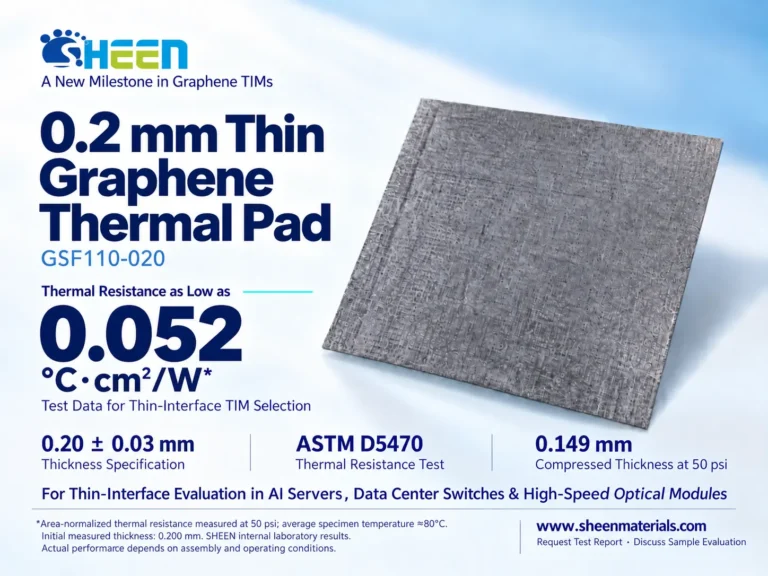
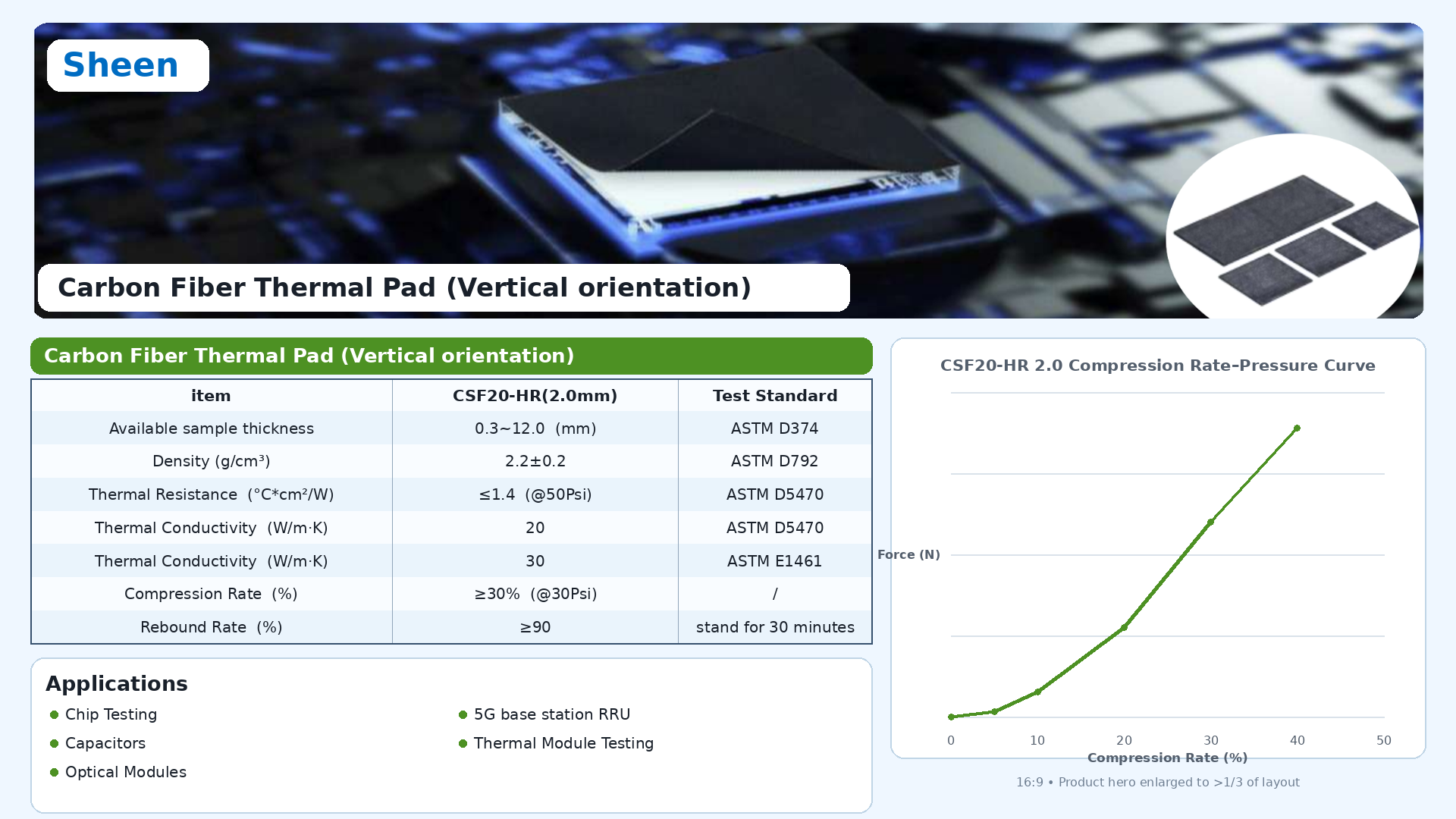
Carbon fiber thermal pads use oriented fiber structures to achieve significantly higher thermal conductivity while allowing different mechanical configurations.
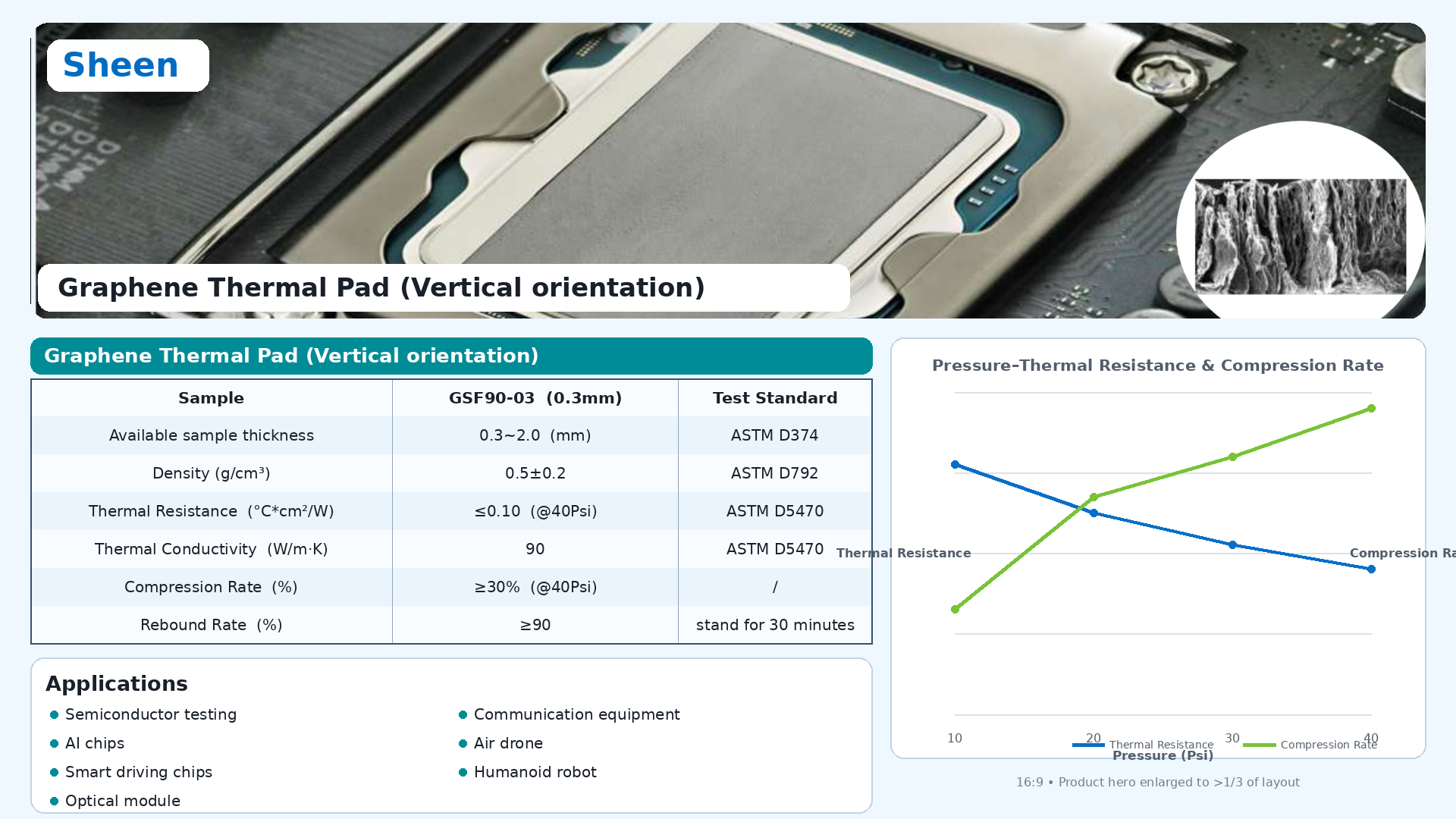
Graphene-based thermal materials are being developed for applications where high heat transfer capability, lightweight structures, or thin designs are important.
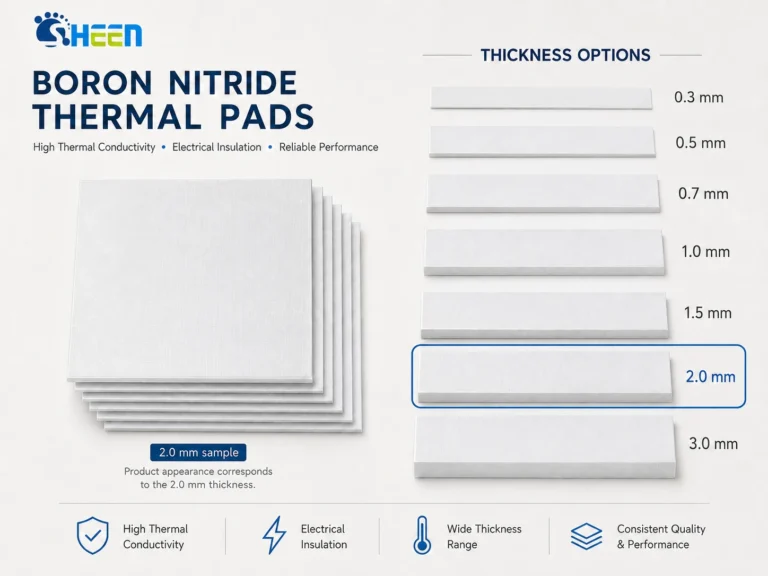
Boron nitride thermal materials are particularly interesting for engineers who need to balance heat transfer with electrical insulation.
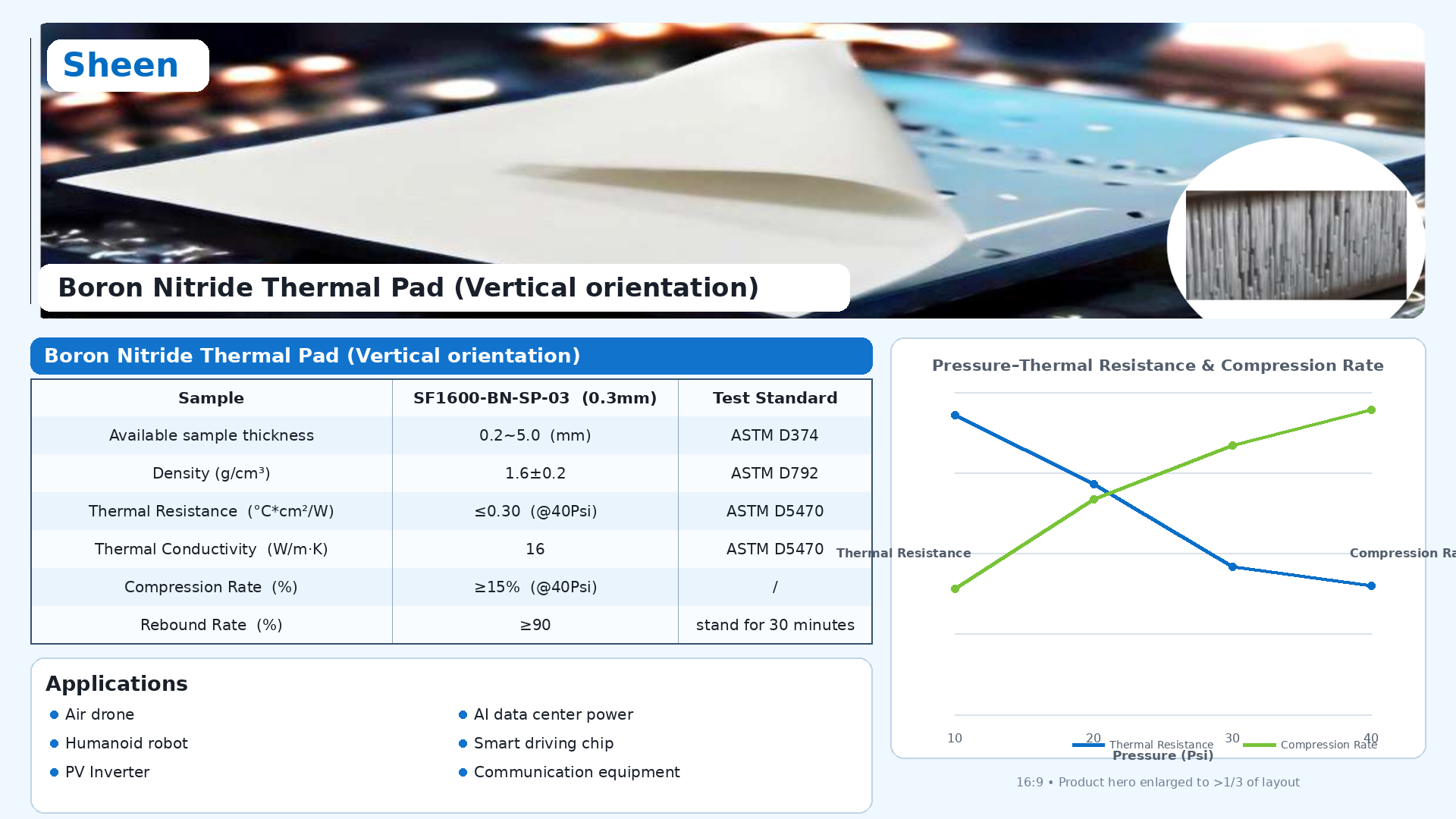
These technologies offer new opportunities—but they also make material selection more application-dependent.
A material with exceptional conductivity may require different compression, surface contact, or structural considerations compared with a conventional silicone pad.
This is where engineering discussion becomes valuable.
What If Silicone Is Not Acceptable?
Some optical, precision electronic, and contamination-sensitive applications place limits on silicone-based materials because of concerns related to silicone oil migration or volatile siloxanes.
For these applications, シーン・マテリアル offers silicone-free thermal interface materials designed to provide thermal performance without the same silicone-related contamination risks.
But changing chemistry can also change mechanical behavior.
A silicone-free material may have different tensile strength, abrasion resistance, conformability, or compression characteristics.
Therefore, replacing one thermal material with another should not be treated as a simple one-to-one substitution.
The entire assembly should be considered.
At electronica 2026, customers evaluating silicone-free designs can discuss not only thermal conductivity but also thickness, hardness, contact condition, and assembly requirements with the シーン・マテリアル team.
Thermal Management Is Also Mechanical Management
One of the most underestimated roles of a thermal interface material is mechanical.
The material is compressed between two surfaces.
That means it influences the pressure applied to the PCB, component package, heatsink, and mechanical frame.
For delicate components, excessive pressure can become a reliability risk.
For larger gaps, insufficient compression can reduce thermal contact.
For systems exposed to vibration or long operating periods, compression set and mechanical stability may influence whether the interface remains effective after months or years of operation.
This is especially important in automotive electronics, industrial equipment, telecom infrastructure, and high-duty-cycle computing systems.
SHEEN therefore evaluates thermal materials not only as heat-conduction media but also as part of the mechanical stack-up.
What Should You Bring to the Sheen Materials Booth?
If you are attending electronica 2026 with a real development project, the most useful conversation may begin with information such as:
your component and heatsink structure, target gap, tolerance range, hotspot temperature, heat load, insulation requirement, allowable compression force, material thickness limits, and environmental requirements.
Even a simple drawing or cross-section can reveal much more about the application than a request for a conductivity value alone.
For projects already using a thermal pad, we can also discuss the reason for replacing it.
Is the device temperature too high?
Is the pad creating too much assembly pressure?
Is there excessive oil bleeding?
Does the customer need silicone-free materials?
Is the existing material too difficult to die-cut or assemble?
Is compression set affecting long-term contact?
Different problems require different solutions.
Validation Before Production
After a candidate material is identified, testing becomes the next step.
シーン・マテリアル maintains testing capabilities for thermal conductivity, siloxane analysis, oil bleeding, humidity aging, and thermal shock.
These tools help evaluate whether material performance remains stable beyond the initial sample stage.
For engineers developing long-life electronics, this is critical.
A thermal interface that performs well during a short laboratory test must still perform after repeated heating and cooling cycles, high humidity exposure, and prolonged compression.
The objective is not simply to pass the first thermal test.
The objective is to create a repeatable material solution suitable for production.
Meet the Sheen Materials Engineering Team at electronica 2026
If you are developing an AI server, networking device, power supply, inverter, industrial controller, automotive electronic module, medical device, or other thermally demanding electronic system, we invite you to visit シーン・マテリアル in Munich.
You do not need to arrive knowing exactly which material you need.
Bring the problem.
We can start from there.
Electronica 2026
November 10–13, 2026 | Munich, Germany
Sheen Materials — Hall B2, Booth No. 275/5
Learn more at www.sheenmaterials.com.