Engineering Custom Graphene Thermal Conductive Solutions for Industry
Heat is choking modern electronics, and Custom graphene thermal conductive solutions step in before performance hits a wall.
Analyses from the International Energy Agency and McKinsey in 2025 highlight mounting thermal constraints across high-density electronics manufacturing ecosystems.
That pressure turns material choice into strategy, pulling engineers toward smarter, scalable heat management fixes.
Key Points: Custom Graphene Thermal Conductive Solutions
→ 熱性能: Graphene nanoplatelets boost heat dissipation and lower junction temperature.
→ Interface Optimization: Balance filler loading and viscosity to cut thermal interface resistance while preserving insulation.
→ Form Factor Selection: Choose films, powders or pastes for screen printing or lamination based on assembly needs.
→ Reliability: Ensure thermal cycling stability and mechanical flexibility to extend device lifetime.
→ Cost Efficiency: Roll-to-roll manufacturing delivers scalable, low-cost graphene versus CVD growth.
Custom Graphene Thermal Conductive Solutions Explained
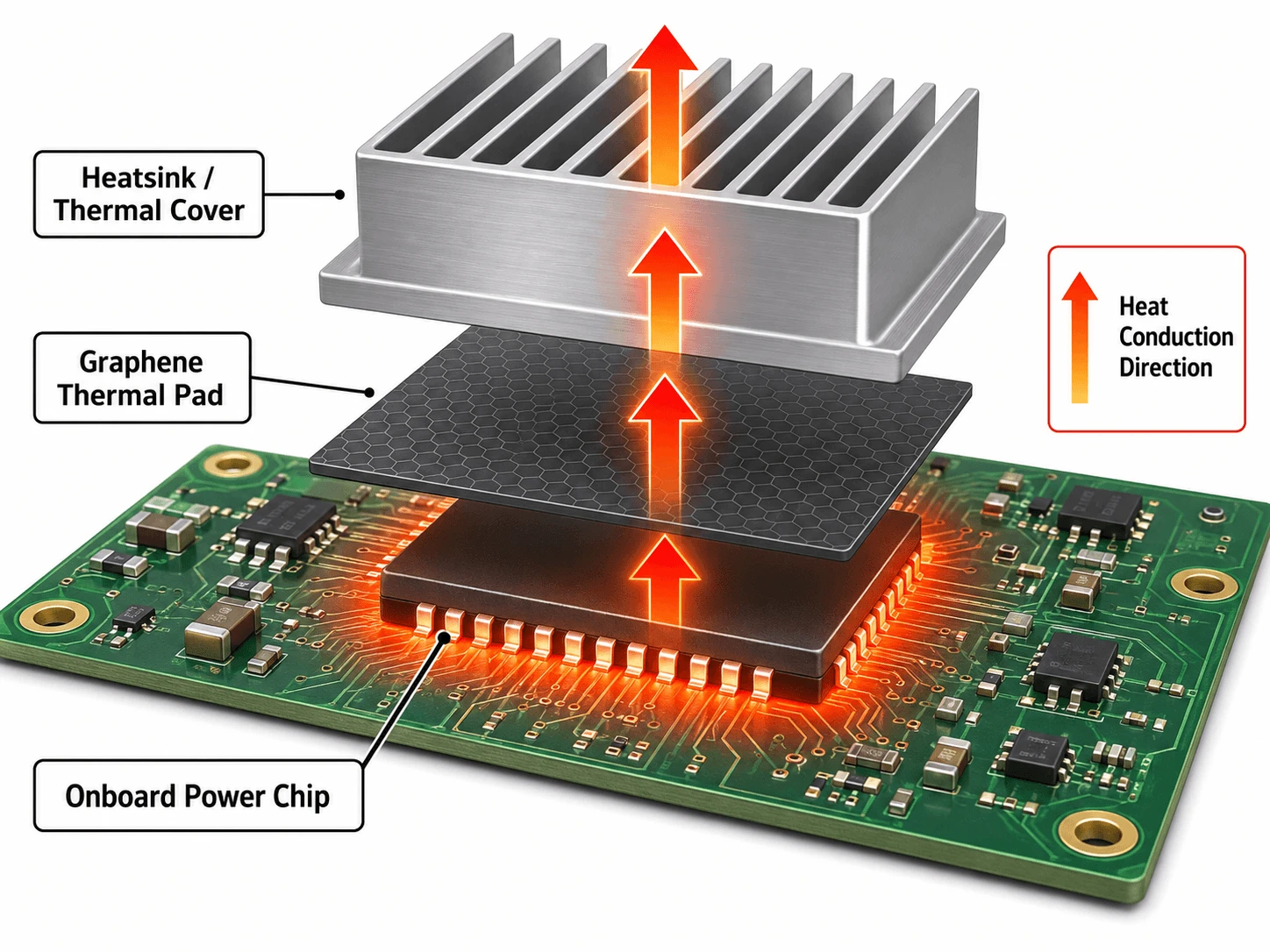
Custom graphene thermal conductive solutions are reshaping how heat gets managed in tight electronic spaces. From chips to LED modules, smart thermal paths matter. By combining graphene thermal materials with tailored composite design, Custom graphene thermal conductive solutions give engineers tighter control over heat flow, insulation, and form factor.
Why Graphene Nanoplatelets Lead in Thermal Conductivity
Custom graphene thermal conductive solutions rely heavily on グラフェン, 特に Nanoplatelets, because of how fast Phonons move across their layered lattice. Heat transfer here isn’t magic; it’s physics working at the atomic scale.
- Ultra-thin 2D Materials shorten heat paths
- High in-plane 熱伝導率 improves lateral spreading
- Tunable Material Properties support composite blending
In practical graphene thermal management design:
- Align nanoplatelets along the heat-flow direction.
- Reduce voids during composite curing.
- Optimize filler loading for stable heat transfer.
Key performance comparison in custom graphene thermal conductive solutions:
| 素材タイプ | In-Plane Thermal Conductivity (W/m·K) | Electrical Resistivity (Ω·cm) | Typical Loading (%) |
|---|---|---|---|
| Graphene Nanoplatelets | 1500–3000 | 10⁻³–10⁻² | 5–30 |
| Aluminum Nitride | 140–180 | >10¹² | 40–70 |
| 窒化ホウ素 | 250–400 | >10¹⁴ | 30-60 |
| グラファイト | 400–800 | 10⁻⁴–10⁻³ | 20–50 |
で シーン・マテリアル, orientation control and dispersion tuning push graphene heat transfer beyond standard filler approaches, keeping custom graphene thermal conductive solutions both compact and efficient.
The International Energy Agency noted in its 2025 advanced materials outlook that thermal management innovations are becoming “a defining constraint in power electronics scaling,” highlighting high-conductivity carbon materials as key enablers.
Balancing Thermal Interface Resistance and Electrical Insulation
下げる Thermal Interface Resistance without losing 電気絶縁 is tricky. Push conductivity too far and dielectric strength drops. Play it too safe and heat dissipation stalls.
A practical roadmap used in custom graphene thermal conductive solutions:
- ◦ Adjust graphene-to-ceramic hybrid ratios
- ◦ Control particle surface treatment
- ◦ Validate 絶縁耐力 under operating voltage
Nested design logic often looks like this:
- Composite Architecture1.1 Select graphene flake size1.2 Introduce insulating Interface Materials
- Process Optimization2.1 Vacuum mixing2.2 Controlled curing
- Validation3.1 Measure Thermal Management efficiency3.2 Confirm breakdown voltage
Short and direct: heat must move; electrons must not. Custom graphene thermal conductive solutions solve that balance by structuring conductive paths inside electrically resistant matrices. That’s how power modules stay cool without shorting out.
From Graphene Films to Powders: Tailoring Material Forms
Not every device wants the same form. Graphene Films suit lamination onto heat spreaders. Graphene Powders blend into Composites, coatings, or dispensing pastes. Real customization means matching Material Forms to real fabrication lines.
In production practice:
- Film Route1.1 CVD growth or roll-to-roll transfer1.2 Direct bonding to metal substrates
- Powder Route2.1 Surface functionalization2.2 Integration into silicone or epoxy matrices
- Application Matching3.1 RF modules3.2 LED packaging3.3 AI server boards
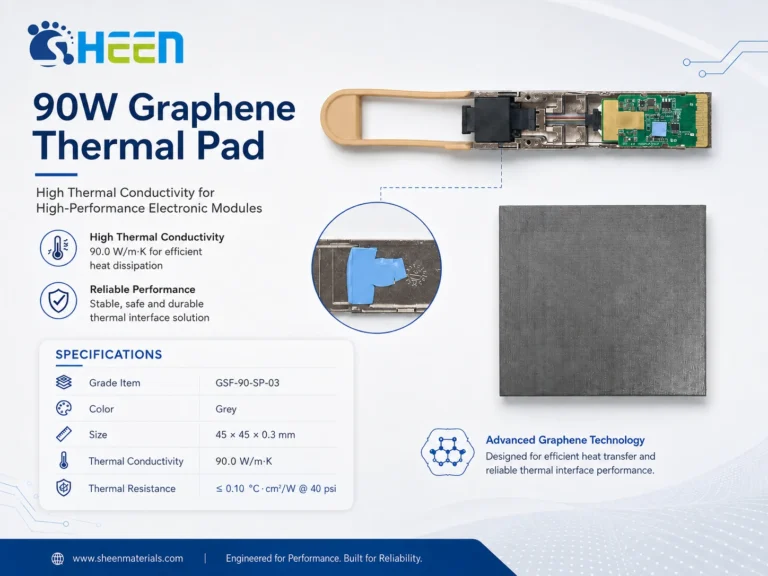
Some engineers prefer coatings for flexibility. Others go with dense laminates for raw heat-spreading power. Custom graphene thermal conductive solutions bridge both worlds, giving designers freedom instead of trade-offs. Sheen Materials supports this shift by offering adaptable graphene thermal materials tailored to real manufacturing workflows.
5 Key Steps for Optimal Heat Dissipation
High-power electronics are running hotter than ever, and off-the-shelf materials just don’t cut it anymore. That’s why Custom graphene thermal conductive solutions are gaining real traction. From chip packaging to power modules, tailored graphene thermal solutions help engineers fine-tune heat flow, boost reliability, and keep performance steady under pressure.
Step 1: Choosing the Right Graphene Formulation
Selecting a graphene formulation starts with matching 材料特性 to device goals. Not all graphene behaves the same.
- Material performance alignment
- 熱伝導率
- In-plane heat spreading for IC substrates
- Through-plane transfer for TIM layers
- 電気伝導度
- Conductive paths for grounding
- Insulating hybrids for sensitive circuits
- 熱伝導率
- Structural considerations
- Purity
- Low defect density improves heat paths
- Controlled oxygen content in reduced forms
- Morphology
- Flake size distribution
- Layer thickness consistency
- Purity
For brands like シーン・マテリアル, tuning graphene nanoplatelets versus multilayer structures allows true Custom graphene thermal conductive solutions that balance heat transfer and insulation without compromise.
Step 2: Optimizing Filler Loading and Viscosity
Thermal gains don’t just depend on adding more filler. Smart control of フィラー充填 そして 粘度 defines real-world 熱性能.
- Dispersion engineering
- Particle size
- Micro-scale for bridging gaps
- Nano-scale for interface density
- Dispersion quality
- Reduced agglomeration
- Stable suspension during storage
- Particle size
- Processing behavior
- Rheology
- Shear-thinning for coating
- Controlled flow during screen printing
- Material processing
- Pumpability
- Void reduction in bond lines
- Rheology
Balanced graphene thermal solutions prevent excessive thickness while maintaining strong interfacial contact. That’s the sweet spot for Custom graphene thermal conductive solutions used in compact power electronics.
Step 3: Integrating Thermal Interface Materials via Screen Printing
Precision matters when applying 熱界面材料 in high-density layouts.
- Application control
- Screen printing
- Mesh selection
- Controlled squeegee pressure
- Layer thickness
- Thin bond lines for low 熱抵抗
- Uniform coverage across substrates
- Screen printing
- Adhesion and reliability
- Printability
- Stable paste formulation
- Adhesion
- Strong substrate bonding
- Minimal void formation
- Printability
Custom graphene thermal conductive solutions designed for printing improve repeatability in large-scale 製造工程 lines. シーン・マテリアル supports this with custom graphene solutions tailored to automated production.
Step 4: Ensuring Thermal Cycling Stability in Device Assembly
Repeated 熱サイクル pushes materials hard. Expansion, contraction, stress—over and over.
- Mechanical endurance
- Thermal stress
- Coefficient of expansion matching
- Adhesion strength
- Resistance to micro-cracking
- Thermal stress
- Reliability metrics
- Material degradation
- Oxidation control
- Interface stability
- Long-term performance
- Consistent conductivity after 1,000+ cycles
- Material degradation
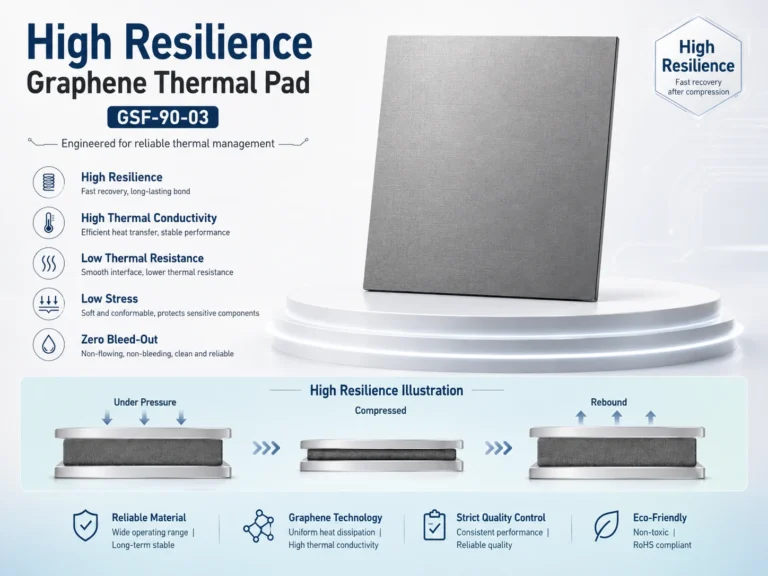
Custom thermal conductive materials built with graphene improve flexibility while maintaining strong bonding. In demanding device assembly environments, graphene heat dissipation solutions help avoid delamination and performance drop-offs.
Step 5: Validating Heat Flux and Junction Temperature Reduction
Performance claims mean nothing without numbers. Real validation focuses on heat flux そして ジャンクション温度.
- Measurement framework
- Measurement techniques
- Infrared thermography
- Embedded thermocouples
- Validation
- Before-and-after comparison
- Power cycling tests
- Measurement techniques
- Efficiency outcomes
- Thermal resistance
- より低いインターフェース抵抗
- Device efficiency
- Higher power density
- Extended component lifespan
- Thermal resistance
When properly engineered, Custom graphene thermal conductive solutions deliver measurable drops in junction temperature, translating directly into safer margins and longer-lasting electronics. That’s where graphene thermal solutions from シーン・マテリアル stand out—performance you can actually verify, not just promise.
Custom Graphene Thermal Conductive Solutions ROI Metrics
Custom graphene thermal conductive solutions are changing how engineers handle heat. From tighter 熱管理 budgets to longer chip life, the numbers now speak loud and clear. Let’s break down how Custom graphene thermal conductive solutions pay off in real operations.
Junction Temperature Drop and Power Density Management
When the ジャンクション温度 drops, everything runs smoother. Custom graphene thermal conductive solutions push 放熱 faster, cutting 熱抵抗 at the interface.
- Lower peak temperature
- より高い 電力密度
- 安定 device performance
- Improve interface contact
- Reduce hotspot formation
- Optimize 冷却ソリューション
Nested impact flow:
- Thermal pathway optimization
- Graphene layer alignment
- ↓ 8–15°C average junction drop
- Graphene layer alignment
- Load handling
- Increased chip stacking
- ↑ power density without throttle
- Increased chip stacking
Performance Snapshot
| 申し込み | Temp Drop (°C) | Power Density Gain (%) |
|---|---|---|
| CPU module | 10 | 18 |
| IGBT | 14 | 22 |
| LED array | 9 | 15 |
| EV inverter | 12 | 20 |
| 5G RF unit | 8 | 13 |
That’s real thermal control, not lab talk.
Extending Device Lifetime through Improved Thermal Stability
Heat stress kills reliability. Custom graphene thermal conductive solutions improve 熱安定性, slowing degradation and protecting 材料特性.
- Reduced micro-cracks
- Lower expansion mismatch
- 長い operational lifespan
Lifecycle chain:
- Temperature stabilization
- 削減 heat stress cycles
- 改善された device lifetime
- Higher field 信頼性
- 削減 heat stress cycles
In practice, electronics using graphene thermal interface materials show fewer early failures. シーン・マテリアル fine-tunes filler dispersion so performance stays consistent across wide swings. The result? Less downtime. More uptime.
Reliability Testing: Thermal Cycling and Mechanical Flexibility
No shortcuts here. Reliability testing validates every batch of Custom graphene thermal conductive solutions.
Process logic:
- Environmental validation
- Thermal cycling (-40°C to 150°C)
- Crack resistance check
- Thermal cycling (-40°C to 150°C)
- Mechanical assessment
- Mechanical flexibility bend tests
- Interface adhesion review
- Mechanical flexibility bend tests
- Stress protocol
- Repeated load simulation
- Material integrity confirmation
- Repeated load simulation
Quick checks include:
• 1,000+ cycle endurance
• Flex radius under 5 mm
• Continuous performance validation
Graphene-based thermal management materials from シーン・マテリアル keep 耐久性 intact even after repeated expansion stress. That’s where graphene cooling solutions stand apart.
Cost Savings of Roll-to-Roll vs. CVD Growth Methods
Production method shapes ROI. Custom graphene thermal conductive solutions made via roll-to-roll manufacturing shift the cost curve.
Comparison structure:
- Production methods
- CVD growth
- High purity, slower throughput
- Roll-to-roll
- 高い scalability
- 強い cost efficiency
- CVD growth
Cost logic:
- Continuous substrate feed
- Reduced transfer steps
- Lower energy input per m²
Short take:
Lower capex.
Faster output.
Stable graphene synthesis quality.
For OEMs scaling graphene heat dissipation films, roll-to-roll fabrication techniques cut total ownership cost while keeping thermal management performance strong. That’s why Custom graphene thermal conductive solutions from シーン・マテリアル balance graphene synthesis control with commercial scalability—smart engineering, solid ROI.