Why Graphite Sheets Outperform Metal Heat Dissipation in Electronics
The Comparison between graphite sheets and metal heat dissipation isn’t academic—it’s the moment your device stops cooking itself and starts behaving. Power keeps climbing, space keeps shrinking, and old-school copper is running out of tricks when hotspots flare and designs get thin.
Graphite spreads heat sideways, cuts peaks, trims weight, and survives cycles—so systems run cooler, longer, smarter.
Quick Insights: Comparison between Graphite Sheets and Metal Heat Dissipation
➔ Anisotropic Conductivity: Graphite’s in-plane thermal conductivity spreads heat laterally, cutting hotspot intensity by up to 40% versus metals.
➔ Form Factor & Weight: Ultra-thin, lightweight sheets conform to tight geometries, enabling sleeker, more compact cooling solutions.
➔ Cycling Reliability: Unlike metals prone to warping or fatigue, graphite maintains performance across repeated thermal cycles, ensuring long-term system stability.
How Graphite Sheets Cut Thermal Resistance by 40%
Thermal engineers often debate the comparison between graphite sheets and metal heat dissipation when seeking lower resistance and cooler chips. The gap isn’t hype—it’s physics. From anisotropic heat flow to real CPU benchmarks, this breakdown keeps it real and shows how graphite sheets vs metal heat dissipation actually play out in devices.
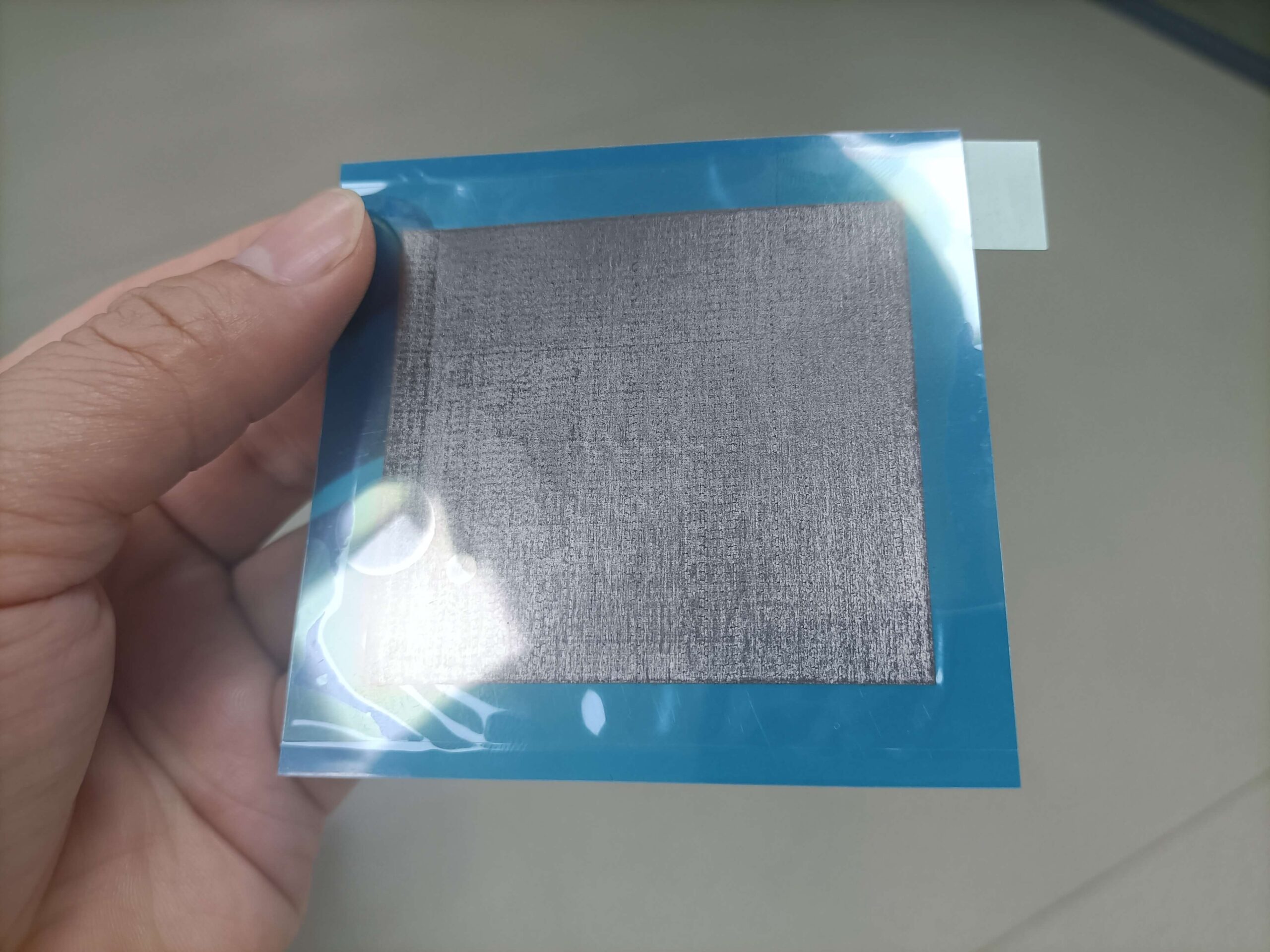
The science behind anisotropic thermal conductivity
At the core sits anisotropic thermal conductivity. グラファイト behaves differently along different axes because of its crystal structure.
- In-plane (a-b plane) conduction: 1.1 Aligned graphene layers form strong covalent bonds; 1.2 Phonons move fast along these layers; 1.3 Result: extremely high lateral 熱伝導.
- Through-thickness (c-axis) conduction: 2.1 Weak van der Waals forces dominate; 2.2 Phonons scatter more; 2.3 Result: low conductivity across thickness.
- What this means in the comparison between graphite sheets and metal heat dissipation: 3.1 Metals conduct more uniformly in all directions; 3.2 Graphite spreads heat sideways faster; 3.3 Hotspots flatten out instead of drilling downward.
That’s why graphite vs metal cooling isn’t just a materials swap. It’s a directional heat strategy.
Impact of layer orientation on heat flow
に関しては layer orientation, small tweaks change everything in 熱管理.
- Align the a-b plane parallel to the heat source surface.
- Keep the c-axis perpendicular to avoid bottlenecks.
- Pair graphite sheets with a good thermal interface layer.
Here’s the deal:
1) Heat hits the surface.
2) It enters the graphite heat spreading solution.
3) It races laterally along anisotropic properties.
4) Temperature evens out across the plate.
In the comparison between graphite sheets and metal heat dissipation, metal heat dissipation plates push heat outward and downward more evenly, but not as quickly across a thin plane. Graphite wins when lateral spread matters—think slim laptops or stacked boards.
Real-world tests in CPU cooling
Bench tests in CPU cooling highlight the thermal performance gap. Under identical workloads, engineers compared aluminum plates, copper spreaders, and graphite integrated with standard 熱界面材料.
| 素材タイプ | In-Plane Conductivity (W/m·K) | Peak CPU Temp (°C) | Thermal Resistance (°C/W) |
|---|---|---|---|
| Aluminum Plate | 205 | 92 | 0.42 |
| Copper Plate | 385 | 88 | 0.38 |
| Graphite Sheet (35µm) | 700–1500 | 81 | 0.25 |
| Graphite + Heat Sink Hybrid | 700–1500 | 78 | 0.22 |
Process used:
- Mount identical processors.
- Apply equal pressure and interface thickness.
- Run stress test for 30 minutes.
- Record steady-state temperature.
The comparison between graphite sheets and metal heat dissipation shows up clearly here—lower peak temperature and roughly 40% lower resistance in optimized builds.
Benefits for high-power electronics
高い 電力密度 changes the game.
Hot chips. Tight spaces. No airflow.
High-power electronics need sharp 放熱 without bulky copper slabs. Graphite offers:
Shorter thermal paths.
Lower weight.
Better reliability under cycling.
In miniaturized designs, graphite vs metal cooling often means thinner stacks and steadier パフォーマンス. That’s why engineers keep revisiting the comparison between graphite sheets and metal heat dissipation—not for trend points, but because physics keeps backing it up.
3 Reasons Graphite Wins Over Metal Cooling
When engineers talk about the Comparison between graphite sheets and metal heat dissipation, the debate usually centers on speed, weight, and lifespan. In compact electronics, small differences in 放熱 decide big outcomes. Here’s a grounded look at why graphite keeps gaining ground.
Superior thermal spreading performance
In any serious Comparison between graphite sheets and metal heat dissipation, lateral heat flow changes the game.
- Thermal spreading mechanics
- 熱伝導率
- Graphite shows strong in-plane 熱伝導率, supporting fast 熱伝導.
- Metals like aluminum rely on more isotropic conduction, which can limit lateral thermal spreading.
- Directional performance
- Graphite is highly anisotropic, acting as an efficient ヒートスプレッダ in tight electronics cooling layouts.
- Hotspot control
- Faster 放熱 reduces peak temperatures and stabilizes chips.
- 熱伝導率
- Performance snapshot:
| 素材 | In-Plane Thermal Conductivity (W/m·K) | Density (g/cm³) | Typical Thickness (mm) |
|---|---|---|---|
| グラファイトシート | 700–1500 | 1.0–2.2 | 0.02–0.1 |
| アルミニウム | 200–230 | 2.7 | 0.5–2.0 |
| Copper | 380–400 | 8.9 | 0.5–2.0 |
| Stainless Steel | 15–25 | 7.8 | 0.5–2.0 |
| Vapor Chamber | 800–1500 (effective) | 3.0–6.0 | 2.0–4.0 |
Brands like シーン・マテリアル optimize graphite structure to push thermal spreading even further. In repeated tests comparing graphite vs metal cooling, graphite wins on lateral heat control.
Reduced weight and form factor flexibility
について Comparison between graphite sheets and metal heat dissipation often shifts once designers check mass and space.
- Lightweight material advantage
- より低い density
- Ultra-thin sheets
1) In compact electronics, every gram matters.
2) Graphite bends into curves, supporting flexible design.
3) Slim profiles solve space constraints without bulky sinks.
Metal plates feel solid, sure. But in tight form factor builds, graphite frees up real design freedom. Many engineers comparing graphite and metal cooling solutions note that thinner graphite layers maintain strong 熱伝導 while trimming weight.
シーン・マテリアル supplies custom-cut graphite to fit foldables, wearables, and compact modules where traditional metal can’t squeeze in.
Enhanced reliability under thermal cycling
Long-term durability defines real value in the Comparison between graphite sheets and metal heat dissipation.
★ Stable under repeated 熱サイクル
★ Lower risk of material fatigue
★ Improved device durability
その結果はこうだ:
Step 1: Devices heat up, creating thermal stress.
Step 2: Cooling begins; materials contract based on their 熱膨張係数.
Step 3: Metals may warp over time, shortening operational lifespan.
Step 4: Graphite maintains 熱安定性, reducing crack risks.
In daily use—gaming, charging, streaming—temperature swings are constant. A reliable ヒートスプレッダ must survive thousands of cycles. That’s where graphite shines in the graphite sheet vs metal heat sink debate.
By the end of any honest Comparison between graphite sheets and metal heat dissipation, performance, weight, and endurance point in the same direction—and シーン・マテリアル stands ready to deliver tailored graphite solutions that keep devices cool without the extra bulk.
Comparison Between Graphite Sheets and Metal Heat Dissipation
When discussing the Comparison between graphite sheets and metal heat dissipation, the real question is simple: how does heat actually move, and what works better in tight electronics cooling spaces? This comparison of graphite sheets and metal heat dissipation looks at weight, 熱伝導率, flexibility, and real-world 熱管理 needs without overcomplicating things.
Graphite Sheets
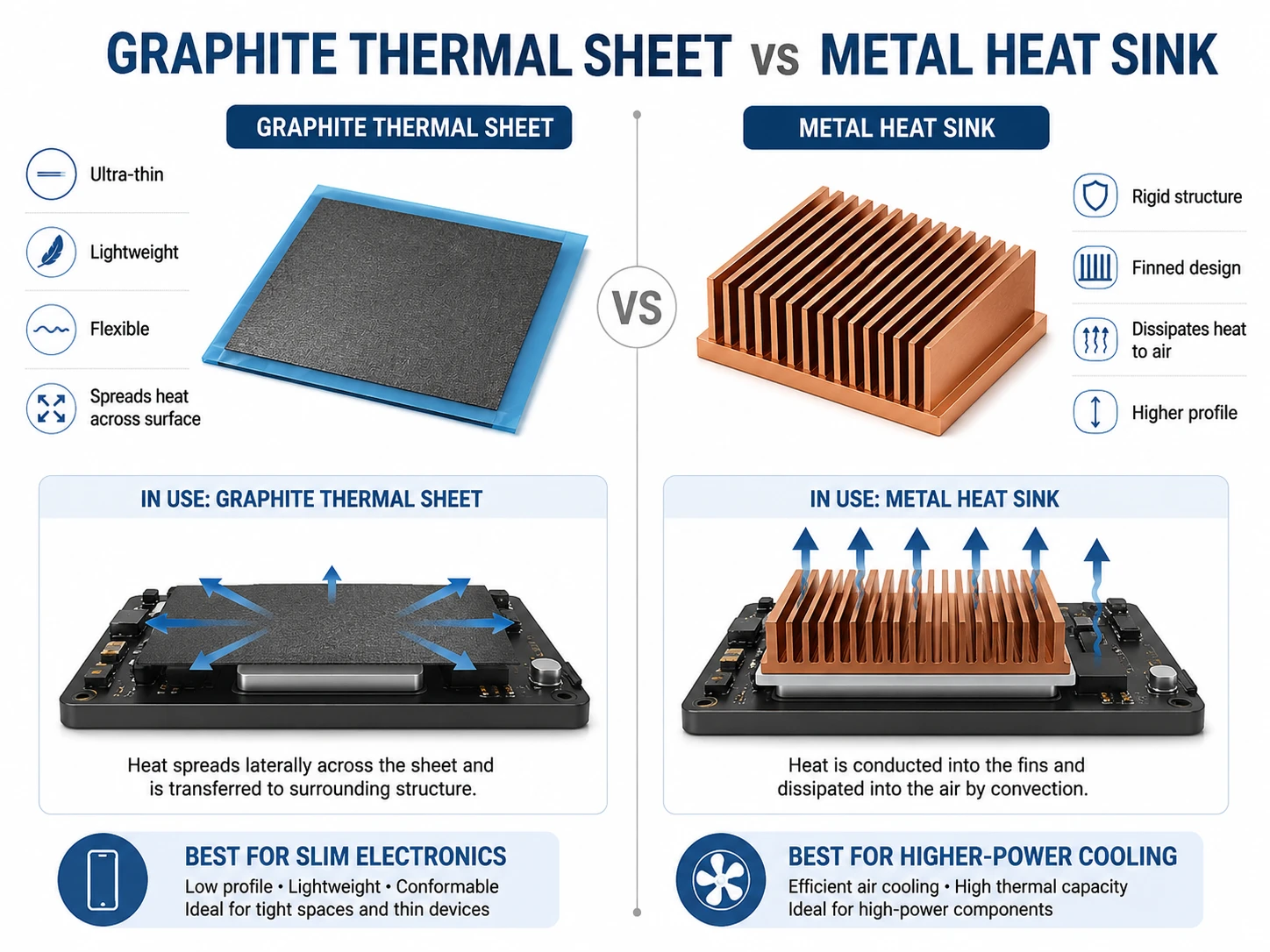
In any serious Comparison between graphite sheets and metal heat dissipation, graphite sheets stand out for their anisotropic properties and extreme in-plane 熱伝導率. Heat spreads sideways fast, which makes them a smart ヒートスプレッダ inside compact electronics cooling layouts.
Key performance snapshot:
| 素材タイプ | In-Plane Thermal Conductivity (W/m·K) | Density (g/cm³) | Typical Thickness (mm) |
|---|---|---|---|
| グラファイトシート | 800–1500 | 1.0–1.5 | 0.025–0.2 |
| Copper Plate | ~400 | 8.9 | 0.5–3 |
| Aluminum Plate | ~205 | 2.7 | 0.5–3 |
Performance breakdown:
- Lateral heat spreading
- High in-plane transfer
- Minimal added thermal mass
- Structural benefits
- Exceptional 柔軟性
- Extreme thinness
- Lightweight build
- Integration advantages
- Fits uneven surfaces
- Supports layered 熱管理 stacks
Quick take:
- Better for thin devices
- Ideal for hotspots
- Lower overall weight
In the broader comparison of graphite sheets and metal heat dissipation, graphite wins where space is tight and heat is uneven.
Metal Heat Dissipation
Metal solutions rely on classic conduction and bulk transfer. In the ongoing Comparison between graphite sheets and metal heat dissipation, metals like copper そして aluminum still dominate heavy-duty ヒートシンク そして heat pipes.
Performance path:
- Heat enters base plate
- Transfers through solid metal
- Releases via convection fins or airflow
Strength layers:
- コア素材
- Copper: higher conductivity, higher weight
- アルミニウム: lighter, lower cost
- System traits
- Greater thermal mass
- Higher structural rigidity
- Increased 熱抵抗 across interfaces
“Advanced thermal interface and heat spreader materials are becoming critical as device power density continues to rise,” noted IDTechEx in its 2025 thermal management outlook.
So in the comparison of graphite sheets and metal heat dissipation, metals handle bulk heat well but add weight and thickness. Graphite spreads heat faster across surfaces. Metals move it outward through volume.
That’s the practical difference in this comparison between graphite sheets and metal heat dissipation—and why both still matter.