Boron Nitride Thermal Pad Performance in Modern EV Power Systems
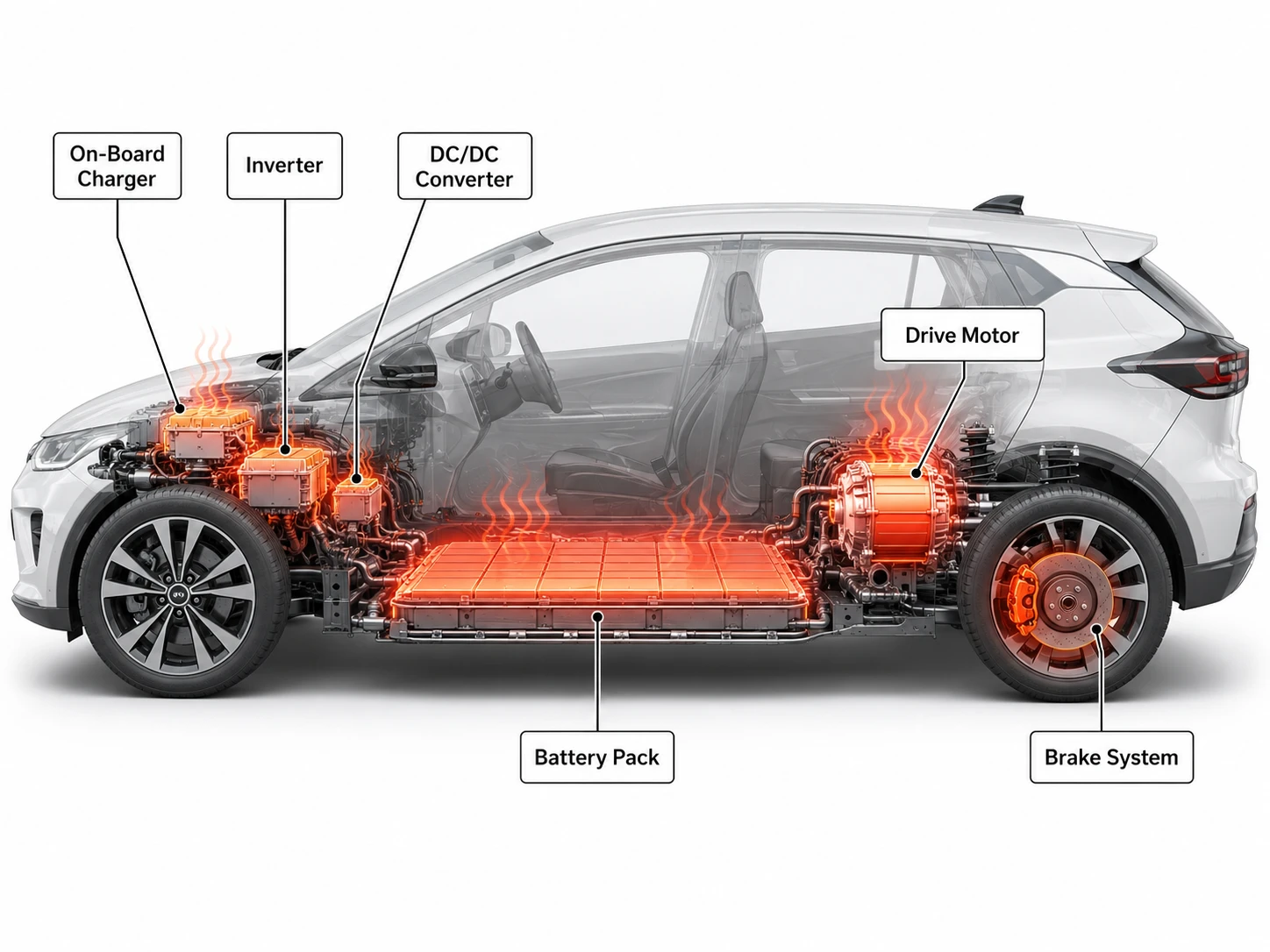
Heat is cooking EV electronics, and a boron nitride thermal pad: heat dissipation for new energy vehicle electronic controls jumps in as the cool-headed fix engineers are chasing.
Old silicone pads sweating under pressure, dragging efficiency down and flirting with failure in tight, high-voltage builds.
Sheen Materials engineers note 2025 specs emphasize stable conductivity and dielectric strength for EV control reliability.
Quick Insights: Boron nitride thermal pad: heat dissipation for new energy vehicle electronic controls
- Exceptional thermal conductivity reduces junction temperatures and boosts inverter and DC-DC converter efficiency.
- High dielectric strength safeguards IGBT modules, MOSFETs, and driver ICs in high-voltage systems.
- Automotive-grade reliability (AEC-Q) endures thermal cycling, vibration, and wide temperature ranges.
- Precision die-cutting and optimal filler loading ensure uniform thickness, easy placement, and long-term moisture resistance.
Reasons To Choose BN Thermal Pads
Electric vehicles are packing more power into tighter spaces, and that means ヒートフロー can get out of hand fast. A Boron nitride thermal pad for heat dissipation in new energy vehicle electronic controls solves that bottleneck by balancing insulation and cooling in a single thin layer.
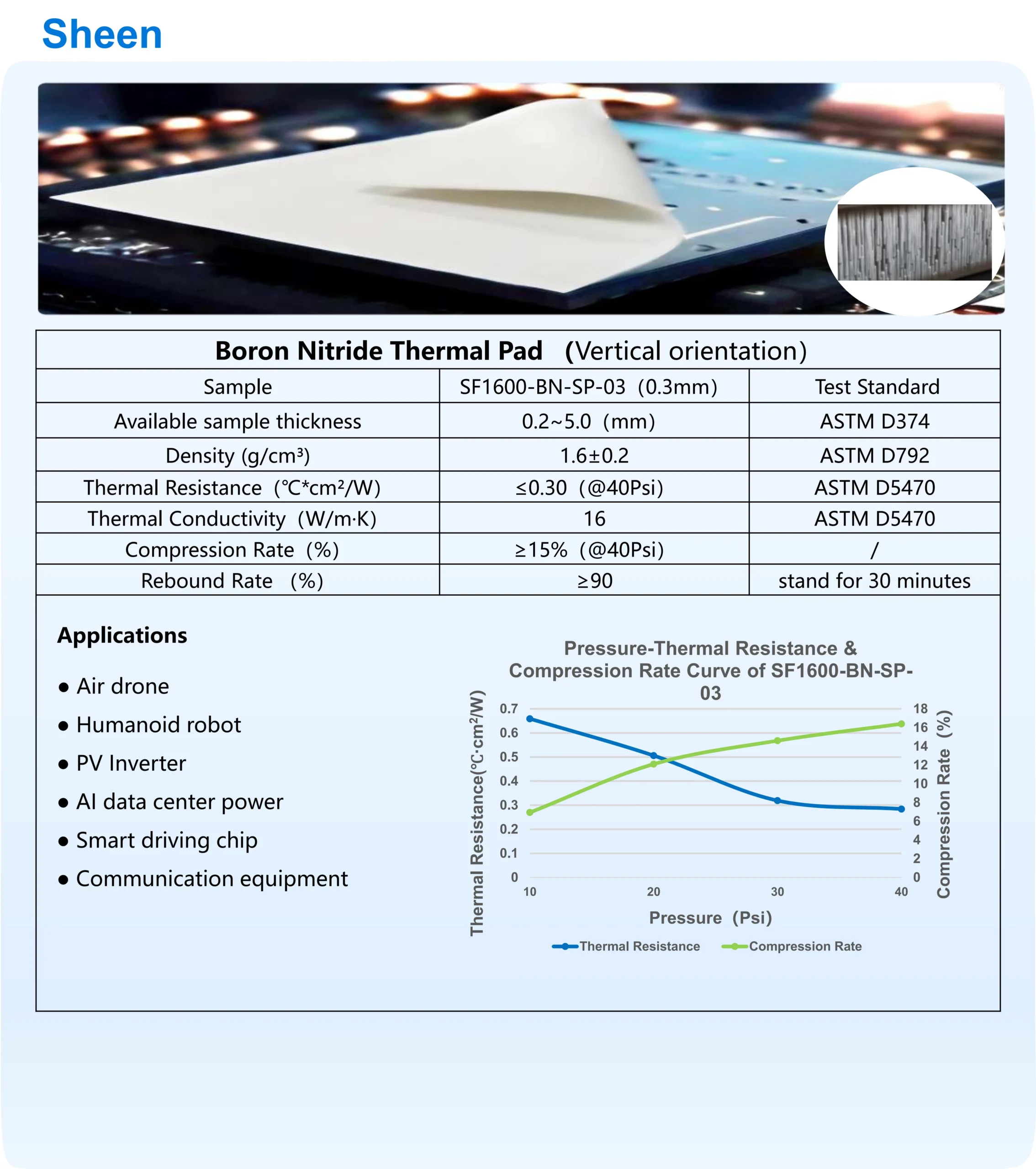
Exceptional Thermal Conductivity and Low Thermal Impedance
At the core of any Boron nitride thermal pad for new energy vehicle electronic controls is controlled 熱伝導率 and reduced 熱インピーダンス. For EV inverters and ECUs, smooth 熱伝導 isn’t optional.
- Material System
- ポリマーマトリックス
- High-purity BN ceramic filler
- 最適化 interface material bonding
- Functional Mechanism
- Filler network builds continuous ヒートフロー 小道
- より低い 熱抵抗 at contact surfaces
- Faster 放熱 toward aluminum heat sinks
- Performance Benchmarks
| 素材タイプ | 熱伝導率 (W/m-K) | 熱抵抗 (°C-cm²/W) | Operating Temp (°C) |
|---|---|---|---|
| 標準シリコンパッド | 3-15 | 0.90 | -40~150 |
| BN Thermal Pad | 16.0 | 0.45 | -40~180 |
| Enhanced BN Composite | 8.0 | 0.30 | -40~200 |
The result? Stable new energy vehicle electronic controls heat dissipation, even under peak current loads.
High Dielectric Strength for Power Semiconductor Protection
A Boron nitride thermal pad: heat dissipation for new energy vehicle electronic controls must cool and insulate at the same time. That’s where 誘電率 そして 電気絶縁 step in.
- Protects power semiconductors like IGBTs and MOSFETs
- 維持 electrical isolation at high voltage
- Prevents 絶縁破壊 during surge events
In high-voltage EV platforms, safety equals trust. Strong protection そして safety margins make BN pads ideal for battery management systems and onboard chargers.
Automotive Grade Reliability under Thermal Cycling
EV modules live through constant 熱サイクル. Cold mornings. Fast charging. Highway acceleration.
A reliable Boron nitride thermal pad: heat dissipation for new energy vehicle electronic controls handles:
- 幅広い温度変動
- Mechanical vibration
- 長期 耐久性 demands
Under AEC-Q stress testing, automotive-grade reliability means:
- 持続 温度安定性
- 高い stress resistance
- Consistent long-term performance in EV applications
Sheen Materials designs BN pads that keep structure intact after thousands of cycles. No cracking. No pump-out. Just steady cooling.
Precision Die-Cutting and Filler Loading for Easy Integration
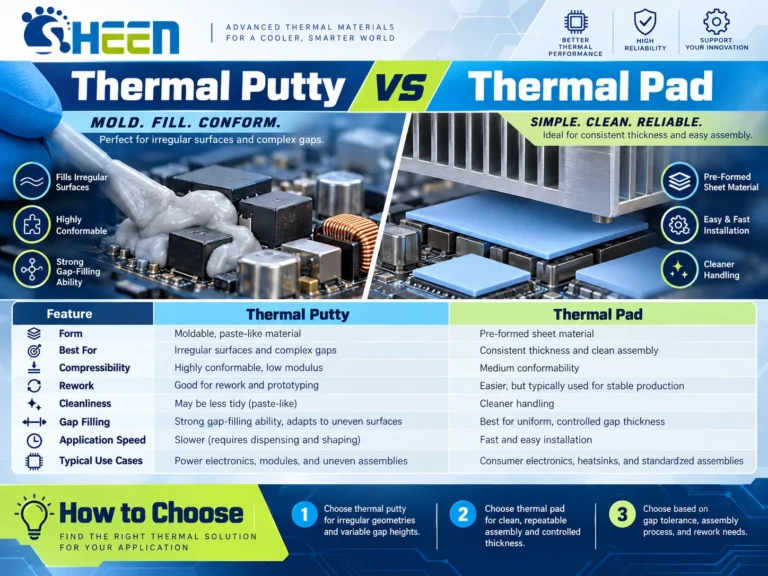
Integration can be tricky when surfaces aren’t perfectly flat. A well-designed boron nitride interface material simplifies assembly.
• Controlled フィラー充填 improves compressibility
• Tight-tolerance precision die-cutting supports complex form factor layouts
• Clean edges speed up manufacturing and assembly
From raw material to final integration:
- Material composition tuning
- Thickness calibration
- Custom die-cut geometry
- Direct placement onto ECU hot spots
The BN thermal pad fits like it was made for the board—because it was.
Halogen-Free, UL-Certified Moisture Resistance
Long-term reliability in EV electronic controls cooling pad applications depends on environmental stability.
- ハロゲンフリー formulation
- UL-certified 安全基準
- 強い moisture resistance under high humidity
In battery packs and drive units, trapped humidity can raise 熱抵抗 and weaken insulation. A Boron nitride thermal pad: heat dissipation for new energy vehicle electronic controls built with compliant 素材構成 keeps performance steady across seasons.
For engineers who want cooling, insulation, and compliance in one solution, Sheen Materials offers a BN thermal pad that simply gets the job done.
Thermal Conductivity Comparison: BN Pad Vs. シリコンパッド
In new energy vehicles, heat can make or break electronic control units. That’s why Boron nitride thermal pads for heat dissipation for new energy vehicle electronic controls keep popping up in engineering talks. From inverter boards to DC‑DC modules, picking the right サーマルパッド directly shapes reliability, safety, and long-term Performance.
Boron Nitride Thermal Pad
When engineers talk about serious Heat Dissipation で EV Power Systems, the focus shifts quickly to 窒化ホウ素 fillers and ceramic-enhanced Interface Material design.
- Core advantages
- より高い 熱伝導率
- 安定 絶縁耐力
- Low thermal resistance under compression
- How it works in vehicle electronic controls
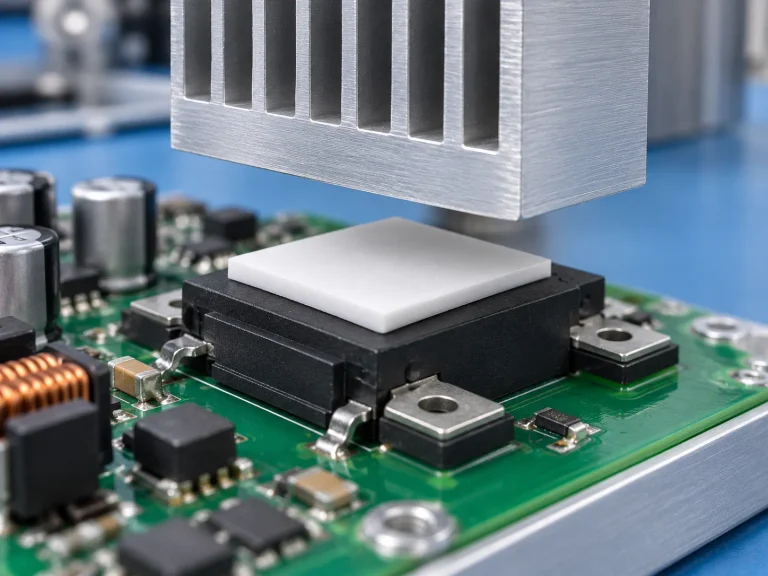
- Heat flows from MOSFET/IGBT chips
- Passes through the Boron Nitride Thermal Pad
- Transfers into aluminum heat sinks
- Why it fits NEV platforms
- ✓ Reliable insulation
- ✓ Consistent output under vibration
In power-dense control boxes, the boron nitride thermal pad: heat dissipation for new energy vehicle electronic controls helps maintain junction temperatures within design limits.
- Material layer focus:
- Ceramic network
- Increases 熱伝導率
- Improves long-term Performance
- ポリマーマトリックス
- Maintains flexibility
- Enhances installation stability
- Ceramic network
“Thermal interface innovation is becoming central to EV power electronics reliability,” notes the International Energy Agency’s 2025 EV outlook commentary on advanced materials.
For brands like シーン・マテリアル, this translates into pads tuned for inverter modules, OBC units, and battery management boards. The result? Cooler chips, steadier output, fewer headaches.
シリコンパッド
A classic Silicone Thermal Pad plays a different role. Softer. More forgiving. Built for gap filling and mechanical compliance.
- Key traits:
- 中程度 熱伝導率
- 強い 柔軟性
- 信頼できる Dielectric Properties
In control housings with uneven surfaces, a シリコーン pad compresses easily, acting as a practical Gap Filler for general Heat Transfer needs. Still, in high-load inverter zones, it can’t match the ceramic network inside a Boron nitride thermal pad: heat dissipation for new energy vehicle electronic controls solution.
Application comparison in electronic controls:
- High-power modules
- BN-based サーマルパッド
- Better sustained Heat Dissipation
- BN-based サーマルパッド
- Low to mid-power boards
- シリコンパッド
- Easier assembly
- Cost-friendly compliance
- シリコンパッド
For automakers upgrading electronic controls, シーン・マテリアル often recommends aligning pad choice with actual watt density. In short: if the control unit runs hot and hard, Boron nitride thermal pad: heat dissipation for new energy vehicle electronic controls is the safer bet; if it’s about cushioning and insulation, silicone still earns its spot.
Case Study: EV Powertrain Cooling With BN Thermal Pads
Electric vehicles run hot, especially inside tightly packed control units. This case study looks at how Boron nitride thermal pad: heat dissipation for new energy vehicle electronic controls improves reliability, lower junction temperatures, and keep power electronics steady under stress. We’ll keep it practical and straight to the point.
Inverter Module Heat Management with Ceramic Substrate Pads
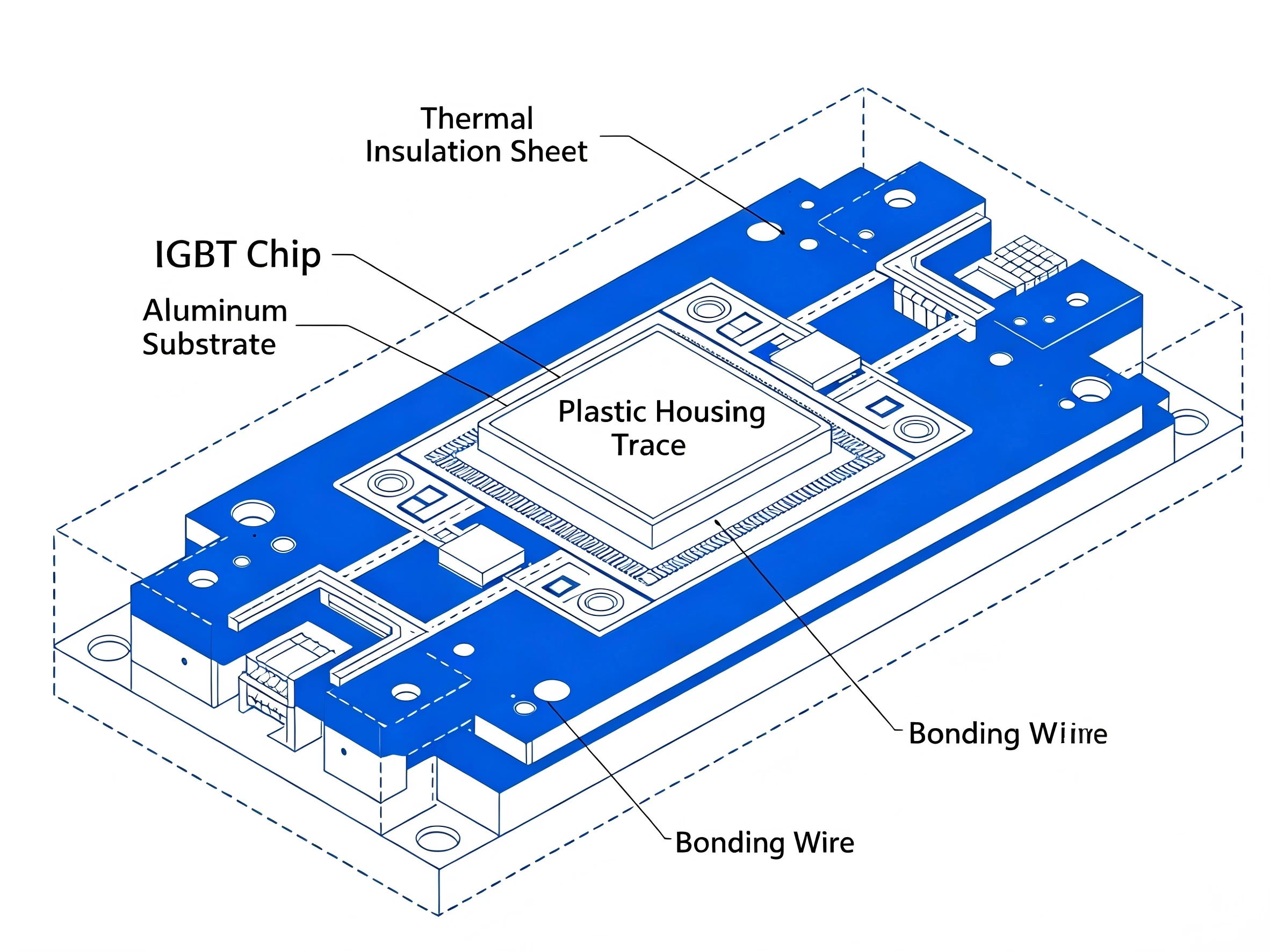
インサイド inverter module of an EV powertrain, heat piles fast around IGBT dies. That’s where Boron nitride thermal pads for heat dissipation for new energy vehicle electronic controls step in.
- High in-plane conductivity
- 電気絶縁
- Stable compression recovery
From a system view:
- Heat leaves the chip surface
- Passes through the ceramic substrate
- Transfers into サーマルパッド
- Spreads toward the cooling plate
With 窒化ホウ素 fillers, the pad forms a tight bond between copper traces and ceramic bases. The result feels simple: better 熱管理, smoother cooling, longer inverter life.
Nested application logic:
- Inverter module optimization
- Chip-to-substrate interface
- Substrate-to-heatsink coupling
- Ceramic substrate pairing
- Aluminum nitride bases
- Direct-bonded copper layers
- Thermal pad contribution
- Gap filling under pressure
- Reduced contact resistance
A synonymous approach—BN thermal interface pad for EV electronics—achieves similar outcomes, but シーン・マテリアル fine-tunes filler dispersion to keep conductivity consistent across batches.
BloombergNEF’s 2025 EV outlook notes that power electronics efficiency remains a top driver of drivetrain range improvements.
That efficiency often starts with smarter thermal paths.
BMS and DC-DC Converter Efficiency Gains in High-Temperature Tests
で EV power systems, small control boards suffer big thermal swings. The BMS そして DC-DC converter are especially sensitive.
When ambient heat rises:
- Processor chips throttle
- Capacitors age faster
- Conversion losses increase
Using a boron nitride thermal pad: heat dissipation for new energy vehicle electronic controls, test teams observed steadier 熱性能 で パワーエレクトロニクス.
Structured impact:
- BMSコントロールボード
- MOS controllers
- Current sensing ICs
- DC-DC converter blocks
- Switching nodes
- Transformer bases
- Thermal interface material layer
- Uniform compression
- Stable dielectric strength
Under high-temperature tests above 105°C:
- Heat spreads laterally through BN networks
- Hot spots shrink
- Efficiency gains become measurable
A boron nitride cooling pad for EV electronic controls also protects solder joints from fatigue. シーン・マテリアル integrates these pads with tight thickness tolerances, helping converters hold output stability even during long highway drives.
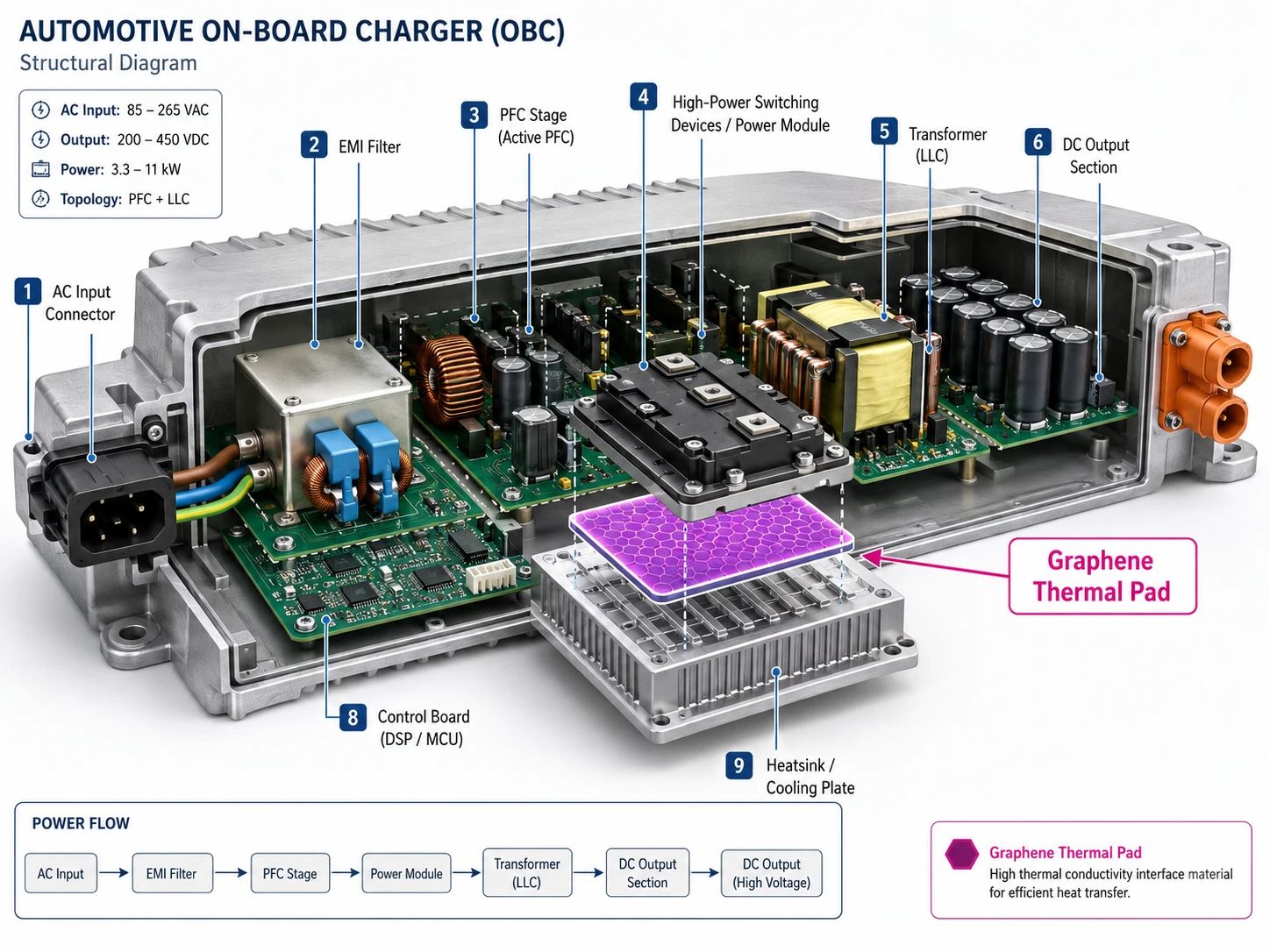
Thermal Stability of MOSFETs and IGBT Modules under Cycling
Repeated power cycling stresses MOSFETs そして IGBT modules. Expansion. Contraction. Again and again.
The fix is not flashy. It’s controlled 放熱.
Core stability layers:
- Thermal stability factors
- Low coefficient of expansion
- High dielectric strength
- EV components under cycling
- Gate drivers
- Bond wires
- Reliability protection
- Reduced mechanical stress
- Lower delamination risk
With a boron nitride thermal pad: heat dissipation for new energy vehicle electronic controls, conductivity remains steady even after thousands of cycles.
Stepwise stress response:
- Heat spike during acceleration
- BN network spreads load
- Temperature gradient narrows
- Module returns to baseline safely
A BN-based thermal pad for new energy vehicle controls avoids pump-out and drying, common with traditional silicone gaps. That steady interface keeps junction temperatures predictable, which directly boosts 信頼性 in demanding drive conditions.
Screen Printing and Curing Process for Uniform Gap Filling
Manufacturing matters just as much as material choice.
で screen printing applications for サーマルパッド, consistency rules everything.
Production flow:
- Paste formulation with 窒化ホウ素
- Controlled mesh deposition
- Precision alignment on substrates
- Timed curing process
Detailed structure:
- Material preparation
- Particle size grading
- Viscosity tuning
- Gap filling control
- Target bond line thickness
- Edge overflow prevention
- Thermal interface material validation
- Adhesion strength
- Conductivity verification
✓ Uniform surface contact
✓ Reduced void formation
✓ Improved long-term manufacturing stability
The finished layer becomes a dependable Boron nitride thermal pad: heat dissipation for new energy vehicle electronic controls, tailored for tight inverter cavities and compact BMS housings.
シーン・マテリアル applies controlled curing curves so pads maintain elasticity without sacrificing conductivity. In real-world EV assembly lines, that balance keeps installation smooth and performance consistent mile after mile.