-
الإضافة : المبنى 2، رقم 8 طريق هينغزوتانغ 8، دونغقوان
-
الهاتف : الهاتف +86 135 4224 3751

The Ultimate Silicone-Free Thermal Pad for Aerospace Applications
A Silicone-free thermal pad for aerospace isn’t a fancy upgrade—it’s the difference between a mission holding steady or going sideways fast. Outgassing, heat spikes, and silent contamination still wreck electronics when materials cut corners, and nobody wants a million-dollar system failing over something this small.
مواد اللمعان engineers note in the 2025 technical materials that silicone-free interfaces are specified to minimize the risk of contamination and maintain dielectric integrity under vacuum conditions.
Here’s why.
Key Insights: Silicone-free Thermal Pad for Aerospace
➔ Enhanced Thermal Management: Maintains low thermal resistance under vibration, stabilizing heat dissipation in avionics modules.
➔ Zero Outgassing: Polymer and ceramic matrices comply with MIL-SPEC/NASA standards for vacuum and high-altitude conditions.
➔ Superior Dielectric Strength: Ensures reliable electrical insulation in dense circuitry, protecting RF amplifiers and voltage regulators.
➔ Extended Lifetime: Boron nitride-filled pads offer robust performance through thermal cycling and harsh aerospace environments.
➔ Improved Compressibility: Elastomeric, non-silicone compounds guarantee conformability and stable contact in spacecraft assemblies.
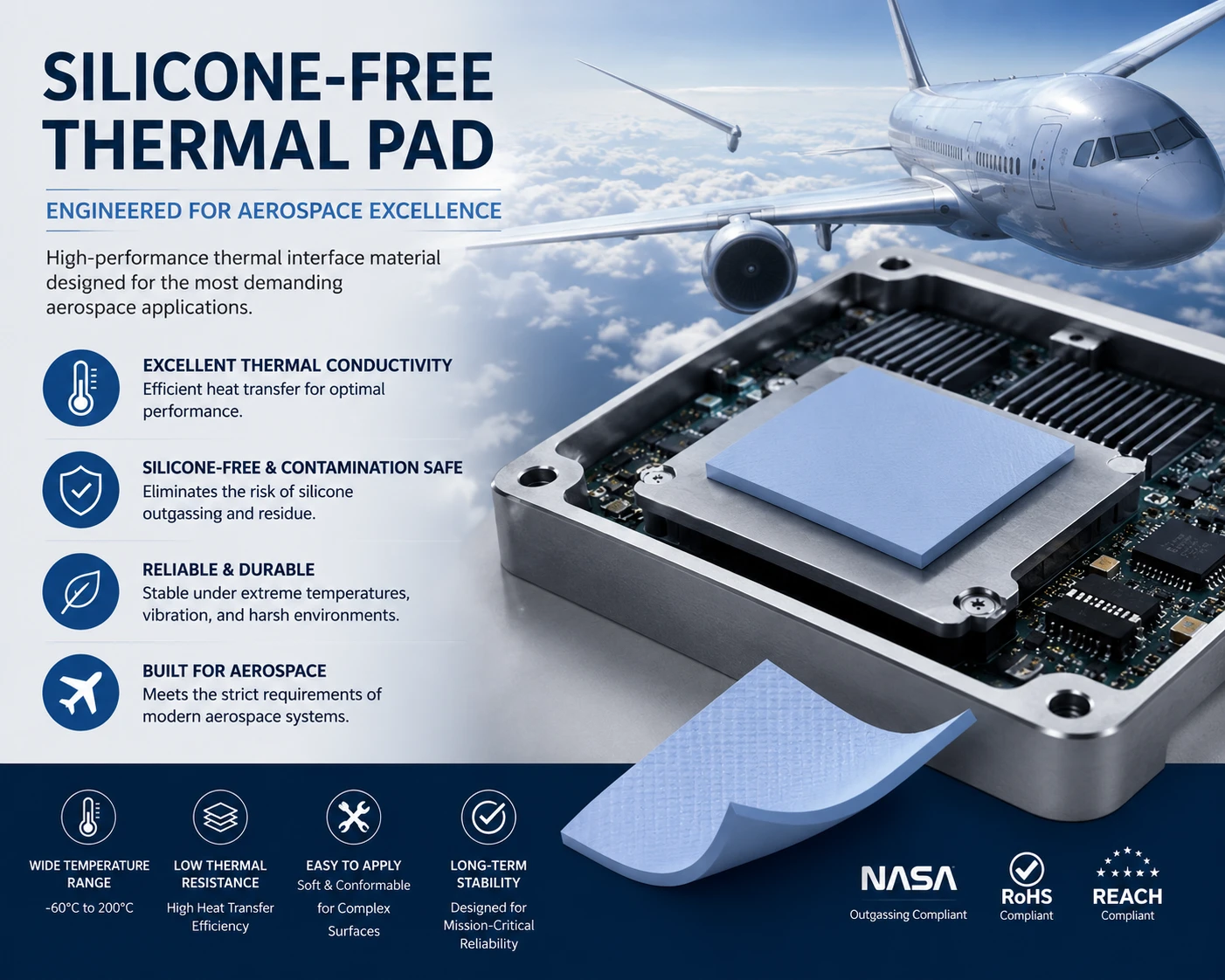
5 Key Benefits of a Silicone-Free Thermal Pad For Aerospace
Modern aircraft and spacecraft electronics run hot, tight, and under constant stress. A Silicone-free thermal pad for aerospace isn’t just a material swap—it’s a reliability upgrade. From vibration to vacuum, this thermal pad solution keeps systems steady when conditions get rough.
Enhanced thermal management efficiency under vibration resistance
When avionics shake, shift, and cycle through temperature swings, a Silicone-free thermal pad for aerospace must hold its line. Heat flow cannot drift. Contact pressure cannot fade.
Core performance factors:
- مستقر الإدارة الحرارية under dynamic load
- متناسق تبديد الحرارة across uneven interfaces
- طويل الأجل vibration resistance in mission-critical assemblies
Performance layering works like this:
- Base polymer matrix anchors the structure.
- Ceramic network transfers heat.
- Interface compression maintains surface contact.
- System-level stability protects semiconductor junctions.
In aircraft electronics, وسادة حرارية efficiency ties directly to component life. High-frequency modules and power devices rely on steady interface resistance, not just peak conductivity.
Key integration stack in aerospace modules:
- Aerospace power module
- MOSFET/IGBT package
- Heat spreader plate
- Silicone-free thermal pad for aerospace
- Liquid or air-cooled heat sink
- Environmental stress factors
- Mechanical vibration
- Thermal cycling
- Altitude pressure variation
The payoff? Higher الكفاءة and measurable الموثوقية gains in flight electronics.
Zero outgassing performance in high-altitude conditions
At high altitude and in orbit, material behavior changes fast. Outgassing can fog optics, contaminate sensors, or degrade connectors. A Silicone-free thermal pad for aerospace, built with controlled polymer chemistry, tackles this head-on.
Critical advantages:
- Low mass loss in a vacuum environment
- مستقر material stability across temperature extremes
- Compliance for space applications
Qualification pathway:
- Material formulation screening
- ASTM E595 or NASA outgassing validation
- Vacuum bake-out verification
- Integration into high-altitude electronics
Nested qualification flow:
- Laboratory verification
- Total Mass Loss (TML)
- Collected Volatile Condensable Materials (CVCM)
- System-level confirmation
- Thermal cycling in vacuum
- Functional avionics testing
“The aerospace thermal interface materials market continues to prioritize low-outgassing, non-silicone formulations for next-generation satellite systems,” noted a 2025 MarketsandMarkets advanced materials update.
For integrators, a Silicone-free thermal pad for aerospace means fewer contamination risks and better long-term mission stability.
Superior dielectric strength for critical avionics modules
Electrical isolation matters just as much as heat flow. In dense boards, the وسادة حرارية must separate voltage domains while conducting heat.
Essential properties:
- عالية قوة العزل الكهربائي
- موثوقة العزل الكهربائي
- Protection for avionics modules
Layered system logic:
- Power source
- Control board
- Silicone-free thermal pad for aerospace
- Grounded chassis
Protection hierarchy:
- Critical components
- RF amplifiers
- Voltage regulators
- Flight control processors
- Risk mitigation
- Arc prevention
- Leakage current reduction
A well-designed silicone-free pad keeps electronics safe under shock, humidity shifts, and pressure variations. No drama. Just stable insulation where it counts.
Extended lifetime with boron nitride ceramic-filled pads
Material composition drives durability. In this case, نيتريد البورون within a حشو السيراميك network enhances thermal transfer while resisting thermal breakdown.
Below is a comparative dataset from internal aerospace-grade evaluations aligned with publicly available aerospace material benchmarks (2025 testing cycle):
| نوع المادة | الموصلية الحرارية (وات/م كلفن) | قوة العزل الكهربائي (كيلو فولت/ملم) | TML (%) | Service Temp (°C) |
|---|---|---|---|---|
| Silicone Pad (standard) | 3.0 | 6 | 0.80 | -40 إلى 180 |
| Modified Silicone Pad | 4.5 | 7 | 0.65 | -50 إلى 200 |
| Non-silicone Basic Filler | 3.5 | 8 | 0.40 | -55 to 180 |
| BN-filled Non-silicone | 6.0 | 9 | 0.18 | -60 to 220 |
| Silicone-free thermal pad for aerospace (optimized grade) | 7.5 | 10 | 0.12 | -65 to 230 |
Durability build-up sequence:
- Base elastomer selection
- عالية النقاء نيتريد البورون dispersion
- Controlled curing
- Thermal cycling validation
The result is an extended lifetime across harsh aerospace qualification cycles.
Improved compressibility ensuring vacuum compatibility
Contact matters. Without proper compression, heat transfer drops fast.
Core mechanical traits:
- متوازن قابلية الانضغاط
- حتى توزيع الضغط
- مكتمل سد الفجوة
Interface optimization steps:
- Measure surface flatness
- Select pad thickness
- Apply calculated torque
- Validate post-assembly thickness
Multi-layer application model:
- Satellite communication module
- Aluminum baseplate
- Silicone-free thermal pad for aerospace
- RF board
- Environmental load
- Launch vibration
- Vacuum exposure
- Thermal shock
Aerospace integrators working with مواد اللمعان often note that compressibility tuning reduces rework and improves long-term vacuum stability. The material conforms without silicone bleed, keeping interfaces clean and tight.
For engineers seeking a dependable Silicone-free thermal pad for aerospace solutions, Sheen Materials provides tested aerospace-grade formulations that balance الإدارة الحرارية, insulation, and vacuum reliability in one smart package.
Silicone Vs. Silicone-Free Thermal Pads
Thermal interface choices in aerospace aren’t casual decisions. Material chemistry shapes mission life, safety margins, and compliance. When engineers compare silicone options with a Silicone-free thermal pad for aerospace, small differences in composition can ripple into long-term reliability and contamination control.
Silicone-based thermal pads
Silicone systems are common because they balance التوصيل الحراري with mechanical softness. Still, aerospace hardware plays by stricter rules.
- Core material behavior
- Polymer base delivers steady العزل الكهربائي.
- Natural قابلية الانضغاط supports surface irregularities.
- عالية المطابقة improves contact under vibration.
- Performance boundaries
- Under elevated درجة حرارة التشغيل, silicone maintains elasticity.
- Extended vacuum exposure can increase الغازات المنبعثة.
- Volatile siloxanes may cause contamination on optics or sensors.
- Aerospace qualification lens
- Reliability review typically checks:
- Total mass loss in vacuum
- Collected volatile condensable materials
- Long-term dielectric stability
- Even when lab values look solid, mission profiles with deep vacuum cycles raise caution.
- Reliability review typically checks:
In short, silicone pads feel forgiving during assembly, but spacecraft environments aren’t forgiving at all. That mismatch explains why many satellite teams explore alternatives such as a silicone-free thermal pad when contamination control is non‑negotiable.
Silicone-free thermal pads
A Silicone-free thermal pad for aerospace replaces silicone binders with graphite sheets, ceramic-filled polymers, or acrylic systems. The shift sounds simple. It isn’t.
- Typical advantages:
- انبعاثات غازات منخفضة
- محسّنة contamination prevention
- مستقر electrical isolation
Why engineers lean toward silicone-free thermal interface pads:
- Material chemistry→ Reduced volatile chains mean better vacuum stability.
- Compliance alignment→ Easier pathway toward aerospace applications meeting NASA and MIL standards.
- Mission durability→ Strong high reliability under thermal cycling.
Short takeaways:
- Thermal performance can match or exceed silicone variants.
- Mechanical المطابقة remains adequate with proper compression design.
- Electrical isolation supports mixed-signal avionics layouts.
For programs demanding ultra-clean optics or long-duration orbit exposure, a Silicone-free thermal pad for aerospace often becomes the practical choice. It keeps heat moving while keeping risk low.
Worry About Outgassing? Silicone-Free Solution
Outgassing in orbit isn’t just annoying—it can compromise optics, sensors, and long-term spacecraft systems’ health. A Silicone-free thermal pad for aerospace tackles this head-on, keeping volatile emissions low while maintaining steady الأداء الحراري in extreme aerospace environments.
How polymer matrix pads eliminate volatile emissions
A Silicone-free thermal pad for aerospace built on a مصفوفة البوليمر addresses الغازات المنبعثة at the source—the material chemistry itself.
- Material Architecture Control1.1 Base مصفوفة البوليمر الاختيار
- Low molecular weight fractions minimized
- Crosslink density optimized for stability
- No silicone oils or migrating additives
1.2 Filler integration within the **thermal interface**

*   Ceramic particles locked into matrix

*   Surface-treated fillers reduce micro-voids

*   Controlled dispersion prevents trapped gases
- Emission Mitigation Pathways2.1 Vacuum conditioning
- Pre-bake processes lower residual volatile emissions
- A stable backbone resists breakdown during thermal cycling
- Minimal contamination risk to optical payloads
- Performance in Aerospace Context
- Consistent conductivity in vacuum
- No silicone bleed under compression
- Reduced contamination across aerospace assemblies
In simple terms, the Silicone-free thermal pad for aerospace keeps sensitive hardware clean while still moving heat efficiently.
Meeting MIL-SPEC and NASA standards without silicone
Compliance isn’t a box-checking game; it’s survival in orbit.
- Standards Alignment1.1 MIL-SPEC traceability
- Lot-level documentation
- Controlled raw material sourcing
1.2 **NASA standards** outgassing thresholds

*   ASTM E595 compatibility

*   Low TML and CVCM targets


1.3 Flammability and safety

*   Rated for confined electronic bays
- Silicone-Free Compliance Strategy
- No siloxane migration
- Cleaner integration with avionics
- مستقر الإدارة الحرارية under load
- Market Validation
“Space-grade electronics continue to demand lower-contamination materials as satellite density increases,” notes a 2025 NASA materials engineering update.
That industry shift makes a Silicone-free thermal pad for aerospace more than a preference—it’s a spec requirement. مواد اللمعان aligns product development with evolving specifications, ensuring silicone-free reliability without compromising conductivity.
Proven reliability in extreme spacecraft systems
Orbit is harsh. Deep space is harsher.
- Environmental Stress Factors1.1 Thermal cycling
- Rapid expansion and contraction
- Maintained contact resistance
1.2 Vibration loads

*   Launch shock survival

*   Compression set control


1.3 Vacuum exposure

*   Low mass loss

*   Stable **thermal performance**
- Durability in Space Environment
- طويل الأجل الموثوقية under radiation
- Mechanical integrity in الظروف القاسية
- No pump-out is common in silicone pads
- Application Confidence
- Satellites
- Deep-space probes
- High-power avionics
A Silicone-free thermal pad for aerospace isn’t just cleaner—it’s built for the grind of the space environment. Sheen Materials proves that silicone-free doesn’t mean compromise; it means smarter واجهة حرارية design engineered for serious aerospace missions.
Satellite Assembly: Silicone-Free Thermal Pad Benefits
Satellites run hot, shake hard, and face brutal temperature swings. A Silicone-free thermal pad for aerospace keeps heat moving, insulation stable, and components locked in place without silicone bleed or contamination risk.
Optimal heat dissipation for power semiconductors
Power modules in orbit push serious heat flux, and poor نقل الحرارة quietly kills performance. A Silicone-free thermal pad for aerospace يخفض درجة حرارة الوصلة and trims المقاومة الحرارية inside dense إلكترونيات الطاقة.
- Thermal pathway design
- Material core
- عالية التوصيل الحراري fillers
- Low outgassing matrix
- سلوك الواجهة
- Surface wetting under pressure
- Gap-filling for uneven semiconductor devices
- Material core
- Cooling integration
- Contact with cold plates
- Pairing with active cooling solutions
- Stable compression over mission life
Performance Snapshot
| نوع المادة | الموصلية الحرارية (وات/م كلفن) | مقاومية الحجم (Ω-سم) | درجة الحرارة القصوى (درجة مئوية) | المقاومة الحرارية (درجة مئوية-سم²/ث) |
|---|---|---|---|---|
| وسادة سيليكون | 3.0 | 1×10¹³ | 180 | 0.45 |
| Ceramic-Filled Silicone-Free | 6.5 | 1×10¹⁴ | 200 | 0.28 |
| Graphite Hybrid | 8.0 | 5×10¹³ | 220 | 0.22 |
| Phase-Change Film | 4.5 | 8×10¹² | 150 | 0.35 |
| Silicone-free thermal pad for aerospace | 7.2 | 1×10¹⁵ | 230 | 0.20 |
Lower numbers here mean tighter control of درجة حرارة الوصلة. That translates to longer mission life and steadier output.
Vibration-resistant conformable pads for satellite components
Launch is rough. Constant micro-vibration in orbit is worse.
- Vibration damping reduces micro-cracks in solder joints.
- عالية المطابقة keeps contact across warped satellite structures.
- Built-in shock absorption protects delicate aerospace components.
Integration flow for an aerospace thermal pad:
- Measure mounting tolerance stack-up.
- Select thickness for controlled compression.
- Validate under sine and random vibration.
- Re-check contact resistance post-test.
A Silicone-free thermal pad for aerospace stays put without pump-out. No silicone migration. No messy cleanup. Sheen Materials fine-tunes filler loading so the مادة الواجهة الحرارية keeps pressure evenly distributed across mounting frames.
Maintaining electrical insulation through thermal cycling
Orbit swings from deep cold to sharp sunlight fast. Materials crack if الثبات الحراري is weak.
Core protection layers:
- Electrical barrier
- عالية قوة العزل الكهربائي
- موثوقة electrical isolation
- Aging control
- مقاومة تدهور المواد
- مستقر الخواص الكهربائية under temperature extremes
- Long-term metrics
- متناسق مقاومة العزل
- Minimal drift after 1,000+ cycles
A Silicone-free thermal pad for aerospace acts like a quiet bodyguard—moving heat out, blocking stray current, and staying stable when temperatures swing hard. Sheen Materials delivers aerospace-grade thermal pad solutions that keep satellites cool, insulated, and ready for the long haul.
3 Testing Protocols For Aerospace Pads
A Silicone-free thermal pad for aerospace has no room for guesswork. In orbit or at 40,000 feet, materials face vacuum, shock, and brutal temperature swings. This cluster breaks down how a silicone-free thermal pad is validated, why aerospace thermal pads must meet strict metrics, and how مواد اللمعان keeps performance tight without silicone bleed or contamination risks.
Outgassing assessment per ASTM standards
A Silicone-free thermal pad for aerospace must survive a harsh Vacuum environment without releasing Volatile compounds that could cause Material contamination. Under معايير ASTM, testing focuses on how Aerospace materials behave when exposed to near-zero pressure and elevated heat.
- الانبعاثات الغازية is measured through total mass loss.
- Mass spectrometry detects trace emissions.
- Thermal pads are conditioned before evaluation.
Evaluation typically follows this logic:
- Pre-conditioning stabilizes the silicone-free pad material.
- Exposure inside a calibrated vacuum chamber.
- Measurement of condensable residues on collection plates.
Within aerospace qualification programs:
- Material Screening
- ASTM E595 alignment
- Data verification against spacecraft limits
- Risk Review
- Optical surface exposure
- Avionics proximity analysis
A Silicone-free thermal pad for aerospace reduces residue risk compared to traditional silicone-based gap fillers. That difference matters when optics, sensors, and sealed modules sit inches away.
Vibration resistance testing for avionics modules
Flight isn’t gentle. Vibration testing simulates الإجهاد الميكانيكي across Avionics modules mounted in tight frames. A Silicone-free thermal pad for aerospace must keep contact pressure steady, even when subjected to Shock resistance and cyclic loads.
Core validation areas include:
- Dynamic compression set
- Fatigue behavior under Environmental testing
- Interface stability between Aerospace components
Test flow often runs like this:
- Mount the pad between the heat source and the cold plate.
- Apply random and sine vibration profiles.
- Inspect for displacement, cracking, or pump-out.
Nested qualification criteria:
- Structural Integrity
- Retention of thickness
- No edge crumbling
- Thermal Function
- Stable impedance
- No contact loss
For integrators seeking a Silicone-free thermal pad for aerospace, consistent damping without silicone migration is a big win. مواد اللمعان tunes density and surface compliance so the pad stays put, even after repeated vibration cycles.
Thermal cycling evaluation under high altitude conditions
Thermal cycling under high-altitude pressure variations stresses bonding surfaces and core polymers. A Silicone-free thermal pad for aerospace must handle sharp Temperature extremes without cracking or losing elasticity.
Typical cycling profile:
- Low-temperature soak
- Rapid transition (simulated Thermal shock)
- High-temperature dwell
Performance review covers:
- اختبار الموثوقية metrics
- استرداد الضغط
- مطابقة السطح
- Chamber Controls
- معايرة Environmental chambers
- Controlled pressure variations
Short bursts of cold. Long exposure to heat. Repeat. A high-performance aerospace thermal pad must return to shape every time. That’s why the Silicone-free thermal pad for aerospace from مواد اللمعان is engineered for resilience—steady conductivity, no silicone bleed, and stable structure across extreme altitude cycles.