-
الإضافة : المبنى 2، رقم 8 طريق هينغزوتانغ 8، دونغقوان
-
الهاتف : الهاتف +86 135 4224 3751

Custom Boron Nitride Thermal Conductive Solutions for Modern Electronics
Heat is killing performance. Custom boron nitride thermal conductive solutions keep cramped electronics cool without sacrificing insulation or design flexibility.
Recent Gartner and IDC reports show accelerating demand for advanced thermal materials in electronics manufacturing.
That shift makes smarter material choices a real competitive edge.
Rhythmic Reading Notes: Custom Boron Nitride Thermal Conductive Solutions
→ Grasp hBN Forms: powders, films, fillers and composites tailor insulation and heat flow.
→ Key Properties: high thermal conductivity, electrical insulation, chemical inertness and thermal stability.
→ Optimal Matching: select based on gap filling, dielectric strength and thermal expansion for ICs, PCBs or power electronics.
→ Performance Testing: measure conductivity, dielectric strength, thermal cycling resilience and real-world durability.
Custom Boron Nitride Thermal Conductive Solutions: What To Know
Custom boron nitride thermal conductive solutions sound technical, yet the idea is simple: move heat fast, block electricity, and keep electronics safe. From custom BN thermal fillers to engineered boron nitride heat conduction materials, the goal stays the same—stable cooling without drama.
Understanding Hexagonal Boron Nitride (hBN) Forms
At its core, hBN is built on a hexagonal structure arranged in a tight crystal lattice. That layered setup gives it the feel of graphite but with insulation baked in.
Common forms include:
- powder form for blending into resins
- flakes و platelets for directional heat flow
- thin nanosheets for coatings
- Bulk material blocks for machining
- Sprayable dispersions
- Polymer-based composites
★ The magic sits in its layered material geometry.
In real-world custom boron nitride thermal conductive solutions, form selection follows a nested logic:
- Structural Format: 1.1 Micro-scale
- Powders
- Agglomerates
1.2 Nano-scale

*   Exfoliated **nanosheets**

*   Surface-treated **platelets**
2. Integration Path: 2.1 Direct filler in thermal interface material; 2.2 Free-standing film.
Short version? Shape controls flow. Thin sheets spread heat sideways. Packed powder pushes it through thickness. That’s how custom BN thermal solutions get tuned without overcomplicating the chemistry.
Key Material Properties for Thermal Management
Heat control lives or dies by numbers. Below is a snapshot engineers often reference when designing custom boron nitride thermally conductive solutions.
| الممتلكات | Typical hBN Value | Engineering Impact |
|---|---|---|
| التوصيل الحراري | 200–400 W/m·K (in-plane) | Rapid heat spreading |
| العزل الكهربائي | >10¹⁴ Ω·cm | يمنع حدوث ماس كهربائي |
| Dielectric constant | 3–4 | Stable signal control |
| High temperature resistance | Up to 900°C (air) | Long-term durability |
| Thermal expansion coefficient | ~1–4 ×10⁻⁶/K | ثبات الأبعاد |
Core performance drivers:
- عالية التوصيل الحراري
- قوي chemical stability
- منخفضة ثابت العزل الكهربائي
- Thermal transfer efficiency
- Electrical safety margin
- Mechanical compatibility
In multi-layer electronics, property matching often looks like this:
- Electrical Layer: 1.1 Needs strict العزل الكهربائي; 1.2 Maintains signal clarity.
- Thermal Layer: 2.1 High in-plane heat spread; 2.2 Controlled thermal expansion coefficient.
- Environmental Layer: 3.1 High temperature resistance; 3.2 Long-term chemical stability.
The International Energy Agency noted in its 2024 data center update that global electricity demand from data centers could double by 2026, intensifying pressure on advanced thermal materials.
That pressure is exactly why custom boron nitride thermal conductive solutions and engineered boron nitride heat conduction materials keep gaining attention.
Matching BN Solutions to Electronic Components
Choosing the right format isn’t guesswork. It follows device architecture.
- IC-level gap filling
- PCB-level spreading
- Module-level insulation
- Thin bond lines → مادة الواجهة الحرارية with fine powder
- Encapsulation → BN-loaded encapsulant
- Structural insulation → ceramic-filled substrate
Nested selection logic:
- Semiconductor Device: 1.1 Chip scale- Low-viscosity potting compound – High-purity filler; 1.2 Package scale- BN-enhanced “heat spreader”.
- Power Module: 2.1 Direct-bonded substrate. 2.2 Insulated power module baseplate.
- Circuit Level: 3.1 BN-filled circuit board laminate; 3.2 Conformal coating.
Multiple quick checkpoints keep designs grounded:
Short gap? Go finer particles.
High voltage? Boost dielectric margin.
Large area? Favor aligned platelets.
That’s how custom boron nitride thermal conductive solutions stay practical, not just theoretical.
Industry Applications from Consumer to Aerospace
Heat shows up everywhere.
- الإلكترونيات الاستهلاكية need slim cooling layers.
- إن automotive industry demands vibration resistance.
- Aerospace systems push temperature extremes.
- Smartphones and tablets
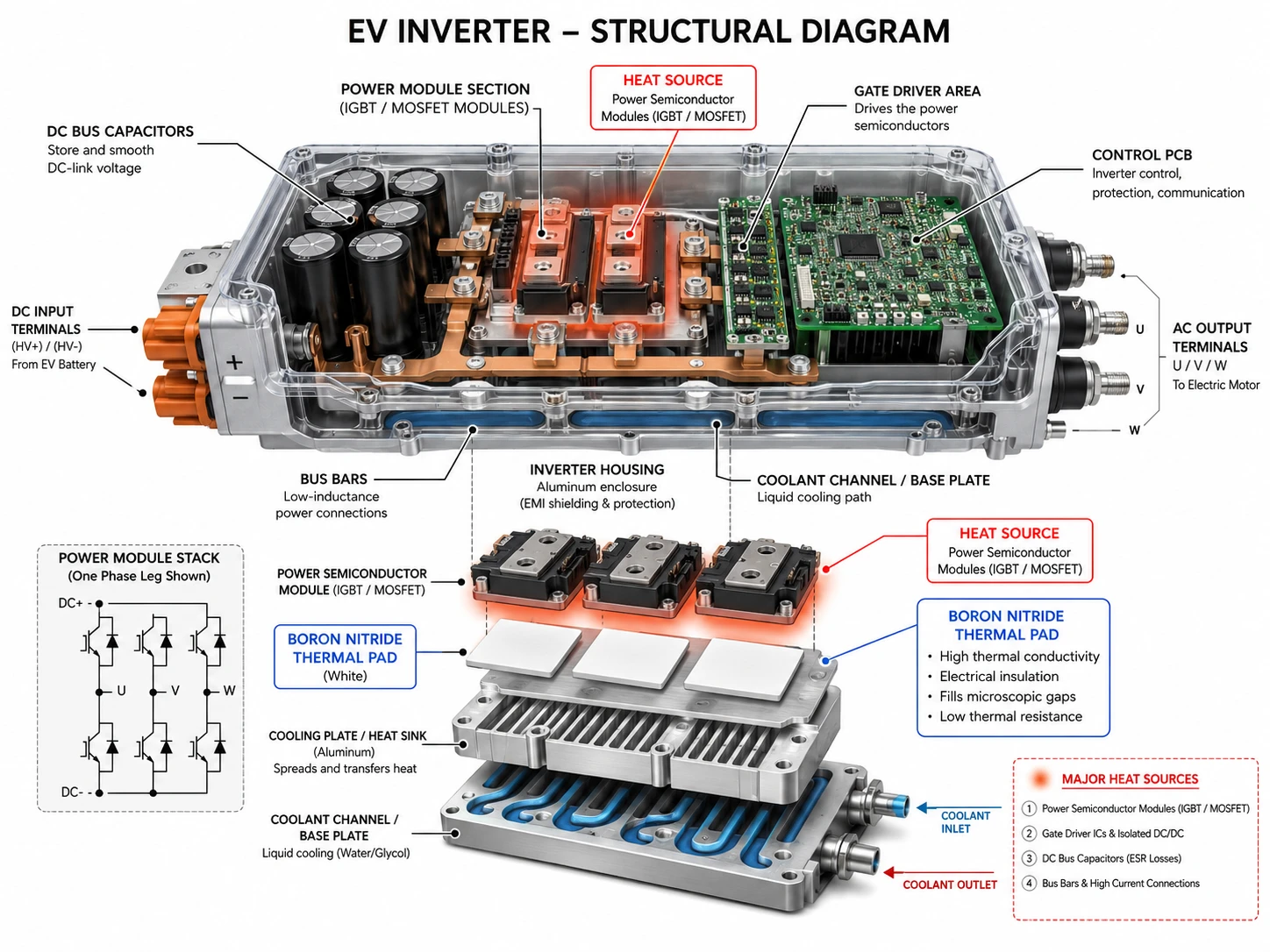
- EV inverters
- Satellite modules
Layered deployment strategy:
- Commercial Devices: 1.1 إضاءة LED boards. 1.2 معدات الاتصالات السلكية واللاسلكية.
- Mobility Platforms: 2.1 EV battery packs; 2.2 Drive-unit إلكترونيات الطاقة
- Mission-Critical Systems: 3.1 Defense applications radar modules; 3.2 Avionics in aerospace systems.
- Infrastructure: 4.1 Server racks; 4.2 Data center cooling interfaces
In everyday terms, custom boron nitride thermal conductive solutions help gadgets run cooler, cars run safer, and satellites survive harsh swings in temperature. The science is precise, yet the outcome feels simple: steady heat flow, longer life, fewer failures.
Types Of Boron Nitride Thermal Interfaces
Heat management in modern electronics is getting serious, and نيتريد البورون keeps popping up as the quiet hero. From powders to nanotubes, these materials support Custom boron nitride thermal conductive solutions that balance insulation and heat flow. If you’re working on custom BN thermal interface materials or tailored boron nitride heat solutions, this breakdown keeps it real and practical.
Boron Nitride Powders in Thermal Pastes
نيتريد البورون Powders are core to high-end Thermal pastes used in Electronics cooling and precision Interface materials. In many Custom boron nitride thermal conductive solutions, powder engineering shapes final Heat conductivity.
- Key powder variables:
- Particle size التوزيع
- Surface treatment
- Loading ratio in silicone or epoxy
- Micron-scale powders fill gaps.
- Nano-scale powders reduce contact resistance.
- Hybrid blends optimize packing density.
Performance Snapshot
| Grade | Avg. Particle Size (µm) | الموصلية الحرارية (وات/م كلفن) | Electrical Resistivity (Ω·cm) |
|---|---|---|---|
| BN-1 | 0.5 | 3.2 | 10¹⁴ |
| BN-2 | 5 | 4.8 | 10¹⁴ |
| BN-3 | 15 | 6.1 | 10¹⁵ |
| BN-Blend | Mixed | 7.0 | 10¹⁴ |
For brands like Sheen Materials, powder tuning is where custom boron nitride thermal interface materials truly stand out.
Thin Boron Nitride Films as Heat Spreaders
نيتريد البورون Thin films serve as dielectric Heat spreaders on ceramic Substrates and metal cores in Electronics.
• Coated as a protective Layer
• Applied by CVD or sputtering الطلاء
• Integrated directly onto chip carriers
في Custom boron nitride thermal conductive solutions, thin films guide Thermal dissipation laterally while blocking current leakage. That combo works well for LEDs and compact power modules where space is tight and hotspots ruin performance fast.
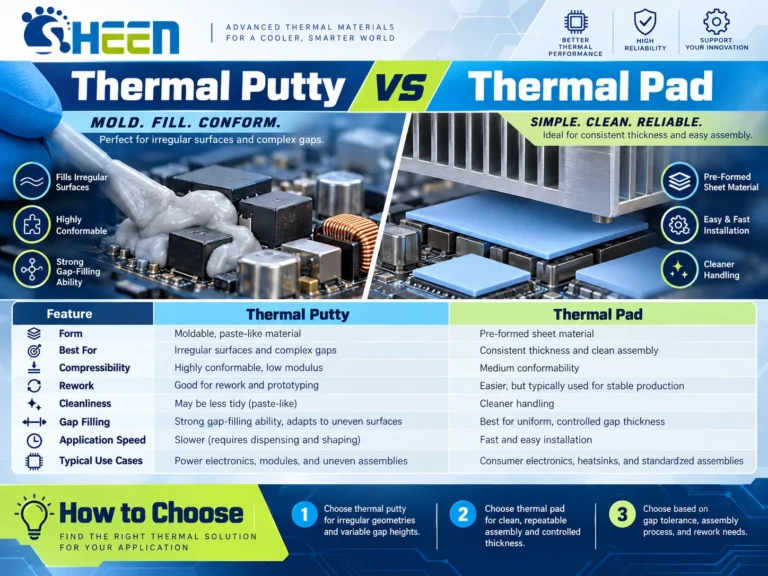
Boron Nitride Fillers for Thermal Pads
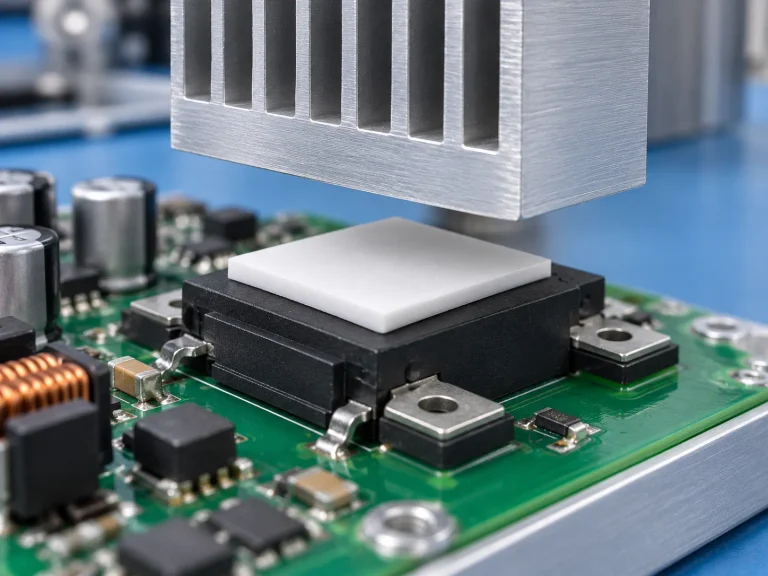
Inside soft Thermal pads, نيتريد البورون Fillers sit within a مصفوفة البوليمر or silicone Elastomers, forming compliant Gap pads for uneven surfaces.
A practical configuration looks like this:
- Base: silicone elastomer
- Filler system:
- Primary: plate-like BN
- Secondary: spherical BN
- Interface pressure: 10–50 psi
This layered filler design boosts التوصيل الحراري while keeping flexibility. In many Custom boron nitride thermal conductive solutions, pad formulation follows a clear flow: material selection → filler dispersion → curing → thermal testing → reliability cycling. The result is stable heat transfer across PCB-to-heatsink Interface zones without cracking under vibration.
BN Nanotubes and Composites in TIMs
نيتريد البورون Nanotubes push TIMs (Thermal Interface Materials) toward next-gen performance. As advanced Nanomaterials, BNNTs create aligned thermal pathways inside Composites, driving enhanced conductivity without losing insulation.
“Electrically insulating yet thermally conductive materials will be central to power electronics growth through 2030,” noted IDTechEx in its 2025 advanced materials outlook.
In practice:
- Disperse BNNTs into resin.
- Align tubes via shear or magnetic fields.
- Cure into structured composite sheets.
This approach supports Custom boron nitride thermal conductive solutions for EV inverters and AI servers. Sheen Materials continues refining these custom BN thermal interface materials, delivering tailored boron nitride heat solutions that handle serious power loads without drama.
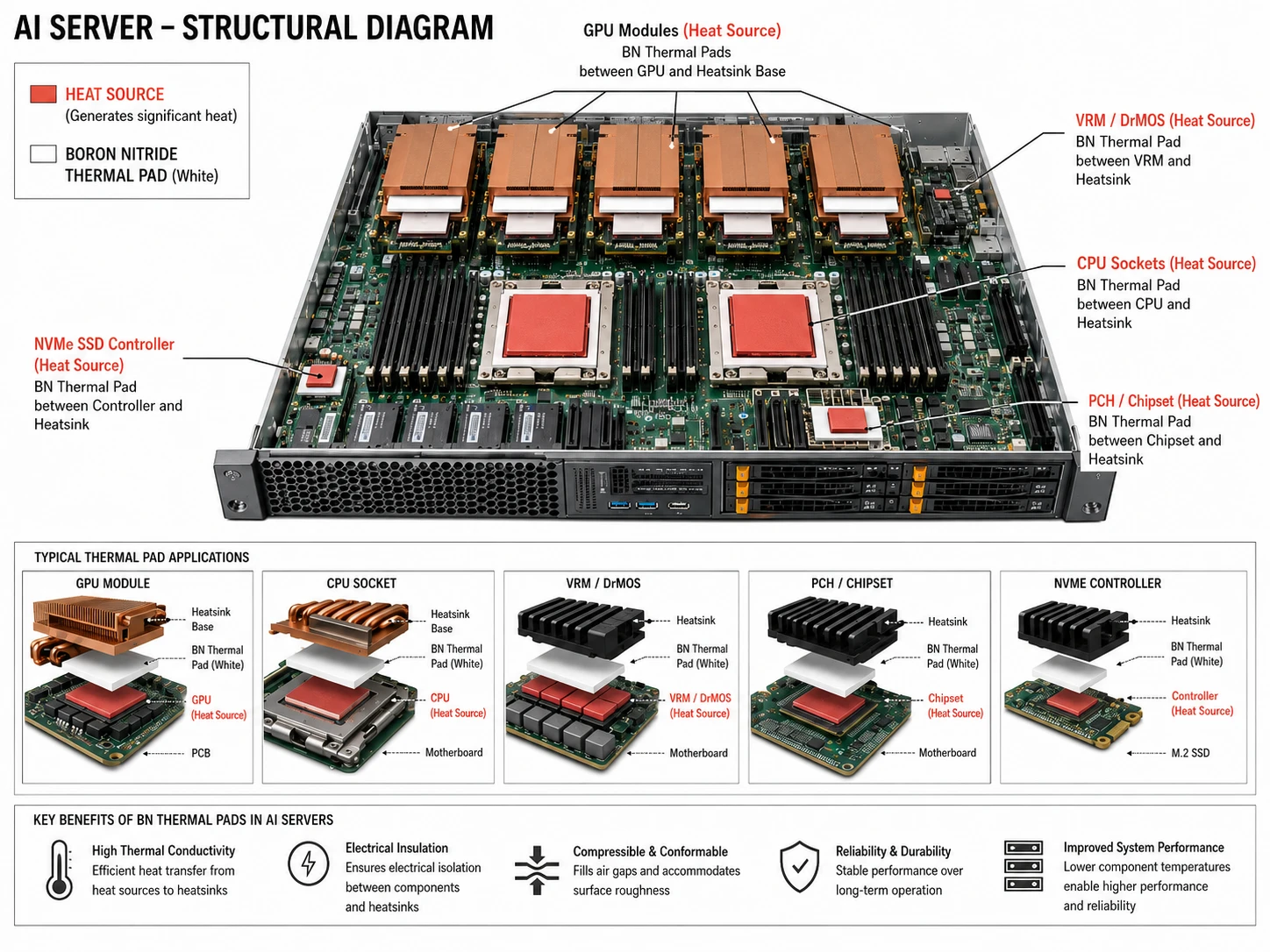
5 Steps To Implement BN Thermal Pads
Custom boron nitride thermally conductive solutions keep modern chips cooler without adding bulk or electrical risk. From phones to EV modules, buyers now expect stable heat transfer and long service life. Sheen Materials develops boron nitride thermal pads that balance softness, conductivity, and production efficiency, giving engineers practical thermal conductive solutions for demanding layouts.
Step 1: Material Formulation and Particle Size Control
- Selecting high-purity نيتريد البورون
- A stable التركيب البلوري improves heat paths.
- متحكم فيه النقاء reduces unwanted electrical leakage.
- Managing حجم الجسيمات و particle shape
- Larger flakes raise in-plane conductivity.
- Mixed distributions improve packing density inside thermal fillers.
- Adjusting تركيبة المادة
- Fine-tuning resin ratio supports custom boron nitride thermal conductive solutions with smoother compression behavior.
- Different طرق التوليف affect consistency during mass coating.
A 2025 Yole Group thermal materials update noted that advanced electronic packaging increasingly depends on engineered BN filler distribution to maintain thermal reliability under compact device conditions.
Step 2: Surface Treatment for Improved Adhesion
جيد surface treatment changes how BN interacts with soft matrices. Proper surface functionalization boosts wetting properties, while tailored coupling agents strengthen interface bonding أثناء التدوير الحراري.
- أفضل adhesion helps pads resist cracking.
• Smart chemical modification improves filler stability.
• Reliable compatibilization supports longer pad lifespan in custom boron nitride thermal conductive solutions.
Step 3: Compounding with Polymers or Silicone
Soft مركبات البوليمر and flexible silicone compounds shape the final pad feel.
- عالية تحميل الحشو increases conductivity.
- متوازن rheological properties keep processing smooth.
- مُحسّن matrix materials help thermal pads fit uneven surfaces.
Some designs resemble thick thermal paste layers, while others behave closer to durable thermal grease sheets. Sheen Materials also supports custom boron nitride thermal conductive solutions for compact AI hardware.
Step 4: Customization for Gap Filling and Stress Reduction
- Improve سد الفجوة
- Enhance المطابقة around uneven chips.
- Maintain stable واجهة حرارية contact.
- Reduce stress
- متحكم فيه قابلية الانضغاط lowers pressure on fragile packages.
- أفضل stress reduction improves cycling durability in الأجهزة الإلكترونية.
- Develop custom solutions
- Thickness and hardness vary by application.
Step 5: Scalability and Dispersion Technology
الكفاءة dispersion technology keeps BN evenly spread during the عملية التصنيع. Poor mixing creates hot spots fast, and nobody wants that headache.
◆ Strong process optimization supports high-volume production.
◆ Uniform filler flow improves production efficiency.
◆ Consistent uniform distribution simplifies quality assurance for boron nitride thermal conductive solutions at scale.
How To Test BN Thermal Performance
Boron nitride materials sit at the center of modern cooling and insulation design, especially in compact power systems and fast-switching electronics. Good testing cuts through marketing noise and shows how materials behave under heat, voltage, pressure, and time. Teams using Custom boron nitride thermal conductive solutions usually compare lab data with field performance before locking in production.
Measuring Thermal Conductivity and Dielectric Strength
Testing starts with two linked targets: stable التوصيل الحراري and reliable قوة العزل الكهربائي in demanding Electronic devices.
- Thermal transfer checks
- Laser flash analysis measures heat flow speed through نيتريد البورون layers.
- Guarded hot plate methods verify bulk تبديد الحرارة behavior.
- Thin interface pads often receive cross-plane and in-plane testing separately.
- Electrical insulation checks
- AC breakdown voltage
- Surface resistance
- Partial discharge behavior under high-frequency loads
| نوع المادة | Thermal Conductivity W/mK | Dielectric Strength kV/mm | Test Temperature °C |
|---|---|---|---|
| BN Pad A | 8 | 18 | 25 |
| BN Composite B | 15 | 22 | 80 |
| BN Coating C | 22 | 19 | 120 |
| BN Sheet D | 30 | 16 | 150 |
Many labs are pairing Measurement methods with Custom boron nitride thermal conductive solutions now to benchmark repeatability after humidity exposure. Sheen Materials commonly recommends comparing dry-state and aged-state data side by side because numbers can drift after long thermal loading.
Evaluating Thermal Cycling Stability and Durability
Repeated Thermal cycling pushes interfaces hard. Tiny expansion differences between metal, ceramic, and polymer layers slowly weaken adhesion.
A normal durability workflow looks like this:
- Heat from -40°C to 150°C
- Hold temperature
- Cool rapidly
- Repeat for 500 to 2000 cycles
During testing, engineers track:
- crack growth
- pump-out behavior
- insulation drift
- mechanical fatigue
بالنسبة لـ Boron Nitride composites, stable performance means more than surviving one hot run. Strong Fatigue resistance supports long-term Reliability in EV power modules, telecom hardware, and LED systems. Some suppliers of Custom boron nitride thermal conductive solutions also add vibration testing to simulate shipping and machine shock.
Assessing Long-term Performance in Real-World Conditions
Lab numbers look nice, but field use tells the real story. Continuous heat, moisture, and pressure gradually change Long-term performance.
Step-by-step validation often includes:
- Install BN material into active equipment.
- Monitor thermal resistance every month.
- Compare aging against baseline values.
- Inspect surfaces for oxidation or delamination.
Under harsh Operational conditions, even small material shifts can affect cooling paths. Engineers testing Boron Nitride solutions in outdoor power systems usually combine humidity chambers with live electrical loads.
Key field factors include:
- Aging effects
- mechanical compression
- airborne contamination
- cyclic power demand
قوي Field validation data helps predict System longevity with fewer warranty surprises. Sheen Materials supports customers by matching test plans to actual application temperatures instead of relying only on generic catalog ratings.