-
АДД: Здание 2, № 8 Хэнчжутан Роуд, Дунгуань
-
Телефон: +86 135 4224 3751

How to Diagnose Causes of Failure of Carbon Fiber Thermal Sheets
The Causes of failure of carbon fiber thermal sheets hit like a quiet storm—devices run hot, warranties creep up, and nobody spots the weak link until it snaps.
Specs can look slick, but hidden pores, sloppy curing, and misaligned fibers mess with heat flow and durability, especially under real-world stress like cycling and flex.
IDTechEx and IEA analyses highlight consistency and process control guiding sourcing decisions.
Key Points: Causes of Failure of Carbon Fiber Thermal Sheets
- Inconsistent Conductivity: Hidden porosity and filler variations create hotspots, accelerating thermal decomposition under cycling.
- Mechanical Weakness: Low flexural modulus and fiber misalignment induce microcracks during thermal shock and repeated bending.
- Curing Flaws: Resin-starved areas and curing inconsistencies lead to voids and delamination, increasing interfacial resistance.
- Oxidative Degradation: UV exposure and oxygen attack degrade the resin matrix, raising porosity and reducing mechanical integrity.
- Electrical Overload Effects: High currents elevate local temperatures, expand voids, and speed fatigue and thermal breakdown.
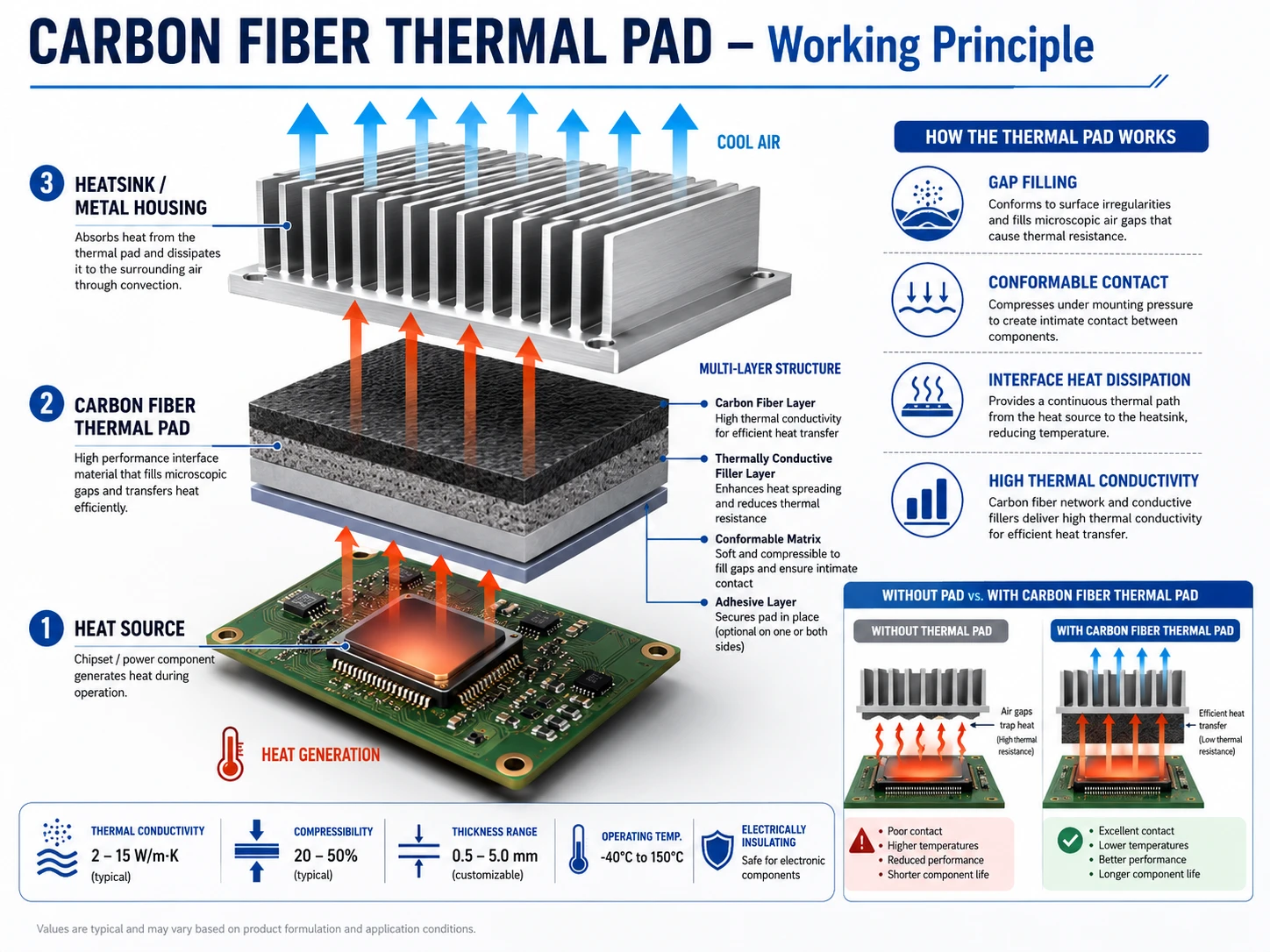
This image was generated using AI. Its content has been reviewed and approved by Sheen Materials; please feel free to save it.
Why Do Thermal Sheets Fail Early?
Thermal sheets can look fine on day one, then fall apart fast when real heat, real cycles, and real sunlight show up. This breakdown isn’t “bad luck.” It’s usually repeatable. Below are the Causes of failure of carbon fiber thermal sheets that sneak in through heat flow, cracking, and UV-driven aging.
Hidden Impact of Thermal Conductivity Variations
Сайт Causes of failure of carbon fiber thermal sheets often start with uneven теплопроводность—tiny differences that wreck теплопередача over time. It sounds small. It isn’t.
- Where does the trouble come from
- material uniformity shifts
- filler clumps and resin-rich pockets
- производственные дефекты like voids and microporosity
- local термическое сопротивление jumps
- heat stalls, then spikes elsewhere
- Repeated cycling turns “warm” into hot spots
- material uniformity shifts
- What you see in the field
- performance drift that looks random
- rising temperatures in one corner
- creeping performance loss under the same load
- Early damage that looks “mysterious.”
- thermal decomposition at the hotspot edge
- weakened структурная целостность where porosity concentrates
- performance drift that looks random
- What to do about it (quick, practical)
- Pick materials with verified conductivity maps, not just averages.
- Tighten incoming checks for porosity and filler dispersion.
- For carbon fiber thermal sheets failure, prioritize uniform layup and controlled cure—Sheen Material typically frames this as a process-control issue, not a “materials lottery.”
Mechanical Strength vs. Thermal Shock Susceptibility
Mechanical limits can turn normal use into carbon fiber sheet failure when temperature swings hit hard. That’s a big slice of the Causes of failure of carbon fiber thermal sheets, especially near fast-heating components.
- Quick red flags (list-style)
- Низкий механическая прочность after bonding or rework.
- Слабый fracture toughness at cut edges.
- Early delamination around fasteners.
1) What triggers thermal shock?
2) Sharp temperature gradients during rapid power changes.
3) stress concentration at corners, holes, and imperfect bonds.
A short reality check: higher stiffness helps… until material brittleness climbs and the sheet can’t flex through the mismatch. Then cracks form, microcracks branch, and fatigue life drops like a rock.
- Practical fix path
- soften gradients (ramp power, add spreaders)
- Redesign edges to reduce notch effects
- validate CTE mismatch and bondline thickness, not just tensile specs
This is classic thermal sheet failure: the part “passes” strength tests, then loses the fight against cycling.
Rapid Oxidative Degradation under UV Radiation
Sunlight plus oxygen is a slow grinder, and it’s a quiet driver in the Causes of failure of carbon fiber thermal sheets. The resin takes the hit first.
- The chemistry chain reaction
- UV radiation generates free radicals в полимерная матрица
- reduced chemical stability
- chain scission, crosslink damage
- Oxygen feeds oxidative degradation
- Surface cracks open pathways
- Environmental aging accelerates
- UV radiation generates free radicals в полимерная матрица
- How it shows up physically
- Surface erosion that starts shallow, then spreads.
- fiber/matrix interface weakens
- dusting, whitening, roughness
- rising porosity and material embrittlement
- lower electrical resistivity consistency
- easier crack growth, earlier failure
- Surface erosion that starts shallow, then spreads.
- How to slow it down
- Add UV-stable coatings or laminates suited to operating temps
- store and ship away from UV exposure (yes, it matters)
- Document outdoor hours; for Causes of failure of carbon fiber thermal sheets, sunlight time is an input, not an afterthought—Sheen Technology commonly pushes UV/oxygen screening as part of qualification for long-life builds.
3 Manufacturing Flaws Causing Thermal Sheet Failure
Carbon fiber thermal sheets fail for reasons that feel small during production but hit hard in real use. This cluster breaks down the Causes of failure of carbon fiber thermal sheets, mixing shop-floor reality with field performance. The goal is simple—spot what goes wrong early, before heat, load, and time do the damage.
Voids from Resin-Starved Areas
Когда Resin starvation sneaks in, Voids и Dry spots follow. That chain reaction sits near the top of the Causes of failure of carbon fiber thermal sheets list.
- Surface-level signs
- Pinholes hint at Porosity
- Patchy gloss flags uneven Resin content
- What happens inside
- Manufacturing defects form during layup
- Trapped air becomes void clusters
- Heat flow breaks, stress stacks up
- Долгосрочный Material failure shows up early
- Why engineers care
- Thermal bottlenecks
- Fatigue cracks near void edges
| Resin Content (%) | Void Volume (%) | Теплопроводность (Вт/м-К) | Failure Risk Index |
|---|---|---|---|
| 32 | 1.2 | 5.8 | Низкий |
| 28 | 2.6 | 4.9 | Средний |
| 24 | 4.1 | 3.7 | Высокий |
| 20 | 6.8 | 2.9 | Critical |
Teams at Материалы для отделки often flag this as a root cause during audits tied to the Causes of failure of carbon fiber thermal sheets.
Delamination Linked to Curing Inconsistencies
Cure cycles look boring on paper. In practice, curing inconsistencies quietly kills Interface integrity.
- Uneven heat ramps weaken the Resin matrix
- Низкий Interlaminar strength invites Delamination under Thermal stress
- The result feels sudden, but it’s not
Recent 2024 industry reliability notes from JEC Composites point out that cure-related Adhesion failure accounts for a growing share of field returns in thermal composites.
Short fixes help. Tight profiles help more. Ignoring it is one of the most repeated Causes of failure of carbon fiber thermal sheets, especially in high-cycle environments. Even seasoned suppliers like Технология Sheen treat cure data as non-negotiable.
Fiber Misalignment Creating Weak Interfaces
Fiber misalignment rarely looks dramatic, yet it rewrites load paths.
- At the ply level
- Skewed Fiber orientation
- Broken thermal pathways
- Under load
- Stress concentration spikes
- Weak interfaces open
- Microcracks spread
- Load transfer drops
- System impact
- Нижний Mechanical properties
- Unstable Composite structure
This defect rounds out the Causes of failure of carbon fiber thermal sheets, and it shows up again and again during teardown. Catching alignment drift early keeps carbon fiber thermal sheets from failing long before their time—and keeps customers from learning the hard way.
Battery Pack: Diagnosing Thermal Sheet Failures
Carbon fiber thermal sheets look tough, but battery packs can be brutal. This run-through keeps it practical: Causes of failure of carbon fiber thermal sheets in heat, stress, overload, and bending. You’ll also see short-tail phrases like causes of failure, carbon fiber failure, and thermal sheet failures—plus where Sheen Technology typically fits into a cleaner fix.
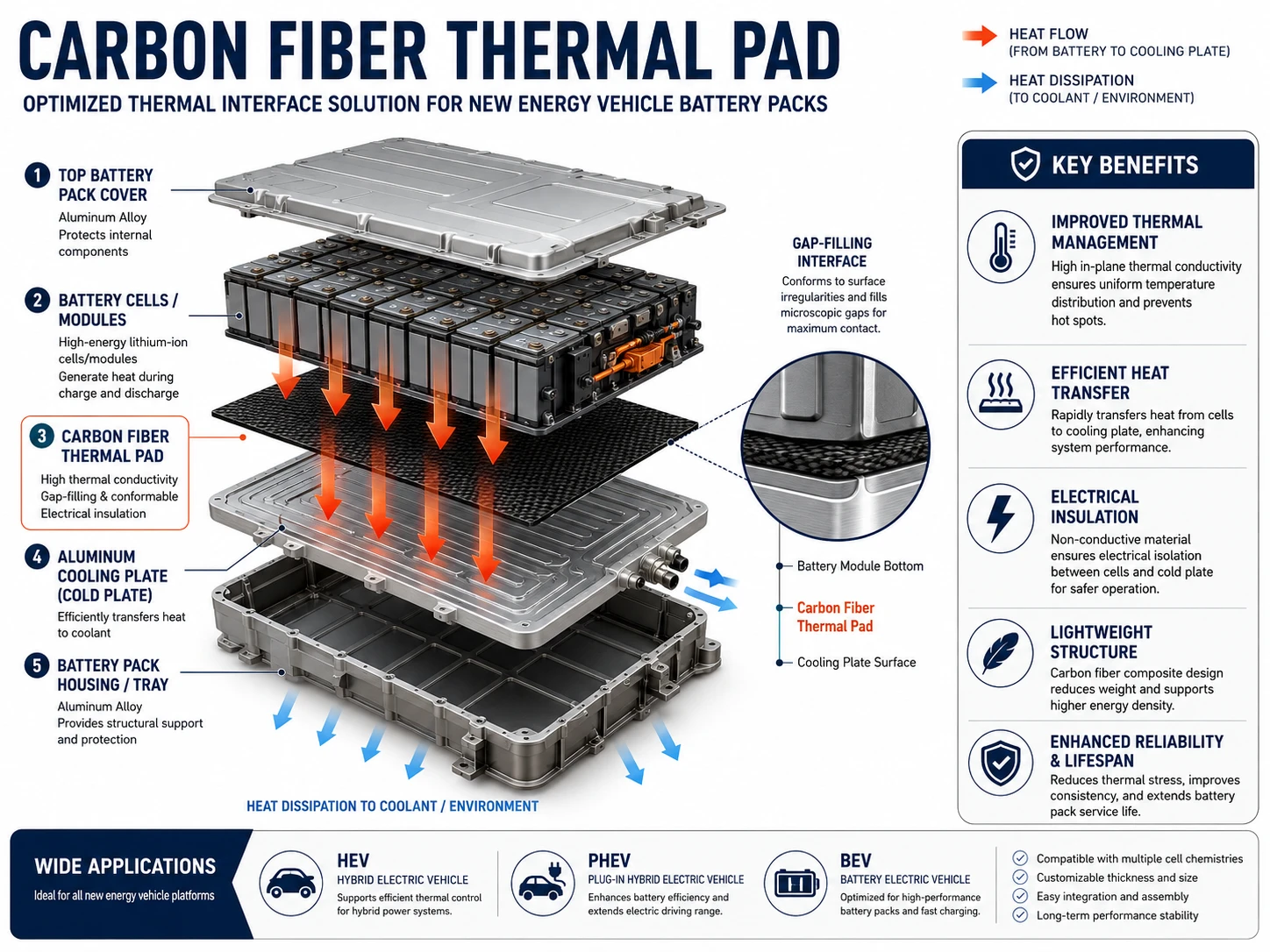
This image was generated using AI. Its content has been reviewed and approved by Sheen Materials; please feel free to save it.
Assessing Thermal Cycling under High Temperature Conditions
- Main Causes of failure of carbon fiber thermal sheets here: thermal cycling, stacked on high temperature heat exposure. Fast. Repeating. Unforgiving.
- What’s really happening:
- Temperature fluctuations drive thermal stress through the thickness.
- Expansion mismatch turns into material fatigue, then slow thermal degradation.
- What you can spot without fancy gear
- A dulling of heat spread, then uneven hot patches.
- Hairline cracks that grow after soak tests.
- What to check in your build notes
- Cure profile drift and clamp pressure history.
- Supplier lot shifts: Sheen Materials usually flags these with tighter incoming checks.
- What’s really happening:
Identifying Interfacial Debonding from Component Attachment Stress
Here, the causes of failure often start simply: a bracket is over-torqued, or an adhesive cure is a bit off, and interface integrity pays the price.
- Load path: component attachment creates механическое напряжение.
- Local spike: stress concentration forms at corners and fasteners.
- Damage mode: interfacial debonding begins, then turns into delamination.
- Quick tells
- Rising thermal resistance and random temp swing under steady power.
- “Crispy” edge lift that screams adhesion failure and dropping bond strength.
Evaluating Electrical Overload Effects on Porosity
Когда electrical overload hits, you’re not just frying traces—you’re changing the sheet inside.
- Electrical side (carbon fiber failure trigger)
- Высокий current density диски Joule heating.
- Electrical resistance stability drifts as the network degrades.
- Microstructure side (thermal sheet failures accelerator)
- образование пустот grows; existing porosity opens up under heat.
- Сайт material microstructure weakens, inviting electrical degradation and faster breakdown.
- Practical guardrails tied to Sheen Technology workflows
- Confirm derating rules match real pack duty cycles.
- Watch hotspot maps after overload simulations; log shifts, not just peaks.
Monitoring Microcracking from Repeated Bending
Repeated flex is a quiet cause of failure of carbon fiber thermal sheets—you won’t always see it until performance drops.
- What bending does:
- Repeated bending applies flexural stress, building damage accumulation.
- Microcracking starts small, then crack propagation cuts thermal pathways and целостность материала.
- A workable routine: 1) Bend-cycle the assembly, not only the raw sheet.2) Re-check thermal spread and stiffness; compare to baseline.3) Add structural health monitoring notes to your QC logs.
- A plainspoken takeaway
- If the design keeps flexing, treat it like it’s on a timer—Материалы для отделки typically pushes for strain relief before the sheet becomes the weak link.