-
АДД: Здание 2, № 8 Хэнчжутан Роуд, Дунгуань
-
Телефон: +86 135 4224 3751

Essential Thermal Conductive Gasket for Vacuum Environment Selection Tips
A thermally conductive gasket for a vacuum environment can make or break your system- no drama needed—heat gets trapped, parts cook, and contamination sneaks in fast.
Buyers feel it in yield loss, rework, and suppliers who promise plenty but deliver headaches.
SEMI and NASA research report demand for low-outgassing thermal interface components in vacuum systems.
Key Insights: Thermal Conductive Gasket for Vacuum Environment
➔ Select materials with high thermal conductivity and low outgassing to prevent heat buildup and contamination.
➔ Balance compressibility and thickness—films (0.025–0.2 mm) fill narrow gaps, pads (0.5–5 mm) suit larger interfaces.
➔ Use manufacturing methods like die-cutting or molding for precise shapes and cleanroom compatibility.
➔ Verify environmental resistance—radiation, vibration, moisture—for aerospace and semiconductor applications.
➔ Compare performance: 0.5 W/m·K gaskets for cost-sensitive low-power use; 5 W/m·K gaskets for high-power demands.
Thermal Conductive Gasket For Vacuum Environment Basics
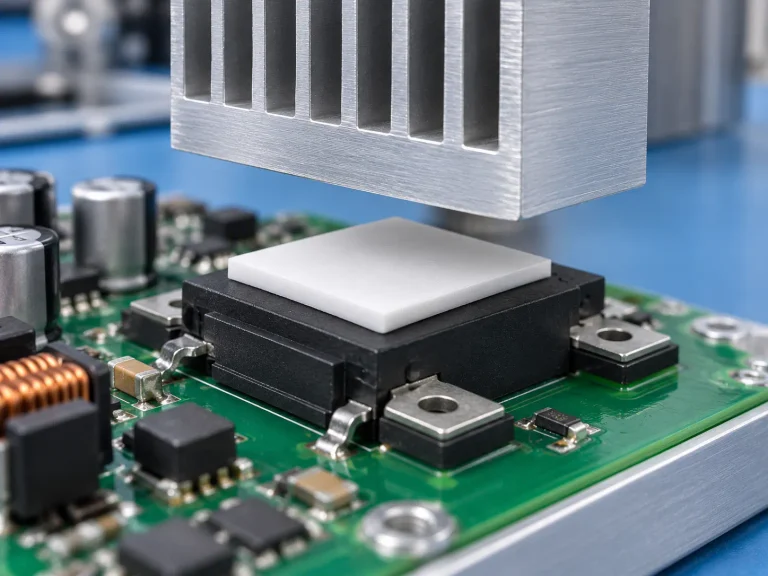
Thermal control in vacuum systems is no small deal. A Thermal conductive gasket for a vacuum environment must move heat fast while staying clean under low pressure. From satellites to chip tools, the right thermally conductive gasket keeps heat steady and contamination low.
Key Material Properties: Thermal Conductivity & Vacuum Compatibility
Designing a Thermal conductive gasket for a vacuum environment starts with two core свойства материала:
- Heat Performance: 1.1 Теплопроводность drives efficient теплопередача across mating surfaces. 1.2 Low термическое сопротивление reduces interface temperature rise. 1.3 Stable output across a wide temperature range prevents drift.
- Vacuum Behavior: 2.1 Proven vacuum compatibility avoids pump contamination. 2.2 Minimal газовыделение protects optics and wafers. 2.3 Controlled mass loss under vacuum bake-out.
Typical measured values:
| Тип материала | Теплопроводность (Вт/м-К) | TML (%) | CVCM (%) |
|---|---|---|---|
| Силиконовый коврик | 1.5–6.0 | 0.8 | 0.02 |
| Графитовый лист | 150–400 | 0.1 | 0.01 |
| Polyimide Film | 0.2–0.4 | 0.7 | 0.03 |
| Composite Pad | 5–15 | 0.6 | 0.02 |
For any thermal conductive gasket in a vacuum environment, balancing conductivity and cleanliness is the real trick.
Common Gasket Materials and Forms: Silicone, Graphite, Films, Sheets
A practical thermal conductive gasket for a vacuum environment often comes in several gasket materials and forms:
- Силикон: flexible elastomers with filler-loaded polymers; great sealing.
- Графит: ultra-high in-plane conductivity; ideal for tight heat paths.
- Films like polyimide: thin, precise spacing control.
- Sheets and pads: easy die-cut shapes for complex flanges.
Quick comparison:
1) Soft pads handle tolerance stack-up.
2) Rigid composites improve structural stability.
3) Thin films suit micro-gaps in optical stacks.
In daily engineering talk, silicone is the “easy fit,” graphite is the “heat highway,” and films are the “tight-space pros.”
Manufacturing Processes: Die-cutting, Molding & Bonding Techniques
Production quality defines long-term stability in vacuum assemblies.
- Высечка and Precision: 1.1 Tight-tolerance cutting reduces edge debris. 1.2 Clean-room fabrication lowers particle load.
- Molding and Compression Control: 2.1 Custom molding tunes compressibility. 2.2 Post-cure curing stabilizes filler networks.
- Bonding techniques and Integration: 3.1 Vacuum-rated adhesives for secure сборка. 3.2 Controlled lamination for layered films and sheets.
A well-made thermal conductive gasket in a vacuum environment is not just cut and placed; it is engineered for stable contact, low газовыделение, and repeatable thermal paths under pressure swings.
Data Proves: 0.5W/m·K Vs. 5W/m·K Gaskets
Choosing a Thermal conductive gasket for a vacuum environment isn’t just about numbers on a spec sheet. In vacuum systems, heat behaves differently, airflow disappears, and sealing becomes mission‑critical. A proper vacuum thermal conductive gasket must balance термическое сопротивление, sealing performance, and real-world durability. Let’s break down how 0.5W/m·K and 5W/m·K options truly perform.
0.5W/m·K Gaskets
При оценке Thermal conductive gasket for a vacuum environment at 0.5W/m·K, performance revolves around controlled heat isolation rather than aggressive cooling.
1. Core Functional Positioning:
1.1 Thermal insulation focus
- Designed for low-conductivity applications
- Limits lateral теплопередача in sensitive assemblies
- Поддерживает стабильную heat isolation inside sealed chambers
1.2 Material Characteristics.

*   Engineered with balanced **material characteristics** for compression recovery.

*   Maintains consistent **thermal resistance** under vacuum pressure.

*   Enhances long-term **sealing performance**
2. Application Context:
2.1 Low-power electronics
- Sensor modules
- Control boards
- Precision instrumentation
2.2 Vacuum compatibility

*   Reduced outgassing behavior

*   Stable structure under pressure cycling

*   Reliable vacuum-compatible gasket behavior
3. Why It Works:
3.1 Controlled impedance slows unwanted heat spread.
3.2 Electrical isolation remains dependable.
3.3 Cost efficiency supports scalable production
For many engineers, a low-conductivity vacuum thermal conductive gasket simply prevents thermal drift. That’s the job. Clean. Predictable. Practical.
5W/m·K Gaskets
Now shift to a 5W/m·K Thermal conductive gasket for a vacuum environment—this one is built for serious thermal dissipation.
Key performance drivers include:
- Высокий теплопередача эффективность
- Превосходный терморегулирование in compact power modules
- Стабильный sealing integrity during temperature spikes
In high-power electronics and LED assemblies, trapped heat is the enemy. A high-conductivity gasket for vacuum cooling pulls thermal energy away from hotspots and channels it toward metal housings or cold plates.
- Performance Impact: 1) Faster heat spreading across contact surfaces. 2) Lower junction temperatures. 3) Improved reliability cycles.
- Material Behavior
- Расширенный свойства материала enhance compression set resistance.
- Maintains contact under vacuum mechanical stress.
- Поддерживает долгосрочную vacuum cooling эффективность.
- Where It Shines• Power converters• Laser systems• Aerospace vacuum assemblies
“Thermal interface materials with higher conductivity are increasingly required for compact, high-power electronics,” notes a 2025 IDTechEx thermal management report, highlighting accelerating demand in aerospace and EV subsystems.
For brands like Материалы для отделки, engineering a high-performance thermal-conductive gasket for a vacuum environment means blending high conductivity with durable sealing mechanics. The result? Cooler systems, longer lifespans, and fewer thermal surprises.
If your design demands active теплопередача, a 5W/m·K vacuum-compatible gasket makes the difference. If isolation and cost control matter more, 0.5W/m·K stays in play. Either way, Материалы для отделки aligns conductivity with real operating conditions—because in vacuum environments, heat never plays fair.
5 Steps To Choose a Vacuum-Proof Heat Gasket
Choosing a Thermal conductive gasket for a vacuum environment is not just about heat flow. It’s about safety, stability, and long-term reliability in tough vacuum systems. From satellites to lab chambers, the right thermally conductive gasket keeps electronics cool and insulation intact without contamination drama.
Step 1: Define Thermal Impedance and Dielectric Strength Needs
При выборе Thermal conductive gasket for a vacuum environment, clarify performance targets before browsing catalogs.
- Key checks:
- Required тепловое сопротивление
- Minimum диэлектрическая прочность
- Target теплопроводность
1) Map actual теплопередача paths between components.
2) Confirm insulation gaps needing электрическая изоляция.
3) Match numbers with certified свойства материала.
For high-power boards, a conductive gasket for vacuum must move heat fast yet block stray current. Too much focus on conductivity alone? That’s risky. Balance performance requirements with safety margins. A vacuum thermal gasket that conducts heat but fails electrically can shut down an entire payload.
Step 2: Select Materials for Low Outgassing and Chemical Resistance
Material choice decides if your vacuum chamber stays clean or becomes a contamination headache.
- Common options:
- Полиимид polymer
- Силикон elastomer
- Ceramic-filled composites
1) Review certified газовыделение data.
2) Check solvent and plasma химическая стойкость.
3) Confirm long-term vacuum compatibility.
A Thermal conductive gasket for a vacuum environment must hold its свойства материала under pressure extremes. NASA and ESA databases are often referenced for screening.
“Low-outgassing materials remain a critical priority for space and high-vacuum electronics through 2025 and beyond,” notes a 2025 materials reliability update from NASA’s Outgassing Database program.
For reliable sourcing, Sheen Materials offers screened compounds tailored for vacuum thermal gasket applications.
Step 3: Choose Forms and Thickness for Optimal Compressibility
Form factor changes performance more than most expect.
- Options:
- Пад
- Sheet
- Custom shape
1) Define the gasket form based on enclosure geometry.
2) Set толщина to handle tolerance stack-up.
3) Verify сжимаемость under assembly torque.
A thicker thermal gasket for vacuum chamber use may improve заполнение зазоров, yet too soft a материал теплового интерфейса can creep. Balance elasticity and pressure. A heat-conductive gasket for vacuum system assemblies should spring back after vibration, not flatten permanently.
Step 4: Verify Environmental Resistance—Radiation, Vibration, Moisture
Harsh environments test everything.
- Radiation exposure
- Launch-level vibration
- Residual moisture cycles
1) Validate radiation resistance for orbital missions.
2) Confirm vibration resistance against mechanical shock.
3) Assess moisture resistance before pump-down.
For aerospace builds, examine layered risks:
- Environmental stability
- Temperature stability across thermal cycling
- Vacuum stability under long dwell times
- Structural durability
- Сопротивление механическое напряжение
- Проверенный долгосрочная надежность
A thermally conductive gasket for a vacuum environment that survives lab tests but fails under combined stress isn’t good enough. Real-world simulation matters.
Step 5: Plan Assembly: Bonding, Curing, and Cleanroom Compatibility
Even the best conductive gasket for vacuum fails with sloppy installation.
- Surface wipe
- Controlled alignment
- Verified cure
1) Execute proper подготовка поверхности to enhance adhesion.
2) Apply selected bonding methods without trapping air.
3) Monitor curing process per spec.
In high-grade builds, detail matters:
- Assembly control
- Documented assembly process
- Particle tracking for contamination control
- Facility alignment
- Подтвердите cleanroom compatibility
- Audit final installation
Sheen Materials supports engineers with guidance on bonding and clean integration so every Thermal conductive gasket for a vacuum environment performs exactly as planned.
Thermal Conductive Gasket For Vacuum Environment Thickness Guide
Getting the thickness right for a Thermal conductive gasket for a vacuum environment isn’t guesswork. It’s about matching load, heat flow, and vacuum seal reliability without overdoing material bulk.
Recommended Thickness Ranges for Sheets, Pads, and Films
При выборе Thickness ranges for a thermal conductive gasket for a vacuum environment, engineers usually compare Gasket forms side by side:
- Film gauges: 0.025–0.2 mm
- Pad dimensions: 0.5–5 mm
- Custom Sheet materials: application-driven
- Ultra-thin films reduce interface resistance.
- Mid-range pads handle uneven Interface thickness.
- Thicker sheets support structural Vacuum seals.
Selection logic often follows this layered view:
- Films
- Ideal for polished flanges
- Minimal gap variation
- Колодки
- Handle micro-voids
- Compensate machining tolerances
- Sheets
- Used in large-area vacuum chambers
- Balance stiffness and thermal spread
A 2025 Grand View Research update notes:
Demand for precision vacuum environment thermal gaskets is rising in semiconductor and aerospace systems where micron-level thickness control impacts thermal efficiency.
For stable supply and tight tolerance control, Материалы для отделки offers calibrated sheet and pad options tailored for high-vacuum assemblies.
Compressibility vs. Gap Filling: Balancing Thermal Expansion
Choosing a Thermal conductive gasket for a vacuum environment means balancing Compressibility and gap-filling performance.
Key considerations:
- Surface flatness
- Expected Тепловое расширение mismatch
- Required Interface contact
Decision path:
- Measure flange deviation.
- Estimate expansion at operating temperature.
- Select material with proper Соответствие.
Nested performance check:
- Mechanical response
- Low load → better Ликвидация пустоты
- High load → risk of squeeze-out
- Thermal response
- Thin layer → low impedance
- Excess thickness → rising resistance
A well-chosen vacuum thermal gasket absorbs stress without increasing impedance. Too soft? You lose long-term stability. Too hard? Poor contact, hot spots, and stress concentration.
Pressure Resistance and Mechanical Hardness Considerations
In vacuum flanges, Pressure resistance и Mechanical hardness decide lifespan.
Evaluation typically follows:
- Material metrics
- Durometer scale rating
- Прочность на разрыв
- Creep resistance
- Load behavior
- Initial compression
- Долгосрочный Набор для сжатия
- Устойчивый Load bearing
Quick reference checklist:
- Shore A 30–50: high conformity
- Shore A 60–80: stronger structural hold
- Low compression set = longer seal life
For vibration-heavy systems, a Thermal conductive gasket for a vacuum environment must resist micro-movement while keeping thermal contact tight. That balance of hardness and elasticity keeps vacuum integrity steady over time.
Engineers seeking durable thermal conductive gaskets for vacuum environment solutions often rely on Материалы для отделки for controlled hardness grades built specifically for aerospace and semiconductor vacuum platforms.
Cost Vs. Performance In Gasket Selection
Selecting a Thermal conductive gasket for a vacuum environment is never just about price tags. Engineers juggle heat flow, sealing strength, and tight project budgets. Get the balance right, and performance hums. Miss it, and costs sneak up fast.
Cost Considerations: Materials, Manufacturing, Volume Pricing
When budgeting a Thermal conductive gasket for a vacuum environment, cost stacks up in layers, not in a single line item.
- Material composition
- Raw material
- Silicone: flexible, moderate processing costs
- Graphite: higher теплопроводность, often higher base price
- Fillers and additives affecting design complexity
- Raw material
- Production methods
- Fabrication techniques
- Die-cutting for simple profiles
- CNC machining for tight tolerances
- Impact on tooling investment
- Fabrication techniques
- Manufacturing scale
- Prototype runs
- Выше labor expenditure per unit
- Mass production
- Lower unit cost through volume pricing
- Prototype runs
Here’s the straight talk:
- High-grade graphite raises upfront spend.
- Complex geometries increase processing costs.
- Tight vacuum specs push inspection time.
At scale, though, unit pricing drops. That’s where planning matters. A thermal gasket for vacuum use designed with simpler profiles can shave tooling hours. Brands like Материалы для отделки often optimize production methods early, so buyers don’t get sticker shock later. Smart sourcing of состав материала keeps the budget grounded without cutting corners.
Performance Metrics: Thermal Impedance, Shore Hardness, Outgassing
Cost means little if the thermal vacuum gasket fails under heat load.
Key checks for any Thermal conductive gasket for a vacuum environment:
- Тепловое сопротивление → governs рассеивание тепла и термическое сопротивление
- Shore Hardness → signals material stiffness and surface conformity
- Outgassing → tied to volatile content и gas release in sealed chambers
1) Start with теплопроводность. Higher values reduce hot spots.
2) Match hardness to flange pressure. Too stiff, poor contact. Too soft, creep risk.
3) Verify vacuum compatibility through controlled outgassing tests.
A quick reality check:
- Heat moves.
- Materials expand.
- Weak seals leak.
Gartner’s 2025 advanced materials outlook notes that thermal interface demand in vacuum electronics is rising as power densities increase, pushing suppliers to improve low-outgassing formulations.
That’s why a thermally conductive gasket for a vacuum environment must balance механические свойства with clean performance. Материалы для отделки focuses on lowering gas release while keeping solid рассеивание тепла, making its vacuum thermal gasket options practical for aerospace and high-power systems.
Gasket Outgassing: Why It Matters
Vacuum systems can’t tolerate guesswork. A Thermal conductive gasket for a vacuum environment must manage heat while limiting газовыделение. When a vacuum thermal gasket fails, contamination spreads fast. For aerospace, optics, and lab tools, that’s a real headache.
Outgassing Mechanisms in Vacuum Chambers
На сайте vacuum chambers, pressure drops. Materials respond.
- Desorption releases trapped moisture.
- Permeation allows gases to migrate.
- Материал outgassing mechanisms accelerate under heat.
- Pressure decreases.
- Volatile molecules gain mobility.
- Surface desorption increases.
- Deposits form inside chambers.
➤ Lower pressure = higher vapor release.
Для Thermal conductive gasket for a vacuum environment, structure matters:
- Material Layer
- Base polymer
- Free volume → drives permeation
- Fillers
- Ceramic particles → reduce diffusion paths
- Base polymer
- Surface Condition
- Post-cure bake
- Plasma cleaning
- Operating Factors
- Temperature cycling
- Residual gas exposure
A vacuum-rated thermal gasket with stable fillers slows these mechanisms. That’s why Sheen Materials designs each thermal-conductive gasket for a vacuum environment with pre-bake conditioning and controlled polymer chemistry.
Impact on Optical Systems, Sensors, and Satellite Components
Contamination hits performance hard.
- Thin film deposition clouds optical systems.
- Signal drift appears in sensors.
- Satellite components lose thermal balance.
Nested impact path:
- Contamination Source
- Gasket газовыделение
- Molecular deposition
- Optical scattering
- Sensor noise
- Gasket газовыделение
- Thermal Disruption
- Reduced heat transfer
- Hot spots
- Long-Term Degradation
- Surface darkening
- Calibration loss
“Contamination control remains a top reliability driver in orbital platforms,” notes NASA’s 2025 materials reliability update, highlighting molecular deposition risks in spacecraft assemblies.
Правильно спроектированный Thermal conductive gasket for a vacuum environment limits this chain reaction. Clean transfer. Stable производительность. No nasty surprises.

Testing Protocols: ASTM E595 & Vacuum Compatibility Standards
Testing protocols define trust.
| Тип материала | Total Mass Loss (%) | Collected Volatile Condensable Materials (%) | Pass/Fail |
|---|---|---|---|
| Silicone Elastomer | 1.25 | 0.18 | Fail |
| Filled Polymer Composite | 0.82 | 0.07 | Pass |
| Polyimide Film | 0.48 | 0.03 | Pass |
| Technical Ceramic | 0.02 | 0.00 | Pass |
По ссылке ASTM E595, limits typically require:
- Total mass loss < 1.0%
- Collected volatile condensable materials < 0.1%
Validation flow:
- Vacuum bake-out
- Gravimetric measurement
- Condensate collection
- Дополнительно residual gas analysis
A thermally conductive gasket for a vacuum environment meeting vacuum compatibility standards ensures stable integration in satellites and lab chambers.
Low-Outgassing Materials: Ceramic, Polyimide, Filled Polymers
Material choice decides everything.
Core categories:
- Ceramic
- Near-zero газовыделение
- High thermal stability
- Полиимид
- Low mass loss
- Flexible film options
- Filled polymers
- Ceramic-loaded matrices
- Balanced conductivity and sealing
Extended material stack:
- Elastomer Base
- Modified silicones
- Low-volatile curing systems
- Filler Network
- Глинозем
- Нитрид бора
- Композитный дизайн
- Reduced free volume
- Enhanced heat paths
A high-performance Thermal conductive gasket for a vacuum environment blends these traits. Clean seal. Solid heat flow. Long mission life.
That’s the edge engineers expect from Sheen Materials when specifying a thermal-conductive gasket for a vacuum environment for aerospace, semiconductor, or research-grade systems.